Orthopedic Massage Therapy OmassageT.com
Athletes constantly push their bodies to perform at a higher level. Whether you are training for a marathon, competing in endurance events, preparing for your next race, or working toward a new personal record, your muscles and joints experience repeated physical stress.
Training is essential for improving athletic performance, but training alone is only part of the equation.
Recovery, mobility, strength, and proper movement are equally important.
When muscles become tight, movement becomes restricted, or an old injury begins affecting the way your body moves, athletic performance can suffer. You may notice that your stride feels different, certain muscles fatigue faster than usual, or the same areas repeatedly become tight or uncomfortable.
For competitive athletes, runners, and endurance athletes, orthopedic massage therapy offers a targeted approach designed to address these types of muscular and soft-tissue problems.
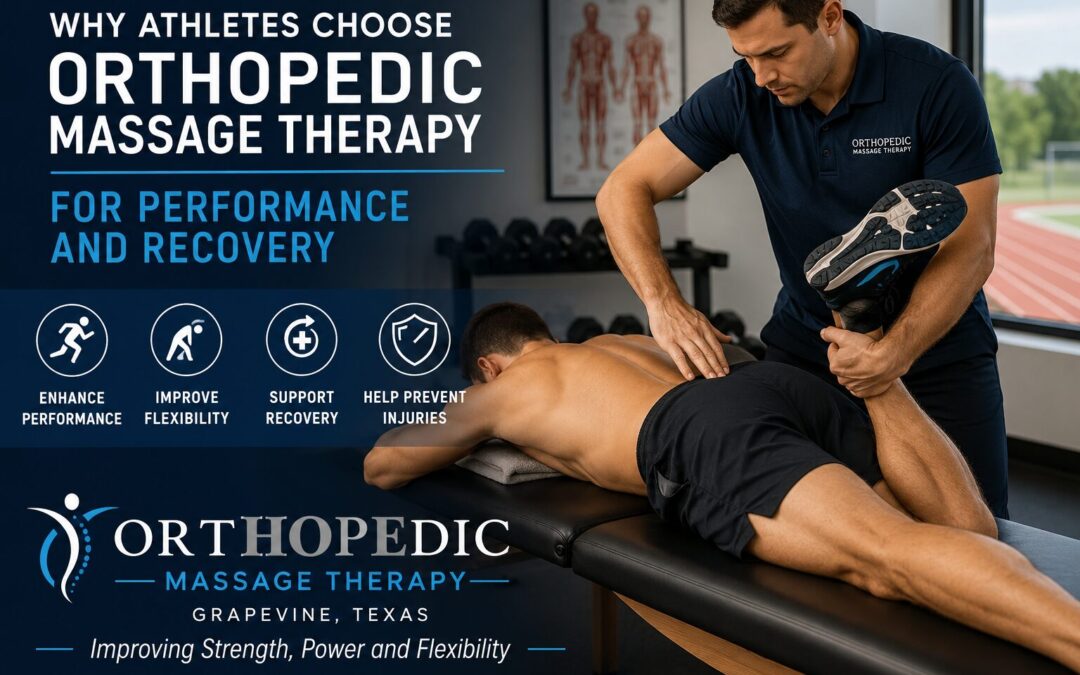
At Orthopedic Massage Therapy in Grapevine, Texas, our approach goes beyond traditional relaxation massage. We focus on identifying muscular restrictions, improving functional movement, supporting injury rehabilitation, and helping athletes work toward better strength, power, and flexibility.
What Makes Orthopedic Massage Different?
Many people think of massage primarily as a way to relax.
While relaxation can certainly be beneficial, orthopedic massage therapy has a different purpose.
Orthopedic massage is a more focused approach to working with the muscles, fascia, tendons, and other soft tissues that influence how the body moves.
Instead of simply providing the same full-body massage to every client, treatment is based on the individual’s specific needs.
An athlete may come in because of tight hamstrings.
A runner may be experiencing recurring calf tension.
Another athlete may notice restricted hip mobility or difficulty moving one shoulder comfortably.
The area where you feel discomfort, however, is not always the only area contributing to the problem.
The body functions as an interconnected system.
A restriction in one area can influence movement somewhere else.
Orthopedic massage therapy looks at these relationships with the goal of addressing the underlying soft-tissue restrictions that may be affecting movement and performance.
Why Athletes Put So Much Stress on Their Bodies
Competitive athletes repeatedly challenge their bodies.
Running, cycling, strength training, jumping, sprinting, swimming, and other athletic activities require muscles to produce and absorb force thousands of times during training and competition.
The body is remarkably capable of adapting to these demands.
However, problems can develop when training demands begin exceeding the body’s ability to recover.
Athletes may begin noticing:
- Persistent muscle tightness
- Reduced flexibility
- Limited range of motion
- Recurring aches and discomfort
- Slower recovery between workouts
- Muscle imbalances
- Changes in running or movement mechanics
- Reduced strength or power
- Difficulty performing movements that previously felt comfortable
These changes do not always mean that a serious injury has occurred.
However, they can be signals that certain muscles or soft tissues are not functioning as efficiently as they should.
Ignoring these signals and continuing to increase training intensity may allow minor restrictions to become larger problems.
Orthopedic massage therapy gives athletes an opportunity to address these issues before they significantly interfere with training.
Orthopedic Massage Therapy for Runners
Running may appear simple, but it is an extremely repetitive athletic activity.
During every mile, your body repeats the same basic movement pattern hundreds or even thousands of times.
Now multiply that by the number of miles completed during a week, month, or entire training season.
Small movement restrictions can become much more noticeable as mileage increases.
Runners commonly experience tightness or discomfort involving the:
- Calves
- Hamstrings
- Quadriceps
- Hip flexors
- Gluteal muscles
- Feet and ankles
- Lower back
These areas do not function independently.
For example, limited ankle mobility may influence movement at the knee.
Restricted hip mobility may affect stride mechanics.
Tight or overworked muscles may cause other muscles to compensate.
This is why simply massaging the location where discomfort is felt may not always provide the best solution.
Orthopedic massage therapy takes a broader look at the muscles and movement patterns that may be contributing to the problem.
For runners in Grapevine, Texas and the surrounding DFW area, this type of targeted treatment can be particularly useful during marathon training, race preparation, increased mileage, or recovery from repetitive-use injuries.
Helping Endurance Athletes Recover From Training
Endurance athletes place unique demands on their bodies.
Distance runners, marathoners, triathletes, cyclists, and other endurance competitors may train for several hours at a time.
The challenge is not simply completing one difficult workout.
The challenge is recovering well enough to train again.
Athletic improvement occurs when the body is given the opportunity to recover and adapt to training.
When recovery is inadequate, athletes may begin carrying muscular fatigue and tightness from one training session into the next.
Over time, this can affect movement quality and performance.
Orthopedic massage therapy may support an athlete’s recovery program by helping address muscular tension and soft-tissue restrictions that develop during demanding training.
Massage should not replace important recovery fundamentals such as:
- Adequate sleep
- Proper nutrition
- Hydration
- Appropriate rest
- Strength training
- Mobility exercises
- Well-designed training progression
Instead, orthopedic massage can become another valuable component of a comprehensive recovery strategy.
The goal is simple:
Help the body move and recover as efficiently as possible.
Orthopedic Massage and Sports Injury Rehabilitation
Injuries are one of the most frustrating challenges an athlete can face.
An injury can interrupt months of training and make athletes feel as though they are losing valuable progress.
Even after pain begins improving, the body may not immediately return to normal movement.
Athletes recovering from an injury may still experience:
- Muscle tightness
- Reduced range of motion
- Weakness
- Protective movement patterns
- Muscle compensation
- Differences between the injured and uninjured side
These changes can sometimes continue long after the original injury occurred.
Orthopedic massage therapy may be incorporated into an athlete’s rehabilitation program when appropriate.
Treatment may focus on improving soft-tissue mobility, addressing muscular restrictions, and helping restore more comfortable movement.
Orthopedic massage can also complement care provided by physicians, physical therapists, chiropractors, athletic trainers, and other healthcare professionals.
The objective is not simply to make an area feel better temporarily.
The larger goal is to help the athlete regain better movement and return to activity safely and confidently.
Improving Flexibility and Mobility for Better Performance
Athletes often talk about flexibility, but flexibility alone is not the goal.
Athletes need functional mobility.
Functional mobility means having enough range of motion to perform the movements required by your sport while maintaining strength and control.
Different athletes require different types of mobility.
A marathon runner does not need exactly the same mobility as a gymnast.
A cyclist has different physical demands than a basketball player.
A competitive weightlifter has different mobility requirements than a distance runner.
Orthopedic massage therapy can target soft-tissue restrictions that may be limiting an athlete’s ability to move comfortably through the ranges required for their sport.
When appropriate mobility improves, athletes may find it easier to:
- Move through a more comfortable range of motion
- Maintain better movement mechanics
- Perform strength exercises effectively
- Run with less restriction
- Reduce unnecessary muscular compensation
- Use their strength more efficiently
The goal is not simply to become more flexible.
The goal is to help the body move better.
The Connection Between Mobility, Strength, and Power
Strength and power depend on more than strong muscles.
The body must coordinate movement efficiently.
Muscles must activate at the appropriate time.
Joints need adequate mobility.
The nervous system must coordinate complex movement patterns.
And the body must transfer force efficiently from one area to another.
When movement becomes restricted, the body often finds another way to complete the task.
This is called compensation.
For example, if an athlete has limited hip mobility, the lower back or pelvis may move differently to compensate.
If the ankle does not move efficiently, the knee or hip may absorb additional stress.
These compensations may initially seem minor.
But when repeated thousands of times during training, they can become significant.
By addressing soft-tissue restrictions and muscular tension, orthopedic massage therapy may help create better conditions for efficient movement.
When the body moves better, athletes may be better able to use the strength and power they have developed through training.
This is why our philosophy at Orthopedic Massage Therapy focuses on:
Improving Strength, Power and Flexibility.
Can Orthopedic Massage Help With Injury Prevention?
No therapy can guarantee that an athlete will never experience an injury.
Sports are unpredictable, and injuries can occur for many reasons.
However, athletes can become more aware of changes in their bodies.
Some warning signs should not be ignored.
These may include:
- The same muscle repeatedly becoming tight
- Persistent discomfort during training
- Noticeable differences between the left and right sides
- Reduced range of motion
- Changes in running stride
- Unusual muscle fatigue
- Difficulty recovering from normal workouts
- A recurring problem that improves temporarily but always returns
Athletes sometimes continue training through these warning signs because the discomfort is not severe enough to stop them.
But small changes in movement can become more significant as training volume increases.
Addressing muscular restrictions early may help athletes maintain better movement and reduce unnecessary compensation.
Orthopedic massage therapy can be one part of that proactive approach.
When Should Athletes Schedule Orthopedic Massage?
There is no single schedule that works for every athlete.
Treatment frequency depends on training volume, competition schedule, injury history, and individual needs.
Some athletes incorporate orthopedic massage regularly into their training and recovery routine.
Others schedule treatment when they notice a specific problem.
Athletes may consider orthopedic massage during:
Heavy Training Periods
As training volume increases, muscular tension and fatigue can accumulate.
Race or Competition Preparation
Treatment can be planned around competition schedules to help address movement restrictions before an important event.
Post-Competition Recovery
After a demanding race or competition, appropriate treatment may become part of an athlete’s recovery strategy.
Injury Rehabilitation
Orthopedic massage may complement an appropriate rehabilitation plan when muscular or soft-tissue restrictions are affecting movement.
Recurring Tightness or Restricted Movement
If the same problem repeatedly returns, it may be time to look beyond temporary relief and determine what may be contributing to it.
Every Athlete Is Different
There is no universal massage routine that is appropriate for every athlete.
Two runners preparing for the same marathon may have completely different needs.
One runner may struggle with calf tightness.
Another may have limited hip mobility.
Another may experience recurring hamstring tension.
Even when athletes have similar symptoms, the underlying factors may be different.
That is why individualized treatment matters.
At Orthopedic Massage Therapy in Grapevine, Texas, the focus is on understanding your specific concerns, your sport, your training demands, and the movement restrictions that may be affecting you.
Treatment can then be directed toward the areas that need attention rather than following the same routine every time.
Competitive Athletes Should Treat Recovery Like Training
Competitive athletes spend countless hours improving their performance.
They track mileage.
They measure pace.
They monitor heart rate.
They follow strength programs.
They plan nutrition.
They analyze race results.
But recovery sometimes receives far less attention.
Recovery should not be something athletes think about only when they become injured.
It should be part of the training process.
Taking care of muscular restrictions, maintaining functional mobility, and paying attention to changes in the body may help athletes train more consistently.
Consistency is one of the most important factors in athletic development.
The better an athlete can maintain healthy, efficient movement, the better positioned they may be to continue training toward their goals.
Orthopedic Massage Therapy in Grapevine, Texas
If you are a competitive athlete, runner, or endurance athlete in Grapevine, Texas, your body works hard every time you train.
Persistent tightness, restricted mobility, recurring discomfort, and slow recovery should not simply become accepted as a normal part of being an athlete.
Your body may be telling you that something needs attention.
At Orthopedic Massage Therapy, we provide targeted orthopedic massage therapy focused on helping athletes improve movement, address muscular restrictions, support injury rehabilitation, and recover from the physical demands of training.
Whether you are preparing for your next race, increasing your mileage, returning from an injury, or working toward your next competitive goal, taking care of your body is an important part of performing at your best.
Train hard. Recover intelligently. Move better.
Improving Strength, Power and Flexibility
Contact Orthopedic Massage Therapy in Grapevine, Texas to learn how orthopedic massage therapy, sports massage and recovery, injury rehabilitation, and targeted soft-tissue treatment can support your athletic performance and help you keep moving toward your goals.