Orthopedic Massage Therapy OmassageT.com
Running is one of the most effective ways to improve endurance, cardiovascular fitness, and overall athletic performance. But whether you are a competitive runner, marathoner, triathlete, weekend runner, or someone training for your first race, running places repetitive demands on your body.
Every step requires your muscles, tendons, joints, and connective tissues to work together.
When everything is functioning efficiently, running can feel smooth, powerful, and natural.
But when muscle tightness, restricted mobility, overuse, or compensation begins changing the way your body moves, discomfort can develop—and sometimes that discomfort keeps coming back.
At Orthopedic Massage Therapy in Grapevine, Texas, we work with athletes and active individuals who want to understand what may be contributing to their muscular pain and movement restrictions.
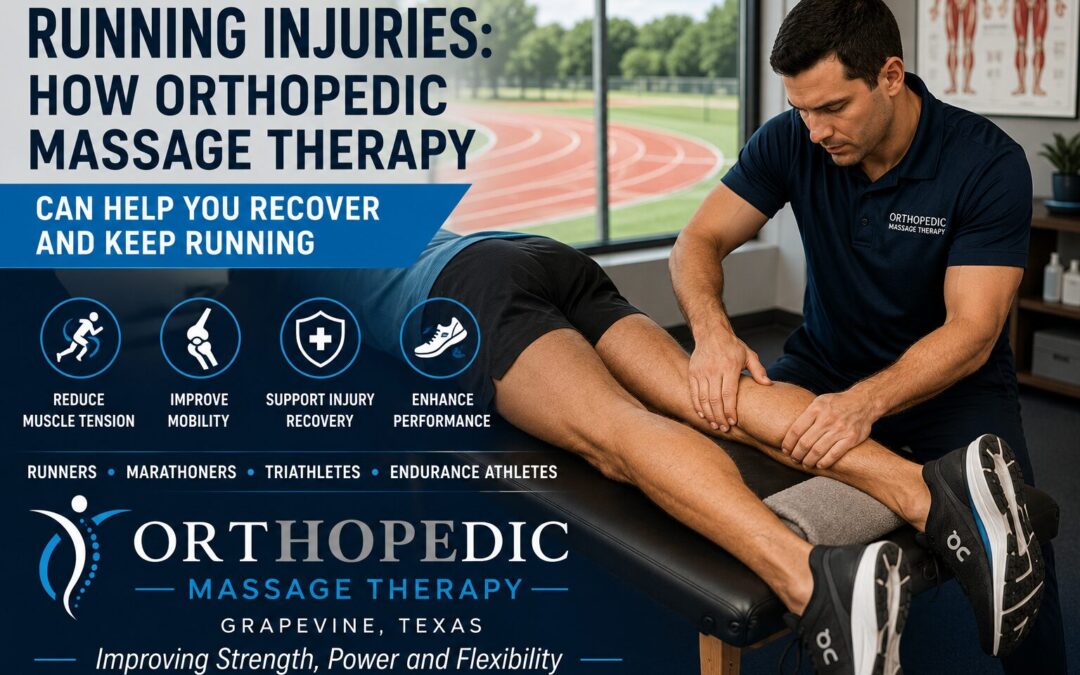
Orthopedic massage therapy takes a targeted approach to helping improve mobility, address soft-tissue restrictions, support recovery, and help athletes return to the activities they enjoy.
For runners, that means one important goal:
Keep your body moving so you can keep running.
Why Are Running Injuries So Common?
Running involves thousands of repeated movements.
Consider how many steps you take during a single run.
Now multiply that by your weekly mileage.
Then multiply it again by months or years of training.
Even a relatively small movement restriction or muscular imbalance can become more noticeable when that movement is repeated thousands of times.
Running-related problems can develop for many reasons, including:
- Rapid increases in training mileage
- Changes in running intensity
- Inadequate recovery
- Muscle weakness
- Limited mobility
- Previous injuries
- Changes in running mechanics
- Repetitive muscular stress
- Poorly managed training loads
- Compensation patterns
Often, several factors are involved at the same time.
That is why simply treating the location where discomfort is felt may not always address the entire problem.
Common Running Injuries and Areas of Pain
Runners can experience discomfort almost anywhere in the lower body.
However, several areas are especially common.
Runner’s Knee
Pain around the front of the knee or kneecap is commonly referred to as runner’s knee.
Several factors may contribute to knee discomfort, including movement mechanics, training volume, strength deficits, and restrictions in surrounding muscles.
The hip, quadriceps, hamstrings, and other tissues can influence how forces move through the knee.
Because of these relationships, addressing knee discomfort may require looking beyond the knee itself.
IT Band-Related Pain
The iliotibial band, commonly called the IT band, runs along the outside of the thigh.
Runners experiencing irritation in this region often report discomfort near the outside of the knee or thigh.
Simply applying pressure directly to the IT band may not address all of the factors contributing to the problem.
Muscles around the hip and thigh can influence tension and movement in this area.
A targeted approach may therefore include evaluating and treating related soft tissues rather than focusing on one location alone.
Shin Pain
Shin discomfort is another common complaint among runners, particularly when training volume or intensity increases quickly.
Muscles of the lower leg repeatedly absorb and control forces during running.
When these tissues become overloaded, tight, or fatigued, discomfort may develop.
Persistent or severe shin pain should always be appropriately evaluated because not all shin pain is muscular.
Calf Tightness
The calf muscles work extremely hard during running.
They help control the ankle, absorb force, and contribute to forward propulsion.
High-mileage runners may experience recurring calf tightness, particularly during periods of increased training.
When calf mobility becomes restricted, movement at the ankle may also be affected.
This can potentially influence mechanics farther up the leg.
Achilles Tendon Problems
The Achilles tendon connects the calf muscles to the heel and plays an important role in running and jumping.
Achilles pain should be taken seriously.
While orthopedic massage may address surrounding muscular restrictions when appropriate, persistent tendon pain requires proper assessment and a carefully managed rehabilitation plan.
Aggressive massage directly over an irritated tendon is not automatically the right treatment.
The goal should always be appropriate treatment—not simply applying more pressure.
Hamstring Tightness
Many runners describe their hamstrings as constantly tight.
But recurring hamstring tightness does not necessarily mean the hamstrings simply need more stretching.
The sensation of tightness may be influenced by several factors, including hip mechanics, muscular workload, strength, training volume, and compensation patterns.
If stretching provides only temporary relief and the tightness repeatedly returns, it may be worth investigating why.
Hip and Gluteal Tightness
The hips play an essential role in running.
The muscles surrounding the pelvis help stabilize the body and control movement with every stride.
When hip mobility becomes restricted or certain muscles become overworked, other areas may compensate.
Runners may notice discomfort in the:
- Glutes
- Outer hip
- Hip flexors
- Lower back
- Hamstrings
- Knees
Addressing hip function can therefore be an important part of helping runners move efficiently.
Plantar Fascia and Foot Discomfort
Your feet are your connection to the ground.
They absorb and transfer force with every running step.
Foot discomfort can be influenced by many factors, including training load, footwear, ankle mobility, calf tightness, and foot mechanics.
Because the calf, ankle, and foot work closely together, treatment may need to consider the entire lower leg rather than focusing only on the painful area.
Why Does the Same Running Injury Keep Coming Back?
This is one of the most important questions a runner can ask.
Many athletes experience a frustrating cycle:
Pain develops.
They stop running.
The pain improves.
They start running again.
The pain returns.
When this happens repeatedly, the problem may require more than temporary symptom relief.
Imagine that a runner has limited ankle mobility.
The body still needs to move forward with every stride, so another area may compensate.
Perhaps the knee moves differently.
Perhaps the hip works harder.
Perhaps the calf becomes overloaded.
Treating only the location of discomfort may provide temporary relief without addressing the movement restriction contributing to the problem.
Orthopedic massage therapy focuses on identifying and addressing soft-tissue restrictions that may be influencing these patterns.
How Orthopedic Massage Therapy Can Help Runners
Orthopedic massage is different from receiving a general relaxation massage.
Treatment is more specific.
The goal is to determine which muscles and soft tissues may be restricted, overworked, or contributing to inefficient movement.
Depending on the runner’s needs, treatment may focus on areas such as the:
- Calves
- Hamstrings
- Quadriceps
- Hip flexors
- Gluteal muscles
- Lower back
- Feet and ankles
Treatment is individualized because every runner is different.
Two athletes can experience pain in exactly the same location while having very different contributing factors.
Improving Mobility for Better Running Mechanics
Running requires mobility in several important areas.
The ankle needs to move appropriately.
The knee must flex and extend efficiently.
The hip needs adequate mobility throughout the running stride.
The pelvis and trunk must help stabilize the body.
When one area becomes restricted, another area may compensate.
Orthopedic massage therapy may help improve soft-tissue mobility and reduce muscular restrictions that interfere with comfortable movement.
Better mobility does not automatically make someone a faster runner.
However, improving movement quality may help the body use its existing strength more efficiently.
Recovery Is Part of Training
Many runners focus heavily on mileage.
They track pace, distance, heart rate, and race times.
But one of the most important parts of training cannot always be measured on a GPS watch:
Recovery.
Training creates stress.
Recovery allows the body to adapt.
When athletes consistently train without adequate recovery, muscular tension and fatigue may accumulate.
This can affect the quality of future training sessions.
Orthopedic massage therapy can be incorporated into a broader recovery strategy that also includes:
- Sleep
- Nutrition
- Hydration
- Appropriate rest
- Strength training
- Mobility work
- Proper training progression
Massage should complement these fundamentals—not replace them.
Don’t Wait Until You Cannot Run
Runners are often very good at ignoring discomfort.
A small ache becomes something they “run through.”
Persistent tightness becomes normal.
A slight change in stride gets ignored.
Then one day, the problem becomes significant enough that running is no longer comfortable.
Pay attention to what your body is telling you.
Warning signs may include:
- Recurring tightness in the same area
- Pain that repeatedly appears at a certain mileage
- Reduced range of motion
- Noticeable differences between your left and right sides
- Changes in your running stride
- Muscles that constantly feel overworked
- Discomfort that disappears with rest but returns when training resumes
These signs do not necessarily mean you have a serious injury.
But they may indicate that something deserves attention.
Earlier intervention may make it easier to address a problem before it significantly interferes with training.
Returning to Running After an Injury
Returning to running is not simply about waiting until pain disappears.
An athlete should also consider whether the body is prepared for the demands of running again.
Depending on the injury, this may involve restoring:
- Mobility
- Strength
- Muscular control
- Confidence
- Training tolerance
Orthopedic massage therapy may be used as part of a broader rehabilitation strategy when soft-tissue restrictions are affecting movement.
In many cases, runners may also benefit from working with appropriate healthcare or rehabilitation professionals.
The goal should be a gradual and intelligent return to activity—not rushing back simply because symptoms temporarily improved.
Strength and Mobility Work Together
Runners sometimes focus heavily on stretching when they feel tight.
But stretching alone may not solve every problem.
Athletes need both mobility and strength.
Mobility allows the body to access movement.
Strength allows the body to control that movement.
For example, improving hip mobility may be helpful, but the muscles surrounding the hip also need sufficient strength and control.
The same principle applies to the ankle, knee, and trunk.
This is why a comprehensive approach to running performance may include:
- Targeted orthopedic massage
- Appropriate strength training
- Mobility work
- Proper recovery
- Gradual training progression
All of these elements can work together to support better movement.
Orthopedic Massage for Marathon and Endurance Training
Preparing for a marathon, half marathon, triathlon, or endurance competition places significant demands on the body.
Weekly mileage increases.
Long training sessions become more frequent.
Recovery becomes increasingly important.
During these training periods, athletes may begin noticing small changes:
A calf that becomes tight after every long run.
A hip that feels restricted.
A hamstring that never seems to loosen.
A recurring ache that appears at the same point during every workout.
These patterns should not automatically be ignored.
Orthopedic massage therapy may help endurance athletes manage muscular restrictions and maintain movement quality throughout demanding training cycles.
The objective is not to eliminate the normal physical demands of training.
The objective is to help your body manage those demands as efficiently as possible.
Orthopedic Massage Therapy for Runners in Grapevine, Texas
Runners throughout Grapevine, Southlake, Colleyville, and the surrounding Dallas-Fort Worth area train for everything from local 5Ks to half marathons, marathons, triathlons, and competitive endurance events.
Regardless of your distance or experience level, your body needs to move efficiently to handle the repetitive demands of running.
At Orthopedic Massage Therapy in Grapevine, Texas, we provide targeted treatment focused on muscular restrictions, movement, recovery, and injury rehabilitation.
Whether you are dealing with recurring tightness, recovering from an injury, increasing your mileage, or preparing for your next race, orthopedic massage therapy may be a valuable part of your training and recovery strategy.
Keep Running Toward Your Goals
Running injuries can be frustrating—especially when the same problem keeps returning.
You work hard for your fitness.
You invest hours into training.
You set goals and prepare for races.
Persistent muscular tightness or restricted movement should not automatically be accepted as something you simply have to live with.
Understanding how different areas of your body work together may be an important step toward improving movement and addressing recurring problems.
At Orthopedic Massage Therapy in Grapevine, Texas, our goal is to help athletes move better, recover effectively, and continue doing the activities they love.
Improving Strength, Power and Flexibility.
If recurring muscle tightness, restricted movement, or a running-related injury is interfering with your training, contact Orthopedic Massage Therapy in Grapevine, Texas to learn how targeted orthopedic massage therapy may support your recovery and help you keep moving toward your next finish line.