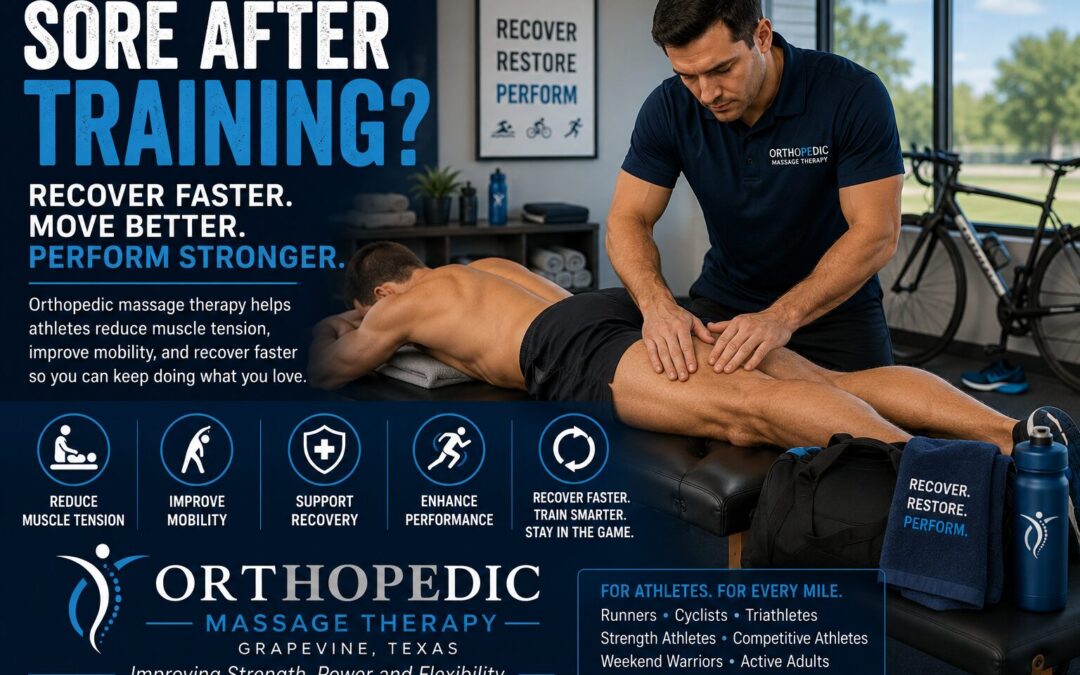
Orthopedic Massage Therapy OmassageT.com
Muscle soreness after a hard workout can feel like proof that you trained effectively.
But when does normal post-workout soreness become something more?
For competitive athletes, runners, endurance athletes, and active adults, understanding the difference between normal muscle fatigue and a recurring problem is important.
A demanding workout naturally places stress on the body. Muscles become fatigued, tissues are challenged, and the body needs time to recover and adapt.
However, when soreness lasts longer than expected, the same muscles constantly feel tight, or discomfort begins affecting the way you move, your body may be telling you that it needs more than another rest day.
At Orthopedic Massage Therapy in Grapevine, Texas, we work with athletes who want to recover effectively, improve mobility, address muscular restrictions, and continue performing at a high level.
Orthopedic massage therapy can be an important part of a comprehensive recovery strategy designed to help athletes stay active and keep moving toward their goals.
Why Do Muscles Get Sore After Exercise?
Exercise creates stress on the body.
That stress is not necessarily bad.
In fact, appropriate training stress is one of the ways the body becomes stronger and better conditioned.
When you run farther, lift heavier weights, increase training intensity, or perform movements your body is not accustomed to, your muscles must adapt to those demands.
It is common to experience temporary soreness afterward.
This is often referred to as delayed onset muscle soreness, or DOMS.
DOMS commonly develops after unfamiliar or demanding exercise and may become noticeable hours after training.
You might experience:
- Muscle tenderness
- Stiffness
- Temporary soreness
- Mild reduction in range of motion
- Muscles that feel tired or heavy
In many cases, this improves naturally as the body recovers.
But not every ache should automatically be dismissed as normal soreness.
Normal Soreness vs. A Problem That Keeps Returning
Athletes become accustomed to discomfort.
That can be both an advantage and a disadvantage.
The ability to tolerate physical stress is part of athletic training.
But athletes can also become so accustomed to soreness that they begin ignoring important warning signs.
Normal post-workout soreness generally improves with recovery.
A recurring movement problem often behaves differently.
Pay attention when:
- The same area hurts after nearly every workout
- Tightness repeatedly returns
- One side feels significantly different from the other
- Your range of motion is decreasing
- Pain changes the way you run, lift, or move
- A problem disappears with rest but immediately returns with training
- Your normal recovery time is becoming longer
- Performance is beginning to decline
These signs do not automatically mean that you have a serious injury.
However, they may indicate that something deserves closer attention.
Why Recovery Is Essential for Athletic Performance
Athletes often believe improvement happens during training.
Technically, training provides the stimulus.
Recovery allows adaptation.
During recovery, the body responds to the demands placed upon it.
That is why athletes cannot simply train harder every day and expect unlimited improvement.
Without adequate recovery, fatigue can accumulate.
Muscles may remain tight.
Movement quality may change.
Training performance may decline.
Eventually, the athlete may find it difficult to maintain the same intensity or volume.
Effective recovery helps athletes prepare for the next training session.
That is why serious athletes treat recovery as part of their training program—not something they do only when they are injured.
How Orthopedic Massage Therapy Supports Athletic Recovery
Orthopedic massage therapy is different from receiving a massage solely for relaxation.
The treatment is targeted.
The goal is to identify specific muscular and soft-tissue restrictions that may be affecting movement, comfort, or athletic performance.
Depending on the athlete, orthopedic massage may focus on areas that have become:
- Tight
- Overworked
- Restricted
- Sensitive
- Fatigued
- Compensating for another area
Treatment is individualized based on the athlete’s needs.
A runner training for a marathon will have different demands than a powerlifter.
A cyclist may develop different restrictions than a basketball player.
A triathlete must manage the combined demands of swimming, cycling, and running.
The treatment approach should reflect those differences.
Reducing Excessive Muscle Tension
Muscle tension is not always a problem.
Muscles need tension to create force.
But excessive or persistent tension can interfere with comfortable movement.
Athletes may describe muscles as feeling:
- Tight
- Heavy
- Knotted
- Restricted
- Constantly fatigued
Sometimes stretching provides temporary relief, but the tightness quickly returns.
This may happen because the muscle is responding to another movement problem or compensating for a restriction elsewhere.
Orthopedic massage therapy can target these areas while also considering how surrounding muscles may be contributing to the pattern.
The objective is not simply to press harder on the tightest muscle.
It is to understand why that muscle may be working so hard.
Improving Mobility Between Training Sessions
Mobility affects almost every athletic movement.
Running requires mobility through the hips and ankles.
Weightlifting requires appropriate mobility to perform exercises efficiently.
Swimming requires significant shoulder and upper-body mobility.
Cycling places the body in repetitive positions for long periods.
When mobility becomes restricted, the body often compensates.
These compensations may initially be subtle.
But when the same movement is repeated hundreds or thousands of times, small restrictions can become more significant.
Orthopedic massage therapy may help address soft-tissue restrictions that limit comfortable movement.
Better movement between training sessions may help athletes return to training feeling less restricted.
Recovery for Competitive Runners
Runners place enormous repetitive demands on their lower bodies.
During high-mileage training, muscles such as the calves, hamstrings, quadriceps, hip flexors, and glutes repeatedly absorb and generate force.
A runner may finish one training session feeling fine but gradually accumulate tightness over several weeks.
Eventually, they may notice:
- Calf tightness
- Heavy legs
- Restricted hips
- Tight hamstrings
- Gluteal discomfort
- Reduced ankle mobility
- Changes in stride
These problems can become especially noticeable during marathon or half-marathon training when weekly mileage increases.
Orthopedic massage therapy can be incorporated into a runner’s recovery program to help manage muscular restrictions throughout demanding training cycles.
Recovery for Cyclists and Triathletes
Cyclists spend long periods in a relatively fixed position.
This can place repetitive demands on the hips, legs, lower back, shoulders, and neck.
Triathletes face an additional challenge.
They must transition between three different movement patterns:
Swimming.
Cycling.
Running.
Each sport places different demands on the body.
This makes recovery especially important.
A restriction developed during cycling may influence running mechanics.
Shoulder fatigue from swimming may affect upper-body tension.
Hip tightness may become more noticeable as training volume increases.
Orthopedic massage therapy can target the specific soft-tissue restrictions associated with these repetitive training demands.
Recovery for Strength and Power Athletes
Strength athletes experience different types of muscular stress.
Heavy resistance training requires muscles to produce significant force.
Over time, athletes may notice restricted movement or persistent muscular tension in areas such as the:
- Shoulders
- Chest
- Upper back
- Lower back
- Hips
- Glutes
- Quadriceps
- Hamstrings
Mobility is particularly important for strength athletes.
Having enough range of motion to perform exercises correctly can influence lifting mechanics.
Orthopedic massage therapy may help address soft-tissue restrictions that interfere with comfortable movement during training.
Why Stretching Is Not Always Enough
When athletes feel tight, the first instinct is often:
“I need to stretch more.”
Sometimes stretching is helpful.
But recurring tightness is not always caused by a simple lack of flexibility.
A muscle may feel tight because it is:
- Overworked
- Fatigued
- Protecting another area
- Compensating for weakness
- Responding to limited mobility elsewhere
This explains why some athletes stretch the same muscle every day without seeing lasting improvement.
The muscle may not be the original problem.
Orthopedic massage therapy takes a more targeted approach by considering the relationships between different muscles and movement patterns.
Massage Should Not Be Painful to Be Effective
Athletes sometimes believe that deeper pressure automatically means better treatment.
That is not always true.
More pressure is not always more effective.
The appropriate treatment depends on:
- The tissue being treated
- The athlete’s condition
- Training schedule
- Injury history
- Sensitivity
- Treatment goals
Aggressive treatment immediately before an important competition, for example, may not be appropriate.
Effective orthopedic massage should be purposeful.
The goal is not to see how much discomfort an athlete can tolerate.
The goal is to improve function.
When Should Athletes Schedule Massage?
The ideal timing varies from athlete to athlete.
Some athletes use orthopedic massage as part of a regular maintenance and recovery program.
Others schedule treatment when they notice a specific problem.
Useful times may include:
During Heavy Training Blocks
As training volume increases, muscular fatigue and restrictions may accumulate.
After Demanding Competitions
Appropriate post-event treatment may complement the recovery process.
When Tightness Keeps Returning
Recurring muscular tension may indicate that an area is consistently being overloaded or compensating.
During Injury Rehabilitation
Orthopedic massage may complement an appropriate rehabilitation program when soft-tissue restrictions are affecting movement.
Before Problems Become Severe
Athletes do not always need to wait until pain prevents them from training.
Paying attention to smaller changes may help identify issues earlier.
What About Massage Before a Race or Competition?
Timing matters.
Athletes should be cautious about receiving unfamiliar or aggressive treatment immediately before an important competition.
Deep, intensive soft-tissue work may temporarily leave some muscles feeling sensitive.
Pre-event treatment should generally be appropriate for the athlete’s goals and competition schedule.
If you are preparing for an important race or event, it may be better to plan treatment strategically rather than scheduling aggressive work at the last minute.
Athletes often spend months preparing for competition.
Recovery planning deserves the same level of thought.
Recovery Is More Than Massage
Orthopedic massage therapy can be valuable, but it is only one part of athletic recovery.
A comprehensive recovery strategy may include:
- Quality sleep
- Proper nutrition
- Adequate hydration
- Appropriate rest days
- Strength training
- Mobility exercises
- Intelligent training progression
- Professional rehabilitation when needed
There is no single recovery technique that replaces the fundamentals.
Massage works best as part of a larger strategy.
Listen to Patterns, Not Just Pain
One of the most useful things an athlete can do is pay attention to patterns.
Ask yourself:
Does the same muscle always tighten after long runs?
Does one hip consistently feel more restricted?
Does soreness last longer than it used to?
Does discomfort always appear at the same point during training?
Does one side fatigue faster?
Patterns provide information.
A problem that repeatedly returns may deserve more attention than a random ache that disappears quickly.
Orthopedic massage therapy can help identify and address muscular restrictions associated with these patterns.
Orthopedic Massage Therapy for Athletes in Grapevine, Texas
Athletes throughout Grapevine, Southlake, Colleyville, and the surrounding Dallas-Fort Worth area work hard to improve their performance.
Whether you are training for a marathon, competing in triathlons, cycling, lifting weights, playing competitive sports, or simply maintaining an active lifestyle, recovery matters.
At Orthopedic Massage Therapy in Grapevine, Texas, our focus goes beyond temporary relaxation.
We provide targeted orthopedic massage therapy designed to address muscular restrictions, improve mobility, support recovery, and complement injury rehabilitation.
Every athlete is different.
Every sport creates different demands.
And every treatment should reflect the individual athlete’s needs.
Train Hard. Recover Smarter. Perform Better.
Training challenges your body.
Recovery prepares it for what comes next.
If persistent tightness, restricted mobility, or recurring muscular discomfort is beginning to interfere with your training, it may be time to give recovery the same attention you give your workouts.
At Orthopedic Massage Therapy in Grapevine, Texas, our goal is to help athletes move better, recover effectively, and continue pursuing the activities and competitions that matter to them.
Improving Strength, Power and Flexibility.
Contact Orthopedic Massage Therapy in Grapevine, Texas to learn how orthopedic massage therapy and targeted sports recovery treatment may help support your training, mobility, and athletic performance.