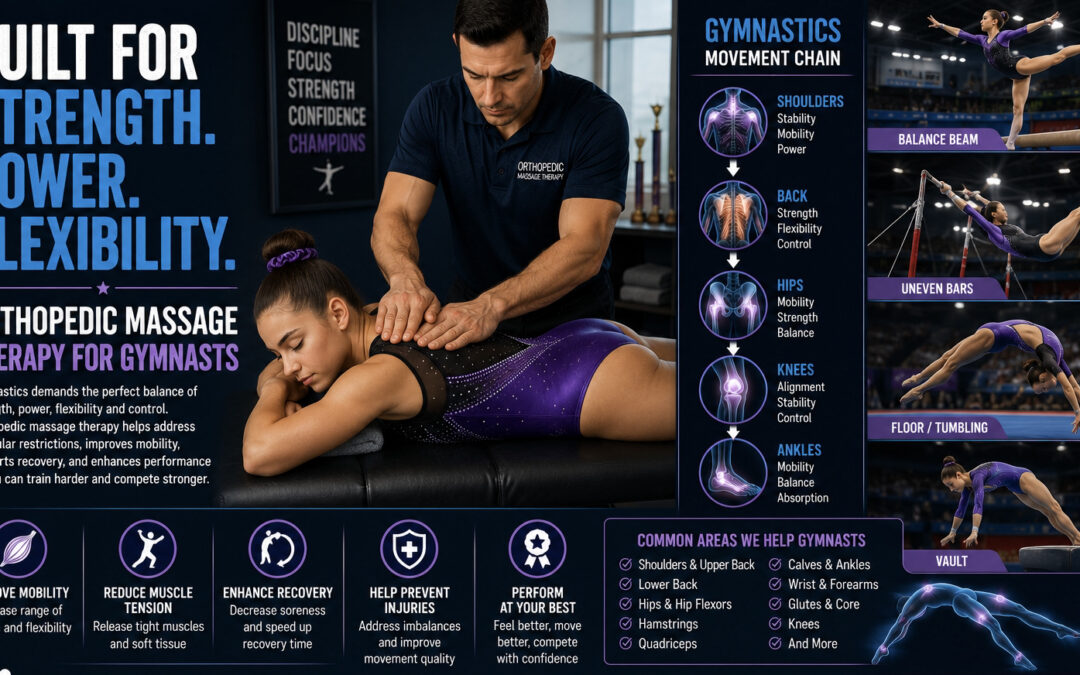
Orthopedic Massage Therapy
Gymnastics demands something extraordinary from the human body.
Strength.
Power.
Flexibility.
Balance.
Coordination.
Speed.
Body control.
And the ability to perform all of these qualities together—often while flipping, twisting, jumping, landing, swinging, or supporting the entire body through the arms.
Whether you are a competitive gymnast training several days per week or an athlete developing higher-level skills, gymnastics places significant demands on nearly every part of the body.
Shoulders and wrists absorb tremendous forces.
The lower back repeatedly extends, rotates, and stabilizes.
Hips require exceptional mobility and control.
Knees and ankles absorb repeated landings.
Muscles must generate explosive power while still maintaining the flexibility necessary to perform advanced skills.
Over time, these demands can contribute to muscular tightness, restricted movement, fatigue, and compensation patterns.
At Orthopedic Massage Therapy in Grapevine, Texas, we use targeted orthopedic massage therapy to help athletes address muscular restrictions, improve functional mobility, support recovery, and maintain the movement necessary for athletic performance.
For gymnasts, the goal is not simply to become more flexible.
It is to develop and maintain the right combination of:
Strength. Power. Flexibility. Control.
Gymnastics Requires a Unique Type of Athlete
Few sports require the combination of physical abilities demanded by gymnastics.
A gymnast may need tremendous upper-body strength to perform on the bars.
Seconds later, that same athlete may need explosive lower-body power for a vault.
Floor routines require tumbling, jumping, landing, flexibility, coordination, and endurance.
Balance beam requires precision and stability.
Each event creates different physical demands.
But one thing remains consistent:
The entire body must work together.
Gymnasts depend on coordinated movement from head to toe.
When one area becomes restricted, fatigued, or overworked, another area may begin compensating.
That is why caring for a gymnast’s body requires looking beyond a single tight muscle or painful area.
Why Gymnasts Experience So Much Muscular Tightness
Gymnastics involves repetitive training.
A gymnast may practice the same skill dozens—or even hundreds—of times while trying to perfect technique.
Repeated:
-
Tumbling
-
Jumping
-
Landing
-
Swinging
-
Handstands
-
Backbends
-
Splits
-
Leaps
-
Turns
can place significant demands on muscles and connective tissues.
Training volume also matters.
Competitive gymnasts may train many hours each week.
As training accumulates, muscles can become fatigued and movement may begin to change.
Gymnasts may notice recurring tightness in areas such as the:
-
Shoulders
-
Upper back
-
Lower back
-
Hip flexors
-
Glutes
-
Hamstrings
-
Quadriceps
-
Calves
Some muscular tension is a normal response to training.
But when the same tightness repeatedly returns or begins affecting movement, it may deserve closer attention.
Flexibility Is Essential—but More Is Not Always Better
Gymnasts require exceptional flexibility.
Splits.
Backbends.
Leaps.
Kicks.
Shoulder flexibility.
These movements require ranges of motion that most people never need.
But there is an important difference between simply being flexible and having functional mobility.
Flexibility refers generally to the ability of tissues to lengthen.
Mobility involves the ability to move through a range of motion with control.
For gymnasts, control is essential.
A gymnast does not simply need to reach an extreme position.
They need the strength and coordination to control that position.
That means the goal should not always be:
“Become more flexible.”
A better goal is:
Develop the mobility needed for gymnastics while maintaining strength and control.
Orthopedic massage therapy may help address muscular restrictions that interfere with comfortable movement, while appropriate strength and conditioning help the athlete control that movement.
Tight Hips in Gymnasts
Hip mobility is extremely important in gymnastics.
Gymnasts require significant hip movement for:
-
Splits
-
Leaps
-
Jumps
-
Kicks
-
Tumbling
-
Dance elements
-
Landing mechanics
But despite being very flexible overall, gymnasts can still develop muscular restrictions.
A gymnast may have excellent flexibility in one direction while experiencing tightness or limited movement somewhere else.
Common areas of muscular tension may include the:
-
Hip flexors
-
Adductors
-
Glutes
-
Deep hip rotators
-
Hamstrings
Repeated training can also create differences between sides.
One split may feel easier.
One hip may rotate differently.
One leg may feel stronger or more stable.
These patterns can be important.
Orthopedic massage therapy may help address specific muscular restrictions around the hips while considering how the athlete moves as a whole.
Hamstring Tightness in Gymnasts
Hamstrings are constantly challenged in gymnastics.
They must allow significant flexibility during:
-
Splits
-
Leaps
-
Kicks
-
Pike positions
But they also need strength.
The hamstrings contribute to running, jumping, tumbling, landing, and hip control.
A gymnast may feel that their hamstrings are always tight and respond by stretching them more aggressively.
But recurring tightness does not always mean the muscle simply needs more stretching.
The hamstrings may be:
-
Fatigued
-
Overworked
-
Compensating
-
Responding to hip restrictions
-
Recovering from high training volume
If stretching provides only temporary relief, it may be helpful to ask why the tightness keeps returning.
Targeted orthopedic massage therapy can help address muscular restrictions while considering the surrounding hips, glutes, and lower body.
Shoulder Mobility for Gymnastics
The shoulders experience extraordinary demands in gymnastics.
Gymnasts repeatedly perform movements where the arms are overhead or supporting body weight.
Examples include:
-
Handstands
-
Bars
-
Back handsprings
-
Cartwheels
-
Walkovers
-
Bridges
-
Tumbling skills
These movements require both mobility and stability.
The shoulder must move through a large range while muscles maintain control.
Restrictions involving the:
-
Lats
-
Chest
-
Rotator cuff region
-
Upper back
-
Shoulder blade muscles
may influence overhead movement.
A gymnast with restricted shoulder mobility may compensate somewhere else.
One common area where compensation may occur is the lower back.
The Shoulder-Lower Back Connection
Consider a gymnast performing an overhead position.
If the shoulders cannot comfortably achieve the necessary range, the athlete still needs to create the visual position required for the skill.
The body may compensate by increasing movement through another area.
Often, that may involve additional arching through the lower back.
This does not mean shoulder tightness automatically causes back pain.
But it demonstrates why the location where an athlete feels discomfort may not always tell the complete story.
The body works as a connected system.
When evaluating muscular restrictions in gymnasts, it can be helpful to consider how the shoulders, upper back, trunk, hips, and lower back interact.
Lower Back Tightness in Gymnasts
Gymnastics requires repeated spinal extension.
Back walkovers.
Bridges.
Back handsprings.
Tumbling.
Dance elements.
These movements can place significant demands on the lower back.
Gymnasts may experience muscular tightness involving the lower back, hips, and surrounding tissues.
But persistent back pain in a gymnast should never automatically be treated as simple muscle tightness.
Gymnasts—particularly young athletes—can experience significant back injuries that require appropriate medical evaluation.
Persistent pain, pain with repeated back extension, neurological symptoms, or worsening symptoms should be assessed by an appropriate healthcare professional.
Massage therapy should not be used to delay necessary medical care.
When muscular restrictions are appropriate for massage, treatment may consider the surrounding hips, glutes, upper back, and other areas rather than aggressively working directly on a painful location.
Wrist and Forearm Demands
Gymnastics places unusual demands on the wrists.
In many sports, the hands primarily grip equipment.
In gymnastics, the hands and wrists may repeatedly support a significant portion—or all—of the athlete’s body weight.
Think about:
-
Handstands
-
Cartwheels
-
Back handsprings
-
Front handsprings
-
Vault
-
Bars
These activities create repetitive demands through the wrists, hands, and forearms.
Muscular fatigue or restrictions in the forearms may influence how these areas feel.
Targeted orthopedic massage therapy may help address muscular tension in the forearms when appropriate.
However, persistent wrist pain, swelling, significant loss of motion, or pain associated with weight-bearing should be appropriately evaluated.
Knees and Repetitive Landings
Gymnasts perform countless landings.
Every landing requires the body to absorb force.
The:
-
Feet
-
Ankles
-
Calves
-
Knees
-
Hips
all contribute.
Landing mechanics require strength, mobility, balance, and control.
If muscular fatigue increases, movement may begin to change.
This is especially important during long training sessions.
A gymnast may perform excellent landings early in practice but become less controlled as fatigue develops.
Recurring knee discomfort should not automatically be viewed as an isolated knee problem.
The hips, quadriceps, hamstrings, calves, and ankles all influence lower-body movement.
Ankles and Calves in Gymnastics
Gymnasts need strong, mobile ankles.
They repeatedly:
-
Jump
-
Land
-
Point their toes
-
Balance
-
Run
-
Tumble
The calves contribute to many of these movements.
Repeated jumping and landing can create muscular fatigue throughout the lower legs.
Gymnasts may experience:
-
Tight calves
-
Ankle stiffness
-
Differences between sides
-
Reduced mobility after training
Previous ankle sprains may also influence movement.
Even after an injury heals, an athlete may develop compensations or lingering restrictions.
Orthopedic massage therapy may help address muscular and soft-tissue restrictions around the calf and lower leg when appropriate.
Why One Side May Feel Different
Gymnastics is not always perfectly symmetrical.
Athletes often have a preferred:
-
Twisting direction
-
Split
-
Turning direction
-
Lead leg
-
Takeoff leg
Over thousands of repetitions, these preferences can create differences between sides.
One hip may feel tighter.
One shoulder may have more mobility.
One calf may fatigue faster.
One hamstring may constantly feel restricted.
Some asymmetry is normal.
The human body is not perfectly symmetrical.
But significant or increasing differences may be worth paying attention to—especially if they begin affecting technique or comfort.
How Orthopedic Massage Therapy May Help Gymnasts
Orthopedic massage therapy is different from a general relaxation massage.
Treatment is targeted toward specific muscular and soft-tissue restrictions.
For gymnasts, treatment may involve areas such as the:
-
Shoulders
-
Lats
-
Upper back
-
Forearms
-
Lower back
-
Hip flexors
-
Glutes
-
Hamstrings
-
Quadriceps
-
Calves
The exact treatment depends on the individual gymnast.
A gymnast struggling with overhead shoulder mobility may require a different approach than one experiencing recurring calf tightness.
A gymnast returning from an ankle injury may have different needs than an athlete dealing with muscular fatigue during a demanding competition season.
Treatment should be individualized.
Orthopedic Massage Therapy and Injury Rehabilitation
Injuries can change the way an athlete moves.
After an injury, a gymnast may unconsciously:
-
Protect one side
-
Shift weight differently
-
Change landing mechanics
-
Reduce movement through one joint
-
Overuse another area
Even after the original injury improves, some compensation patterns may remain.
Orthopedic massage therapy may be used as part of a broader rehabilitation strategy to address muscular restrictions associated with these changes.
Depending on the injury, massage therapy may complement care provided by physicians, physical therapists, athletic trainers, and other healthcare professionals.
The goal is not simply to make the athlete feel better temporarily.
The goal is to support better movement.
Recovery Is Training
Gymnasts are often highly disciplined athletes.
They understand repetition.
Practice.
Consistency.
But athletes sometimes underestimate the importance of recovery.
Training creates stress.
Recovery allows adaptation.
Without adequate recovery, fatigue can accumulate.
Muscles may remain tight.
Movement quality may decline.
Performance may suffer.
A comprehensive recovery strategy may include:
-
Adequate sleep
-
Proper nutrition
-
Hydration
-
Appropriate rest
-
Strength and conditioning
-
Mobility work
-
Intelligent training progression
-
Targeted orthopedic massage therapy
Recovery should not be viewed as time away from training.
Recovery is part of training.
Massage During Competition Season
Competition season can be physically demanding.
Gymnasts may be balancing:
-
Multiple weekly practices
-
Strength and conditioning
-
Competitions
-
Travel
-
School
-
Limited recovery time
During demanding periods, muscular fatigue can accumulate.
Orthopedic massage therapy may be incorporated into an athlete’s recovery program to help address muscular restrictions and maintain comfortable movement.
Timing matters.
Aggressive or unfamiliar treatment immediately before an important competition may not always be appropriate.
Treatment should consider the athlete’s training and competition schedule.
The objective is to support performance—not interfere with it.
Young Gymnasts Require Special Consideration
Many competitive gymnasts begin training at a young age.
Young athletes are still growing and developing.
Pain should not automatically be dismissed as:
“Just part of gymnastics.”
Persistent pain deserves attention.
Parents, coaches, therapists, and healthcare professionals should work together when necessary to ensure young athletes receive appropriate care.
Massage therapy should be age-appropriate, professional, and used within an appropriate scope of practice.
When an injury or medical condition is suspected, proper evaluation should come first.
Signs a Gymnast May Need More Attention
Gymnasts are accustomed to soreness.
But there is a difference between normal post-training fatigue and recurring problems.
Pay attention when an athlete experiences:
-
The same muscular tightness after every practice
-
Increasing differences between sides
-
Decreasing mobility
-
Pain that changes technique
-
Persistent back discomfort
-
Repeated shoulder or wrist discomfort
-
Pain during landings
-
Tightness that immediately returns after stretching
-
Difficulty recovering between training sessions
These patterns do not automatically mean the athlete has a serious injury.
But they may indicate that something deserves attention.
Strength and Flexibility Must Work Together
Gymnastics requires extraordinary flexibility.
But flexibility without strength and control is not enough.
Athletes need the ability to control their available range of motion.
That is why one of the most important concepts for gymnasts is the combination of:
Mobility + Strength + Stability + Control
Orthopedic massage therapy may help address muscular restrictions affecting mobility.
Strength and conditioning help athletes control movement.
Technical coaching helps athletes apply those abilities to gymnastics skills.
Recovery helps the body adapt.
All of these pieces work together.
Orthopedic Massage Therapy for Gymnasts in Grapevine, Texas
Competitive gymnasts throughout Grapevine, Southlake, Colleyville, Keller, and the surrounding Dallas-Fort Worth area dedicate countless hours to developing their skills.
Every practice requires tremendous physical effort.
Every skill requires coordination between multiple areas of the body.
At Orthopedic Massage Therapy in Grapevine, Texas, we provide targeted orthopedic massage therapy focused on:
-
Athletic mobility
-
Muscular restrictions
-
Sports recovery
-
Injury rehabilitation
-
Strength and flexibility support
-
Athletic performance
We understand that athletes do not simply want temporary relaxation.
They want to move.
Train.
Compete.
And perform at their best.
Move Better. Recover Stronger. Perform With Confidence.
Gymnastics demands an extraordinary combination of strength, power, flexibility, and control.
Your body must repeatedly absorb force, generate power, move through extreme ranges of motion, and recover quickly enough to do it all again.
When muscular restrictions begin interfering with movement, simply stretching harder may not always be the complete answer.
Look at the entire athlete.
The shoulders.
The back.
The hips.
The hamstrings.
The knees.
The calves.
The ankles.
Everything works together.
At Orthopedic Massage Therapy in Grapevine, Texas, our goal is to help athletes address muscular restrictions, improve functional mobility, support recovery, and continue pursuing the sports they love.
Improving Strength, Power and Flexibility.
Contact Orthopedic Massage Therapy in Grapevine, Texas to learn how targeted orthopedic massage therapy may support a gymnast’s mobility, recovery, injury rehabilitation, and athletic performance.