Orthopedic Massage Therapy OmassageT.com
Gymnasts need extraordinary hip mobility.
Splits.
Leaps.
Kicks.
Jumps.
Dance elements.
Tumbling.
These skills require the hips to move through ranges of motion far beyond what most people use in everyday life.
But here is something that surprises many athletes and parents:
A gymnast can be extremely flexible and still have tight hips.
One split may be flat while the other feels restricted.
A gymnast may have beautiful passive flexibility but struggle to lift the leg high without assistance.
The hips may feel tight after practice even though the athlete stretches every day.
Or the gymnast may keep stretching harder and harder without seeing meaningful improvement.
Why?
Because gymnastics flexibility is about more than how far a muscle can stretch.
It requires:
Mobility. Strength. Stability. Control.
At Orthopedic Massage Therapy in Grapevine, Texas, we use targeted orthopedic massage therapy to help athletes address muscular restrictions, improve functional mobility, support recovery, and complement appropriate strength and flexibility training.
When a gymnast struggles with tight hips or uneven splits, the most important question may not be:
“How can I stretch more?”
It may be:
“What is limiting this movement?”
Flexibility and Mobility Are Not the Same Thing
The words flexibility and mobility are often used interchangeably.
But they are not exactly the same.
Flexibility generally refers to the ability of muscles and other tissues to lengthen.
Mobility refers more broadly to the ability to move through a range of motion effectively.
For a gymnast, there is another important piece:
Control.
Imagine a gymnast lying on their back while someone gently lifts one leg toward their head.
The leg may move very high.
That demonstrates passive flexibility.
Now ask the gymnast to stand and lift the same leg as high as possible without assistance.
The range may be much smaller.
Why?
Because active movement requires strength and control.
Gymnasts do not simply need to reach flexible positions.
They need to control those positions during athletic movement.
Why Do Gymnasts Get Tight Hips?
Gymnasts use their hips constantly.
The muscles surrounding the hips contribute to:
-
Leaps
-
Splits
-
Kicks
-
Jumps
-
Tumbling
-
Landings
-
Running
-
Dance elements
-
Balance
High training volume can create significant muscular fatigue.
Possible contributors to recurring hip tightness may include:
-
Repetitive training
-
Muscular fatigue
-
High-volume stretching
-
Strength training
-
Growth and development
-
Differences between sides
-
Previous injuries
-
Compensation patterns
-
Inadequate recovery
Sometimes the muscle that feels tight may truly have a restriction.
Other times, the sensation of tightness may reflect fatigue or the body’s attempt to create stability.
This is why simply stretching harder may not always be the best answer.
Understanding the Hip Flexors
The term “hip flexors” refers to several muscles that help bring the thigh toward the body.
These muscles work constantly in gymnastics.
Think about:
-
Pike positions
-
Leg lifts
-
Kicks
-
Leaps
-
Running approaches
-
Core exercises
-
Bar skills
The hip flexors may become fatigued or feel tight after repeated training.
Gymnasts often respond by stretching them aggressively.
Stretching may be helpful when appropriate.
But if the same tightness returns after every practice, it may be useful to consider why these muscles are repeatedly becoming overworked.
Are they compensating?
Is the athlete fatigued?
Is there a difference between sides?
Is another muscle group contributing less efficiently?
Recurring tightness is a pattern.
Patterns can provide useful information.
Why One Split Is Often Better Than the Other
Ask almost any gymnast:
“Which split is your good split?”
They usually know immediately.
One side often feels natural.
The other requires more work.
Why?
Gymnastics is not perfectly symmetrical.
Athletes often develop preferred:
-
Lead legs
-
Leap legs
-
Turning directions
-
Twisting directions
-
Takeoff legs
Over thousands of repetitions, differences between sides may develop.
One hip may move differently.
One hamstring may feel tighter.
One hip flexor may be more restricted.
One side may have better active control.
Some asymmetry is normal.
Human bodies are not perfectly symmetrical.
But significant differences may be worth addressing—especially when they affect technique or comfort.
What Actually Happens During a Split?
A split is not simply a “hamstring stretch.”
Multiple areas contribute.
In a front split, the front leg requires significant hamstring length and hip movement.
The back leg requires hip extension and flexibility through structures at the front of the hip and thigh.
The pelvis also needs to be controlled.
This means a gymnast struggling with a split may have restrictions involving several areas, including the:
-
Hamstrings
-
Hip flexors
-
Quadriceps
-
Adductors
-
Glutes
-
Deep hip muscles
Simply stretching the hamstring harder may not address the complete movement.
The entire position should be considered.
Why Forcing a Split May Not Be the Best Strategy
Gymnasts are often highly motivated.
If a split is not flat, the instinct may be:
Push harder.
Stretch longer.
Add more pressure.
But flexibility should be developed thoughtfully.
Forcing the body aggressively into extreme ranges may not always be appropriate—especially for young athletes.
Pain should not automatically be interpreted as proof that a stretch is working.
A better strategy considers:
-
The athlete’s age
-
Current mobility
-
Strength
-
Control
-
Training volume
-
Tissue tolerance
-
Previous injuries
Progress should be purposeful.
The goal is not simply to force the body into a position.
The goal is to develop usable movement.
Passive Flexibility vs. Active Flexibility
This distinction is extremely important in gymnastics.
Passive flexibility is the range available when an outside force helps create the movement.
For example:
A coach helps lift the leg higher.
Gravity pulls the gymnast deeper into a split.
Active flexibility is the athlete’s ability to create and control the movement using their own muscles.
For example:
Holding the leg high during a leap.
Performing a controlled high kick.
Maintaining body position during a gymnastics skill.
Gymnasts need both.
But exceptional passive flexibility without adequate active control may not translate into better athletic performance.
This is why strength and flexibility must work together.
The Hamstring-Hip Connection
Hamstrings are extremely important for gymnasts.
They need flexibility for:
-
Splits
-
Leaps
-
Pike positions
-
Kicks
But they also need strength for:
-
Running
-
Jumping
-
Tumbling
-
Landing
-
Hip control
A gymnast may constantly feel the need to stretch their hamstrings.
But recurring hamstring tightness does not always mean the muscle needs more flexibility.
It may be:
-
Fatigued
-
Overworked
-
Compensating
-
Responding to hip restrictions
-
Recovering from high training volume
Orthopedic massage therapy may help address muscular restrictions involving the hamstrings while also considering the hips, glutes, and surrounding tissues.
Inner-Thigh Tightness and Middle Splits
Middle splits require significant mobility through the hips and inner thighs.
The adductor muscles along the inside of the thighs play an important role.
Gymnasts may experience tightness in these muscles from:
-
Repeated split training
-
Leaps
-
Jumps
-
Dance elements
-
Strength training
Aggressively forcing middle splits may create unnecessary stress.
If one side feels significantly more restricted or the athlete experiences sharp discomfort, it should not simply be pushed through.
Targeted orthopedic massage therapy may help address muscular restrictions in the adductors when appropriate.
Mobility work should then be combined with strength and control.
The Glutes Are Part of Flexibility
Athletes often think of the glutes only as strength muscles.
But they also play an important role in hip movement and control.
The gluteal muscles contribute to:
-
Hip extension
-
Hip rotation
-
Pelvic stability
-
Jumping
-
Landing
-
Tumbling
Restrictions around the glutes and deep hip muscles may influence how the hip moves.
At the same time, gymnasts need strong glutes to control their available mobility.
This reinforces an important concept:
Flexibility without strength is incomplete.
Hip Mobility and Lower-Back Compensation
The hips and lower back work closely together.
If a gymnast needs to achieve a particular position but lacks sufficient movement through the hips, the body may create movement somewhere else.
Sometimes that may involve the lower back.
This can be relevant during:
-
Splits
-
Leaps
-
Backbends
-
Dance elements
-
Tumbling
The gymnast may appear to achieve the required position.
But the movement may not be distributed efficiently.
This is why our gymnastics series connects so closely:
Shoulders → Back → Hips
A restriction in one area can influence another.
The body does not operate as separate pieces.
Growth Spurts Can Change Flexibility
Young gymnasts may suddenly feel tighter during periods of growth.
An athlete who previously had effortless splits may temporarily struggle with flexibility.
This can be frustrating.
But growing bodies change.
Bone growth, muscle length, coordination, and strength may not all adapt at exactly the same speed.
During growth periods, coaches and parents may notice changes in:
-
Flexibility
-
Balance
-
Coordination
-
Strength
-
Technique
This may require patience and appropriate adjustments to training.
Forcing flexibility aggressively during these periods may not always be appropriate.
Young athletes need individualized care.
How Orthopedic Massage Therapy May Help With Hip Mobility
Orthopedic massage therapy focuses on muscular and soft-tissue restrictions that may influence movement.
For a gymnast with hip tightness or limited mobility, treatment may involve areas such as the:
-
Hip flexors
-
Quadriceps
-
Hamstrings
-
Adductors
-
Glutes
-
Deep hip rotators
The exact treatment depends on the athlete.
A gymnast struggling with a front split may have different restrictions than one working on middle splits.
An athlete with one significantly tighter hip may require a different approach than a gymnast experiencing general muscular fatigue.
Treatment should be individualized.
Massage Does Not Create a Split by Itself
This is important.
Massage therapy does not magically create flexibility.
Orthopedic massage may help address muscular restrictions that interfere with comfortable movement.
But gymnasts still need:
-
Appropriate mobility training
-
Strength
-
Active flexibility
-
Technical coaching
-
Recovery
Massage can complement these strategies.
Think of it this way:
Massage may help create better conditions for movement.
Training teaches the athlete how to use that movement.
Both matter.
Don’t Chase Flexibility at the Expense of Stability
Gymnastics celebrates beautiful flexibility.
But more range of motion is not always automatically better.
The athlete must be able to control that range.
The hips need stability during:
-
Landings
-
Tumbling
-
Jumps
-
Balance skills
-
Direction changes
A gymnast who continually pursues more passive flexibility without developing adequate strength may not get the athletic benefit they expect.
The goal should be:
Strong through the entire range of motion.
That is functional flexibility.
When Hip or Groin Pain Needs Medical Evaluation
Not every hip problem is simple muscular tightness.
Seek appropriate medical evaluation when a gymnast experiences:
-
Persistent or worsening pain
-
Sharp groin pain
-
Significant clicking associated with pain
-
Inability to bear weight normally
-
Pain following significant trauma
-
Significant loss of movement
-
Symptoms that interfere with normal training or daily activities
Young athletes deserve particular attention when pain persists.
Massage therapy should never be used to delay necessary medical evaluation.
Recovery and Flexibility
Fatigued muscles may feel tighter.
This is important for gymnasts who stretch intensely after long practices.
An athlete may assume:
“My flexibility is getting worse.”
But the body may simply be fatigued.
Recovery influences how muscles feel and perform.
A comprehensive strategy may include:
-
Adequate sleep
-
Proper nutrition
-
Hydration
-
Appropriate rest
-
Strength and conditioning
-
Mobility work
-
Intelligent flexibility training
-
Targeted orthopedic massage therapy
More stretching is not always the answer.
Sometimes the athlete needs recovery.
Orthopedic Massage Therapy for Gymnasts in Grapevine, Texas
Gymnasts throughout Grapevine, Southlake, Colleyville, Keller, and the surrounding Dallas-Fort Worth area depend on exceptional hip mobility for training and competition.
At Orthopedic Massage Therapy in Grapevine, Texas, we provide targeted orthopedic massage therapy focused on:
-
Muscular restrictions
-
Functional mobility
-
Sports recovery
-
Injury rehabilitation support
-
Athletic performance
-
Strength and flexibility
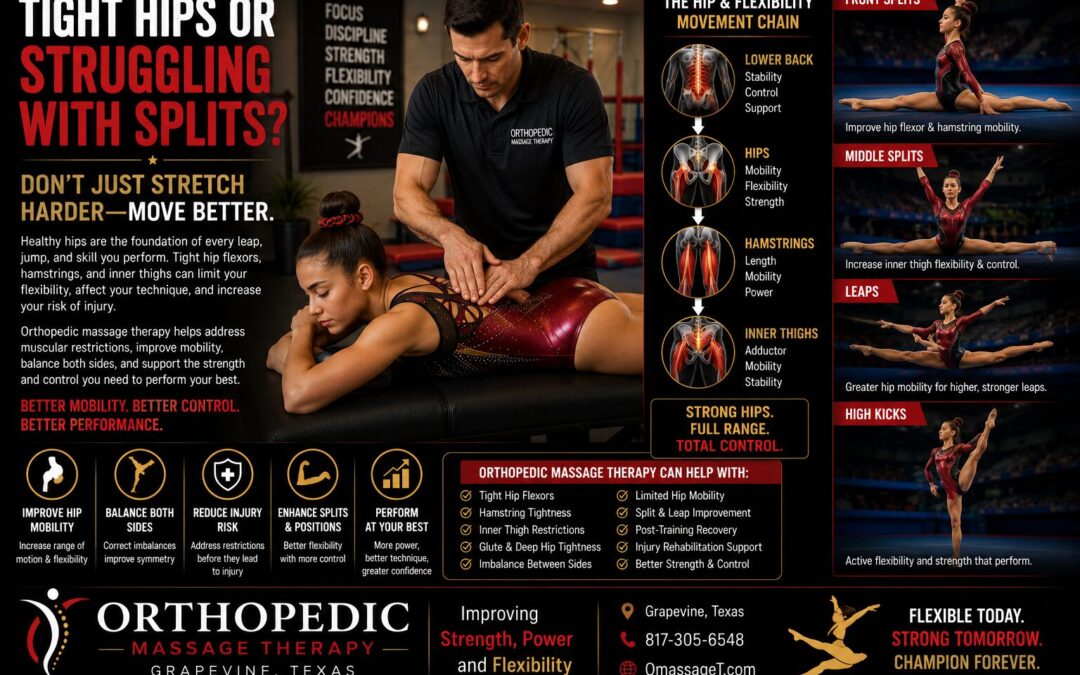
For gymnasts working on hip mobility and splits, we consider the entire movement chain:
Lower Back → Pelvis → Hips → Hamstrings → Inner Thighs
Because the muscle that feels tight may not be the only factor limiting the movement.
Don’t Just Stretch Harder—Move Better
If a gymnast stretches every day but the same hip always feels tight, simply adding more stretching may not be the complete answer.
Ask better questions.
Which muscles are restricted?
Is one side different?
Does the athlete have active control of the range?
Is fatigue contributing?
Are the hips compensating for another area?
Is the athlete recovering adequately?
True gymnastics flexibility is not simply about how far the body can be pushed.
It is about how well the athlete can move, control, and perform through that range.
At Orthopedic Massage Therapy in Grapevine, Texas, our goal is to help athletes address muscular restrictions, improve functional mobility, support recovery, and continue pursuing the sport they love.
Improving Strength, Power and Flexibility.
Contact Orthopedic Massage Therapy in Grapevine, Texas to learn how targeted orthopedic massage therapy may support a gymnast’s hip mobility, flexibility, recovery, injury rehabilitation, and athletic performance.
Grapevine, Texas | 817-305-6548 | OmassageT.com