Orthopedic Massage Therapy
Competitive gymnasts know how to train hard.
Early practices.
Long practices.
Strength and conditioning.
Repetition after repetition.
Tumbling.
Bars.
Beam.
Vault.
Then competition season arrives.
Now add meets, travel, school, homework, changing schedules, and the pressure to perform at your best.
The question becomes:
How well is your body recovering from everything you are asking it to do?
Gymnasts often focus on what happens during training.
But what happens between practices and competitions can be just as important.
Recovery is when the body has an opportunity to respond to training, manage fatigue, and prepare for the next physical demand.
Without adequate recovery, muscular fatigue can accumulate.
Tightness may increase.
Movement may begin to feel different.
Skills that normally feel effortless may suddenly feel harder.
At Orthopedic Massage Therapy in Grapevine, Texas, we use targeted orthopedic massage therapy to help athletes address muscular restrictions, support functional mobility, and incorporate recovery into a larger athletic performance strategy.
Because competitive gymnastics is not only about how hard you train.
It is also about how well you recover.
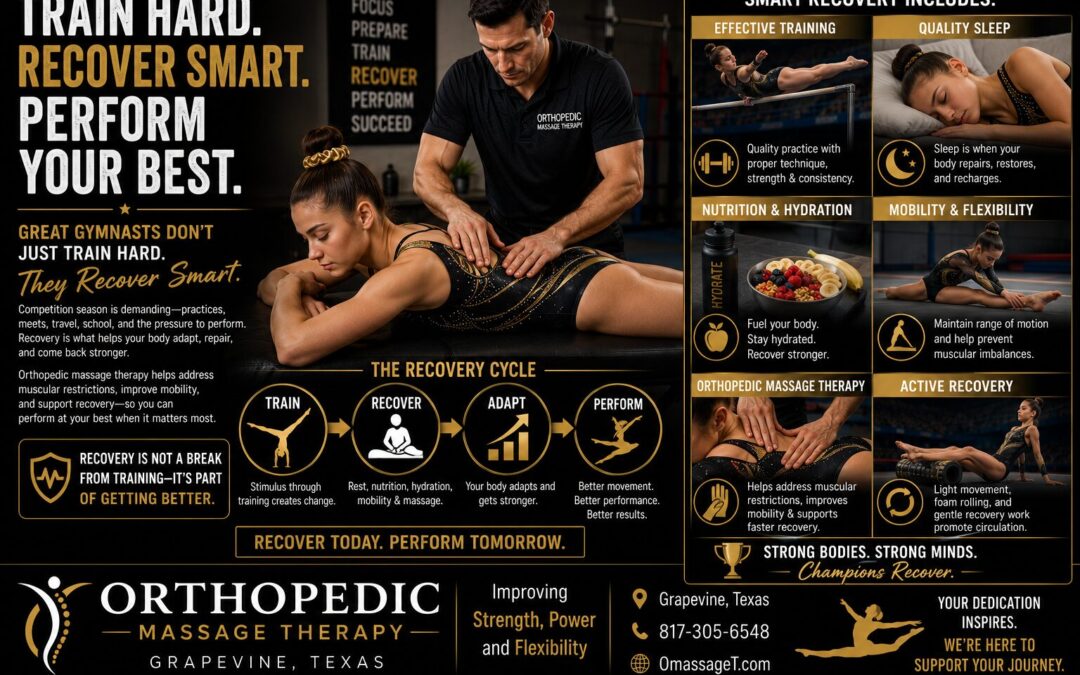
Train hard. Recover smart. Perform your best.
Gymnastics Creates Whole-Body Fatigue
Few sports challenge as many physical qualities simultaneously as gymnastics.
Gymnasts need:
-
Strength
-
Power
-
Flexibility
-
Mobility
-
Balance
-
Coordination
-
Endurance
-
Precision
Every event creates different demands.
Vault requires explosive speed and power.
Bars place tremendous demands on the shoulders, forearms, hands, and upper body.
Beam requires balance, control, and precision.
Floor combines tumbling, jumping, landing, dance, flexibility, and endurance.
The result?
The entire body works.
That means recovery must also consider the entire athlete.
What Is Athletic Recovery?
Recovery is more than simply taking a day off.
Athletic recovery includes everything that helps an athlete prepare physically and mentally for future training and competition.
That may include:
-
Sleep
-
Nutrition
-
Hydration
-
Appropriate rest
-
Mobility work
-
Strength and conditioning
-
Training-load management
-
Orthopedic massage therapy
No single recovery method replaces the fundamentals.
Massage cannot replace sleep.
Stretching cannot replace nutrition.
A day off cannot automatically correct poor training progression.
The strongest recovery strategies combine multiple pieces.
Why Gymnasts May Struggle to Recover During Competition Season
Competition season changes the normal training environment.
A gymnast may practice several days during the week.
Then travel to a meet.
Compete.
Travel home.
Return to school.
And begin training again.
There may be very little downtime.
The athlete may also experience:
-
Less sleep
-
Travel fatigue
-
Changes in nutrition
-
Increased stress
-
More time sitting in cars or airplanes
-
Competition nerves
-
Continued training demands
All of these factors can influence recovery.
The athlete may not necessarily feel injured.
They may simply begin feeling:
Tighter.
Heavier.
Slower.
Less explosive.
More fatigued.
These changes are worth paying attention to.
Muscle Soreness vs. Persistent Tightness
Muscular soreness after training can be normal.
A gymnast performs a demanding workout, and the muscles feel sore afterward.
But recurring tightness deserves a closer look.
For example:
“My calves are tight after every practice.”
“My shoulders always feel stiff after bars.”
“My hamstrings never seem to loosen up.”
“My lower back is constantly tight.”
“My hips feel different on one side.”
Patterns matter.
The goal should not simply be to temporarily make the tight area feel better.
Ask:
Why does this keep returning?
High training volume?
Muscular fatigue?
Restricted mobility?
Compensation?
Previous injury?
Inadequate recovery?
Understanding the pattern can help guide a more appropriate approach.
Why Recovery Can Affect Performance
Fatigue does not only make an athlete feel tired.
It can influence movement.
A gymnast who is well recovered may demonstrate:
-
Better power
-
Better coordination
-
Better control
-
More consistent technique
As fatigue accumulates, movement may begin to change.
Small differences can matter in gymnastics.
A slightly slower takeoff.
A less controlled landing.
Reduced shoulder mobility.
Less confidence on beam.
A split that suddenly feels tighter.
None of these automatically indicate an injury.
But they may signal that the athlete is not fully recovered.
Recovery Between Practices Matters
Many competitive gymnasts train multiple days per week.
Sometimes practices are separated by less than 24 hours.
That means what happens after one practice can influence the next.
Imagine finishing a demanding evening practice.
The athlete is tired.
Calves are tight.
Shoulders are fatigued.
Then the gymnast sleeps only six hours and returns to training the next day.
Compare that with an athlete who:
Hydrates.
Eats appropriately.
Sleeps adequately.
Manages recovery.
The training response may be very different.
Recovery should be planned with the same seriousness as training.
Sleep: One of the Most Important Recovery Tools
Athletes sometimes search for complicated recovery methods while overlooking one of the most powerful fundamentals:
Sleep.
Sleep supports physical and mental recovery.
Competitive gymnasts—especially young athletes—may have demanding schedules involving:
-
School
-
Homework
-
Practice
-
Travel
-
Competitions
It can be difficult to maintain adequate sleep.
But consistently sacrificing sleep may affect how an athlete feels and performs.
Parents and athletes should consider sleep part of the training program.
Not an optional extra.
Nutrition and Hydration Matter
Gymnastics requires energy.
Athletes need appropriate nutrition to support:
-
Training
-
Recovery
-
Growth
-
Strength
-
Performance
Hydration also matters.
A gymnast may spend several hours training in a warm gym while sweating throughout practice.
Even mild dehydration can influence how an athlete feels.
Recovery begins with the basics.
Eat appropriately.
Hydrate.
Sleep.
Then consider additional recovery strategies.
Mobility Work vs. Stretching Everything
Gymnasts stretch frequently.
But more stretching is not automatically better.
A gymnast may already have exceptional passive flexibility.
The goal should be functional mobility.
That means having enough range of motion for gymnastics while maintaining:
Strength + Stability + Control
Mobility work should be purposeful.
Instead of automatically stretching every muscle because it feels tight, consider why the tightness is present.
Sometimes a muscle may be fatigued.
Sometimes another area may be restricted.
Sometimes the athlete may simply need recovery.
Orthopedic Massage Therapy as Part of Recovery
Orthopedic massage therapy can be incorporated into an athlete’s recovery strategy when muscular and soft-tissue restrictions are present.
Depending on the gymnast’s needs, treatment may involve the:
-
Shoulders
-
Lats
-
Upper back
-
Forearms
-
Lower back
-
Hip flexors
-
Glutes
-
Hamstrings
-
Quadriceps
-
Calves
The goal is not simply relaxation.
Treatment may focus on muscular restrictions that influence movement or contribute to recurring tightness.
Every gymnast is different.
A bar specialist may experience different muscular demands than an athlete struggling with repeated lower-body fatigue from tumbling and vault.
Treatment should reflect the individual athlete.
Massage Before a Competition
Timing matters.
A gymnast should not necessarily receive aggressive, unfamiliar treatment immediately before an important meet.
Deep or intense treatment may temporarily leave tissues feeling sore.
Before competition, massage—when appropriate—may be lighter and focused on helping the athlete feel mobile and prepared.
The goal before competition is not to completely overhaul the athlete’s body.
It is to support readiness.
Athletes should avoid experimenting with major new recovery strategies immediately before an important event.
Competition preparation should be familiar and predictable.
Massage After a Competition
After a meet, the athlete may experience muscular fatigue from:
-
Warm-ups
-
Competition routines
-
Repeated landings
-
Travel
-
Stress
Post-competition treatment may focus on recovery and areas that feel particularly overworked.
However, treatment should still consider the athlete’s schedule.
Does the gymnast compete again tomorrow?
Is there practice the next morning?
Is there a full week before the next meet?
Recovery strategies should match the timeline.
Recovery Between Multi-Day Competitions
Some gymnastics competitions involve multiple days.
The athlete may need to recover quickly.
During these situations, aggressive treatment may not always be appropriate.
The priority may be:
-
Hydration
-
Nutrition
-
Sleep
-
Gentle mobility
-
Appropriate recovery work
The goal is to help the athlete feel prepared for the next competition day.
Recovery should support performance—not interfere with it.
Don’t Wait Until Something Hurts
Athletes often think about recovery only after pain develops.
But recovery can be proactive.
A gymnast may notice early signs such as:
-
Increasing muscular tightness
-
Reduced mobility
-
Heavy legs
-
Shoulder fatigue
-
Decreasing flexibility
-
Difficulty recovering between practices
These signs may indicate accumulating fatigue.
Addressing recovery before symptoms become more limiting may help the athlete maintain more consistent training.
The Recovery Chain
Just as the body has movement chains, athletes also have a recovery chain.
Think of it like this:
TRAIN → RECOVER → ADAPT → PERFORM
Training creates the stimulus.
Recovery gives the body an opportunity to respond.
Adaptation helps the athlete become better prepared.
Performance is the result.
If recovery is consistently inadequate, the chain becomes incomplete.
More training is not always the solution.
Sometimes better recovery is what allows training to work.
Why Rest Days Matter
Competitive athletes sometimes feel guilty taking a rest day.
They worry that another gymnast is practicing.
Getting stronger.
Learning new skills.
But appropriate rest is not laziness.
Rest can be part of intelligent training.
Muscles need time to recover.
The nervous system experiences training demands.
Mental fatigue matters too.
A properly planned rest day can help prepare the athlete for higher-quality training later.
The goal is not to train the most.
The goal is to train effectively enough to improve.
Active Recovery
Not every recovery day needs to involve complete inactivity.
Depending on the athlete and training plan, active recovery might include:
-
Easy walking
-
Gentle mobility
-
Light movement
-
Appropriate recovery exercises
The intensity should match the purpose.
Recovery should feel like recovery.
Turning every recovery session into another hard workout defeats the point.
Growth Makes Recovery Even More Important
Young gymnasts are often training intensely while simultaneously growing.
Growth can temporarily influence:
-
Flexibility
-
Coordination
-
Strength
-
Balance
-
Movement patterns
A young gymnast may suddenly feel tighter.
Skills may temporarily feel different.
Recovery needs may change.
Parents and coaches should recognize that young athletes are not simply smaller adults.
Their bodies are developing.
Training and recovery should reflect that.
Pain Is Not a Badge of Honor
Gymnasts are mentally tough.
That toughness helps them succeed.
But toughness should not mean ignoring pain.
There is a difference between:
Working hard.
Being tired.
Feeling normal post-training soreness.
And experiencing persistent pain.
Athletes should feel comfortable communicating when something does not feel right.
Pain that persists, worsens, changes technique, or interferes with normal activity deserves appropriate evaluation.
Massage therapy should never be used to hide symptoms so an athlete can continue competing through a potentially significant injury.
Health comes first.
Parents: Watch for Recovery Changes
Parents may notice signs of inadequate recovery outside the gym.
For example:
-
Constant complaints of soreness
-
Difficulty sleeping
-
Persistent fatigue
-
Decreased enthusiasm for training
-
Recurring muscular tightness
-
Changes in appetite
-
Performance changes
These signs do not automatically mean something is wrong.
But patterns deserve attention.
Communication between the athlete, parents, coaches, and healthcare professionals can be valuable.
Coaches: Recovery Supports Training Quality
Coaches want athletes to improve.
Improvement requires training.
But training quality matters.
A fatigued gymnast performing repeated low-quality skills may not always benefit from simply adding more repetitions.
Recovery can help athletes return to training better prepared to perform quality movement.
A well-designed program balances:
Training stress + Recovery
Both are necessary.
Orthopedic Massage Therapy During Competition Season
Orthopedic massage therapy may be strategically incorporated into a gymnast’s schedule throughout the season.
Treatment frequency depends on factors such as:
-
Training volume
-
Competition schedule
-
Individual needs
-
Muscular restrictions
-
Injury history
-
Recovery demands
There is no universal schedule that fits every gymnast.
Some athletes may benefit from periodic maintenance sessions.
Others may need more targeted treatment during demanding training periods.
The approach should be individualized.
Orthopedic Massage Therapy for Competitive Gymnasts in Grapevine, Texas
Competitive gymnasts throughout Grapevine, Southlake, Colleyville, Keller, and the surrounding Dallas-Fort Worth area dedicate countless hours to their sport.
At Orthopedic Massage Therapy in Grapevine, Texas, we understand that athletic performance involves more than what happens during practice.
Recovery matters too.
Our targeted orthopedic massage therapy focuses on:
-
Muscular restrictions
-
Functional mobility
-
Sports recovery
-
Injury rehabilitation support
-
Athletic performance
-
Strength and flexibility
We work with the athlete’s goals and training demands in mind.
Because the goal is not simply to feel better for an hour.
The goal is to support the athlete’s ability to:
Move better. Recover better. Perform better.
Train Hard. Recover Smart. Perform Your Best.
Gymnasts are taught to work hard.
Repeat the skill.
Make the correction.
Try again.
That dedication creates champions.
But the strongest athletes also learn when their bodies need recovery.
Training and recovery are not opposites.
They are partners.
TRAIN → RECOVER → ADAPT → PERFORM
Sleep matters.
Nutrition matters.
Hydration matters.
Mobility matters.
Strength matters.
Recovery matters.
At Orthopedic Massage Therapy in Grapevine, Texas, our goal is to help athletes address muscular restrictions, support functional mobility, recover effectively, and continue pursuing the sport they love.
Improving Strength, Power and Flexibility.
Contact Orthopedic Massage Therapy in Grapevine, Texas to learn how targeted orthopedic massage therapy may support a competitive gymnast’s recovery, mobility, injury rehabilitation, and athletic performance throughout training and competition season.
Grapevine, Texas | 817-305-6548 | OmassageT.com