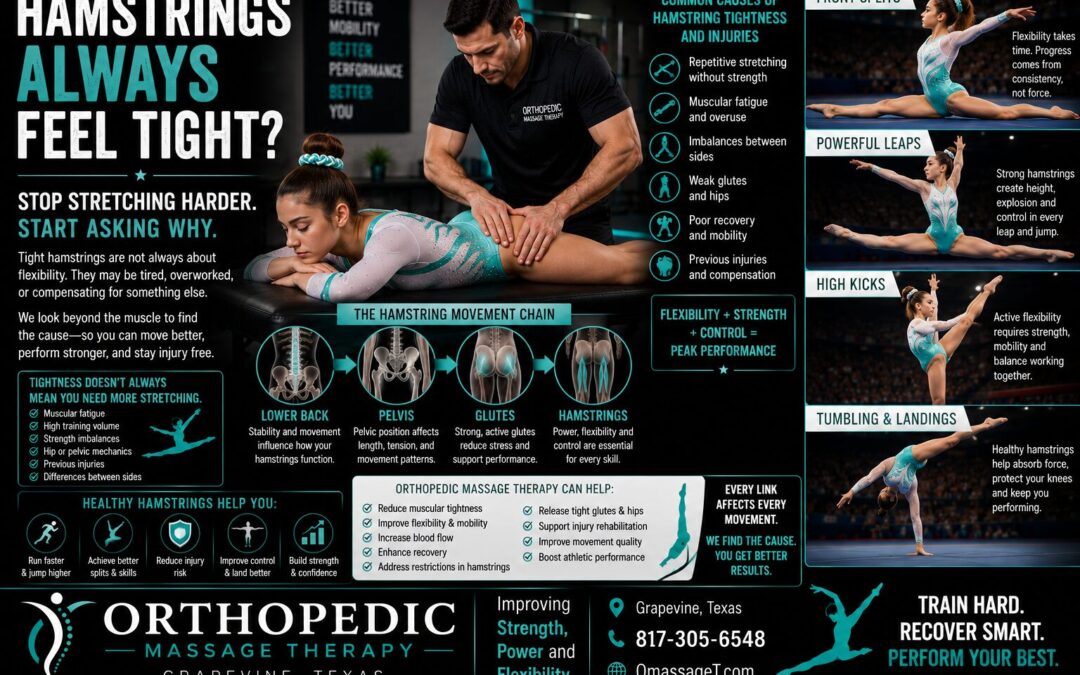
Orthopedic Massage Therapy OmassageT.com
Gymnasts stretch their hamstrings constantly.
Splits.
Pike stretches.
Leg kicks.
Leaps.
Needle positions.
Dance elements.
For many gymnasts, stretching is simply part of everyday training.
So why does a hamstring sometimes still feel tight?
Why is one leg consistently tighter than the other?
Why does the same hamstring keep bothering an athlete even though they stretch every day?
And why can aggressive stretching sometimes seem to make the problem worse instead of better?
The answer begins with an important idea:
A muscle that feels tight does not always need more stretching.
Sometimes the hamstring may be fatigued.
Sometimes it may be overworked.
Sometimes it may be compensating for another area.
And sometimes pain or tightness may indicate an injury that needs appropriate evaluation and rehabilitation.
At Orthopedic Massage Therapy in Grapevine, Texas, we use targeted orthopedic massage therapy to help athletes address muscular restrictions, improve functional mobility, support recovery, and complement appropriate injury rehabilitation.
When a gymnast repeatedly experiences hamstring tightness, we do not simply ask:
“How tight is the hamstring?”
We also ask:
“Why does it keep getting tight?”
That question can change the entire approach.
Gymnasts Need Flexible AND Powerful Hamstrings
The hamstrings are a group of muscles located along the back of the thigh.
Gymnasts need tremendous hamstring flexibility for movements such as:
- Front splits
- Pike positions
- Leaps
- High kicks
- Needle positions
- Dance elements
But flexibility is only half the story.
The hamstrings also need to generate and control force.
They contribute to:
- Sprinting
- Jumping
- Tumbling
- Hip extension
- Landing control
- Knee movement
That means a gymnast’s hamstrings must be both:
Flexible AND strong.
A muscle that can stretch far but cannot effectively control that range may not provide everything the athlete needs for performance.
Gymnastics requires usable flexibility.
Why Do My Hamstrings Feel Tight Even Though I Stretch Every Day?
This is one of the most common questions athletes ask.
A gymnast may stretch every day and still feel like the hamstrings are constantly tight.
The natural response is:
“I need to stretch more.”
But that may not always be true.
A sensation of tightness can have several possible contributors, including:
- Muscular fatigue
- High training volume
- Repetitive stretching
- Strength demands
- Compensation patterns
- Hip or pelvic mechanics
- Previous injury
- Differences between sides
The important point is that the feeling of tightness does not automatically tell us the cause.
If stretching provides temporary relief but the same sensation returns after every practice, it may be time to look at the bigger picture.
Hamstrings Work Hard During Gymnastics
It is easy to think of hamstrings primarily as muscles that need to stretch.
But gymnasts use them constantly.
Consider a floor routine.
The athlete may:
Run.
Tumble.
Jump.
Leap.
Kick.
Land.
Each of these activities places different demands on the hamstrings.
The muscles may need to lengthen rapidly during one movement and then produce force during the next.
This ability to transition between flexibility and strength is essential.
As training volume increases, muscular fatigue may accumulate.
A fatigued muscle can feel tight.
That does not always mean it needs to be stretched harder.
Sometimes it needs recovery.
The Difference Between Tightness and Injury
Not every tight hamstring is injured.
But athletes should learn to recognize when symptoms deserve more attention.
General muscular tightness may feel like:
- Stiffness
- Reduced flexibility
- Muscle fatigue
- A mild pulling sensation that improves with movement
A possible injury may involve symptoms such as:
- Sudden sharp pain
- A popping sensation
- Significant weakness
- Bruising
- Swelling
- Pain during walking or running
- Pain that persists or worsens
If a gymnast experiences sudden or significant hamstring pain, appropriate medical evaluation may be necessary.
Massage therapy should never be used to delay diagnosis of a potentially significant injury.
Why One Hamstring Is Often Tighter
Many gymnasts have a “good leg.”
One split is easier.
One leap feels better.
One leg naturally goes higher.
Gymnastics involves many repeated movement preferences.
An athlete may have a preferred:
- Lead leg
- Takeoff leg
- Split
- Turning direction
- Twisting direction
Over thousands of repetitions, differences may develop.
One hamstring may experience different demands.
One hip may move differently.
One side may have more active flexibility.
Some asymmetry is normal.
But if one hamstring becomes increasingly tight, painful, or repeatedly injured, that pattern deserves attention.
The Hip-Hamstring Connection
The hamstrings do not function independently.
They cross the hip and work closely with the pelvis and surrounding muscles.
The:
Lower Back → Pelvis → Glutes → Hamstrings
all interact.
If movement changes around the hips or pelvis, the hamstrings may experience different demands.
For example, a gymnast may continually stretch the hamstrings while overlooking restrictions or muscular imbalances around the hips.
This does not mean every hamstring problem originates in the hips.
But recurring symptoms may require looking beyond the back of the thigh.
Glutes and Hamstring Compensation
The gluteal muscles are powerful hip muscles.
They contribute to:
- Hip extension
- Jumping
- Sprinting
- Tumbling
- Landing
The glutes and hamstrings often work together.
If movement patterns change or the glutes become fatigued, the hamstrings may take on different workloads.
This may contribute to a feeling that the hamstrings are constantly working.
Orthopedic massage therapy may help address muscular restrictions in both the hamstrings and surrounding hip musculature when appropriate.
But massage does not replace strength training.
Athletes also need appropriate strength and control.
Hamstrings and Splits
Front splits place significant demands on the hamstrings of the front leg.
A gymnast may spend considerable time trying to improve a split by pushing deeper.
But forcing flexibility aggressively is not always the best strategy.
If the hamstring is already irritated, repeatedly pushing into intense stretching may aggravate symptoms.
Flexibility training should consider:
- Tissue tolerance
- Strength
- Active flexibility
- Training volume
- Previous injuries
- Differences between sides
The goal is not simply to force the leg farther.
The goal is to develop usable, controlled range of motion.
Active Flexibility Matters
Imagine a gymnast who can perform a perfect split on the floor.
Now ask that gymnast to perform a leap.
Can the athlete actively create the same range while moving explosively?
That requires more than passive flexibility.
It requires:
Strength + Mobility + Coordination + Control
Active flexibility is especially important for:
- Leaps
- Kicks
- Jumps
- Dance elements
A gymnast should not only be able to stretch into a position.
They should develop the strength to control the movement required by their sport.
Why Aggressive Stretching Can Sometimes Backfire
Gymnasts are often taught to tolerate discomfort.
That mental toughness can be valuable.
But pain during stretching should not automatically be viewed as progress.
If a hamstring is irritated or injured, repeatedly forcing it into deeper stretching may not be appropriate.
More intensity is not always better.
Athletes should be cautious with:
- Forced splits
- Partner-assisted stretching
- Aggressive overstretching
- Stretching through sharp pain
Flexibility develops over time.
The goal should be long-term athletic function—not simply achieving a position at any cost.
Hamstring Injuries During Leaps and Kicks
Leaps and high kicks require the hamstring to lengthen rapidly.
These movements may occur at high speed.
The athlete needs both flexibility and control.
A gymnast who is fatigued, insufficiently warmed up, or returning from a previous injury may experience different demands.
A sudden sharp pain during a leap or kick should not simply be stretched away.
The athlete should stop and receive appropriate assessment when necessary.
Early management can be important.
Hamstrings During Tumbling
Tumbling requires explosive hip movement.
The hamstrings contribute to:
- Running approaches
- Hip extension
- Jumping
- Body control
- Landings
As the gymnast becomes fatigued, these muscles may work differently.
This is especially relevant during high-volume floor practices.
An athlete may feel excellent during the beginning of training but develop increasing hamstring tightness later.
That pattern may provide useful information about fatigue and workload.
Growth Spurts and Hamstring Tightness
Young gymnasts may suddenly feel much tighter during periods of rapid growth.
An athlete who previously had effortless splits may temporarily lose some flexibility.
This can be frustrating.
But growth changes the body.
Bones, muscles, coordination, and strength may adapt at different rates.
During these periods, forcing flexibility aggressively may not be appropriate.
Training may need to adjust while the athlete adapts.
Patience matters.
Previous Hamstring Injuries Matter
After a hamstring injury, the athlete may eventually feel better.
But returning to gymnastics requires more than simply waiting until pain disappears.
The athlete needs appropriate:
- Strength
- Mobility
- Confidence
- Progressive loading
- Sport-specific preparation
A previous injury may also influence movement.
The gymnast may unconsciously protect one leg.
They may rely more heavily on the other side.
These patterns can sometimes continue even after the original injury has improved.
Orthopedic massage therapy may complement an appropriate rehabilitation program by addressing muscular restrictions.
How Orthopedic Massage Therapy May Help
Orthopedic massage therapy focuses on muscular and soft-tissue restrictions that may influence movement.
For a gymnast experiencing recurring hamstring tightness, treatment may involve the:
- Hamstrings
- Glutes
- Hip flexors
- Adductors
- Deep hip muscles
- Calves when relevant
The exact treatment depends on the athlete.
A gymnast with general muscular fatigue may require a different approach than one returning from a previous hamstring injury.
An athlete struggling with one-sided split restrictions may have different needs than someone experiencing tightness after tumbling.
Treatment should be individualized.
Massage Should Not Be Aggressive Over an Acute Injury
If a gymnast has a suspected acute hamstring injury, aggressive massage directly over the injured area may not be appropriate.
The athlete may need medical evaluation and an appropriate rehabilitation plan.
Massage therapy should respect:
- Stage of healing
- Tissue sensitivity
- Injury severity
- Medical recommendations
- Rehabilitation goals
The objective is to support recovery—not interfere with healing.
Strength Is Part of Flexibility
Gymnasts often spend enormous amounts of time developing flexibility.
But strength throughout the available range is equally important.
Hamstring strengthening may be part of an appropriate conditioning or rehabilitation program.
The goal is to create muscles that can:
Lengthen.
Generate force.
Control movement.
Absorb force.
That combination supports athletic performance.
When Hamstring Pain Needs Medical Evaluation
Seek appropriate evaluation when symptoms include:
- Sudden sharp pain
- A popping sensation
- Significant bruising
- Swelling
- Significant weakness
- Difficulty walking normally
- Persistent pain
- Symptoms that repeatedly worsen with activity
Massage therapy should not be used to hide symptoms so an athlete can continue training through a potentially significant injury.
Health comes first.
Recovery Between Practices
Hamstrings need recovery.
A gymnast may perform:
Splits.
Leaps.
Kicks.
Tumbling.
Strength training.
All in the same practice.
Then return the next day and repeat it.
Recovery strategies may include:
- Adequate sleep
- Proper nutrition
- Hydration
- Appropriate rest
- Strength training
- Mobility work
- Intelligent flexibility training
- Targeted orthopedic massage therapy
Remember:
A muscle that feels tight may sometimes be a muscle that is tired.
Parents and Coaches: Watch for Patterns
A gymnast may not always report symptoms immediately.
Watch for:
- Repeatedly rubbing the back of the thigh
- Avoiding splits on one side
- Lower kicks than usual
- Changes in leaps
- Difficulty with tumbling
- Favoring one leg
- Complaints of constant tightness
These signs do not automatically indicate an injury.
But recurring patterns deserve attention.
Orthopedic Massage Therapy for Gymnasts in Grapevine, Texas
Gymnasts throughout Grapevine, Southlake, Colleyville, Keller, and the surrounding Dallas-Fort Worth area require an extraordinary combination of flexibility and strength.
At Orthopedic Massage Therapy in Grapevine, Texas, we provide targeted orthopedic massage therapy focused on:
- Muscular restrictions
- Functional mobility
- Sports recovery
- Injury rehabilitation support
- Athletic performance
- Strength and flexibility
When a gymnast experiences recurring hamstring tightness, we consider the entire movement chain:
Lower Back → Pelvis → Glutes → Hamstrings → Lower Leg
Because the muscle that feels tight may only be one part of the picture.
Stop Stretching Harder. Start Asking Why.
If a gymnast stretches their hamstrings every day but the same muscle always feels tight, simply adding more stretching may not be the complete answer.
Ask:
Is the muscle fatigued?
Is there a difference between sides?
Are the hips moving well?
Are the glutes contributing effectively?
Is the athlete recovering?
Was there a previous injury?
Does the gymnast have strength throughout the available range?
The goal is not simply to create the most flexible athlete.
The goal is to create an athlete who can use their flexibility with strength, power, and control.
At Orthopedic Massage Therapy in Grapevine, Texas, our goal is to help athletes address muscular restrictions, improve functional movement, support recovery, and continue pursuing the sport they love.
Improving Strength, Power and Flexibility.
Contact Orthopedic Massage Therapy in Grapevine, Texas to learn how targeted orthopedic massage therapy may support a gymnast’s hamstring mobility, athletic recovery, injury rehabilitation, and performance.
Grapevine, Texas | 817-305-6548 | OmassageT.com