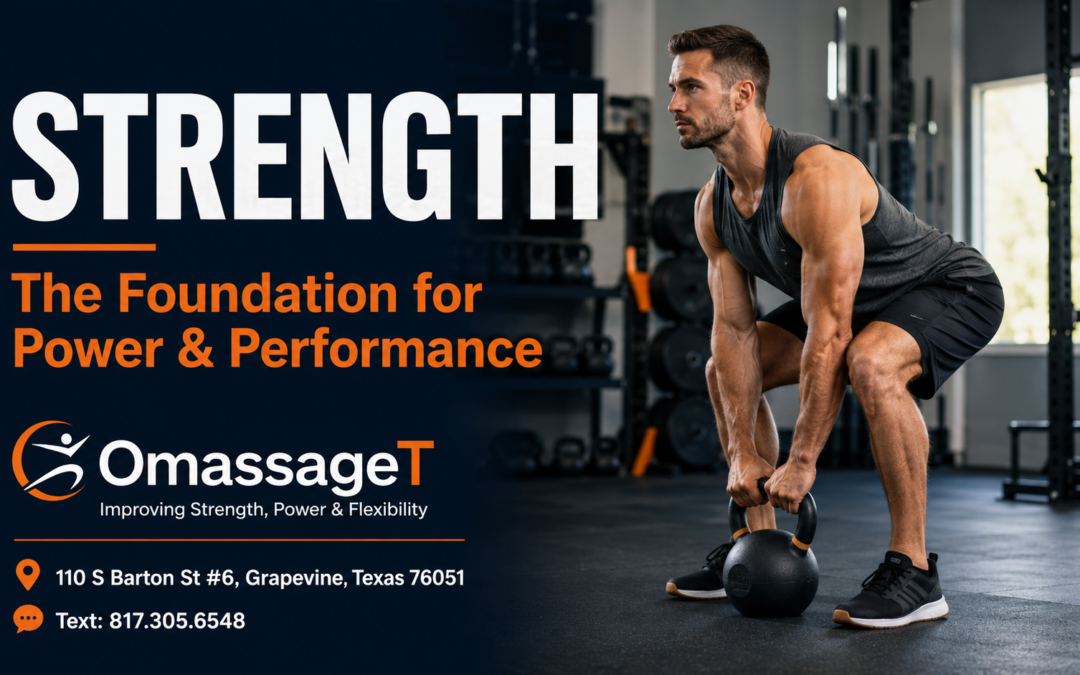
Building Strength: The Foundation for Power and Athletic Performance
Strength is often measured by how much weight someone can lift, but true strength involves much more than moving a heavy object. It is the body’s ability to create and control force while maintaining balance, stability, and efficient movement.
Strength helps runners maintain their form, gymnasts control landings, weightlifters stabilize loads, and active adults complete everyday activities with greater confidence. It also helps the body manage the demands created by work, exercise, sports, and repetitive movement.
Before strength can be used effectively, however, the body needs an appropriate foundation. Balance, stability, mobility, and flexibility all contribute to the way strength is developed and expressed.
At OmassageT in Grapevine, Texas, orthopedic massage therapy takes a whole-body approach to muscular balance and movement. The goal is not simply to relax tight muscles. It is to identify restrictions and compensations that may interfere with a client’s ability to move, recover, and build strength effectively.
What Is Strength?
Strength is the ability of muscles to produce force against resistance.
That resistance might be a barbell, a kettlebell, your own body weight, an opponent, gravity, or the physical demands of daily life. Even standing upright requires muscles to produce and control force.
Strength is not limited to large or visibly muscular people. A dancer needs strength to hold a position. A runner needs strength to maintain posture and control each landing. A massage therapist needs strength and endurance to work throughout the day. An older adult needs strength to climb stairs, carry groceries, and get up from a chair.
The type and amount of strength needed will vary from one person to another. The goal should be to develop the strength required for your activities while maintaining efficient and controlled movement.
Strength Depends on a Strong Foundation
Strength does not work independently from the rest of the body.
Balance helps the body recognize and maintain its position. Stability helps control that position. Mobility provides access to usable movement. Flexibility allows muscles and soft tissues to lengthen. Strength then helps control the available movement and produce force.
This creates an important progression:
Balance → Stability → Mobility → Flexibility → Strength → Power → Performance
If one part of that progression is limited, the body may compensate.
For example, an athlete with restricted ankle mobility may shift the feet, knees, hips, or back when squatting. The person may be strong enough to lift the weight, but the movement may not distribute force efficiently.
A person with limited shoulder mobility may arch the lower back to press a weight overhead. Someone with poor pelvic stability may recruit the lower back or upper legs differently when running, lifting, or changing direction.
Building strength on top of an unbalanced movement pattern may reinforce the compensation. This is why quality of movement matters—not only the amount of weight being lifted.
Strength and Muscular Balance
Muscular balance does not mean that every muscle must have exactly the same strength. It means that muscles need to coordinate appropriately for the movement being performed.
Some muscles create motion, while others stabilize joints or control unwanted movement. When certain muscles become overworked and others do not contribute effectively, the body may develop an imbalance.
Possible signs of muscular imbalance include:
- One side feeling stronger than the other
- Repeated tightness in the same area
- Difficulty maintaining proper exercise form
- A joint feeling unstable during movement
- One hip or shoulder moving differently
- Muscles becoming tired unusually quickly
- Reduced range of motion under resistance
- Recurring discomfort during a specific activity
- Using momentum to complete controlled exercises
- Holding your breath or creating excessive tension
These signs do not automatically identify a specific injury or diagnosis. They may indicate that the body is finding another way to complete the task.
Why Muscles Become Overworked
A muscle can become overworked even when it is strong.
It may be compensating for weakness, instability, restricted mobility, or an old movement habit. It may also be performing the work of another area that is not contributing effectively.
For example, the muscles of the lower back may work excessively when the hips and core are not coordinating well. The upper shoulders may remain tense when the shoulder blades and upper back are not providing enough support. The quadriceps may dominate a movement when the hips, gluteal muscles, or lower legs are not sharing the load efficiently.
An overworked muscle may feel tight, tender, fatigued, or difficult to relax. Stretching it may provide temporary relief, but the tension may return if the underlying movement pattern remains unchanged.
This is why the location of tightness is not always the source of the problem.
How Orthopedic Massage Therapy May Support Strength
Orthopedic massage therapy does not directly replace strength training. Instead, it may help address muscular and soft-tissue restrictions that interfere with movement, recovery, or exercise technique.
Treatment may help reduce unnecessary tension in overworked muscles, improve tissue mobility, and support a more balanced range of motion. This may make it easier for the client to perform appropriate strengthening exercises with better awareness and control.
At OmassageT, Steven considers the client’s activities, injury history, symptoms, and movement goals. When someone reports discomfort in one area, the assessment may also include related areas above and below it.
A client with knee discomfort, for example, may also have relevant restrictions involving the feet, ankles, hips, or pelvis. Someone experiencing lower-back tension may have contributing factors involving the hips, upper legs, core, or previous injuries.
The purpose is to understand how the body is working as a connected system.
Strength for Athletes
Every sport places different strength demands on the body.
Runners need strength to control the pelvis, absorb force, and maintain their stride over time. When fatigue develops, inadequate strength or muscular coordination may cause running form to change.
Gymnasts need exceptional strength throughout large ranges of motion. They must create power while also controlling landings, rotations, balances, and positions.
Weightlifters need strength to move resistance, but they also need mobility and stability to maintain appropriate lifting positions. Increasing the load before mastering the movement may reinforce compensations.
Dancers need strength that supports flexibility and precise movement. Flexibility without adequate strength may make it difficult to control the end of a range.
Athletes involved in golf, baseball, tennis, or other rotational sports need strength that transfers through the feet, legs, hips, torso, and upper body. If one link in that chain is restricted or unstable, another area may compensate.
Athletic strength should therefore be specific, controlled, and appropriate for the demands of the sport.
Strength for Everyday Life
Strength is equally important outside athletics.
Daily activities require people to push, pull, carry, reach, squat, bend, and rotate. Maintaining strength may make it easier to perform these tasks without relying excessively on one part of the body.
For active adults, useful strength may include the ability to:
- Carry groceries comfortably
- Lift objects from the floor
- Climb stairs
- Work in the yard
- Play with children
- Maintain posture during desk work
- Participate in recreational exercise
- Get up from a chair or the floor
- Travel and walk for longer periods
- Continue doing enjoyable activities
Strength training does not need to involve competitive lifting. Body-weight exercises, resistance bands, controlled free-weight movements, and appropriately selected machines can all help develop strength.
The correct approach depends on the individual’s experience, health, movement quality, and goals.
Acute Injuries and Strength Training
An acute injury is different from chronic muscular tightness or weakness.
Acute injuries may occur during a fall, collision, sudden movement, or other trauma. Symptoms can include severe pain, swelling, bruising, sudden weakness, numbness, or difficulty using the affected area.
Attempting to strengthen or aggressively massage a newly injured area may not be appropriate. A new or serious injury should be evaluated by the appropriate healthcare professional before returning to exercise.
Chronic movement limitations usually develop or remain present over a longer period. They may be related to repetitive activity, previous injuries, muscular imbalance, work posture, training habits, or compensation.
A past injury may continue to influence strength and movement even after the original tissues have healed. However, acute pain and chronic movement patterns should never be treated as though they are the same situation.
Recovery Is Part of Building Strength
Strength does not develop only during exercise. The body also needs time to recover and adapt.
Training places stress on muscles and other tissues. Appropriate rest, nutrition, hydration, sleep, and recovery help the body respond to that stress.
When recovery is inadequate, an athlete may notice persistent soreness, reduced performance, unusual fatigue, difficulty maintaining technique, or recurring muscular tightness.
Sports massage and orthopedic massage therapy may be useful components of a broader recovery plan. Massage may help reduce the feeling of muscular tension, promote relaxation, and make the athlete more aware of areas that are working differently.
Massage should support training—not replace appropriate exercise, medical care, or recovery habits.
Strength Must Be Controlled Before It Becomes Power
Strength and power are related, but they are not the same.
Strength is the ability to produce force. Power is the ability to produce force quickly.
A person may be strong but unable to use that strength rapidly or efficiently. Before adding speed and explosive movement, the body should be able to control the basic movement pattern.
A runner needs strength before producing a powerful stride. A gymnast needs strength before safely controlling explosive tumbling. A weightlifter needs strength and technique before increasing speed or load.
The stronger and more coordinated the foundation becomes, the more effectively the body may be able to develop power.
Build Strength and Improve Movement in Grapevine, Texas
If muscular tightness, previous injuries, or movement restrictions are interfering with your training, orthopedic massage therapy may be a useful addition to your strength and recovery plan.
At OmassageT in Grapevine, Texas, Steven works with competitive athletes, runners, gymnasts, weightlifters, performers, and active adults. Each session considers the individual’s history, activities, restrictions, and goals.
The objective is not simply to make a muscle feel looser. It is to help the body move with better balance and coordination so strength can be developed and used more effectively.
When balance, stability, mobility, flexibility, and strength work together, the body has a stronger foundation for power and performance.
To learn more or schedule an orthopedic massage therapy session, contact OmassageT:
110 S Barton St #6, Grapevine, Texas 76051
Text: 817.305.6548
OmassageT — Improving Strength, Power & Flexibility