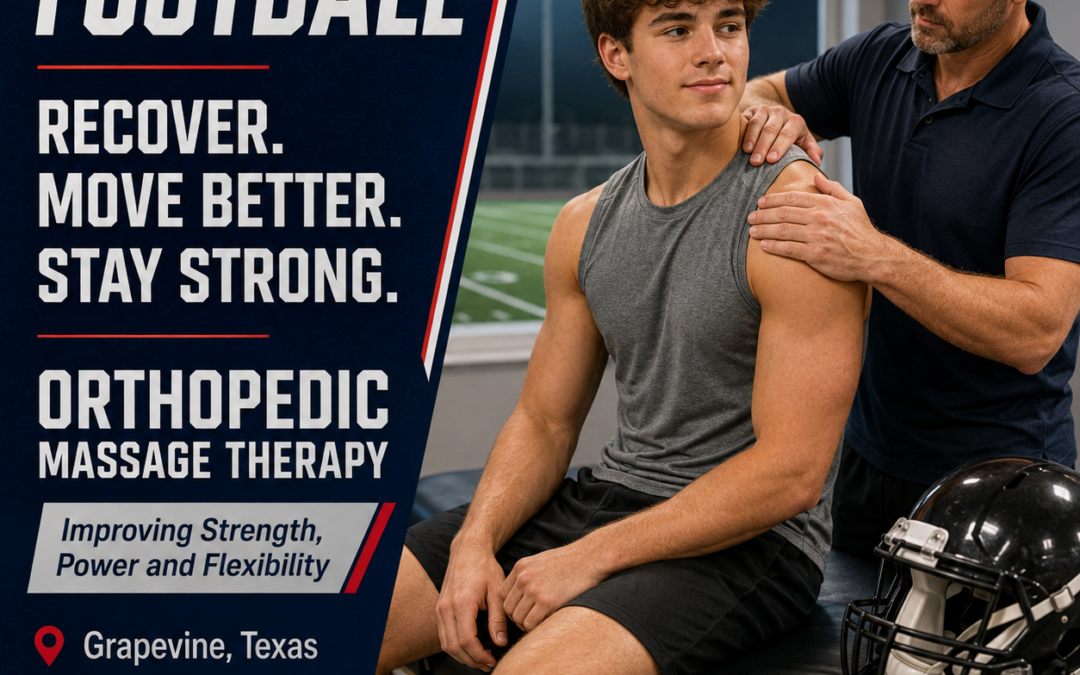
How Orthopedic Massage Therapy Can Help High School Football Players Recover, Move Better, and Stay Strong
High school football demands strength, speed, flexibility, balance, and endurance. During practices and games, players repeatedly sprint, change direction, tackle, block, jump, and absorb physical contact. These movements can place considerable stress on muscles, fascia, joints, and connective tissues.
As the season progresses, players may begin to experience tightness, restricted movement, soreness, or imbalances that affect how they perform. Orthopedic massage therapy can support high school football players by improving movement, assisting recovery, and addressing restrictions before they develop into larger problems.
At Orthopedic Massage Therapy in Grapevine, Texas, I work with athletes by looking beyond the location of discomfort. The painful area is not always where the underlying problem began. An old injury, tight hip, restricted ankle, or imbalance through the pelvis can change how an athlete moves and place additional stress elsewhere in the body.
Football Places Stress on the Entire Body
Football players use nearly every part of their bodies during competition. Their legs generate speed and power, the core provides stability, and the shoulders and upper body help them block, tackle, throw, and protect the football.
Different positions also create different physical demands.
Linemen repeatedly push against resistance and may develop restrictions through the shoulders, chest, neck, hips, and lower back. Running backs and wide receivers depend on acceleration and quick changes of direction, placing stress on the hips, hamstrings, quadriceps, calves, and ankles. Quarterbacks require mobility and coordination through the hips, spine, shoulders, and throwing arm.
Even when an athlete is not experiencing a specific injury, these repeated movements can produce tightness and compensation patterns. The body may begin to change how it moves to protect an overworked or restricted area.
Why the Painful Area May Not Be the Source
When a football player complains of knee, back, shoulder, or hamstring discomfort, it is important to consider the entire movement system.
Knee discomfort, for example, may be influenced by restrictions above or below the knee. Tightness through the hips or quadriceps may change the position of the leg. Limited ankle mobility can also affect how the foot, knee, and hip work together when the athlete runs, lands, or changes direction.
Lower-back discomfort may be connected to tight hips, restrictions through the upper quadriceps, or an imbalance involving the pelvis and core. Shoulder discomfort may be influenced by tightness through the chest, upper back, neck, or muscles surrounding the shoulder blade.
This is why orthopedic massage therapy is not simply about rubbing the place that hurts. The goal is to identify and address the patterns that may be limiting movement or placing unnecessary stress on the athlete’s body.
Fascia and Athletic Movement
Fascia is connective tissue that surrounds and connects muscles, bones, nerves, and other structures throughout the body. It helps different areas of the body work together during movement.
After repeated physical stress, inactivity, or an injury, fascia can become restricted and feel hardened or bound. A restriction in one area may influence movement in another because the body is interconnected.
Myofascial release and other orthopedic massage techniques may help reduce these restrictions and allow the athlete to move more freely. When the body is balanced and the tissues can glide more normally, movement may feel easier and more efficient.
Some clients describe feeling more open, balanced, relaxed, or even taller after treatment. They have not physically grown taller. Instead, reducing restrictions may allow them to return closer to their natural posture and actual height.
Supporting Recovery Between Practices and Games
Hard practices and games can leave a football player feeling sore, heavy, and restricted. Recovery is important because athletes often have only a few days before returning to the field.
Orthopedic and sports massage may support recovery by:
- Reducing muscular tension and stiffness
- Improving flexibility and range of motion
- Supporting healthy circulation
- Addressing restrictions in the fascia
- Promoting relaxation and better body awareness
- Helping restore balance after repetitive physical stress
Massage does not replace sleep, hydration, proper nutrition, athletic training, or medical care. It can, however, be a valuable part of a well-rounded recovery program.
Treatment should be adjusted to the athlete’s condition and schedule. A session immediately before competition may have a different purpose and intensity than a recovery session after a game or a corrective session during the week.
Improving Flexibility Without Losing Stability
Football players need enough flexibility to run, rotate, reach, tackle, and change direction. However, flexibility alone is not the goal. Athletes also need strength, stability, and control.
An athlete may stretch frequently but continue to experience tight hamstrings. In some situations, the hamstrings may be compensating for restrictions or weakness somewhere else, such as the hips, pelvis, or core. Stretching the hamstrings repeatedly may provide temporary relief without resolving the reason they continue to feel tight.
Orthopedic massage therapy considers how different parts of the body work together. Addressing surrounding restrictions may help the athlete use the available movement more effectively while maintaining the stability required for football.
Addressing Old Injuries and Compensation Patterns
Many young athletes continue playing after minor injuries or return to activity as soon as the immediate pain improves. Although the original injury may seem resolved, the body may have developed a compensation pattern.
For example, an athlete who previously injured an ankle may unconsciously place more weight on the opposite leg. Over time, this may affect the knee, hip, pelvis, or lower back. A previous hip or quadriceps injury may also change running mechanics and contribute to discomfort elsewhere.
Orthopedic massage therapy can help identify areas that feel restricted, overworked, or out of balance. Improving movement in these areas may help the athlete move with greater comfort and confidence.
Common Areas of Concern for Football Players
High school football players may seek orthopedic massage therapy for concerns involving:
- Tight hips and hip flexors
- Hamstring or quadriceps tightness
- Calf and ankle restrictions
- Knee discomfort
- Lower-back tightness
- Shoulder restrictions
- Neck and upper-back tension
- General soreness following practices or games
- Limited flexibility or range of motion
- Imbalances caused by previous injuries
Every athlete is different. Their position, training schedule, injury history, movement patterns, and current symptoms should all be considered before treatment.
Communication and Comfort Matter
High school football players are often minors, so clear communication with the athlete and their parent or guardian is especially important.
Before beginning a session, I explain the areas that will be evaluated, the treatment approach, and where I will place my hands. I continue checking with the athlete throughout the session to make sure they are comfortable.
Treatment should never be about forcing the body or simply applying as much pressure as possible. The amount of pressure and the techniques used should match the athlete’s needs and tolerance.
When a Player Should See a Medical Professional
Massage therapy is not a substitute for medical diagnosis or emergency care. A football player should be evaluated by an appropriate healthcare professional when experiencing symptoms such as:
- Severe or increasing pain
- Significant swelling or bruising
- Inability to bear weight
- Suspected fracture or dislocation
- Numbness, tingling, or unusual weakness
- Symptoms following a head impact
- Loss of normal function
- Pain that does not improve or continues to worsen
If an athlete has received a diagnosis or is recovering from a significant injury or surgery, massage therapy should be coordinated with the recommendations of the athlete’s physician, physical therapist, or athletic trainer.
Helping Young Athletes Build Better Body Awareness
One of the most valuable benefits of working with young athletes is helping them understand their bodies. Athletes who recognize changes in flexibility, balance, or movement may be able to address problems before they become more serious.
I want athletes to understand why an area may feel tight, how one part of the body can affect another, and what they can do to support their long-term movement. The goal is not merely temporary relief. It is to help the athlete move better, recover well, and continue developing strength, power, and flexibility.
Orthopedic Massage Therapy for Football Players in Grapevine, Texas
High school football is physically demanding, and the effects of repeated training and contact can accumulate throughout the season. Orthopedic massage therapy can help address muscular and fascial restrictions, support recovery, improve mobility, and restore balance throughout the body.
Whether an athlete is preparing for the season, recovering between games, or dealing with restrictions from an old injury, the treatment should be tailored to that athlete’s specific needs.
If your high school football player is experiencing tightness, restricted movement, or difficulty recovering, contact Orthopedic Massage Therapy in Grapevine, Texas.
Improving Strength, Power and Flexibility
Text: 817-305-6548
Website: OmassageT.com
Location:
110 S Barton St #6
Grapevine, Texas 76051