Why Proper Body Support Matters During Orthopedic Massage Therapy
The techniques used during an orthopedic massage session are important, but treatment begins before the therapist applies pressure. How the client is positioned and supported can influence comfort, breathing, muscular tension, and the body’s ability to relax.
A person who is uncomfortable on the table may brace without realizing it. The neck may tighten, the shoulders may lift, or the lower back may arch. Instead of releasing tension, the body may continue protecting itself.
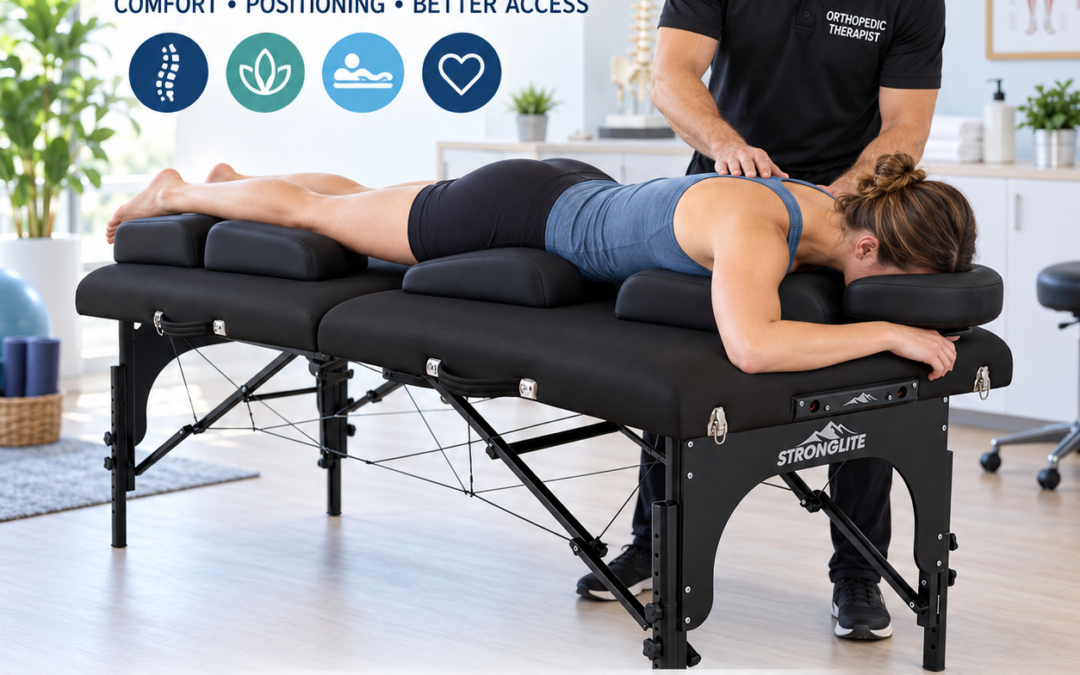
This is why I use a professional Stronglite Premier portable massage table together with a body-support positioning system. The support can be adjusted for the client’s body, condition, and treatment position.
At Orthopedic Massage Therapy in Grapevine, Texas, body support is not merely about adding cushions. It is part of creating a thoughtful treatment environment where the client can feel safe, comfortable, and properly positioned.
A Massage Table Is the Foundation
A massage table must provide a stable foundation for both the client and therapist.
I use a black Stronglite Premier portable massage table. Its sturdy construction provides the foundation needed for orthopedic, myofascial, sports, and other hands-on techniques.
A stable table allows me to apply treatment in a controlled and purposeful way. It also helps the client feel secure while changing positions or receiving work in different areas.
The table itself has a continuous padded surface. The separate body-support cushions are placed on top and arranged according to the client’s needs.
This distinction is important. The support system is not a segmented medical table. It is a collection of specially shaped cushions that work with the massage table.
What Is a Body-Support Positioning System?
The body-support system includes separate supports for different regions of the body. These may include:
-
Face support
-
Chest support
-
Pelvic support
-
Split leg supports
The cushions can be arranged to support the body while the client is face-down, face-up, side-lying, or seated.
When the client is lying face-down, the chest and pelvis can be supported separately. This creates space for the abdomen and helps prevent the entire front of the body from being pressed flat against the table.
The face, chest, pelvis, and legs can each receive support instead of forcing the body to adapt to one flat surface.
The exact arrangement depends on the client. A position that feels comfortable for one person may need to be changed for another.
Comfort Can Affect Muscular Tension
Comfort is not simply a luxury during orthopedic massage therapy. It may influence how the nervous system and muscles respond to treatment.
When someone feels unsupported, the body may create tension to maintain stability. A client may tighten the neck to hold the head comfortably, brace the lower back, contract the hips, or resist movement through the shoulders.
This tension can make it more difficult to evaluate how the tissues naturally move and respond.
When the body is supported more effectively, the client may be able to let go of some protective muscular effort. This can allow treatment to feel more comfortable and give me a clearer understanding of the restrictions that remain.
The goal is never to force relaxation. The goal is to create conditions that make relaxation and comfortable movement more possible.
Supporting the Face and Neck
Traditional face cradles can be comfortable for many clients, but every person’s neck, shoulders, and facial structure are different.
The face support should allow the client to breathe comfortably while keeping the head and neck in a position that does not create unnecessary strain.
If the face support is too high, too low, or incorrectly angled, the neck may be placed in extension or flexion. The client may begin tightening the upper shoulders or turning the head to find a more comfortable position.
A properly adjusted support helps keep the head centered while providing room for comfortable breathing.
This is especially important when treating clients who already experience neck pain, headaches, shoulder tension, or upper-back restrictions.
Supporting the Chest and Shoulders
The chest support helps lift and position the upper torso.
When someone lies flat on their stomach, the shoulders may roll forward or become compressed. The chest and front of the shoulders may feel restricted, especially for clients with limited mobility, larger bodies, breast sensitivity, previous surgery, or upper-body pain.
A separate chest support may provide space for the shoulders and help the upper body rest more comfortably.
This positioning can also improve access to the:
-
Thoracic spine
-
Shoulder blades
-
Upper back
-
Neck
-
Posterior shoulders
-
Lower ribs
When the chest is supported well, the therapist can address these areas without the client needing to hold the body in an uncomfortable position.
Supporting the Pelvis and Lower Back
The pelvic support is an important part of positioning the body’s center.
When the pelvis is unsupported or placed at an uncomfortable angle, the lumbar spine may arch or the hip muscles may tighten. A client may feel pressure through the front of the hips, abdomen, or lower back.
A properly placed pelvic support may help distribute weight and reduce the need for the lower-back muscles to brace.
This can be especially helpful when working with:
-
Lower-back tightness
-
Hip restrictions
-
Pelvic imbalance
-
Tight hip flexors
-
Previous injuries
-
Postural compensation
-
Athletic recovery
-
Limited comfort while lying face-down
The position is adjusted based on the client’s comfort. The objective is not to force the pelvis into a predetermined alignment. It is to provide support so the body can rest with less unnecessary effort.
Creating Space for the Abdomen and Diaphragm
When the chest and pelvis are supported separately, space can remain beneath the abdomen.
This may help prevent direct compression of the abdominal region while the person is lying face-down. It can also allow more freedom for movement through the lower ribs and abdomen during breathing.
The diaphragm, abdominal wall, lumbar spine, pelvic floor, and hips work together as part of the body’s central support system.
If the abdomen is compressed or the client feels unable to breathe comfortably, the body may begin bracing elsewhere. The shoulders may rise, the neck may tighten, or the lower back may become more active.
Providing space for comfortable breathing supports the whole treatment experience.
Supporting the Legs
Split leg supports can be positioned separately beneath the legs.
This can be useful because the two sides of the body are not always identical. One hip may have less mobility, one knee may need additional support, or a previous injury may make a symmetrical position uncomfortable.
Separate leg supports may allow the hips and legs to rest without forcing them into one rigid position.
They may also help reduce pulling through the hamstrings, hips, pelvis, and lower back.
For some clients, even a small change in leg position can make a significant difference in comfort.
Support for Different Body Types and Needs
No single position is ideal for every person. Clients differ in height, body shape, mobility, injury history, surgical history, and comfort.
A body-support system can be adapted for:
-
Athletes with muscular development
-
Clients with shoulder or hip restrictions
-
People with lower-back discomfort
-
Individuals who cannot comfortably lie flat
-
Clients recovering after surgery with medical clearance
-
Pregnant clients when treatment is appropriate
-
People who prefer side-lying treatment
-
Clients who need additional breast or abdominal space
-
Older adults with reduced mobility
-
People with sensitive joints or tissues
Support should always be individualized. The presence of positioning cushions does not automatically make one arrangement appropriate for everyone.
I ask how the client feels and adjust the supports as needed.
Face-Down Is Not the Only Treatment Position
Orthopedic massage therapy does not require the client to remain face-down for the entire session.
Depending on the area being treated, the client may be positioned:
-
Face-down
-
Face-up
-
Side-lying
-
Seated
Side-lying may provide better access to the hips, ribs, shoulders, or lateral structures. Face-up positioning may be appropriate when addressing the neck, chest, abdomen, iliacus, psoas, quadriceps, or front of the shoulders.
Seated treatment may be useful for certain movements or for clients who are more comfortable upright.
The body-support system can be rearranged to help make these positions more secure and comfortable.
Positioning Can Improve Access to Connected Areas
The place where someone hurts is not always where the larger movement problem began.
Neck or shoulder pain may involve restrictions through the thoracic spine, ribs, diaphragm, core, pelvis, or hips. Lower-back discomfort may be influenced by the hips or lower thoracic region.
Proper positioning helps me access and examine these connected areas more effectively.
For example, supporting the chest and pelvis separately may improve access to the lower ribs, lumbar spine, quadratus lumborum, and thoracic region. Side-lying support may make it easier to work with the lateral hip, rib cage, and shoulder.
Positioning is therefore part of the treatment strategy—not simply preparation for treatment.
Communication Is Essential
Even carefully designed supports must be adjusted to the person using them.
Before treatment begins, I explain how I plan to position the client and why the supports are being used. I ask about pressure, breathing, comfort, and any sensitive areas.
During the session, I continue checking with the client. If a cushion creates pressure or a position becomes uncomfortable, we can change it.
Clients should never feel that they must remain silent or tolerate discomfort. They can ask questions, request an adjustment, decline a position, or stop treatment at any time.
Feeling informed and respected is an important part of feeling supported.
Support Is Different From Restraint
A positioning system should help the body rest. It should never make a client feel trapped or unable to move.
The client remains able to communicate and change position. Supports can be moved, removed, or rearranged throughout the session.
The purpose is to reduce unnecessary pressure and effort while respecting the client’s comfort, boundaries, and control.
Proper Positioning Supports a Whole-Body Approach
Orthopedic massage therapy examines how different regions of the body influence one another.
The table and body-support system create the physical foundation for this approach. They can help support the spine, ribs, pelvis, hips, shoulders, face, and legs while leaving room for comfortable breathing.
When the body does not have to work as hard to maintain a position, treatment may be more comfortable and purposeful.
Clients sometimes describe feeling open, balanced, relaxed, or lighter following a session. Thoughtful positioning may be one part of helping the body release unnecessary guarding and return toward more comfortable movement.
Orthopedic Massage Therapy in Grapevine, Texas
Your comfort and support matter during treatment.
At Orthopedic Massage Therapy in Grapevine, Texas, I use a professional Stronglite Premier portable massage table with an adjustable body-support positioning system. The setup is adapted to your body, treatment needs, and comfort.
The goal is to create a secure foundation for individualized orthopedic massage therapy while addressing the connected patterns that may influence pain and movement.
Supported for Comfort. Treated as a Whole.
Improving Strength, Power and Flexibility
Text: 817-305-6548
Website: OmassageT.com
Location: 110 S Barton #6
Grapevine, Texas
76051