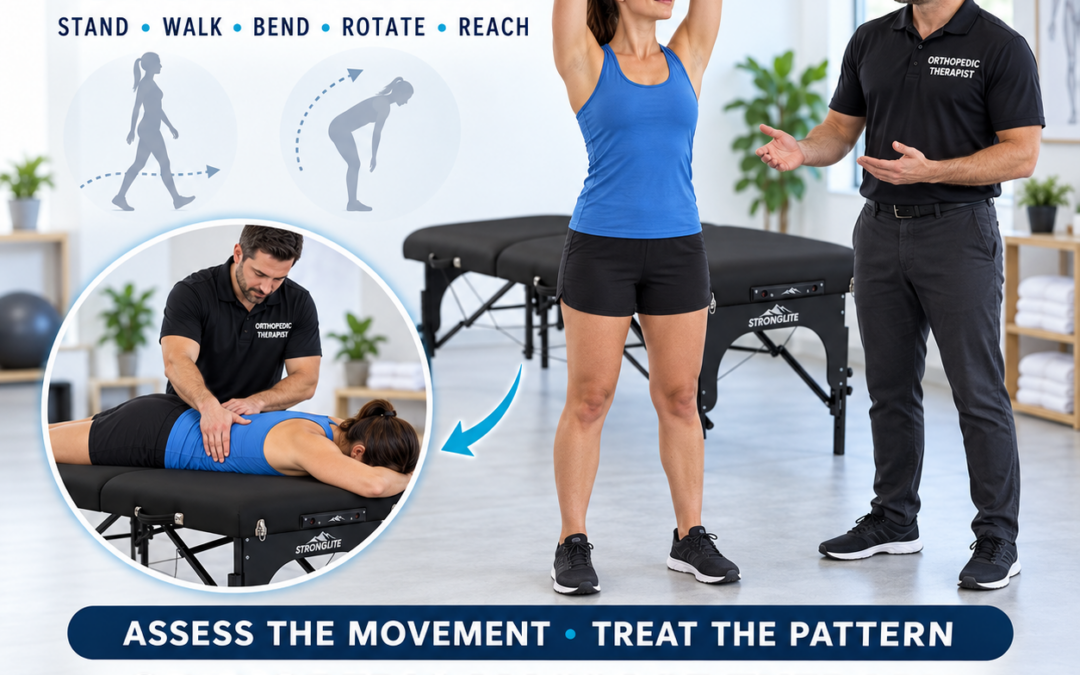
Why Movement Assessment Is an Important Part of Orthopedic Massage Therapy
Orthopedic massage therapy is more than working on the area where a person feels pain. It also involves understanding how the body moves and how different regions may be influencing one another.
Before or during a session, I may ask a client to stand, walk, bend, rotate, raise an arm, move a leg, or change positions. These movements can provide useful information about flexibility, balance, stability, coordination, and compensation.
A painful area may be working harder because another area is restricted. A movement assessment can help reveal that larger pattern.
At Orthopedic Massage Therapy in Grapevine, Texas, movement is evaluated as part of developing an individualized treatment approach—not as a test that clients must pass.
What Is a Movement Assessment?
A movement assessment is a careful observation of how someone performs selected movements.
The assessment may be simple. I may ask a client to:
- Stand comfortably
- Walk across the room
- Bend forward or to the side
- Rotate the torso
- Raise one or both arms
- Turn the head
- Lift a knee
- Squat within a comfortable range
- Move a hip or shoulder
- Shift weight between the legs
The movements chosen depend on the client’s symptoms, history, abilities, and goals.
An athlete seeking help with performance may be evaluated differently from someone recovering after surgery. A client experiencing neck pain may perform different movements from someone with hip or lower-back discomfort.
The goal is not to complete a standard routine. It is to gather information that is relevant to the individual.
Movement Can Reveal What Resting Posture Cannot
Looking at someone while they stand still provides only limited information.
The body may appear balanced at rest but move differently during walking, reaching, or rotation. One hip may have less mobility, one shoulder may rise earlier, or the torso may rotate more easily in one direction.
Movement can reveal:
- Differences between the right and left sides
- Areas that move too little
- Areas that appear to compensate
- Protective guarding
- Limited coordination
- Changes in balance
- Movements that reproduce discomfort
- Movements that feel easier after treatment
A movement difference does not automatically mean something is wrong. Human bodies are naturally varied and are not perfectly symmetrical.
The important question is whether the pattern is connected to pain, restricted function, or the client’s goals.
The Painful Area May Be Compensating
Suppose a client experiences recurring tightness on the right side of the lower back.
The right lower-back muscles may be painful because they are working harder to compensate for limited movement in the left hip. The pelvis may rotate differently while walking, causing the lumbar region to provide additional movement or stability.
Working only on the painful right side may help temporarily, but the tension may return if the hip and pelvic pattern remains unchanged.
Movement assessment helps me consider whether the painful area is the source of the problem or a region that is compensating.
This same principle may apply to:
- Knee discomfort influenced by the hip or ankle
- Shoulder pain influenced by the thoracic spine
- Neck tension influenced by the ribs or breathing
- Hamstring tightness influenced by the pelvis
- Lower-back discomfort influenced by the hips
- Upper-back tension influenced by the core
This does not mean pain can always be traced to one distant structure. Pain is complex and may have many contributing factors. Movement assessment helps identify possibilities that can guide treatment.
Comparing the Right and Left Sides
People often notice that one side feels tighter, weaker, or less coordinated.
During an assessment, I may compare how each side performs the same movement. For example:
- Does one arm raise more easily?
- Does the torso rotate farther in one direction?
- Does one hip move more freely?
- Does the client place more weight on one leg?
- Does one shoulder blade move differently?
- Is one stride shorter?
- Does one side feel more stable?
The objective is not to create perfect symmetry. Most people have natural differences based on handedness, occupation, sports, previous injuries, and daily habits.
The comparison helps identify where the body may be working harder and which restrictions may be relevant to the client’s symptoms.
Walking Provides Valuable Information
Walking requires coordination throughout the entire body.
The feet, ankles, knees, hips, pelvis, spine, rib cage, shoulders, and arms must work together with every step.
While a client walks, I may notice:
- Differences in stride length
- How the feet contact the floor
- Whether one foot turns outward
- How the pelvis rotates
- Whether one arm swings less
- If the torso leans to one side
- Whether the shoulders remain level
- How weight transfers from one leg to the other
A previous injury may affect walking even after the original pain has improved.
For example, an old ankle or knee injury may cause someone to spend less time on one leg. The opposite hip or lower back may then work harder to keep the body moving forward.
Observing walking can help connect an old injury with a current compensation pattern.
Assessing the Core and Pelvis
The core and pelvis form the center of the body and help transfer force between the upper and lower regions.
I may observe how the pelvis and torso respond when a client:
- Shifts weight
- Lifts one leg
- Rotates
- Bends
- Walks
- Reaches overhead
- Moves from sitting to standing
If the pelvis shifts or rotates during movement, the spine and shoulders may compensate to keep the person balanced.
Restrictions involving the iliacus, psoas, quadratus lumborum, diaphragm, pelvic floor, hips, or surrounding fascia may influence how the body’s center coordinates.
Movement assessment does not diagnose a specific muscle or condition. It provides information that can be considered alongside hands-on evaluation and the client’s history.
Evaluating the Thoracic Spine and Shoulders
The thoracic spine and rib cage provide the foundation on which the shoulder blades move.
When a client raises an arm, I may observe whether:
- The shoulder elevates too early
- The shoulder blade moves smoothly
- The ribs flare or shift
- The lower back arches
- The head moves forward
- One arm has less range
- The client holds their breath
If the thoracic spine does not extend or rotate comfortably, the neck, shoulders, or lower back may create additional movement.
The painful shoulder may need treatment, but the thoracic spine, ribs, diaphragm, or pelvis may also be part of the pattern.
Breathing Is Also Movement
Breathing requires movement through the diaphragm, ribs, abdomen, spine, and pelvic floor.
I may observe whether the lower ribs expand, whether one side moves differently, or whether the shoulders lift with each breath.
A person experiencing stress or pain may take smaller breaths and brace through the abdomen. The muscles of the neck and upper chest may then contribute more heavily to breathing.
Massage therapy does not diagnose or treat respiratory conditions. However, observing ordinary breathing mechanics may help identify soft-tissue restrictions around the ribs, diaphragm, thoracic spine, and core.
Sudden or severe breathing difficulty, chest pain, or other concerning symptoms require prompt medical attention.
Previous Injuries Matter
A complete movement assessment includes listening to the client’s history.
I ask about:
- Previous injuries
- Surgeries
- Childbirth
- Sports and exercise
- Work activities
- Repetitive movements
- Sitting and driving
- Sleeping positions
- Changes in balance or mobility
An old injury may explain why a current movement pattern developed.
The body adapts to protect painful or healing tissues. These adaptations may be necessary during recovery, but they can remain after the original injury has healed.
A client may no longer remember favoring one leg after an injury, yet the compensation may still be visible during walking or standing.
Why Clients Wear Shorts and a Tank Top
Comfortable athletic clothing is useful during movement assessment.
At Orthopedic Massage Therapy, clients remain dressed in athletic shorts and a tank top throughout the session.
This clothing allows the client to bend, rotate, walk, lie down, sit up, and change positions while remaining comfortable and covered.
It also allows me to observe general movement through the shoulders, spine, hips, knees, and pelvis without restrictive fabric interfering.
Clients may move between:
- Standing
- Seated
- Face-down
- Face-up
- Side-lying
Athletic shorts and a tank top help make these transitions easier while preserving coverage and professional boundaries.
Assessment Should Never Be Painful or Intimidating
A movement assessment is not an athletic competition or fitness test.
Clients are not expected to push through pain, perform difficult exercises, or demonstrate a certain level of flexibility.
I explain each movement before asking the client to perform it. The movement should remain within a comfortable and appropriate range.
If a movement causes pain, dizziness, instability, or concern, it can be stopped or modified.
Some clients have limited mobility because of age, injury, surgery, pain, or neurological conditions. The assessment is adapted to the person’s abilities.
What matters is how the individual moves—not how their movement compares with someone else.
Reassessing After Treatment
Movement may be evaluated again after working on a particular area.
For example, I may ask the client to raise an arm, rotate the torso, or walk again. This can help determine whether the treatment affected the movement being addressed.
The client may notice:
- Greater ease
- Improved range
- Better balance
- Less pulling
- More stability
- Reduced discomfort
- A feeling of being more open or upright
Not every change is immediate, and one session may not resolve a long-standing pattern.
Reassessment helps guide what should be addressed next and whether the treatment approach should be adjusted.
Feeling Taller After Treatment
Some clients say they feel taller after a session.
They have not physically become taller. Reduced muscular and fascial restriction may allow them to return closer to their natural posture and actual height.
When the hips, pelvis, spine, ribs, and shoulders are moving with less restriction, the person may feel more upright, balanced, or open.
Movement assessment helps demonstrate this change. The client may stand or walk differently even when the change feels subtle.
Movement Assessment Is Not a Medical Diagnosis
Orthopedic massage therapists do not diagnose medical conditions.
Movement observation can identify patterns that may be relevant to treatment, but it cannot determine every cause of pain.
Symptoms such as severe pain, unexplained weakness, significant swelling, numbness, loss of coordination, sudden balance changes, or worsening function may require evaluation by an appropriate healthcare professional.
Massage therapy can work alongside medical care, physical therapy, athletic training, and other rehabilitation services when appropriate.
From Assessment to Individualized Treatment
Information gathered during movement assessment helps guide the session.
Treatment may involve areas such as the:
- Hips and pelvis
- Core and abdomen
- Iliacus and psoas
- Quadratus lumborum
- Lower back
- Thoracic spine and ribs
- Diaphragm region
- Neck and shoulders
- Arms or legs
- Surrounding fascia
Not every client requires treatment in every area. The plan depends on what is relevant to their symptoms and movement.
Before beginning, I explain the areas I recommend treating and where my hands will be placed. I continue checking with the client throughout the session.
Orthopedic Massage Therapy in Grapevine, Texas
Movement assessment helps reveal how different parts of the body may be working together.
By observing standing, walking, bending, rotating, breathing, and joint movement, I can develop a more individualized treatment approach.
The goal is not to judge posture or search for perfect symmetry. It is to identify restrictions and compensation patterns that may be influencing pain, mobility, balance, and performance.
At Orthopedic Massage Therapy in Grapevine, Texas, you will remain comfortably dressed in athletic shorts and a tank top while treatment and assessment are adapted to your needs.
Assess the Movement. Treat the Pattern. Support the Whole Body.
Improving Strength, Power and Flexibility
Text: 817-305-6548
Website: OmassageT.com
Location: 110 S Barton #6
Grapevine, Texas
76051