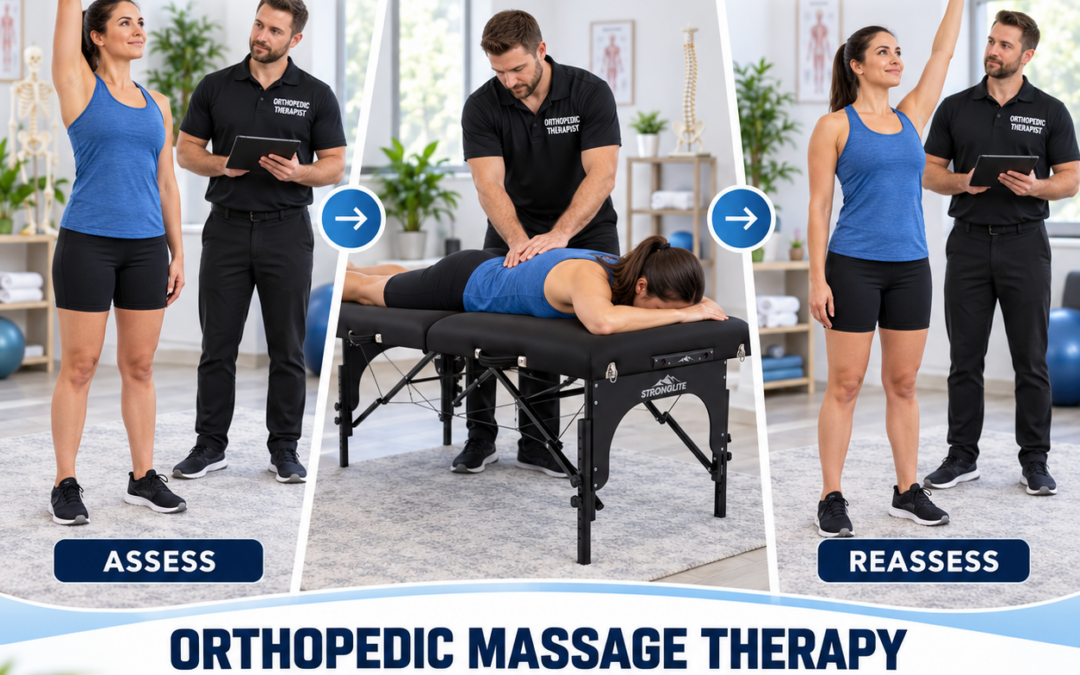
Why Reassessment Matters After Orthopedic Massage Treatment
An orthopedic massage session should not end simply because the hands-on work is finished. After treating an area, I may ask a client to stand, walk, bend, rotate, raise an arm, or repeat another movement from the beginning of the session.
This process is called reassessment.
Reassessment helps us observe whether the movement feels or looks different after treatment. It can show which restrictions responded, which areas may still be compensating, and what may need to be addressed next.
At Orthopedic Massage Therapy in Grapevine, Texas, assessment and reassessment are important parts of providing treatment based on the individual rather than following the same routine for everyone.
Assessment Creates a Starting Point
Before treatment, I may ask a client to perform a few comfortable movements related to their symptoms or goals.
A client with shoulder discomfort may raise both arms or rotate the torso. Someone with lower-back or hip tightness may walk, bend, shift weight, or lift one knee.
These movements create a starting point.
We may notice:
- One side moves more easily
- A movement feels tight or restricted
- The body shifts away from one side
- One shoulder rises earlier
- The lower back arches during an overhead reach
- One stride is shorter
- The client feels unstable during weight transfer
- A particular movement reproduces discomfort
This information helps guide the treatment plan. Repeating the movement later allows us to compare it with that starting point.
Why Reassessment Is Different From Asking, “Do You Feel Better?”
Asking whether someone feels better is useful, but it may not tell the complete story.
A client may feel relaxed while lying on the table but notice the original restriction again after standing. Another person may not recognize an improvement until repeating the movement that was difficult earlier.
Reassessment provides a more specific comparison.
Instead of asking only, “Does it feel better?” we can consider:
- Does the movement feel easier?
- Has the available range changed?
- Is there less pulling or tightness?
- Does the client feel more balanced?
- Is the painful area working differently?
- Has the movement become smoother?
- Is the client breathing more comfortably?
- Does one side still feel different?
The client’s experience remains central. Reassessment combines what the client feels with what we observe together.
Reassessment Helps Determine Whether We Addressed the Right Area
The location of pain is not always the location of the most important restriction.
For example, a client may arrive with right-sided lower-back pain. During the initial assessment, the left hip may appear to have less mobility. The right lower back may be working harder to compensate.
After addressing the left hip, pelvis, and surrounding fascia, the client may repeat the original movement. If the lower back feels easier or the motion becomes more balanced, that change suggests the hip restriction was relevant to the larger pattern.
This does not prove that one muscle caused the pain. Pain is complex and can involve many factors. However, the response gives us useful information about how the body is working together.
Changes May Occur Away From the Treatment Area
Because the body is connected, a client may notice improvement somewhere other than where treatment was applied.
Work around the:
- Hips may change how the lower back moves
- Pelvis may influence balance and stride
- Lower thoracic spine may improve rotation
- Ribs may affect shoulder movement
- Diaphragm region may change how the torso feels
- Quadratus lumborum may influence pelvic movement
- Core may affect stability
- Shoulder blade may change neck tension
Reassessment helps reveal these relationships.
A client may be surprised that an arm raises more easily after treatment around the ribs or that walking feels more balanced after work around the pelvis.
The goal is not to promise a particular result. It is to observe how the individual responds.
The Client Becomes Part of the Process
Reassessment helps clients participate in understanding their own movement.
Many people have lived with tightness or compensation for so long that it feels normal. They may not realize that one side moves differently until they compare it with the other side or repeat a movement after treatment.
A client may say:
- “That feels smoother.”
- “I do not feel the same pulling.”
- “My shoulder moves farther.”
- “I feel more balanced.”
- “I can turn more easily.”
- “I feel more open.”
- “I feel taller.”
Clients do not physically become taller during treatment. Reduced muscular and fascial restrictions may allow them to stand closer to their natural posture and actual height.
Feeling and observing these changes can improve body awareness and help the client recognize patterns outside the treatment room.
Reassessment Guides the Rest of the Session
Reassessment does not always occur only at the end.
I may reassess a movement after treating one area and before moving to another. This helps determine whether the first area affected the pattern.
If the movement improves, we may continue building on that change. If it remains the same, I may consider another connected region.
For example, limited shoulder movement may involve the shoulder itself, but it may also involve the:
- Neck
- Shoulder blade
- Thoracic spine
- Rib cage
- Diaphragm
- Core
- Pelvis
Reassessing after each relevant area helps prevent the treatment from becoming a series of assumptions.
The body’s response helps guide the process.
Not Every Change Is About Greater Range of Motion
More movement is not always the only goal.
A client may already have considerable flexibility but lack stability or control. An athlete may be able to move through a large range but feel unstable while doing so.
Reassessment may focus on:
- Control
- Balance
- Stability
- Coordination
- Comfort
- Breathing
- Confidence
- Quality of movement
A smaller, controlled movement may be more useful than a larger movement that the person cannot stabilize.
The goal is not to create as much flexibility as possible. It is to support movement that is comfortable, controlled, and appropriate for the individual.
Reassessment May Reveal That More Treatment Is Not Needed
Sometimes a meaningful change occurs before every planned area has been treated.
Reassessment may show that a movement already feels easier after addressing one or two key restrictions. Continuing to apply more pressure or treat additional areas may not be necessary during that session.
More treatment is not automatically better.
The body needs time to respond and adapt. Reassessment can help determine when enough has been accomplished for one visit.
This supports a thoughtful approach rather than treating every area simply because time remains.
Reassessment May Reveal Another Part of the Pattern
In other cases, one movement improves while another restriction becomes more noticeable.
For example, after the hips begin moving more freely, the client may become aware of tightness through the lower thoracic spine. Improving shoulder movement may reveal a remaining restriction around the ribs or neck.
This does not mean the treatment created a new problem. The body’s original compensations may have made one restriction more noticeable than another.
As the larger pattern changes, we may gain a clearer view of what still needs attention.
What If the Movement Does Not Change?
Not every movement changes immediately.
Long-standing restrictions, previous injuries, surgery, inflammation, neurological conditions, or structural limitations may require more time or another type of care.
If reassessment shows little or no change, that information is still valuable. It may indicate that:
- A different area should be considered
- The treatment approach should be adjusted
- The body needs time to respond
- The limitation may not be primarily soft-tissue related
- Medical or rehabilitation evaluation may be appropriate
- The goal should focus on comfort or function rather than range
A lack of immediate change is not a failure. It helps guide the next decision.
Reassessment Should Remain Comfortable
Clients should not push through pain to demonstrate whether treatment worked.
The movements used during reassessment should be appropriate for the person’s condition and abilities.
A client recovering from surgery, experiencing balance concerns, or living with limited mobility may need a small or supported movement. Another client may be able to perform a more active assessment.
The movement can be stopped or modified if it causes pain, dizziness, numbness, instability, or concern.
Reassessment is not a performance test. It is a way of gathering information.
Clothing Makes Reassessment Easier
Clients remain dressed in athletic shorts and a tank top throughout treatment at Orthopedic Massage Therapy.
This clothing allows them to move comfortably between:
- Standing
- Walking
- Seated positions
- Face-down treatment
- Face-up treatment
- Side-lying treatment
When it is time to reassess, the client can safely stand and repeat a movement without needing to change clothes or rearrange complicated draping.
The clothing provides coverage while allowing the shoulders, hips, spine, and legs to move naturally.
Reassessment and Athletic Performance
Athletes may use reassessment to observe changes related to performance and recovery.
Depending on the sport, we may repeat movements involving:
- Squatting
- Rotation
- Overhead reach
- Hip mobility
- Weight transfer
- Shoulder movement
- Running mechanics
- Balance
The objective is not to replace coaching, physical therapy, medical care, or athletic training.
Orthopedic massage reassessment focuses on how soft-tissue treatment may have influenced movement, comfort, and coordination during the session.
Reassessment After Surgery or Injury
Clients recovering from injury or surgery may have specific movement restrictions or precautions.
Treatment and reassessment should respect guidance from the client’s physician, physical therapist, or rehabilitation team.
The reassessment may be limited to a small movement, a change in position, or the client’s ability to stand and walk more comfortably.
Orthopedic massage does not replace medical follow-up. Reassessment helps determine how the client responded to the massage session within the boundaries of appropriate care.
Reassessment Supports Honest Expectations
No therapist should promise that one session will permanently correct a movement pattern or eliminate pain.
The way a person moves may be influenced by:
- Daily habits
- Work demands
- Sleep
- Stress
- Previous injuries
- Medical conditions
- Athletic training
- Strength
- Mobility
- Recovery time
A positive change during reassessment is encouraging, but the body will continue responding after the session.
Some clients may need additional treatment, home movement, medical care, physical therapy, strength training, or other support.
Reassessment helps us discuss progress honestly and decide on a reasonable next step.
From Temporary Relief to Better Understanding
Relaxation and pain relief can be valuable, but orthopedic massage therapy also aims to help clients understand their bodies.
When a client feels a movement before treatment and then repeats it afterward, the difference can make the session more meaningful.
They may begin recognizing:
- How one hip affects the lower back
- How the ribs influence the shoulder
- How the pelvis affects balance
- How breathing affects neck tension
- How an old injury changes movement
- How sitting or standing habits contribute to tightness
This awareness can help clients make more informed choices about movement, recovery, and future care.
Orthopedic Massage Therapy in Grapevine, Texas
Reassessment helps answer an important question: did the treatment change the movement or pattern we intended to address?
By repeating selected movements, we can observe changes in comfort, mobility, stability, balance, and coordination.
Not every change happens immediately, and not every restriction is caused by soft tissue. However, reassessment provides useful information that helps guide individualized treatment.
At Orthopedic Massage Therapy in Grapevine, Texas, the process includes listening, assessing, treating, and reassessing.
Assess. Treat. Reassess.
Improving Strength, Power and Flexibility
Text: 817-305-6548
Website: OmassageT.com
Location: 110 S Barton St #6
Grapevine, Texas
76051