Why Client Communication Matters During Orthopedic Massage Therapy
Orthopedic massage therapy should be a collaborative process. The therapist brings knowledge, observation, and treatment skills, but the client brings something equally important: information about what the body is experiencing.
No therapist can know exactly what pressure feels like inside another person’s body. We cannot see every sensation, determine whether a position feels secure, or know that someone is holding their breath unless the client communicates.
That is why I encourage clients to speak openly throughout an orthopedic massage session.
At Orthopedic Massage Therapy in Grapevine, Texas, communication helps keep treatment comfortable, pain-free, respectful, and individualized. It allows me to adjust the pressure, positioning, pace, and treatment plan according to how the client responds.
Communication Begins Before Treatment
A productive session begins with a conversation.
I want to understand why the client scheduled the appointment, what has changed, and what they hope to improve. This may include questions about:
-
The location and type of discomfort
-
When the problem began
-
Previous injuries or surgeries
-
Current medical care or physical therapy
-
Activities that increase or decrease symptoms
-
Changes in sleep, work, exercise, or stress
-
Swelling or visible differences
-
Positions that are difficult or uncomfortable
-
The client’s goals for treatment
These details help establish a starting point.
Two people may both arrive with lower-back pain, but their histories can be completely different. One may have developed discomfort after sitting for long hours. Another may be recovering from hip surgery. A third may have an old ankle, knee, or quadriceps injury that changed how the person walks and uses the pelvis.
Without communication, these important differences could be missed.
The Client’s Experience Is Important Information
A therapist can observe movement, posture, muscle tension, breathing, balance, and visible swelling. However, observation is only one part of the assessment.
The client can describe:
-
Whether discomfort is sharp, dull, burning, aching, or tight
-
Whether an area feels weak, unstable, numb, or sensitive
-
What movements feel restricted
-
Where pressure is felt
-
Whether a sensation travels to another area
-
Whether the body feels guarded
-
Whether a position creates discomfort
-
Whether breathing feels easy or restricted
These descriptions can help guide the session, but they do not replace medical diagnosis when concerning symptoms are present.
New weakness, unexplained numbness, severe pain, chest pain, difficulty breathing, fever, suspected fracture, or changes in bowel or bladder control require appropriate medical evaluation.
Comfortable Pressure Requires Feedback
Pressure is not experienced the same way by every person.
A level of pressure that feels comfortable for one client may feel painful to another. Sensitivity can also vary between different areas of the same body.
A client may be comfortable with firm pressure around the hips but require lighter work around the neck, abdomen, or a previous surgical area. Pressure that felt appropriate during the last appointment may feel different today because of fatigue, stress, activity, inflammation, or poor sleep.
I encourage clients to tell me whether pressure feels:
-
Too light
-
Comfortable and productive
-
Sensitive but manageable
-
Too intense
-
Sharp, burning, or unpleasant
Pain is not the goal. The client should not feel obligated to tolerate painful pressure because of the belief that orthopedic massage must hurt to work.
Saying “That Is Too Much” Is Helpful
Some clients hesitate to speak because they do not want to interrupt the session or offend the therapist.
However, saying that pressure is too intense is helpful information.
It allows the therapist to reduce pressure, slow the technique, change the angle, treat a surrounding area, or reconsider whether that tissue should be treated at all.
The purpose is not to see how much discomfort a client can endure. The purpose is to work with the body in a way that encourages relaxation and useful change.
When a client knows their feedback will be respected, it becomes easier to trust the process.
Research involving musculoskeletal rehabilitation has identified communication, collaboration, individualized care, and taking the patient’s opinions into account as important parts of the patient–therapist relationship.
Communication Can Reduce Guarding
When treatment becomes painful, the body may respond by protecting itself.
The client may hold the breath, tighten the abdomen, raise the shoulders, clench the jaw, stiffen the legs, or pull away. This guarding can make relaxation more difficult.
Communication helps identify guarding before it becomes stronger.
A client might say:
-
“I noticed that I am holding my breath.”
-
“My shoulder is beginning to tense.”
-
“I feel myself pulling away.”
-
“That position is uncomfortable for my hip.”
-
“I feel pressure, but it does not hurt.”
-
“My back is beginning to relax.”
This feedback allows treatment to change immediately.
A pain-free session does not mean that the therapist avoids specific or focused work. It means that the work remains within a level the client can comfortably accept without fighting against it.
Positioning Should Be a Conversation
Comfortable positioning is essential during orthopedic massage therapy.
I use a body-support system on my Stronglite Premier portable massage table. Separate supports can be adjusted around the head, chest, pelvis, and legs.
The client may be positioned face down, face up, side lying, seated, partially elevated, or in another supported position.
Although a position may look correct from the outside, only the client knows how it feels.
The client should communicate if:
-
The neck feels turned or compressed
-
The shoulder feels crowded
-
The lower back is uncomfortable
-
Pressure is building around a hip
-
An ankle or knee needs more support
-
Breathing feels restricted
-
A previous surgical area feels vulnerable
-
The client does not feel secure or adequately covered
Clients wear athletic shorts and a tank top so they can remain comfortable and covered while moving between positions.
A support can be moved, added, or removed at any time. There is no benefit in remaining in an uncomfortable position simply because treatment has already begun.
Consent Continues Throughout the Session
Consent is not limited to the beginning of the appointment.
A client who agrees to orthopedic massage therapy has not agreed to every possible technique, body area, pressure level, or position.
Before changing positions or working in a sensitive area, the therapist should explain what is planned. The client should have an opportunity to ask questions, request a modification, or decline.
A client may ask to:
-
Change the pressure
-
Move to another position
-
Add or adjust a support
-
Avoid a particular area
-
Pause the treatment
-
Receive an explanation
-
Stop the session
The answer should be respected without pressure or judgment.
The client remains in control of what happens to their body.
Feedback Helps With Reassessment
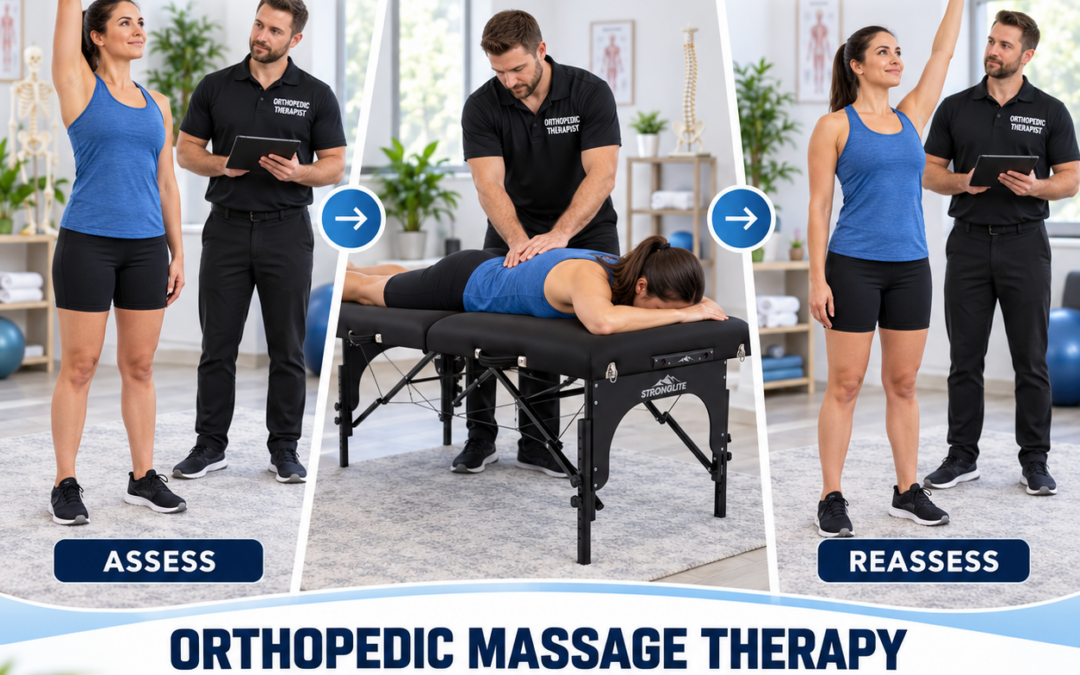
Communication is also important when checking movement before and after treatment.
The therapist may observe that the client can turn the head farther, raise the arm higher, or rotate the hip more easily. However, the client may notice additional changes that are not visible.
A client may say:
-
“The movement feels smoother.”
-
“I do not feel as much pulling.”
-
“I feel more balanced.”
-
“My shoulder feels lighter.”
-
“I can breathe more easily.”
-
“The pain has moved.”
-
“The range looks better, but the movement still feels guarded.”
This information helps determine whether to continue in the same direction or evaluate another area.
The change does not always need to be dramatic. A small improvement in comfort or effort may be the first step toward continued progress.
Communication Between Appointments Matters Too
At the beginning of a follow-up session, I want to know what happened after the previous appointment.
The client may report:
-
Deeper sleep
-
Easier movement
-
Reduced tension
-
Less visible ankle swelling
-
Reduced puffiness near the clavicle
-
Improved balance or stability
-
Better exercise recovery
-
Temporary soreness
-
A new or changing symptom
These reports help us understand how the body responded.
It is important not to assume that every change was caused by massage. Activity, sleep, hydration, medication, medical treatment, natural recovery, and many other factors can affect how the body looks and feels.
Communication allows us to consider the complete picture.
Honest Communication Includes What Did Not Improve
Clients should not feel that they must report improvement to please the therapist.
If something did not change, that is useful information.
If a movement improved only briefly, we should know. If discomfort returned after a particular activity, that matters. If one treatment position created soreness later, the next session should be adjusted.
Honest feedback helps prevent the same approach from being repeated without a reason.
The treatment plan may need to focus on a different area, use another technique, change positioning, or involve referral to another healthcare professional.
Person-centered care is based on collaboration and recognizing the individual’s experience, preferences, and goals.
A Strong Therapeutic Relationship Supports Progress
A good therapeutic relationship is built through listening, trust, clear explanations, and respect.
Systematic reviews in musculoskeletal rehabilitation have examined how the therapeutic alliance may influence pain and treatment outcomes. Although the research is not specific to every form of massage, it supports the value of a collaborative relationship between the client and practitioner.
The client should feel heard—not rushed, dismissed, or expected to silently tolerate treatment.
When communication is open:
-
The client can relax more easily.
-
Pressure can remain pain-free.
-
Positioning can be adjusted quickly.
-
Guarding can be recognized.
-
Treatment can become more specific.
-
Reassessment becomes more meaningful.
-
Continued improvement can be documented.
-
Appropriate medical referrals can be made when needed.
Communication does not replace skilled treatment. It helps make skilled treatment more responsive.
Orthopedic Massage Is a Partnership
Orthopedic massage therapy works best as a partnership.
The therapist observes, assesses, explains, treats, and reassesses. The client describes, asks questions, provides feedback, and helps identify meaningful changes.
Together, we can determine:
What feels restricted?
What position feels best?
What pressure is comfortable?
What changed after treatment?
What should happen next?
This approach allows the session to remain pain-free, individualized, and focused on the client’s goals.
Orthopedic Massage Therapy in Grapevine, Texas
At Orthopedic Massage Therapy, clients are encouraged to communicate throughout every session.
Your comfort matters. Your questions matter. Your feedback matters. You never need to endure painful pressure or remain in an uncomfortable position.
By working together, we can create a treatment experience that supports relaxation, movement, balance, stability, strength, power, and flexibility.
Orthopedic Massage Therapy
110 S Barton #6
Grapevine, Texas 76051
Text: 817-305-6548
Website: OmassageT.com
This article is for general educational purposes and is not a diagnosis or substitute for medical care.