Why High School Football Players Benefit From Recovery Work
High school football is demanding on the body.
Players sprint, accelerate, stop, change direction, jump, block, tackle and repeatedly produce force throughout practices and games.
They also spend time in the weight room, conditioning, traveling and attending school.
All of these demands require the body to recover.
I have worked with many high school football players, and one thing I consistently see is the importance of giving the body attention between periods of intense activity.
Recovery is not only about what happens after an injury.
It is also about helping the body manage the demands of training and competition.
Football Requires the Whole Body
Football is not simply a leg sport or an upper-body sport.
A player needs the entire body working together.
The feet connect with the ground.
The ankles and knees help absorb and produce force.
The hips and pelvis help transfer force.
The core helps stabilize the trunk.
The upper body contributes to blocking, tackling, throwing and absorbing contact.
The nervous system coordinates all of these movements.
That is why recovery should also consider the body as a whole.
Football Players Need More Than Strength
Strength is obviously important in football.
But strength is only one part of athletic performance.
Players also need:
-
Power
-
Speed
-
Mobility
-
Flexibility
-
Balance
-
Stability
-
Coordination
-
Recovery
A strong athlete who cannot move efficiently may have limitations that strength alone does not address.
Likewise, an athlete with excellent flexibility still needs stability and strength to control that range of motion.
Performance depends on how these qualities work together.
What Happens During a Football Season?
A football season can involve a tremendous amount of repetition.
Players may practice several times each week while also participating in strength and conditioning programs.
Then there are games.
The body has to repeatedly produce force and recover from it.
Even when an athlete does not experience an obvious injury, they may notice soreness, stiffness or changes in mobility.
That does not automatically mean something is wrong.
Soreness can be part of training.
However, paying attention to changes in how the body feels and moves can be useful.
Recovery Is Part of Training
Many athletes focus heavily on the work they perform.
They want to train harder.
Run faster.
Lift more.
Become stronger.
Improve their technique.
But recovery is also part of the training process.
Your body needs time to adapt to physical demands.
Sleep, nutrition, hydration, appropriate training loads, mobility work and other recovery strategies can all be part of an athlete’s overall program.
Massage can be another tool some athletes choose to include.
Orthopedic Massage for Football Players
An orthopedic massage session for an athlete is not necessarily about simply giving the athlete a relaxing massage.
The focus can be on areas that feel restricted or overworked and on supporting comfortable movement.
Depending on the athlete, attention may be given to areas such as:
-
Hips
-
Pelvis
-
Lower back
-
Upper back
-
Shoulders
-
Legs
-
Feet
-
Core-related movement patterns
The exact focus depends on the individual athlete.
Previous Injuries Can Change Movement
Football players may have previous injuries from football, other sports or everyday activities.
An old ankle injury, for example, may have changed the way an athlete runs.
A previous hip injury may affect how they move through their pelvis.
A history of shoulder problems may influence how they use their upper body.
The original injury may no longer hurt.
But the movement pattern may still be different.
That is why I ask about previous injuries when working with athletes.
Understanding an athlete’s history can provide useful context.
Balance and Stability Matter on the Football Field
Football involves constant changes in direction.
Players accelerate, decelerate and react to other players.
That requires balance and stability.
Consider a defensive player changing direction.
The athlete must control their body while moving quickly.
The feet interact with the ground.
The knees and hips bend.
The pelvis and core stabilize the trunk.
The athlete then produces force to move in another direction.
This is a whole-body movement.
Mobility Is Important Too
Mobility allows athletes to move through the positions required by their sport.
A football player needs to be able to run, squat, bend, rotate, accelerate and change direction.
Mobility does not mean being extremely flexible.
It means having the movement available for the activities you need to perform and being able to control that movement.
This is why mobility and stability should be considered together.
The Role of the Core
The core is an important part of athletic movement.
It helps connect the upper and lower body.
A football player may generate force through the legs while using the trunk to stabilize and transfer that force.
The core is also involved in changing direction, absorbing force and maintaining body control.
This is one reason I use the phrase:
Pain Relief by Improving/Repairing Core Performance.
The goal is not to suggest that every athletic problem comes from the core.
Instead, it reflects the importance of looking at how the center of the body participates in movement.
Fascia and Athletic Recovery
Fascia is another part of the body’s connective tissue system.
Athletes repeatedly load their muscles and tissues through training and competition.
When certain areas feel restricted, myofascial techniques may be used as part of an orthopedic massage session.
Some athletes describe restricted areas as feeling tight, bound up or less mobile.
Working with these areas may help them feel more comfortable moving.
However, massage should not be viewed as a replacement for proper athletic training or medical care when an injury is suspected.
Pain-Free Orthopedic Massage
My approach is based on pain-free orthopedic massage.
I do not believe an athlete has to endure unnecessary pain for a session to be useful.
Football players already place substantial demands on their bodies.
The recovery environment should be comfortable.
Communication is important.
If an area feels uncomfortable, the athlete should be able to communicate that during the session.
The goal is to work with the body rather than simply apply as much pressure as possible.
Recovery Before There Is a Problem
Recovery work does not necessarily have to begin after an injury.
It can also be part of an athlete’s normal routine.
An athlete may use recovery strategies because they want to maintain mobility, manage the demands of training and feel prepared for their next practice or competition.
That does not guarantee injury prevention.
There are many factors involved in sports injuries, including training load, technique, previous injury, environment, conditioning and chance.
But thoughtful recovery can be a useful part of an athlete’s overall approach.
When an Athlete Is Experiencing Pain
Athletes sometimes try to play through everything.
That can be part of the culture of competitive sports.
But significant or persistent pain should not simply be ignored.
A suspected injury may require evaluation by an appropriate healthcare professional.
Massage therapy is not a substitute for diagnosis or treatment of injuries that require medical care.
As a massage therapist, I focus on the areas and movement patterns appropriate for massage therapy and refer out when a situation requires another type of care.
High School Athletes Are Still Developing
High school athletes are also different from professional athletes.
They are still growing and developing physically.
They are balancing sports with school, sleep, academics and other activities.
Their training should be appropriate for their age and development.
Recovery should be approached with the same care.
Parents, coaches, athletic trainers, physicians, physical therapists and other qualified professionals can all play important roles in an athlete’s development and recovery.
Helping Athletes Move Better
My goal when working with athletes is not simply to make them feel good for an hour.
I want to understand what they are experiencing and how their body is moving.
That may include looking at:
Balance
Stability
Mobility
Flexibility
Strength
Power
Recovery
These qualities are connected.
A football player needs the ability to produce force, control force and recover from repeated demands.
Recovery and Performance
High school football players put a tremendous amount of work into their sport.
Practices, games, strength training and conditioning all require effort.
Recovery deserves attention too.
Orthopedic massage therapy can be one component of a broader recovery plan.
It can provide a comfortable environment for working with areas that feel restricted while helping the athlete become more aware of how their body feels and moves.
The goal is not to replace training.
It is to complement it.
The Goal: Keep Moving Forward
Every football player is different.
A lineman has different physical demands than a receiver.
A running back moves differently from a quarterback.
A defensive player has different responsibilities from a kicker.
Their recovery needs may also differ.
That is why I take an individualized approach.
Rather than assuming every athlete needs the same treatment, I consider the athlete, their history, their activities and what they are experiencing.
The goal is simple:
Help the athlete move comfortably, recover appropriately and continue developing strength, power, flexibility, balance and stability.
Orthopedic Massage Therapy for Athletes in Grapevine, Texas
At OmassageT.com, I provide pain-free orthopedic massage therapy with a focus on movement and performance.
I have worked with many high school football players and understand that athletic recovery involves much more than simply addressing one sore muscle.
The focus is on the whole body and the relationship between:
Strength. Power. Flexibility. Balance. Stability. Mobility.
OmassageT.com
110 S Barton #6
Grapevine, Texas 76051
817-305-6548
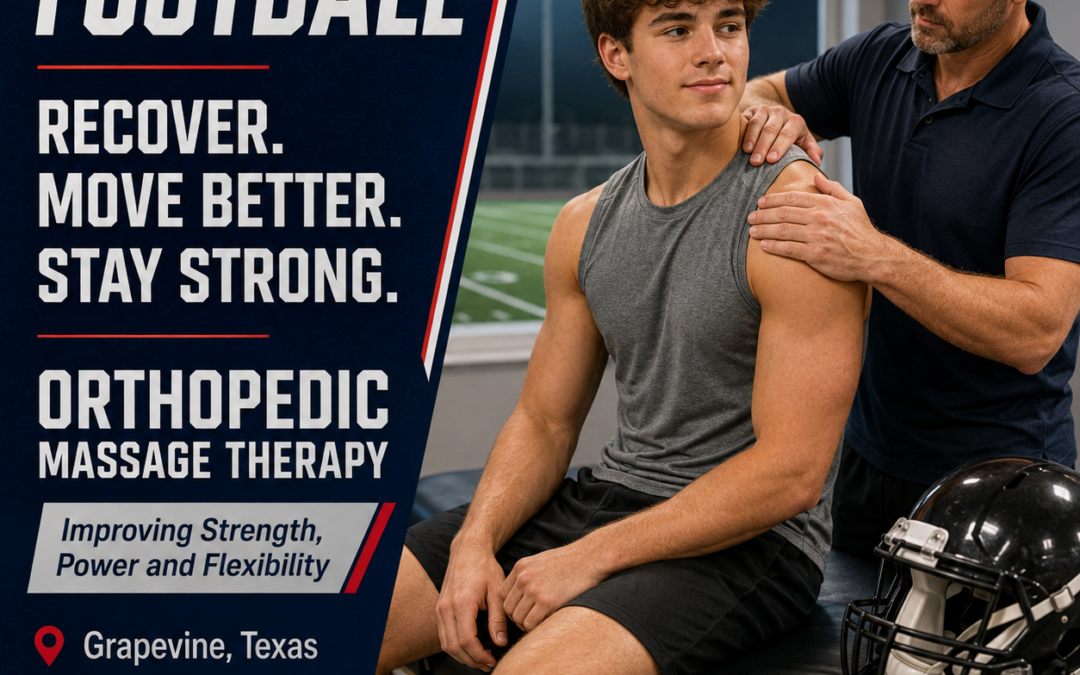
Improving Strength, Power and Flexibility
Pain Relief by Improving/Repairing Core Performance