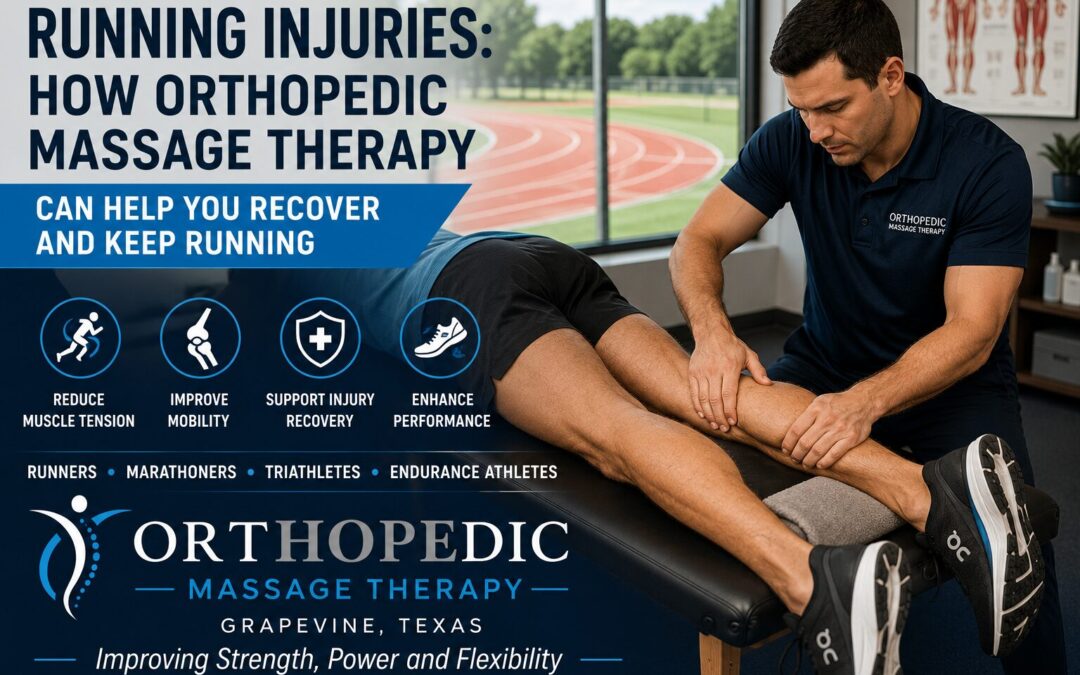
Orthopedic Massage for Runners: Supporting Recovery and Mobility
Running can look simple from the outside.
One foot moves forward, then the other.
But running is actually a highly repetitive full-body movement. Every stride requires coordination between the feet, ankles, knees, hips, pelvis, core and upper body.
For runners, small changes in mobility, balance, flexibility or stability can affect how the body moves.
I have worked with runners and endurance athletes and have seen how important it can be to look beyond the location where a runner feels discomfort.
Orthopedic massage therapy can be one part of a runner’s overall approach to recovery, mobility and performance.
Running Places Repeated Demands on the Body
Every running stride places demands on the body.
The foot contacts the ground.
The ankle responds.
The knee bends and extends.
The hip moves.
The pelvis and core help control the body.
The upper body contributes to balance and coordination.
Then the entire sequence happens again.
And again.
And again.
A runner may take thousands of steps during a single training session.
That repetition makes recovery important.
Recovery Is More Than Rest
Rest is important, but recovery involves more than simply taking a day off.
Runners also pay attention to:
-
Sleep
-
Hydration
-
Nutrition
-
Training volume
-
Strength
-
Mobility
-
Flexibility
-
Balance
-
Stability
-
Recovery between workouts
Massage may be another tool a runner chooses to include in that process.
The goal is not to replace proper training or medical care. Instead, orthopedic massage can complement a runner’s broader recovery strategy.
Why Runners May Feel Tight
Running uses many of the body’s muscles repeatedly.
Depending on the runner’s training, tightness may be noticed around the calves, hamstrings, quadriceps, hips, glutes or lower back.
But the location where a runner feels tight does not always tell the entire story.
For example, a runner may feel tension around the lower leg while also having movement restrictions higher in the body.
This is why I like to consider the entire movement pattern rather than automatically focusing only on the area that feels uncomfortable.
The Connection Between the Feet and the Rest of the Body
The feet are the foundation of every running stride.
They interact with the ground and help the body respond to each step.
That movement is connected to everything above it.
The ankle influences the knee.
The knee works with the hip.
The hip works with the pelvis.
The pelvis works with the core and spine.
This does not mean that every running problem starts at the feet or that every problem can be traced to one specific area.
It means the body works as a connected system.
Hip and Pelvic Movement
The hips and pelvis play an important role in running.
Runners need sufficient mobility to move through their stride while also having enough stability to control that movement.
Restrictions around the hips or pelvis may change how an athlete moves.
A runner may compensate without realizing it.
Over time, that altered movement may contribute to additional areas feeling tight or overworked.
This is one reason I consider the relationship between the hips, pelvis, lower back and core when working with runners.
Core Performance and Running
The core is much more than the abdominal muscles.
It helps connect the upper and lower body and contributes to stability during movement.
When running, the body must maintain control while the legs repeatedly produce force.
The core helps support that process.
This is part of the reason I focus on what I call core performance.
The goal is not simply to strengthen the abdomen.
It is to consider how the center of the body participates in balance, stability and movement.
Balance Matters to Runners
Running requires balance on every stride.
At certain points during a running gait, the body is essentially supported by one leg.
The runner has to control the body while moving forward.
Balance and stability therefore become important parts of efficient movement.
When a runner feels that one side of the body is working differently from the other, it can be useful to pay attention to those differences.
That does not automatically mean there is an injury.
It simply provides information about how the body is moving.
Flexibility and Mobility Are Different
Runners often talk about flexibility.
But flexibility and mobility are not exactly the same thing.
Flexibility generally refers to how much a muscle or group of tissues can lengthen.
Mobility involves the ability to move through a range of motion with control.
A runner may have good flexibility but still have limitations in how they control movement.
That is why I believe runners benefit from thinking about both flexibility and mobility.
Fascia and Running
Fascia is the connective tissue that surrounds and connects structures throughout the body.
Running places repetitive demands on the muscles and connective tissues.
When an area feels restricted or bound up, myofascial work may be incorporated into an orthopedic massage session.
My approach focuses on working with areas of restriction rather than simply applying aggressive pressure.
Some runners describe the feeling of restriction as tightness, stiffness or a sense that an area does not move as freely as it should.
Myofascial Release for Runners
Myofascial release is a technique that can be used to address areas of restricted movement within the soft tissues.
I often describe these areas as feeling bound up.
The goal is to work with the tissue in a way that supports comfortable movement.
A runner does not need to experience painful treatment for the work to be meaningful.
My approach is based on pain-free orthopedic massage.
Comfort and communication are important throughout the session.
Running Injuries and Previous Injuries
Many runners have experienced an injury at some point.
It could be something relatively minor or something that required a longer period of rehabilitation.
Even after an injury has healed, a runner may continue moving differently.
The body can develop compensation patterns.
For example, an athlete may unconsciously protect one side after an injury and place more demand on the other side.
That is one reason an athlete’s history matters.
When I work with a runner, I want to understand what has happened before and what the runner is experiencing now.
Training for a Race
Runners preparing for a race often increase their training volume.
That may mean longer runs, additional speed work or changes in their weekly schedule.
As training demands increase, recovery becomes increasingly important.
A runner may benefit from planning recovery rather than waiting until the body feels overwhelmed.
Massage can be scheduled as one component of that recovery process.
The exact timing depends on the individual runner, training schedule and goals.
During the Racing Season
Once racing begins, runners may have less time between competitions.
Recovery becomes especially important when training and racing are occurring close together.
Some athletes prefer massage because it gives them dedicated time to slow down and pay attention to how their body feels.
Others use it when particular areas feel tight or restricted.
Every runner is different.
The appropriate approach depends on the athlete and their circumstances.
Massage Does Not Replace Medical Care
It is important to recognize the limits of massage therapy.
If a runner has significant pain, swelling, loss of function, numbness, weakness, an acute injury or another concerning symptom, evaluation by an appropriate healthcare professional may be necessary.
Massage should not be used to diagnose or treat conditions that require medical care.
For athletes recovering from an injury, communication among the runner, healthcare professionals, coaches and other members of the athlete’s support team can be important.
Helping Runners Keep Moving
The purpose of orthopedic massage is not simply to make a runner’s muscles feel temporarily different.
My goal is to look at the body from a movement perspective.
That means considering:
Balance
Stability
Mobility
Flexibility
Strength
Power
Recovery
These qualities work together.
A runner needs the ability to move efficiently, control movement and recover from repeated physical demands.
Runners Are Not All the Same
A recreational runner, marathon runner, sprinter and high school cross-country athlete can have very different needs.
Their training schedules are different.
Their mileage is different.
Their sports may be different.
Their injury histories may be different.
Their goals are different.
That is why I do not believe there should be one identical massage approach for every runner.
The session should be based on the individual.
Supporting Strength, Power and Flexibility
Running performance is not only about how many miles you can complete.
It is also about how your body handles movement.
Balance and stability help you control your body.
Mobility helps you move.
Flexibility contributes to available range of motion.
Strength helps you produce and control force.
Power helps you produce force quickly.
Recovery gives your body an opportunity to adapt to training.
Together, these qualities contribute to what I call:
Improving Strength, Power and Flexibility.
Orthopedic Massage for Runners in Grapevine, Texas
If you are a runner in Grapevine, Southlake, Colleyville, Coppell or the surrounding North Texas area, orthopedic massage therapy may be one part of your approach to recovery and mobility.
At OmassageT.com, I work with athletes using a pain-free orthopedic massage approach focused on the relationship between movement, balance, stability, mobility and the body’s overall performance.
Running places repeated demands on the body.
Taking time to understand how your body moves can be an important part of taking care of it.
OmassageT.com
110 S Barton #6
Grapevine, Texas 76051
817-305-6548
Improving Strength, Power and Flexibility
Pain Relief by Improving/Repairing Core Performance