Sports Massage vs. Performance Massage: What's the Difference?
Athletes hear many different terms when looking for massage therapy.
Sports massage.
Performance massage.
Recovery massage.
Orthopedic massage.
Sometimes these terms can sound interchangeable, but they can describe different ways of approaching an athlete’s needs.
At OmassageT.com in Grapevine, Texas, I work with athletes using a pain-free orthopedic massage approach that considers movement, recovery, mobility, balance, stability and performance.
Understanding the differences between these approaches can help athletes decide what type of massage may fit their goals.
What Is Sports Massage?
Sports massage is generally associated with people who participate in athletic activities.
The focus may be on muscles and areas that experience significant physical demands from training or competition.
A runner may want attention to the legs.
A football player may need work around the hips, legs or shoulders.
A gymnast may have different areas that receive repeated stress.
Sports massage can be used at different points in an athlete’s training cycle.
The exact approach depends on the athlete, their sport and their current needs.
What Is Performance Massage?
Performance massage focuses on the athlete’s ability to move and perform.
Rather than thinking only about soreness after a workout, performance massage can consider qualities such as:
-
Mobility
-
Flexibility
-
Balance
-
Stability
-
Strength
-
Power
-
Movement efficiency
-
Recovery
The emphasis is on supporting the athlete’s overall physical performance.
For some athletes, that may mean working on areas that feel restricted.
For others, it may mean focusing on recovery after intense training.
What Is Orthopedic Massage?
Orthopedic massage takes a more movement-oriented approach.
It may consider how different areas of the body interact with one another.
For example, someone experiencing shoulder discomfort may also have movement restrictions involving the upper back or core.
A runner experiencing knee discomfort may have movement differences involving the hips, pelvis, ankle or foot.
That does not mean the problem necessarily originates in one of those areas.
It means the entire movement pattern can provide useful information.
Sports Massage and Recovery
Athletes place repeated demands on their bodies.
Training creates physical stress that the body needs time to recover from.
Sports massage may be incorporated into an athlete’s recovery routine.
Some athletes use massage after demanding training periods.
Others prefer massage during lighter training periods.
The timing depends on the individual and their training schedule.
Massage should complement—not replace—appropriate training, recovery, sleep, nutrition and medical care when needed.
Performance Is More Than Strength
Strength is important for athletes.
But strength is only one part of performance.
An athlete also needs to control that strength.
They need mobility.
They need balance.
They need stability.
They may need to produce force quickly, which involves power.
They need coordination.
They need the ability to recover from repeated physical demands.
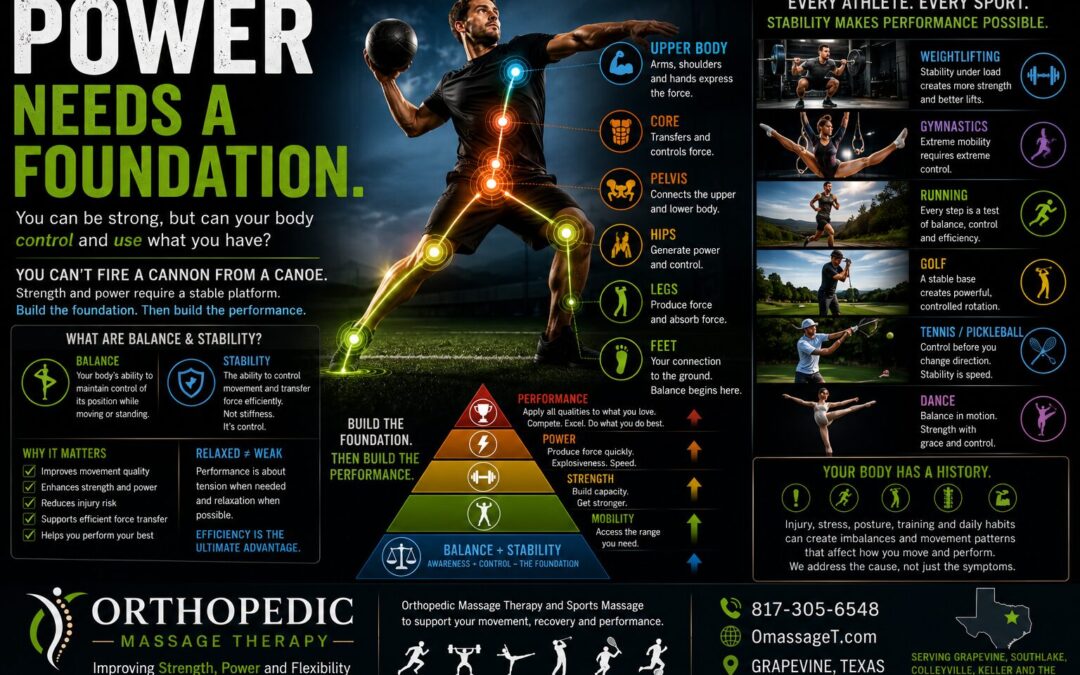
This is why I focus on the relationship between:
Strength + Power + Flexibility + Balance + Stability.
The Importance of Mobility
Mobility allows an athlete to move through the positions required by their sport.
A football player needs to accelerate and change direction.
A runner needs to repeatedly move through a running stride.
A gymnast needs to control large ranges of motion.
A baseball player needs to rotate and produce force.
Different sports require different types of mobility.
The goal is not necessarily to make an athlete as flexible as possible.
The goal is to support the movement they need for their activity.
Flexibility and Mobility Are Not the Same
Flexibility and mobility are related but different concepts.
Flexibility generally refers to the available length or range of a muscle and surrounding tissues.
Mobility often refers more broadly to the ability to actively move through a range with control.
An athlete may be flexible but lack stability.
Another athlete may be strong but have restricted mobility.
Performance depends on how these qualities work together.
Balance and Stability
Balance is an essential part of athletic movement.
Running, jumping, cutting, landing and changing direction all require the body to control itself.
Stability helps the athlete manage forces while moving.
The core, pelvis, hips, legs and feet all contribute.
When athletes work on performance, these qualities deserve attention alongside strength and flexibility.
The Core and Performance
Your core is more than your abdominal muscles.
It helps connect your upper and lower body and contributes to trunk stability.
For athletes, this connection can be particularly important.
A football player transferring force from the legs through the upper body needs trunk control.
A runner needs to maintain control while the legs repeatedly produce force.
A gymnast needs exceptional control of the trunk while moving through different positions.
This is why core performance is an important part of my approach.
Fascia and Athletic Movement
Fascia is connective tissue that surrounds and connects structures throughout the body.
Athletes repeatedly load the tissues involved in movement.
Sometimes an athlete describes an area as feeling tight, restricted or “bound up.”
Myofascial techniques may be used to work with areas that feel restricted.
The goal is not to force the tissue or create unnecessary pain.
It is to work comfortably with the body while supporting movement.
Pain-Free Orthopedic Massage
My approach is intentionally pain-free.
Some people assume that sports massage has to be painful because athletes train hard.
I don’t approach it that way.
The athlete should be comfortable enough to communicate throughout the session.
If a technique creates unnecessary discomfort, it can be adjusted.
The goal is to work with the body rather than simply apply more pressure.
Before a Competition
Massage timing can matter.
A session close to competition may have a different purpose from a recovery session after competition.
Athletes should work with their coaches, trainers and healthcare professionals to determine what fits their training and competition schedule.
A massage session should not be treated as a guarantee of improved athletic performance.
Instead, it can be one component of an athlete’s preparation and recovery routine.
After Training or Competition
After demanding activity, athletes may experience temporary muscle soreness and fatigue.
Recovery strategies can help an athlete manage their training routine.
Some athletes choose massage as part of that process.
The goal may be relaxation, working with areas that feel restricted or simply giving the athlete time to slow down and pay attention to their body.
Every athlete responds differently.
Sports Massage, Performance Massage and Orthopedic Massage
So which one should an athlete choose?
There is no universal answer.
Sports massage generally emphasizes the needs associated with athletic activity.
Performance massage focuses on movement and qualities associated with physical performance.
Orthopedic massage can take a broader movement-based approach, considering relationships between different areas of the body.
There can be significant overlap between these approaches.
The terminology matters less than understanding what the session is designed to accomplish.
Looking at the Whole Athlete
One of the biggest differences in my approach is the emphasis on the whole body.
If an athlete says their hamstring feels tight, I don’t want to automatically assume the hamstring is the only thing worth considering.
I may also think about the hips, pelvis, core and movement pattern.
If a runner experiences discomfort around the knee, I may consider the relationship between the knee, ankle, hip and pelvis.
Again, this is not a diagnosis.
It is a way of looking at movement.
When Medical Evaluation Is Important
Massage therapy is not a replacement for medical care.
An athlete with significant pain, swelling, loss of function, weakness, numbness or a suspected acute injury should receive appropriate evaluation.
A medical professional can determine whether imaging, physical therapy, rehabilitation or another form of treatment is appropriate.
Massage may be incorporated into recovery when appropriate.
Knowing when to refer out is an important part of responsible massage therapy.
Choosing the Right Approach for Your Goals
The best massage approach depends on what the athlete wants to accomplish.
You may want help with general recovery.
You may want to address areas that feel restricted.
You may want a session focused on mobility.
You may simply need time to relax after a demanding training week.
Your goals, training schedule, sport and injury history all matter.
That is why I prefer an individualized approach.
Supporting Athletic Performance
Athletic performance is built from many pieces.
Strength.
Power.
Flexibility.
Mobility.
Balance.
Stability.
Coordination.
Recovery.
No single massage session can replace the work required to develop these qualities.
But massage can be one component of an athlete’s overall recovery and movement strategy.
Orthopedic Massage for Athletes in Grapevine
At OmassageT.com, I work with athletes using a pain-free orthopedic massage approach.
My focus is on helping clients understand how their bodies move and addressing areas of restricted movement within the scope of massage therapy.
Whether you are a high school football player, runner, endurance athlete or recreational athlete, your recovery needs are individual.
The goal is to support comfortable movement while keeping the bigger picture in mind.
Improving Strength, Power and Flexibility is at the center of the approach.
Orthopedic Massage Therapy in Grapevine, Texas
OmassageT.com
110 S Barton #6
Grapevine, Texas 76051
817-305-6548
Improving Strength, Power and Flexibility
Pain Relief by Improving/Repairing Core Performance