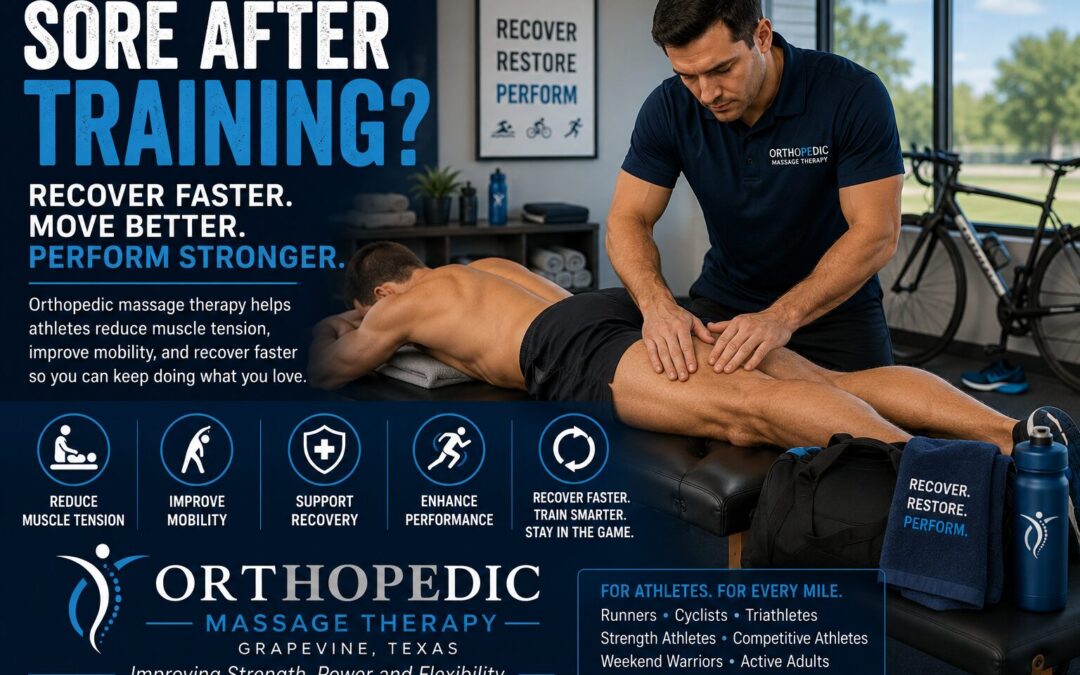
Recovery Between Workouts: Why Your Body Needs More Than Rest
Athletes spend a lot of time training.
They run.
They lift.
They practice.
They compete.
They repeat movements over and over while working to become stronger, faster and more efficient.
But training is only one part of athletic development.
Recovery matters too.
And recovery is more than simply taking a day off.
Your body has to respond to the physical demands you place on it. Giving it appropriate time, movement, nutrition, sleep and recovery strategies can all be part of that process.
For athletes, recovery should be considered part of the overall training program—not something that only happens when something hurts.
What Happens During Training?
Training places stress on the body.
That stress can be productive.
When you challenge your muscles and cardiovascular system appropriately, the body responds and adapts.
Strength training challenges muscles.
Running challenges the cardiovascular system and lower body.
Football practice requires repeated acceleration, deceleration and changes of direction.
Gymnastics requires strength, flexibility, balance and control.
Every sport creates its own physical demands.
The body needs recovery time to respond to those demands.
Rest Is Important—but It Is Not the Whole Picture
Rest gives your body an opportunity to recover.
But recovery can include much more than simply sitting on the couch.
Athletes may also benefit from paying attention to:
-
Sleep
-
Hydration
-
Nutrition
-
Training volume
-
Mobility
-
Flexibility
-
Strength
-
Balance
-
Stability
-
Appropriate recovery activities
The right combination depends on the individual athlete.
There is no single recovery strategy that works exactly the same way for everyone.
Why Sleep Matters
Sleep is one of the most important parts of recovery.
Athletes need sleep to support normal physical and mental function.
When training demands increase, paying attention to sleep becomes even more important.
A massage session cannot replace sleep.
Neither can stretching or another recovery technique.
These strategies can complement a healthy recovery routine, but adequate sleep remains fundamental.
Hydration and Nutrition
The body needs fuel and fluids to support physical activity.
Athletes who train regularly need to pay attention to their nutrition and hydration.
What an athlete needs can vary depending on factors such as training intensity, duration, environment and individual needs.
Recovery is not simply something that happens through massage.
It begins with taking care of the basic requirements of the body.
Mobility Between Workouts
Mobility can be another part of recovery.
After repeated training, athletes may notice that certain movements feel different.
They may feel stiff after sitting.
They may feel tight before their next workout.
Gentle movement can help an athlete stay aware of how their body feels.
Mobility work should be appropriate for the athlete and their training program.
The goal is not to force a body part into a position.
It is to maintain comfortable movement.
Flexibility Is Part of the Picture
Flexibility is another quality athletes often focus on.
Different sports require different amounts and types of flexibility.
A gymnast has different flexibility demands than a football player.
A runner has different needs from a baseball player.
Flexibility should therefore be considered in relation to the athlete’s sport.
More flexibility is not automatically better.
The goal is to have the movement capacity needed for the activity while maintaining control and stability.
Balance and Stability
Recovery is also an opportunity to pay attention to balance and stability.
An athlete may notice that one side feels different.
Maybe one leg feels less stable.
Maybe one hip feels restricted.
Maybe an athlete feels less comfortable landing or changing direction.
These observations do not automatically mean there is an injury.
But they can provide useful information.
Understanding how the body feels before the next workout can help an athlete make informed decisions about training and recovery.
The Role of the Core
The core helps connect the upper and lower body.
It contributes to trunk stability during athletic movement.
This makes core performance important for many sports.
An athlete may have strong legs but still need to coordinate the trunk and pelvis while producing force.
This is why I look beyond isolated muscle strength.
I consider how the core, pelvis, hips and spine participate in movement.
Recovery and the Pelvis
The pelvis is an important connection point between the lower and upper body.
The hips attach to the pelvis.
The pelvis connects with the spine.
Movement through the legs influences the pelvis, while the pelvis helps transfer movement toward the upper body.
For athletes, the relationship between the hips, pelvis and core can be important when considering overall movement.
This does not mean that every athletic problem originates in the pelvis.
It simply means that the pelvis is part of the movement system.
What About Fascia?
Fascia is connective tissue that surrounds and connects many structures throughout the body.
Athletic activity places repeated demands on the body’s muscles and connective tissues.
Some athletes describe certain areas as feeling tight, restricted or bound up.
Myofascial work may be used as part of an orthopedic massage session when appropriate.
The goal is to work with areas of restriction while maintaining the athlete’s comfort.
Orthopedic Massage and Recovery
Orthopedic massage can be one component of an athlete’s recovery routine.
The focus may include areas that feel restricted or overworked and may consider how different areas of the body participate in movement.
For example, an athlete with tightness around the lower back may also have movement restrictions involving the hips or pelvis.
A runner with tight calves may also have differences higher in the leg.
A football player with shoulder tension may have contributing movement demands involving the upper back and core.
These are examples of why I prefer to consider the whole body.
Pain-Free Recovery Work
My approach is based on pain-free orthopedic massage.
Recovery work does not have to be painful to be useful.
Some athletes believe that a deeper or more painful massage automatically means a better massage.
That is not how I approach treatment.
I want the athlete to be comfortable enough to communicate throughout the session.
The body can be worked with rather than simply pushed.
When Should an Athlete Get a Massage?
There is no universal schedule for massage.
Some athletes may prefer massage during periods of heavy training.
Others may schedule sessions during recovery weeks.
Some may seek massage when particular areas feel restricted.
The appropriate frequency depends on the athlete, training schedule, goals and individual response.
Massage should be considered one part of a larger recovery strategy.
Recovery During a Training Cycle
Training is often organized into cycles.
An athlete may have periods of increasing workload followed by lighter training.
Recovery strategies can change with those demands.
For example, an athlete preparing for a competition may train differently from an athlete who is in an off-season.
A recovery approach that works during one phase may not be appropriate during another.
That is why recovery should be individualized.
Recovery After an Injury
Recovery after an injury requires additional consideration.
An athlete should follow the guidance of the appropriate healthcare professionals involved in their care.
Depending on the injury, rehabilitation may involve a physician, physical therapist, athletic trainer or other qualified professional.
Massage may sometimes be incorporated into recovery when appropriate.
But massage should never be used to ignore or mask an injury that needs evaluation.
Listening to Your Body
Athletes often become very good at pushing themselves.
That can be an important quality in competition.
But knowing when to slow down is also part of athletic development.
Persistent pain, unusual swelling, significant weakness, loss of function or other concerning symptoms should not simply be ignored.
Sometimes the best recovery decision is to have an injury evaluated.
Listening to your body does not mean avoiding hard work.
It means understanding the difference between normal training fatigue and symptoms that deserve attention.
Recovery Is Individual
Two athletes can complete the same workout and recover differently.
Age, training history, sleep, nutrition, stress, previous injuries, conditioning and many other factors can influence recovery.
That is why there is no perfect recovery formula.
What works for one athlete may not work for another.
The goal is to develop a recovery routine that fits the individual athlete.
More Than Rest: Active Recovery
Recovery can sometimes include gentle activity.
Walking, easy movement, mobility work or other low-intensity activities may be appropriate depending on the athlete and their training program.
Active recovery should not become another demanding workout.
The purpose is to support recovery rather than add additional stress.
Again, the appropriate approach depends on the individual.
Recovery Supports Performance
Athletes sometimes think of recovery as something separate from performance.
But recovery and performance are connected.
Training creates the stimulus.
Recovery gives the body an opportunity to adapt.
Without appropriate recovery, an athlete may struggle to maintain consistent training.
That is why recovery should be considered part of the performance process.
Strength, Power and Flexibility
My approach centers around:
Improving Strength, Power and Flexibility.
But these qualities do not work independently.
They interact with:
Balance.
Stability.
Mobility.
Coordination.
Recovery.
An athlete needs the ability to produce force, control force, move efficiently and recover from repeated physical demands.
The Goal Is to Keep Moving
Whether you are a high school football player, runner, endurance athlete, gymnast or recreational athlete, your body needs recovery.
Recovery is not a sign of weakness.
It is part of managing the physical demands of training.
A good recovery routine can include sleep, nutrition, hydration, appropriate training, mobility work, strength development and other strategies that fit your individual needs.
For some athletes, orthopedic massage may be another useful component.
Orthopedic Massage for Athletic Recovery in Grapevine
At OmassageT.com, I provide pain-free orthopedic massage therapy with an emphasis on comfortable movement, recovery and whole-body performance.
My approach considers the relationship between the:
Feet
Legs
Hips
Pelvis
Core
Spine
Shoulders
Rather than automatically focusing only on one sore muscle, I consider how different areas participate in movement.
The goal is to support the athlete’s ability to move comfortably while respecting the limits of massage therapy.
Orthopedic Massage Therapy in Grapevine, Texas
Recovery is part of training.
It is part of performance.
And it is part of taking care of your body.
OmassageT.com
110 S Barton #6
Grapevine, Texas 76051
817-305-6548
Improving Strength, Power and Flexibility
Pain Relief by Improving/Repairing Core Performance