Orthopedic Massage Therapy OmassageT.com
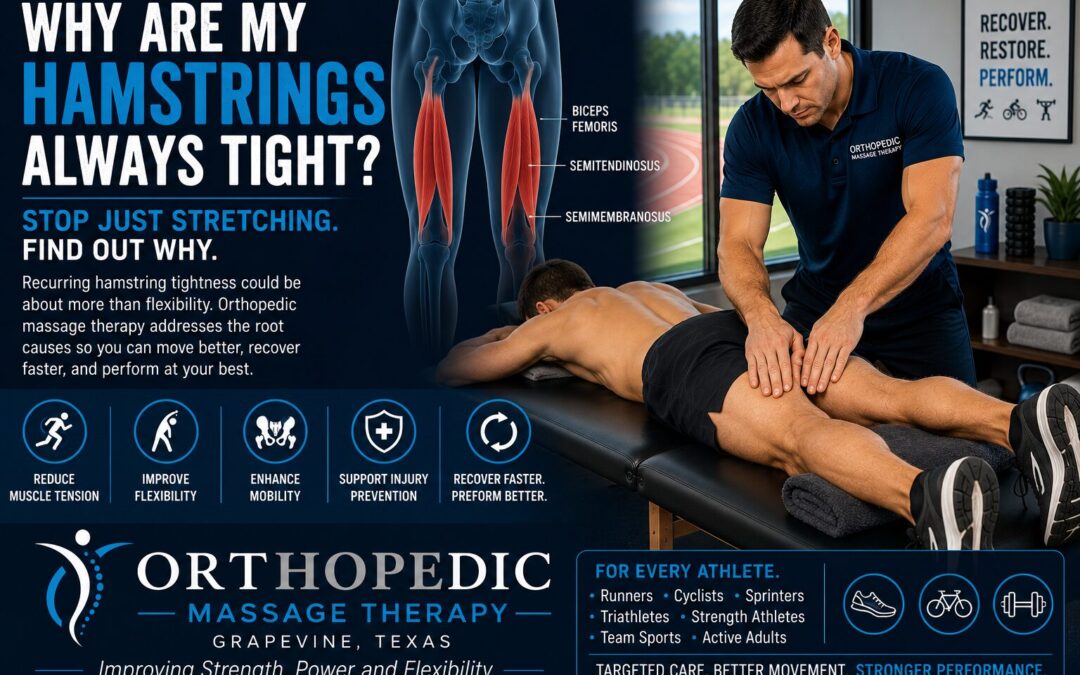
Why Are My Hamstrings Always Tight? How Orthopedic Massage Therapy Can Help Athletes Move Better
You stretch your hamstrings before training.
You stretch them afterward.
You use a foam roller.
Maybe you even stretch every morning.
But somehow, your hamstrings still feel tight.
For runners, cyclists, strength athletes, and competitive athletes, recurring hamstring tightness can be frustrating—especially when stretching provides only temporary relief.
The important question may not be:
“How can I stretch my hamstrings more?”
A better question may be:
“Why do my hamstrings keep feeling tight in the first place?”
Persistent hamstring tightness does not always mean you simply need more flexibility. Muscles can feel tight for many reasons, including repetitive training, fatigue, muscular compensation, limited mobility elsewhere, or the demands of your sport.
At Orthopedic Massage Therapy in Grapevine, Texas, we use targeted orthopedic massage therapy to address muscular restrictions, improve functional mobility, support recovery, and help athletes move more efficiently.
Understanding why your hamstrings continually feel tight may be the first step toward finding a more effective solution.
What Are the Hamstrings?
The hamstrings are a group of muscles located along the back of the thigh.
They play an important role in many athletic movements.
Your hamstrings help with:
-
Bending the knee
-
Extending the hip
-
Running
-
Sprinting
-
Jumping
-
Decelerating
-
Changing direction
-
Stabilizing movement
These muscles work closely with the glutes, hips, pelvis, knees, and lower back.
Because the hamstrings participate in so many movements, they can experience significant physical demands during athletic training.
Running and sprinting can place especially high demands on them.
Strength exercises such as deadlifts, squats, and lunges also require coordinated hamstring function.
When these muscles become fatigued, restricted, overloaded, or forced to compensate for another area, athletes may experience the familiar sensation of “tight hamstrings.”
But that feeling does not always tell the entire story.
Why Do Hamstrings Feel Tight?
There is no single reason hamstrings become tight.
Different athletes can experience the same symptom for completely different reasons.
Possible contributing factors include:
-
Repetitive training
-
High running mileage
-
Sprinting
-
Heavy strength training
-
Muscular fatigue
-
Limited hip mobility
-
Reduced movement elsewhere
-
Previous injuries
-
Training-load changes
-
Compensation patterns
-
Long periods of sitting
Sometimes the hamstring itself may have a soft-tissue restriction.
Other times, it may be responding to what is happening somewhere else in the body.
This is why repeatedly stretching the hamstrings does not always provide lasting improvement.
Why Stretching Doesn’t Always Fix Tight Hamstrings
If something feels tight, stretching seems like the obvious solution.
And sometimes it helps.
But consider this:
What if your hamstrings are already working harder than they should?
What if they are compensating for another muscle that is not contributing effectively?
What if limited hip movement is changing how your hamstrings function?
In these situations, repeatedly stretching the hamstrings may provide temporary relief without addressing why they keep becoming tight.
The sensation of tightness can sometimes be the body’s response to workload, fatigue, or compensation.
That means the tight muscle may not always be the original problem.
Orthopedic massage therapy takes a broader approach by considering how different muscles and movement patterns may be connected.
The Connection Between Tight Hips and Tight Hamstrings
The hips and hamstrings work closely together.
The hamstrings cross the hip and knee, which means their function is influenced by movement at both joints.
If hip mobility is restricted, movement patterns may change.
The hamstrings may begin working differently to compensate.
This is especially important for athletes who run, sprint, cycle, or perform repetitive lower-body training.
For example, if an athlete cannot move efficiently through the hip, the body still has to complete the movement somehow.
Other muscles may take on additional work.
The hamstrings may become part of that compensation strategy.
This is one reason a targeted treatment approach may involve more than simply working directly on the hamstrings.
The hips, glutes, pelvis, and surrounding muscles may also need attention.
Tight Hamstrings in Runners
Runners place repetitive demands on the hamstrings with every stride.
The faster you run, the greater some of those demands may become.
During running, the hamstrings help control the leg and contribute to hip extension.
Over thousands of steps, muscular fatigue and restrictions can accumulate.
Runners may notice:
-
Tightness after long runs
-
One hamstring feeling tighter than the other
-
Reduced stride comfort
-
Tightness near the glutes
-
Discomfort behind the thigh
-
A pulling sensation during faster running
-
Recurrent stiffness despite stretching
These symptoms should not automatically be ignored.
A sudden sharp pain, significant weakness, bruising, or a “popping” sensation may indicate an injury requiring appropriate medical evaluation.
But for recurring muscular tightness without an acute injury, orthopedic massage therapy may help address soft-tissue restrictions and movement limitations contributing to the problem.
Hamstring Tightness in Sprinters
Sprinters place extremely high demands on their hamstrings.
Sprint mechanics require rapid, powerful muscle contractions at high speeds.
The hamstrings must help control and reposition the leg quickly while generating and absorbing significant forces.
Because of these demands, hamstring health is especially important for:
-
Track athletes
-
Football players
-
Soccer players
-
Baseball players
-
Rugby players
-
Other speed-based athletes
Recurring tightness in a sprinter should be taken seriously.
Simply pushing through increasing tightness may not be a good strategy.
Athletes should pay attention to changes in movement, strength, and how the muscles feel during high-speed activity.
Hamstrings and Strength Training
Strength athletes also place significant demands on the hamstrings.
Exercises such as:
-
Deadlifts
-
Romanian deadlifts
-
Squats
-
Lunges
-
Kettlebell swings
-
Olympic lifts
require coordinated function between the hamstrings, glutes, hips, and lower back.
If an athlete has limited mobility or compensation patterns, certain muscles may take on more work than intended.
For example, an athlete may feel their hamstrings doing nearly all the work during exercises that should also involve significant gluteal contribution.
This does not automatically mean something is wrong.
But recurring tightness or muscular imbalance may be worth addressing.
Better movement can help athletes use their strength more efficiently.
Hamstring Tightness in Cyclists
Cyclists spend long periods performing repetitive hip and knee movements.
The hamstrings contribute throughout the pedal cycle and may become fatigued during long rides or intense training.
Cyclists may also spend extended periods in a flexed riding position.
When combined with everyday sitting, this can influence how the hips, pelvis, and surrounding muscles feel.
A cyclist may notice:
-
Hamstring tightness after long rides
-
Hip stiffness
-
Lower-back tension
-
Differences between sides
-
Reduced flexibility after training
For triathletes, these restrictions may become especially noticeable when transitioning from cycling to running.
Targeted orthopedic massage therapy may help address muscular restrictions associated with these repetitive endurance demands.
Can Tight Hamstrings Affect the Lower Back?
The hamstrings and pelvis are closely connected.
Changes in muscular tension around the hips and thighs can influence how the pelvis moves.
The lower back and pelvis must coordinate during athletic and everyday movement.
This does not mean that tight hamstrings automatically cause lower-back pain.
Lower-back discomfort can have many possible causes.
However, when evaluating movement restrictions, it may be useful to consider the entire hip and pelvic region rather than treating the lower back in isolation.
In some athletes, addressing restrictions in the hamstrings, hips, and glutes may be part of a broader strategy for improving movement.
What About the Glutes?
The gluteal muscles are among the most powerful muscles involved in athletic movement.
They contribute to:
-
Hip extension
-
Pelvic stability
-
Running
-
Sprinting
-
Jumping
-
Lifting
-
Changing direction
The glutes and hamstrings often work together.
If movement patterns change, one muscle group may begin doing more work.
An athlete who constantly experiences hamstring tightness may benefit from considering how the entire posterior chain is functioning.
The posterior chain generally refers to muscles along the back side of the body, including the glutes, hamstrings, and back muscles.
Athletic movement depends on these muscles working together effectively.
When Tightness May Actually Be an Injury
Not every tight hamstring is simply muscular tension.
Athletes should be cautious when symptoms include:
-
Sudden sharp pain
-
A popping sensation
-
Bruising
-
Significant weakness
-
Difficulty walking normally
-
Pain following an explosive sprint or movement
-
Significant swelling
These symptoms may indicate a hamstring strain or another injury.
Appropriate medical evaluation may be necessary.
Massage should not automatically be performed aggressively over an acute injury.
Treatment should always match the condition and stage of healing.
How Orthopedic Massage Therapy Can Help
Orthopedic massage therapy is a targeted approach.
Rather than performing the same massage routine for every athlete, treatment focuses on specific muscular and soft-tissue restrictions.
For recurring hamstring tightness, treatment may involve areas such as the:
-
Hamstrings
-
Gluteal muscles
-
Hip rotators
-
Hip flexors
-
Adductors
-
Lower back
-
Calves
Why would areas other than the hamstrings be treated?
Because movement is interconnected.
A restriction somewhere else may influence how the hamstrings function.
The goal is not simply to make one muscle feel looser temporarily.
The goal is to help improve overall movement and function.
Mobility, Strength, and Control
Healthy athletic movement requires more than flexibility.
Athletes need:
Mobility.
The ability to move through an appropriate range of motion.
Strength.
The ability to produce and control force.
Coordination.
The ability to use muscles efficiently during movement.
Improving flexibility without strength and control may not improve performance.
That is why orthopedic massage therapy can work well as part of a larger strategy that includes appropriate strength training, mobility exercises, and sport-specific conditioning.
Massage may help address soft-tissue restrictions.
Training helps the athlete use that movement effectively.
Recovery Matters
Sometimes tight hamstrings are simply tired hamstrings.
Athletes often focus on training harder without considering whether they are recovering adequately.
Warning signs of accumulated fatigue may include:
-
Persistent muscle tightness
-
Heavy legs
-
Declining performance
-
Longer recovery between workouts
-
Recurrent soreness
-
Changes in movement quality
A good recovery strategy may include:
-
Adequate sleep
-
Nutrition
-
Hydration
-
Appropriate rest
-
Mobility work
-
Strength training
-
Intelligent training progression
-
Targeted massage therapy
Recovery should be considered part of training—not separate from it.
Stop Stretching the Same Muscle Without Asking Why
If stretching your hamstrings helps for ten minutes and then the tightness immediately returns, it may be time to ask a different question.
Instead of:
“How can I stretch harder?”
Ask:
“Why does this keep happening?”
Recurring muscular tightness is a pattern.
Patterns can provide useful information about how the body is responding to training and movement.
Orthopedic massage therapy focuses on these patterns and the soft-tissue restrictions that may contribute to them.
Orthopedic Massage Therapy for Athletes in Grapevine, Texas
Athletes throughout Grapevine, Southlake, Colleyville, and the surrounding Dallas-Fort Worth area depend on healthy hamstring function for training and competition.
Whether you are a:
-
Runner
-
Sprinter
-
Marathoner
-
Triathlete
-
Cyclist
-
Strength athlete
-
Competitive athlete
-
Active adult
recurring hamstring tightness can interfere with movement and performance.
At Orthopedic Massage Therapy in Grapevine, Texas, we provide targeted orthopedic massage therapy focused on muscular restrictions, functional mobility, athletic recovery, and injury rehabilitation.
Treatment is individualized because every athlete is different.
Your training is different.
Your movement is different.
And the reason your hamstrings feel tight may be different from someone else’s.
Move Freely. Train Strong. Perform Better.
You should not have to stretch the same muscle every day just to temporarily feel normal.
If your hamstrings constantly feel tight, the solution may involve looking beyond the hamstrings themselves.
Your hips, glutes, training demands, recovery, mobility, and movement patterns may all play a role.
At Orthopedic Massage Therapy in Grapevine, Texas, our goal is to help athletes address muscular restrictions, improve functional movement, recover effectively, and continue pursuing their athletic goals.
Improving Strength, Power and Flexibility.
Contact Orthopedic Massage Therapy in Grapevine, Texas to learn how targeted orthopedic massage therapy may help address recurring hamstring tightness, improve mobility, support recovery, and help you move better.