How Your Pelvis Can Affect Your Back, Hips and Shoulders
How Your Pelvis Can Affect Your Back, Hips and Shoulders
When people experience back, hip or shoulder discomfort, they often focus on the area that hurts. But the body does not always work that way. Your muscles, joints and connective tissues work together as a system, and the pelvis is an important part of that system.
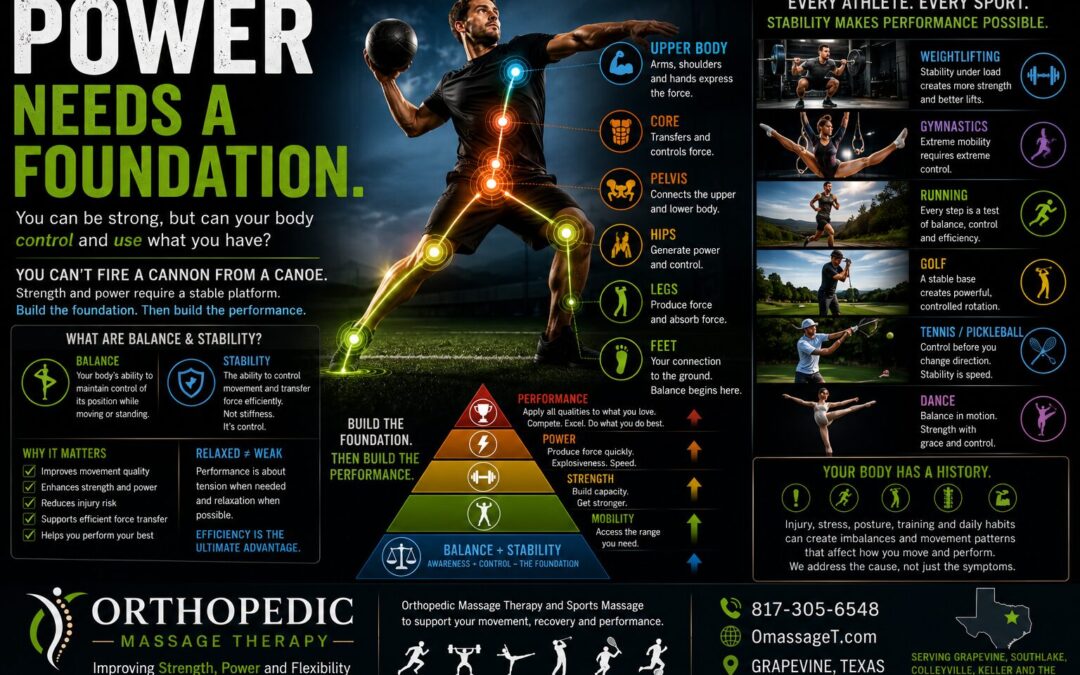
The pelvis sits between the upper and lower body. It connects the spine and trunk with the hips and legs, making it an important part of balance, stability and movement.
At OmassageT.com in Grapevine, Texas, orthopedic massage therapy takes a whole-body approach to understanding movement. Rather than focusing only on where discomfort is felt, the goal is to consider how different areas of the body may be working together.
Why the Pelvis Matters
Your pelvis provides a foundation between your spine and your legs.
Every time you walk, stand, sit, bend or change direction, the pelvis participates in the movement. The muscles surrounding the pelvis also interact with the lower back, hips, abdomen and upper body.
When movement changes in one area, other areas may compensate.
This does not mean that pelvic imbalance is automatically the cause of someone’s pain. Pain can have many causes, and persistent or severe symptoms should be evaluated by an appropriate healthcare professional.
However, the pelvis can be an important area to consider when looking at overall movement and muscle tension.
The Pelvis and Lower Back
The lumbar spine and pelvis work closely together.
When you bend forward, stand up or walk, movement occurs through both the spine and hips. Muscles surrounding the pelvis help support these movements.
If certain muscles become tight or movement becomes restricted, the body may change how it performs an activity.
Someone may notice tension in the lower back even though the movement pattern involves the hips or pelvis as well.
This is one reason orthopedic massage therapy can look beyond the exact location where a person feels discomfort.
The Pelvis and Hips
The pelvis and hips have an especially close relationship.
Your hip joints allow your legs to move while the muscles around the pelvis help provide control and stability.
Limited hip mobility can influence how someone moves through the pelvis and lower back. Likewise, changes in pelvic movement can affect how the hips participate in walking, running, squatting or other activities.
For athletes, this relationship can be particularly important.
Running, jumping, cutting and changing direction require coordinated movement between the feet, legs, hips and pelvis.
The Pelvis and Upper Back
The connection may seem surprising, but the pelvis can also be part of the movement chain that reaches the upper back.
Your body has to coordinate movement from the lower extremities through the pelvis and spine.
When someone develops a movement pattern after an old injury, prolonged sitting or another change in activity, different muscles may begin working differently.
A person may then feel tension farther up the body.
This is why someone with upper or mid-back discomfort may benefit from looking at more than just the upper back.
What About the Shoulders?
The shoulders are also connected to the rest of the body through the spine and trunk.
Think about reaching overhead, carrying something, throwing a ball or simply walking. Your shoulder does not operate independently from your trunk.
The position and movement of your trunk can influence how your shoulders move.
For this reason, a whole-body approach can be useful when looking at movement restrictions.
Again, this does not mean that every shoulder problem originates in the pelvis. Shoulder pain can have many different causes. The point is that the body works as a connected system.
Sitting Can Affect How Your Body Moves
Modern life often involves a great deal of sitting.
Long periods at a desk, in a vehicle or on a couch can place the hips and pelvis in one position for extended periods.
When you eventually stand and move, your body has to transition from that position into movement.
People may notice stiffness around the hips, lower back or other areas after prolonged sitting.
Regular movement throughout the day can help reduce the amount of time your body spends in one position.
Simple habits such as standing up, walking, changing positions and taking a few slow breaths can help you become more aware of how your body feels.
Previous Injuries Can Change Movement
An old injury can continue to influence movement even after the original injury has healed.
Sometimes people unconsciously protect an area that once hurt. They may shift their weight, change their stride or avoid certain movements.
Over time, these adaptations can become part of the way they move.
This is one reason a history of previous injury can be useful information during an orthopedic massage session.
Understanding what happened in the past can provide additional context for how someone moves today.
Balance and Stability Begin With the Whole Body
Balance is not simply a matter of standing on one foot.
Your nervous system, muscles, joints and connective tissues all contribute to maintaining your position and controlling movement.
The pelvis plays an important role because it sits between the upper and lower portions of the body.
Good movement requires both mobility and stability.
Too much restriction can make movement difficult, while insufficient control can make movement less efficient.
The goal is not simply to make everything loose. The body needs appropriate stability as well.
Orthopedic Massage and the Pelvis
Orthopedic massage therapy can be used to work with muscles and soft tissues that contribute to movement.
At OmassageT.com, the focus is on helping people improve how their bodies move by considering relationships between different areas.
Depending on the individual, this may include attention to the hips, pelvis, lower back, abdominal region, upper back and surrounding soft tissues.
The approach emphasizes balance, stability, strength, power and flexibility rather than treating every painful area as an isolated problem.
Sessions are designed to be comfortable and pain-free, allowing the body to relax while the therapist works with areas of restriction and tension.
Looking Beyond the Location of Pain
Where you feel pain is important information, but it may not tell the entire story of how your body is moving.
Your pelvis is connected to your hips and spine, while your spine connects the lower body with the upper body. Movement is a chain.
When one part of that chain changes, other areas may have to adapt.
Understanding these relationships can provide a different perspective on pain, mobility and performance.
The Goal: Better Movement
The goal of orthopedic massage is not simply to chase pain from one location to another.
A whole-body approach looks at how the body moves together.
By considering the relationship between the pelvis, hips, spine, core and surrounding soft tissues, orthopedic massage therapy can be part of a broader strategy for supporting mobility, relaxation and physical performance.
At OmassageT.com in Grapevine, Texas, the focus is on Improving Strength, Power and Flexibility while helping people better understand how their bodies move.
If you are experiencing persistent, severe or unexplained pain, consult an appropriate healthcare professional for evaluation.
OmassageT.com
110 S Barton #6
Grapevine, Texas 76051
817-305-6548