
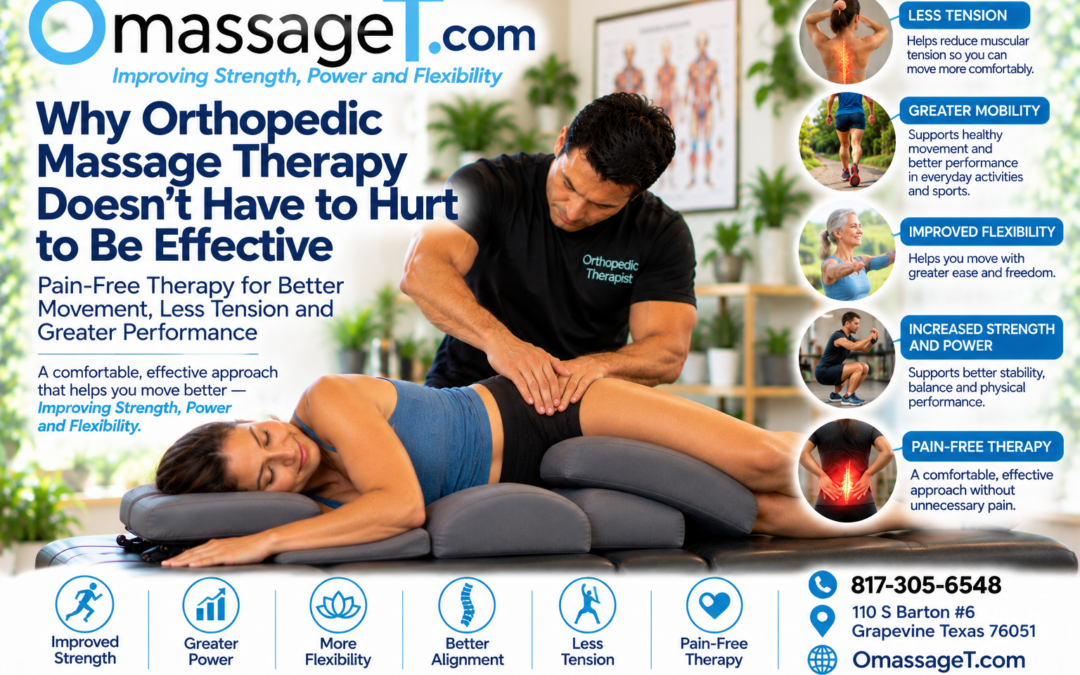
Why Orthopedic Massage Therapy Doesn't Have to Hurt to Be Effective
OmassageT.com | Pain-Free Orthopedic Massage Therapy | Grapevine, Texas
Improving Strength, Power and Flexibility!
Have you ever heard someone say, “No pain, no gain”?
That expression is common in fitness, sports, and even massage therapy. Some people believe that if a massage doesn’t hurt, it isn’t doing enough to make a difference.
But is pain really necessary for effective orthopedic massage therapy?
The answer is no. Effective massage therapy does not have to be painful.
At OmassageT.com in Grapevine, Texas, pain-free orthopedic massage therapy is more than a treatment preference. It is a central part of the approach to helping people improve comfort, movement, flexibility, and physical function.
Whether you’re a competitive athlete, an active teenager, an older adult, or someone experiencing recurring muscular discomfort, treatment should respect your body’s comfort and individual needs.
The objective isn’t to see how much pressure someone can tolerate. It’s to understand how the body moves and identify appropriate ways to support improvement.
1. Why Do People Believe Massage Has to Hurt?
For years, deep tissue massage has sometimes been associated with intense pressure and discomfort.
Some people believe that painful pressure is necessary to break up muscle knots, release fascia, or correct muscular restrictions.
Others assume that soreness following treatment means the massage was effective.
However, the intensity of pressure is not a reliable measure of treatment quality.
While some people enjoy firm pressure, others respond better to gentle or moderate techniques.
Pain tolerance also varies considerably between individuals.
A treatment that feels comfortable to one person may feel excessive to another.
Effective massage should be individualized rather than based on the assumption that greater pressure produces better results.
2. Pain Is a Signal, Not a Treatment Goal
Pain is a complex protective experience involving the nervous system, tissues, and many other factors.
When someone experiences pain, their body may respond by changing muscle activity or movement.
For example, a person with lower back discomfort may become hesitant to bend or rotate.
Someone experiencing shoulder pain may avoid reaching overhead.
These responses can be protective, especially following an injury.
During massage therapy, excessive pressure may increase discomfort or cause someone to tense their muscles.
This doesn’t mean that every uncomfortable sensation is harmful. However, intentionally producing pain is not necessary for effective treatment.
At OmassageT.com, the emphasis is on working within the client’s comfort level.
3. What Makes Pain-Free Orthopedic Massage Different?
Orthopedic massage therapy focuses on muscular and soft-tissue discomfort associated with movement, physical activity, and certain musculoskeletal conditions.
A pain-free approach emphasizes comfortable treatment techniques and communication throughout the session.
Instead of relying on aggressive pressure, treatment may incorporate gentle soft-tissue work, myofascial techniques, supportive positioning, and comfortable movement.
The specific approach depends on the individual’s needs.
For example, someone recovering from a previous injury may require a different treatment strategy from an athlete experiencing muscular soreness after training.
At OmassageT.com, the goal is to consider how muscles, connective tissues, joints, and movement patterns interact.
The focus is not simply on where discomfort occurs, but on understanding what may be contributing to it.
4. Why Relaxation Matters During Treatment
When someone feels safe and comfortable during massage, they may find it easier to relax.
Relaxation can influence perceived muscle tension and overall comfort.
Some people notice that their breathing becomes slower or that they feel less guarded during gentle treatment.
This may help them tolerate comfortable positioning or movement.
However, relaxation does not automatically correct an injury or permanently change muscle structure.
It is one useful component of an individualized approach.
At OmassageT.com, client comfort is emphasized throughout the session.
Communication about pressure, positioning, and treatment areas helps ensure that the experience remains appropriate.
5. The Relationship Between Pain-Free Massage and Fascia
Fascia is connective tissue that surrounds and supports muscles, nerves, blood vessels, and other structures.
It helps organize tissues and contributes to movement between neighboring structures.
Following injury, surgery, or reduced activity, some individuals experience soft-tissue sensitivity or stiffness.
Myofascial release is a manual therapy approach that uses controlled pressure and gentle movement to address discomfort.
Some research suggests that myofascial techniques may provide short-term improvements in pain or range of motion for certain conditions.
However, evidence does not establish that aggressive pressure is necessary to achieve these benefits.
Nor has research demonstrated that massage reliably breaks apart deep fascial adhesions.
A comfortable approach can be appropriate when addressing sensitive soft tissues.
6. Why Working Beyond the Painful Area Can Matter
Your body functions as an interconnected movement system.
Your hips, pelvis, spine, shoulders, knees, and ankles coordinate during everyday activities.
When one area becomes painful or restricted, you may change how you move.
For example, someone experiencing lower back discomfort may also have limited hip mobility.
A runner with knee discomfort may benefit from evaluating training demands, strength, and lower-body movement.
Someone experiencing neck tension may also notice discomfort around the shoulders and upper back.
These relationships don’t mean that every painful area originates somewhere else.
Instead, they demonstrate why considering the individual’s overall movement can be useful.
At OmassageT.com, orthopedic massage therapy emphasizes understanding relevant muscular and movement-related factors.
7. Pain-Free Orthopedic Massage for Athletes
Athletes regularly place significant demands on their bodies.
Runners, football players, gymnasts, swimmers, and weightlifters all rely on coordinated movement, strength, and mobility.
After training or competition, athletes may experience temporary muscle soreness and fatigue.
Sports massage and orthopedic massage may help reduce perceived soreness and promote relaxation.
However, massage does not replace appropriate training, conditioning, recovery, or injury rehabilitation.
For athletes, pain-free treatment may be particularly appealing when muscles are already sensitive following demanding activity.
The goal is to support comfortable movement without adding unnecessary discomfort.
This philosophy aligns with the OmassageT.com message:
Improving Strength, Power and Flexibility.
8. Pain-Free Therapy for People of Different Ages and Activity Levels
Not everyone seeking orthopedic massage is an athlete.
Some people want to move more comfortably during everyday activities.
Others experience muscular tension from work, previous injuries, or prolonged sitting.
Older adults may be interested in maintaining mobility and comfort.
Teenage athletes may seek help managing soreness associated with training.
People recovering from orthopedic procedures may experience sensitive tissues or restricted movement.
Treatment needs can vary considerably.
A pain-free approach allows techniques and positioning to be adapted to the individual.
For minors, appropriate parental consent and supervision are essential.
Following surgery, massage should be performed only when appropriate for the stage of healing and consistent with medical guidance.
9. Why Body Positioning Makes a Difference
Comfortable positioning is an important part of orthopedic massage therapy.
Not everyone can lie comfortably on their stomach or back for an extended period.
Someone with shoulder discomfort may find side-lying positioning more comfortable.
A person with hip or lower back sensitivity may benefit from supportive cushions.
Body-support systems can help accommodate individual needs and reduce unnecessary pressure on sensitive areas.
At OmassageT.com, positioning is considered part of creating a comfortable treatment experience.
The goal is to allow the client to relax while maintaining appropriate support and coverage.
10. Communication and Consent Are Essential
Effective treatment involves more than manual techniques.
It also requires communication, respect, and informed consent.
Before working with sensitive areas, a therapist should explain the intended approach and obtain appropriate consent.
Clients should feel comfortable asking questions or requesting changes in pressure or positioning.
Treatment should remain within professional boundaries and the therapist’s scope of practice.
At OmassageT.com, the emphasis on pain-free treatment includes respecting each client’s comfort throughout the session.
A client should never feel that they must tolerate pain to receive effective care.
11. What Results Can Someone Expect?
People respond differently to massage therapy.
Some individuals experience temporary reductions in muscular discomfort.
Others notice improved relaxation or short-term changes in range of motion.
Some clients describe feeling lighter, more open, or more comfortable moving after a session.
These experiences can be meaningful, but they do not necessarily indicate permanent structural changes.
Massage outcomes depend on several factors, including the individual’s condition, activity demands, health history, and treatment goals.
No single technique guarantees relief, and persistent symptoms may require additional medical evaluation or rehabilitation.
At OmassageT.com, the goal is to provide individualized treatment that supports comfort and movement.
12. Improving Strength, Power and Flexibility Without Painful Treatment
Strength, power, and flexibility are important throughout life.
Strength supports everyday activities such as lifting, climbing stairs, and carrying objects.
Power contributes to activities requiring quick or forceful movement.
Flexibility helps provide the range of motion needed for comfortable physical activity.
Orthopedic massage may help manage muscular discomfort and temporarily improve movement tolerance.
However, lasting improvements in strength and power generally require appropriate exercise and conditioning.
Massage can complement these activities by helping some individuals feel more comfortable participating in movement.
This is why the OmassageT.com philosophy brings together two important ideas:
Improving Strength, Power and Flexibility through Pain-Free Orthopedic Massage Therapy.
13. When Should You Seek Professional Evaluation?
Although massage may help certain types of muscular discomfort, not all pain is appropriate for massage treatment.
Persistent or worsening symptoms, unexplained swelling, progressive weakness, numbness, or significant limitations should be evaluated by a qualified healthcare professional.
Recent injuries or surgeries may require medical clearance before massage.
Orthopedic massage should complement appropriate healthcare rather than replace necessary diagnosis or treatment.
Pain-Free Orthopedic Massage Therapy in Grapevine, Texas
Effective orthopedic massage therapy doesn’t have to involve painful pressure.
For people experiencing muscular tension, recurring discomfort, or movement restrictions, a comfortable approach may provide meaningful benefits.
At OmassageT.com, pain-free orthopedic massage therapy emphasizes individualized care, supportive positioning, communication, and consideration of the whole body.
Whether you’re a competitive athlete, an older adult, or someone simply wanting to move more comfortably, the goal is to support your physical well-being without unnecessary pain.
You don’t have to hurt to work toward feeling better.
Schedule Your
Orthopedic Massage Therapy Session
OmassageT.com — Pain-Free Orthopedic Massage Therapy
110 S Barton #6
Grapevine, Texas 76051
Call or text: 817-305-6548
OmassageT.com | Pain-Free Orthopedic Massage Therapy | Grapevine, Texas
Improving Strength, Power and Flexibility through Pain-Free Orthopedic Massage Therapy!
