
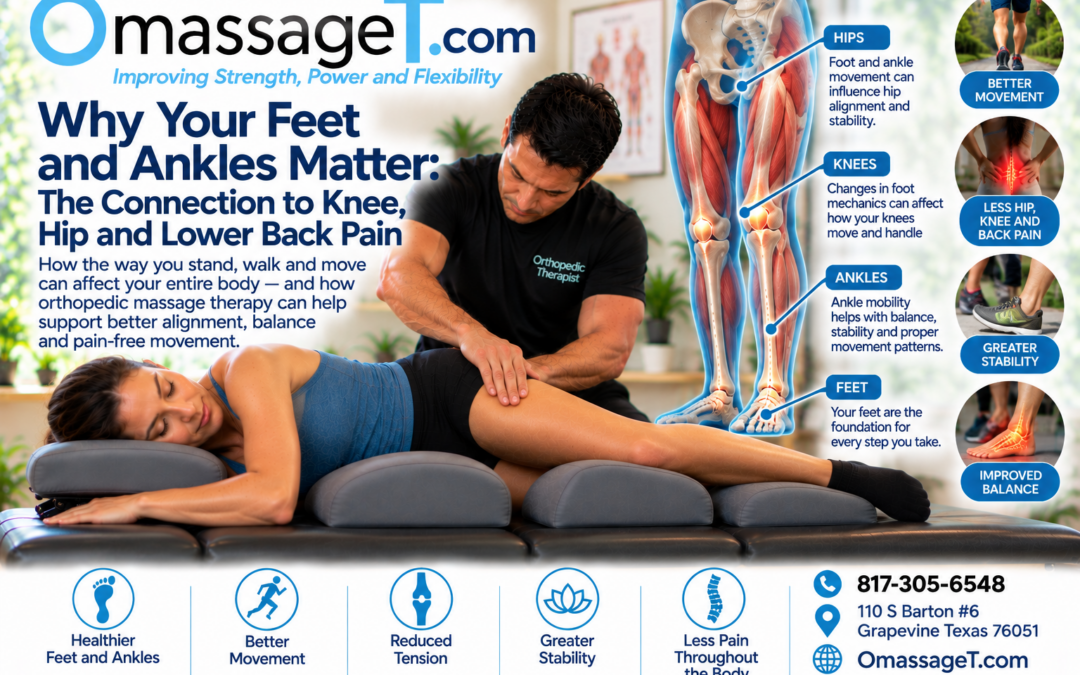
Why Your Feet and Ankles Matter: The Connection to Knee, Hip, and Lower Back Pain
Orthopedic Massage Therapy in Grapevine, Texas | OmassageT.com
Improving Strength, Power and Flexibility
Have you ever experienced knee pain without remembering a knee injury? Perhaps one hip feels tighter than the other, your lower back becomes uncomfortable after walking, or you’ve noticed that one ankle doesn’t move as freely as the other.
Sometimes, an important part of understanding these symptoms is looking farther down the body—at your feet and ankles.
Your feet are your primary points of contact with the ground when standing and walking. They help support body weight, absorb and transfer forces, and contribute to balance and movement.
Your ankles coordinate with your knees, hips, pelvis, and spine during everyday activities.
When movement becomes painful or limited in one area, other parts of the body may adjust how they function.
At OmassageT.com in Grapevine, Texas, orthopedic massage therapy emphasizes understanding these relationships rather than focusing exclusively on where someone feels discomfort.
1. Your Feet Are the Foundation of Standing and Walking
Each foot contains 26 bones, numerous joints, muscles, ligaments, and connective tissues.
These structures work together to support movement and adapt to different surfaces.
During walking, your feet help manage forces as your body weight moves from one leg to the other.
The arches of your feet contribute to load distribution and movement.
Your feet also contain sensory receptors that provide information about contact with the ground.
This sensory information helps your nervous system coordinate balance and movement.
However, there is no single ideal foot shape or arch height for everyone.
People naturally have different foot structures, and these differences do not automatically indicate a problem.
2. How Ankle Mobility Can Influence Knee Movement
Your ankle allows several movements, including dorsiflexion and plantarflexion.
Dorsiflexion occurs when the top of your foot moves toward your shin.
This movement is important during walking, squatting, stair climbing, and many athletic activities.
If ankle dorsiflexion becomes limited, someone may adjust how they move through the knee or hip.
For example, a person with reduced ankle mobility may change their squat technique or lift their heels during certain movements.
These adaptations are not automatically harmful.
However, if a movement limitation is associated with discomfort, it may be worth evaluating.
Orthopedic massage may help address muscular tension around the calf and ankle, while appropriate mobility exercises and rehabilitation may also be beneficial.
3. Can Foot Mechanics Contribute to Knee Pain?
Your feet, ankles, and knees work together during weight-bearing activities.
When you walk or run, movement occurs throughout the lower extremities.
Foot pronation is a normal movement that helps the foot adapt to the ground and manage forces.
However, some individuals experience pain associated with particular loading patterns or movement demands.
For example, runners with knee discomfort may benefit from evaluating training load, strength, footwear, and movement mechanics.
It is important to recognize that foot pronation or flat feet do not automatically cause knee pain.
Knee discomfort can arise from many factors, including local injuries, tendon problems, joint conditions, and physical activity demands.
At OmassageT.com, the goal is to consider relevant movement relationships without assuming that every knee problem originates in the feet.
4. How Your Ankles and Hips Work Together
Your ankles and hips coordinate movement during walking, running, and standing.
When you stand on one leg, muscles around your hip help control the position of your pelvis and thigh.
At the same time, muscles around your ankle make adjustments to help maintain balance.
If one ankle is painful or unstable, you may change how you distribute weight.
This can alter muscular demands around the knee and hip.
Previous ankle injuries may also affect balance and coordination after the original pain has improved.
However, these changes do not necessarily cause hip pain.
An individualized evaluation can help determine whether ankle function is relevant to a person’s symptoms.
5. Why an Old Ankle Injury May Still Matter
Ankle sprains are common, particularly among athletes.
Following an ankle injury, some individuals experience lingering weakness, reduced mobility, or decreased confidence during movement.
Others may develop chronic ankle instability, which can involve repeated episodes of the ankle giving way.
These symptoms can affect activities such as running, jumping, and changing direction.
If someone continues to avoid loading the injured ankle, they may develop compensating movement patterns.
However, an old injury does not automatically explain new pain elsewhere in the body.
Understanding injury history is useful because it can identify areas that may benefit from further assessment or rehabilitation.
Orthopedic massage may help manage associated muscular discomfort, but balance training and strengthening are often important parts of ankle rehabilitation.
6. The Role of Your Calf Muscles in Movement
Your calf contains several important muscles, including the gastrocnemius and soleus.
These muscles contribute to ankle movement and help generate force during walking, running, and jumping.
The gastrocnemius crosses both the knee and ankle joints.
The soleus plays an important role in controlling forward movement of the lower leg during weight-bearing activities.
When calf muscles become fatigued or sensitive, some people experience tightness or discomfort.
However, calf tightness does not always indicate that the muscles are physically shortened.
Muscle fatigue, training demands, and nervous system sensitivity can contribute to the sensation.
Massage may help reduce temporary soreness, while appropriate strengthening and activity management support longer-term function.
7. How Fascia Connects Your Feet and Lower Legs
Fascia is connective tissue that surrounds and supports muscles, nerves, blood vessels, and other structures.
The plantar fascia is a thick band of connective tissue along the bottom of your foot.
It contributes to supporting the arch and managing forces during walking and running.
The lower leg also contains fascial compartments that organize muscles and other structures.
Following injury or periods of reduced activity, some individuals may experience soft-tissue sensitivity or stiffness.
Myofascial release techniques use controlled pressure and gentle movement to address discomfort.
Some people experience short-term improvements in pain or range of motion.
However, research has not established that massage permanently breaks apart deep fascial adhesions or corrects foot structure.
At OmassageT.com, myofascial techniques may be incorporated into an individualized orthopedic massage session when appropriate.
8. Why Your Feet and Ankles Matter for Balance
Balance depends on coordinated activity between the nervous system, muscles, joints, vision, and inner ear.
Your feet and ankles provide important sensory information about your position relative to the ground.
When standing, small adjustments around the ankles help maintain stability.
During more challenging movements, the hips and trunk also contribute.
If someone experiences ankle pain, weakness, or reduced sensation, balance may become more difficult.
Massage may help manage muscular discomfort, but improving balance generally requires appropriate exercise and movement training.
For individuals experiencing significant balance problems, professional evaluation is important.
9. Why Runners and Athletes Should Pay Attention to Their Feet
Running places repeated demands on the feet, ankles, knees, and hips.
Every stride involves absorbing and transferring forces through the lower extremities.
For athletes, several factors contribute to comfortable movement, including training load, strength, footwear, recovery, and individual biomechanics.
Runners may experience conditions such as Achilles tendon pain, plantar heel pain, or muscular soreness.
However, these symptoms should not automatically be attributed to poor foot mechanics.
Sports massage may help manage temporary muscle soreness and promote relaxation.
Persistent pain or recurring injuries may require evaluation by a sports medicine professional or physical therapist.
10. Why Pain-Free Orthopedic Massage Matters
Some people assume that painful pressure is necessary to release tight muscles.
That isn’t necessarily true.
At OmassageT.com, the philosophy emphasizes pain-free orthopedic massage therapy.
Comfortable treatment allows clients to relax and communicate throughout the session.
Treatment may involve gentle soft-tissue massage, myofascial release, and individualized positioning.
For someone experiencing lower-leg muscular discomfort, treatment may focus on relevant muscles around the calf, ankle, or surrounding areas.
The objective is to support relaxation and comfortable movement without unnecessary pain.
11. Three Simple Ways to Support Foot and Ankle Movement
If you’re generally healthy and want to introduce comfortable movement into your day, consider these gentle activities.
Ankle circles: While seated, slowly move your foot in comfortable circles in both directions.
Supported calf raises: Stand near a stable counter or chair and slowly rise onto your toes, then lower your heels.
Gentle ankle mobility: While seated, slowly move your foot upward toward your shin and then downward.
These movements should not cause sharp pain, dizziness, or instability.
If you have a recent injury, significant swelling, or a medical condition affecting your feet or ankles, seek appropriate guidance before beginning unfamiliar exercises.
12. When Should Foot or Ankle Pain Be Evaluated?
Occasional muscular soreness after activity is common.
However, persistent pain, significant swelling, difficulty bearing weight, or repeated ankle instability deserves medical evaluation.
Sudden swelling in one leg, particularly with warmth, redness, or calf pain, requires prompt medical assessment because it may indicate a blood clot.
People with diabetes, neuropathy, or circulation problems should also seek appropriate professional guidance before receiving certain foot treatments.
Orthopedic massage may help with some types of muscular discomfort, but it does not replace medical diagnosis or necessary treatment.
Orthopedic Massage Therapy in Grapevine, Texas
Your feet and ankles contribute to much more than walking.
They work with your knees, hips, pelvis, and spine to support movement, balance, and stability.
When one area becomes painful or restricted, considering the entire lower-body movement system may help identify relevant contributing factors.
At OmassageT.com, orthopedic massage therapy emphasizes a pain-free, individualized approach.
Whether you’re a runner managing muscular soreness, an athlete recovering from training, or someone experiencing recurring lower-body tension, orthopedic massage may be a helpful part of your overall wellness plan.
Better movement begins with understanding how your body works together—from your feet to your spine.
Schedule Your,
Orthopedic Massage Therapy Session
OmassageT.com — Orthopedic Massage Therapy
110 S Barton #6
Grapevine, Texas 76051
Call or text: 817-305-6548
Website: OmassageT.com
Improving Strength, Power and Flexibility
