
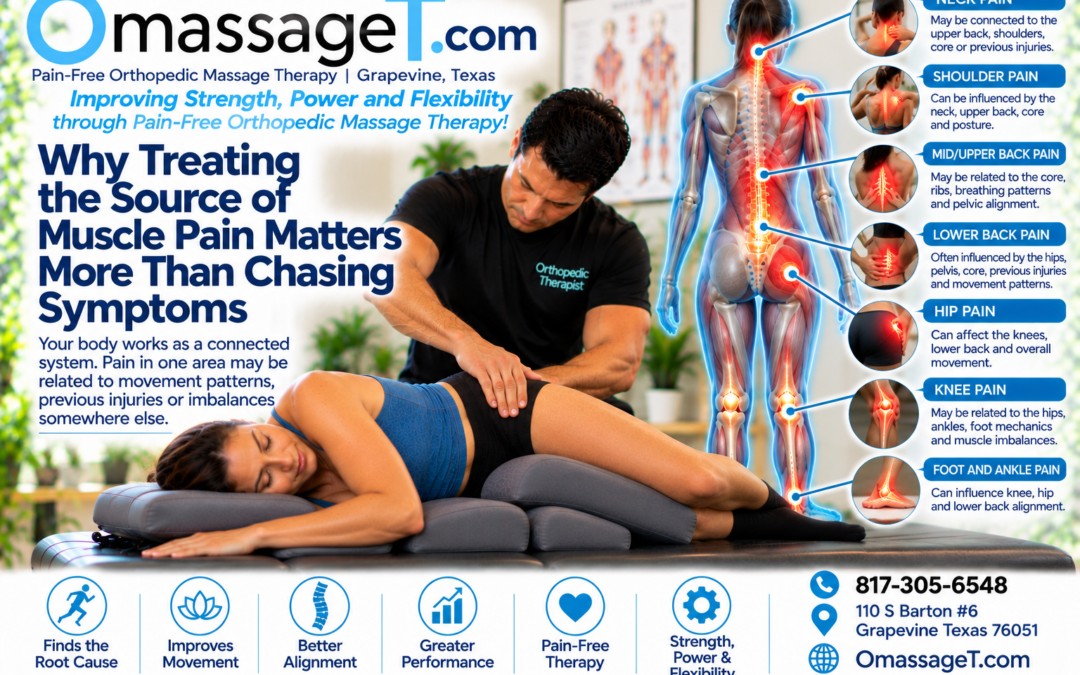
Why Treating the Source of Muscle Pain Matters More Than Chasing Symptoms
OmassageT.com | Pain-Free Orthopedic Massage Therapy | Grapevine, Texas
Improving Strength, Power and Flexibility
through Pain-Free Orthopedic Massage Therapy!
Understanding Why Pain Happens
Have you ever experienced pain in one part of your body, received treatment, felt better, and then noticed the same discomfort returning?
Perhaps your lower back keeps tightening up. Maybe one shoulder repeatedly becomes uncomfortable, or your knee begins hurting after running even though you don’t remember injuring it.
It’s natural to focus on the area where you feel pain.
However, the location of discomfort doesn’t always reveal every factor contributing to it.
Your body is an interconnected movement system. Muscles, joints, fascia, nerves, and connective tissues work together to help you stand, walk, bend, reach, and perform physical activities.
When one area becomes painful or restricted, other parts of the body may adjust how they function.
At OmassageT.com in Grapevine, Texas, pain-free orthopedic massage therapy emphasizes understanding these relationships.
Rather than concentrating exclusively on symptoms, the approach considers relevant muscular restrictions, previous injuries, and movement patterns that may contribute to discomfort.
1. What’s the Difference Between a Symptom and a Contributing Factor?
A symptom is something you experience, such as pain, stiffness, or muscular tightness.
A contributing factor is something that may influence the development or persistence of that symptom.
For example, someone experiencing recurring neck tension may spend long hours performing repetitive computer work.
The neck discomfort is the symptom.
Sustained muscular demands, limited movement breaks, stress, or reduced activity tolerance may be contributing factors.
Similarly, someone experiencing knee discomfort while running may have recently increased their training distance.
The knee pain is the symptom, while the sudden increase in physical demands may be relevant.
However, pain is complex, and it isn’t always possible to identify one specific source.
The goal is to consider the available information rather than assume that every symptom has a single mechanical explanation.
2. Why the Painful Area Isn’t Always the Only Area Worth Evaluating
Your body coordinates movement across multiple joints and muscle groups.
When you walk, your feet, ankles, knees, hips, pelvis, and spine all participate.
When you reach overhead, your shoulder blades, rib cage, thoracic spine, and shoulders work together.
If movement becomes limited or uncomfortable in one region, you may change how you perform certain activities.
For example, someone with reduced hip mobility may alter how they squat or bend.
Someone recovering from an ankle injury may temporarily shift more weight onto the opposite leg.
These adjustments are often natural and protective.
However, if discomfort persists, understanding movement throughout the body may help identify relevant limitations.
This doesn’t mean that the source of pain is always somewhere other than where it hurts.
Local injuries, joint conditions, and other medical factors can also be responsible.
3. How Previous Injuries May Influence Current Discomfort
Previous injuries can sometimes affect movement after the original pain has improved.
Imagine someone who experienced a quadriceps strain several years ago.
During recovery, they may have temporarily changed how they walked, ran, or lifted their leg.
If strength or mobility did not fully return, certain movement differences might persist.
Similar situations can occur following ankle sprains, knee injuries, hip injuries, or orthopedic surgery.
These adaptations do not automatically cause new pain.
However, injury history can provide useful information when considering recurring muscular discomfort.
At OmassageT.com, understanding previous injuries is part of considering the individual as a whole.
4. Why Your Pelvis and Core May Matter for Lower Back Pain
Your pelvis connects your spine to your lower extremities.
Muscles surrounding the hips, abdomen, and lumbar spine help coordinate movement and stability.
These include the gluteal muscles, abdominal wall, hip flexors, spinal muscles, and other supporting structures.
When someone experiences lower back discomfort, movement around the hips and trunk may be relevant.
For example, limited hip extension may influence how someone walks or performs certain exercises.
However, there is no single ideal pelvic alignment or posture that guarantees freedom from pain.
People naturally have different movement patterns and anatomical structures.
The objective is to identify limitations that are meaningful to the person’s symptoms and activities.
Orthopedic massage may help manage associated muscular tension, while appropriate exercise or rehabilitation may also be beneficial.
5. How Fascia and Soft Tissues Contribute to Movement
Fascia is connective tissue that surrounds and supports muscles, nerves, blood vessels, and other structures.
It helps organize tissues and contributes to movement between neighboring structures.
Following injury, surgery, or periods of reduced activity, some individuals experience soft-tissue sensitivity or stiffness.
Myofascial release techniques use controlled pressure and gentle movement to address discomfort.
Some people experience short-term improvements in pain or range of motion.
However, massage has not been shown to reliably break apart deep fascial adhesions or permanently correct structural alignment.
At OmassageT.com, myofascial techniques may be incorporated into individualized, pain-free orthopedic massage sessions when appropriate.
6. Why Pain-Free Treatment Is Important
Some people believe that effective massage must involve deep, painful pressure.
That isn’t necessarily true.
At OmassageT.com, pain-free orthopedic massage therapy is a central principle.
Excessive pressure may increase discomfort or cause protective muscle activity.
Comfortable treatment allows clients to relax and communicate throughout the session.
Techniques may include gentle soft-tissue massage, myofascial release, supportive positioning, and comfortable movement.
The objective is not to force the body through pain.
It is to support relaxation, comfort, and movement while respecting the individual’s needs.
7. Why Recurring Pain May Require More Than Massage
Massage can be helpful for certain types of muscular discomfort.
However, recurring pain may involve factors that require additional attention.
For example, someone experiencing repeated discomfort after running may need to consider training load, strength, footwear, and recovery.
A person with recurring neck tension may benefit from movement breaks, physical activity, and changes to sustained work demands.
Someone recovering from an injury may require rehabilitation to rebuild strength or coordination.
Massage may complement these approaches by helping manage muscular soreness and discomfort.
However, it should not replace medical evaluation or necessary rehabilitation.
8. The Relationship Between Strength, Power, and Flexibility
At OmassageT.com, the philosophy of Improving Strength, Power and Flexibility reflects the importance of comfortable physical function.
Strength helps you produce and control force.
Power allows you to generate force quickly.
Flexibility contributes to the range of motion available during movement.
These qualities matter throughout life.
For athletes, they support the physical demands of training and competition.
For working adults, they contribute to everyday activities.
For older individuals, they can be important for maintaining mobility and independence.
Massage may help manage discomfort that interferes with movement, while lasting improvements in strength and power generally require appropriate exercise and conditioning.
9. Why Athletes Benefit From Understanding Movement Patterns
Athletes repeatedly place substantial demands on their bodies.
Runners, football players, gymnasts, and weightlifters all rely on coordinated movement across multiple joints.
When discomfort develops, considering the entire movement system may provide useful information.
For example, a runner with knee pain may benefit from evaluating training demands, lower-body strength, and movement mechanics.
A football player experiencing shoulder discomfort may need to consider local shoulder function alongside trunk movement and previous injuries.
Sports massage may help manage temporary soreness and promote relaxation.
However, performance development and injury prevention depend on appropriate training, recovery, and rehabilitation when necessary.
10. Why Comfortable Positioning Matters
A pain-free treatment experience involves more than the amount of pressure used.
Body positioning is also important.
Someone with lower back discomfort may benefit from cushions supporting the hips or knees.
An individual with shoulder sensitivity may find side-lying positioning more comfortable.
People recovering from injuries may require additional support.
At OmassageT.com, supportive positioning helps create a comfortable environment for individualized treatment.
Communication about pressure, positioning, and treatment areas is essential.
11. What Does Meaningful Improvement Look Like?
Progress can mean different things to different people.
For a runner, it may mean returning to training more comfortably.
For a working adult, it may mean experiencing less muscular tension after a long day.
For an older individual, it may mean moving more comfortably during everyday activities.
Some clients describe feeling more relaxed, open, or comfortable in their posture following massage.
These experiences may reflect temporary changes in muscular tension, relaxation, or movement perception.
They do not necessarily indicate permanent structural changes.
Massage outcomes vary, and no specific result can be guaranteed.
The goal is to support each person’s individual movement and comfort goals.
12. When Should Recurring Pain Be Evaluated?
Recurring muscular discomfort may sometimes respond to conservative approaches such as massage, exercise, and activity modification.
However, persistent or worsening pain deserves appropriate medical evaluation.
Symptoms such as unexplained swelling, progressive weakness, numbness, or significant movement limitations should not automatically be attributed to muscle tightness.
Orthopedic massage should complement appropriate healthcare rather than replace medical diagnosis or necessary treatment.
Pain-Free Orthopedic Massage Therapy in Grapevine, Texas
Relieving pain is important.
But understanding the factors that may contribute to recurring discomfort can be equally valuable.
At OmassageT.com, orthopedic massage therapy emphasizes an individualized, pain-free approach that considers the body as an interconnected movement system.
Whether you’re an athlete managing recurring soreness, a working adult experiencing muscular tension, or someone recovering from a previous injury, the goal is to support comfortable movement and physical well-being.
Don’t focus only on where it hurts. Consider how your body moves and what may be contributing to the discomfort.
Improving Strength, Power and Flexibility through Pain-Free Orthopedic Massage Therapy!
Schedule Your
Orthopedic Massage Therapy Session
OmassageT.com | Pain-Free Orthopedic Massage Therapy | Grapevine, Texas
110 S Barton #6
Grapevine, Texas 76051
Call or text: 817-305-6548
Website: OmassageT.com
Improving Strength, Power and Flexibility
through Pain-Free Orthopedic Massage Therapy!
