Standing, Sitting and Sleeping: How Daily Positions Affect Your Body
Your body spends a lot of time in three basic situations: standing, sitting and sleeping.
We often think about exercise when we think about movement and physical health, but the positions you spend hours in every day can also influence how your body feels and moves.
The way you sit at work, stand during the day, drive your car or sleep at night can all become part of your body’s movement patterns.
At OmassageT.com in Grapevine, Texas, orthopedic massage therapy takes a whole-body approach to movement. Looking at daily habits can provide useful information when someone experiences stiffness, muscle tension, restricted mobility or discomfort.
Your Body Adapts to the Positions You Use
Your body is constantly adapting.
If you spend several hours sitting, your body becomes accustomed to that position.
If your job requires standing for most of the day, your body adapts to that demand.
If you regularly sleep in one position, you may notice that certain areas feel different when you wake up.
None of these positions is automatically “bad.”
The important consideration is often how long you stay in one position and how much movement you get between those periods.
Your body was designed to move through many different positions.
Sitting for Long Periods
Sitting is part of everyday life.
We sit at desks, in cars, at restaurants, while watching television and while using computers and phones.
The challenge can come when sitting lasts for hours without much movement.
Your hips remain flexed.
Your pelvis supports your body.
Your spine maintains the position.
Your shoulders and neck may remain in one position while you look at a screen.
After several hours, you may notice stiffness when you finally stand.
This is one reason changing positions throughout the day can be valuable.
Standing All Day
Standing is often considered the opposite of sitting, but standing in one position for long periods can also be demanding.
People may shift their weight from one leg to another, lock their knees, lean against something or favor one side without realizing it.
These habits can become part of how the body maintains balance.
If you notice that you consistently stand with more weight on one side, it may be worth paying attention to how that affects your movement.
Balance does not mean standing perfectly still.
Your body is constantly making small adjustments to keep you upright.
Your Feet Are Part of the Picture
Your feet provide your connection with the ground.
When you stand, information from your feet helps your body understand where you are in space.
Your ankles, knees, hips and pelvis respond to that information.
Your spine and upper body then make additional adjustments.
This is another example of how the body works as a connected system.
A movement issue does not necessarily begin where you feel it.
The Pelvis and Your Daily Positions
The pelvis plays an important role in both sitting and standing.
When you sit, the pelvis supports your body and your hips remain flexed.
When you stand, your pelvis becomes part of the foundation supporting your trunk over your legs.
Changing between these positions requires coordination.
Standing up from a chair is a simple movement, but it involves your feet, ankles, knees, hips, pelvis, core and spine.
This is why the pelvis is such an important part of understanding movement.
Your Sleeping Position Matters Too
Sleep is different from standing and sitting because you are not consciously controlling your position for much of the night.
People naturally move while they sleep.
Still, you may have a preferred position.
Some people sleep on their side.
Some sleep on their back.
Others move between several positions throughout the night.
There is no single sleeping position that is perfect for everyone.
However, if you consistently wake up with neck, shoulder, back or hip stiffness, your sleeping position, pillow, mattress, or other factors may be worth considering.
Persistent or significant pain should be evaluated appropriately rather than automatically blaming your sleeping position.
“I Slept Wrong”
Almost everyone has experienced waking up and thinking:
“I slept wrong.”
Sometimes you may wake up with a stiff neck or sore shoulder after sleeping in an unusual position.
The sensation can be temporary.
When you suddenly change positions during sleep or remain in one position for a long time, certain muscles and joints may feel different when you wake up.
Gentle movement may help the body transition back into normal activity.
If pain is severe, persistent or accompanied by other concerning symptoms, seek appropriate medical evaluation.
Movement Between Positions Matters
One of the most important parts of this conversation is not finding a perfect position.
It is changing positions.
If you sit for a long time, stand up and move.
If you stand for hours, sit down or walk around.
If you have been lying down, give your body a chance to move gradually.
Your body benefits from variety.
Movement gives different muscles and joints opportunities to participate.
Your Core Helps You Transition
Your core is involved whenever you change positions.
Think about getting out of a chair.
Your feet connect with the floor.
Your legs generate force.
Your hips and pelvis move.
Your core stabilizes your trunk.
Your spine moves into an upright position.
This is a coordinated movement.
Core performance is therefore about much more than abdominal strength.
It involves the ability to stabilize and control your body while you move.
Breathing Can Help You Become More Aware
Breathing is another simple way to reconnect with your body.
If you have been sitting at a computer for several hours, try stopping for a moment.
Stand up.
Relax your shoulders.
Take a comfortable breath.
Allow your rib cage to move.
Then gently move your spine, hips and shoulders.
The goal is not to force a stretch.
It is simply to interrupt the period of inactivity and become aware of how your body feels.
Previous Injuries Can Change How You Sit and Stand
A previous injury can influence daily movement.
Someone with an old hip injury may sit differently.
Someone with a previous knee injury may stand with more weight on the opposite side.
Someone with a history of back discomfort may avoid certain positions.
These adaptations can become automatic.
They may continue even after the original injury has improved.
This is why your injury history can be valuable information during an orthopedic massage session.
Looking at Your Whole Day
Instead of thinking only about your exercise routine, consider your entire day.
How many hours do you sit?
How often do you stand?
How much do you walk?
Do you change positions regularly?
How do you feel when you first get out of bed?
Do you feel stiff after driving?
Does one side of your body feel different from the other?
These observations can help you become more aware of your movement patterns.
Orthopedic Massage and Daily Movement
At OmassageT.com, orthopedic massage therapy focuses on the relationship between different areas of the body.
The goal is not to tell every person that their posture is “wrong.”
There is no single posture that everyone must maintain all day.
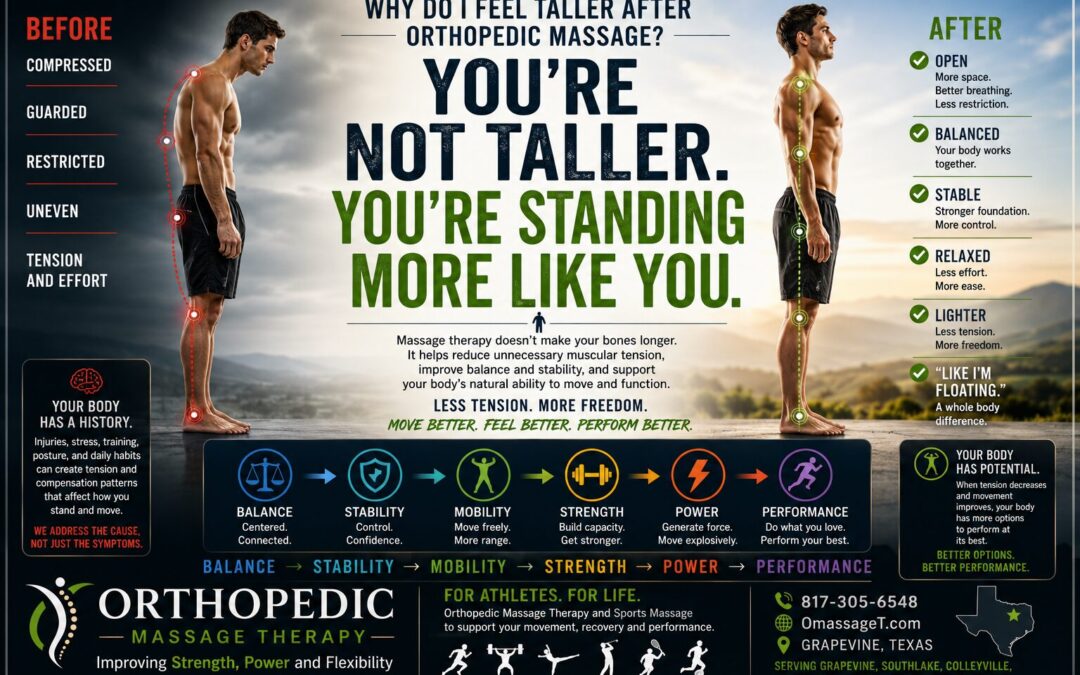
Instead, the focus is on movement, balance, stability, mobility, strength, power and flexibility.
If areas of the body feel restricted, orthopedic massage and myofascial work may be used as part of a broader approach to supporting comfortable movement.
Your Body Needs Variety
Standing, sitting and sleeping are all normal parts of life.
The goal is not to eliminate any of them.
The goal is to avoid being trapped in one position for too long.
Your body needs movement and variety.
Stand.
Sit.
Walk.
Breathe.
Stretch comfortably.
Change positions.
Let your body experience different forms of movement throughout the day.
Improving Strength, Power and Flexibility
At OmassageT.com in Grapevine, Texas, the philosophy is centered around Improving Strength, Power and Flexibility.
But these qualities do not exist separately from your daily life.
They are connected to how you sit, stand, sleep, walk, exercise and recover.
Understanding your daily movement habits can be an important part of understanding your body.
And sometimes the simplest change is simply to stop staying in one position and move.
OmassageT.com
110 S Barton #6
Grapevine, Texas 76051
817-305-6548