Orthopedic Massage Therapy OmassageT.com
If you run, cycle, lift weights, compete in sports, or simply live an active lifestyle, you have probably experienced tight hips at some point.
Maybe your hips feel stiff when you first get out of bed.
Perhaps your stride feels restricted when you run.
You might have difficulty getting into a deep squat, feel tightness after cycling, or notice that one hip moves differently than the other.
Many athletes simply accept tight hips as part of training.
But persistent hip tightness may affect more than comfort.
The hips play a central role in nearly every athletic movement. When mobility becomes restricted, the body may compensate somewhere else—potentially affecting the lower back, knees, hamstrings, or even the way you run and generate power.
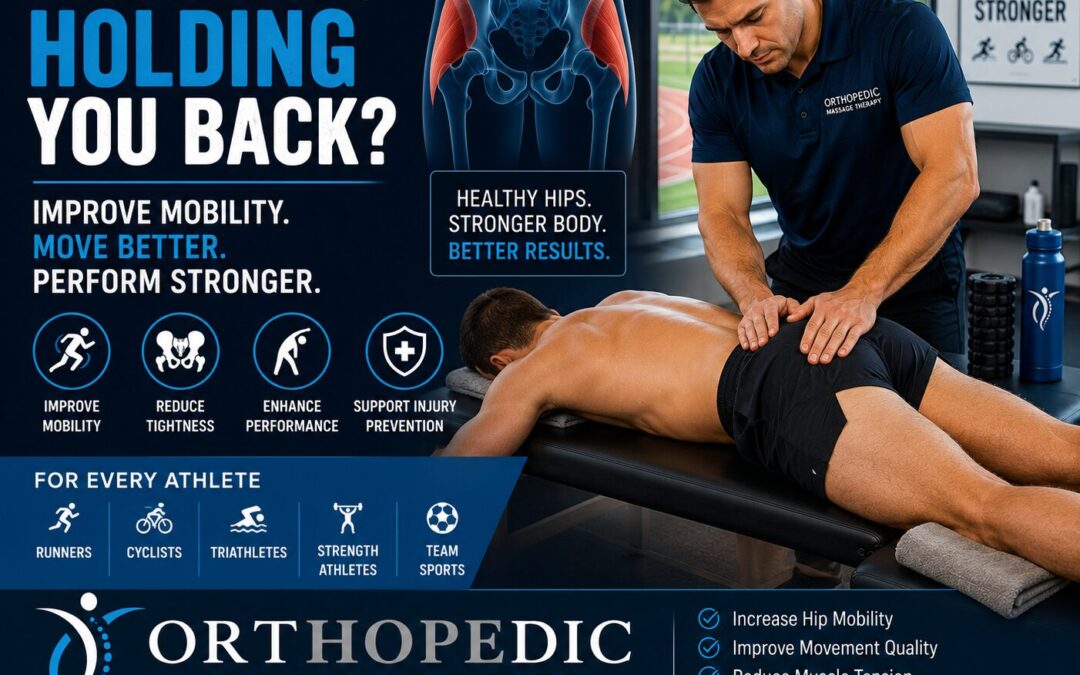
At Orthopedic Massage Therapy in Grapevine, Texas, we use targeted orthopedic massage therapy to help address muscular restrictions, improve functional mobility, support recovery, and help athletes move more efficiently.
If tight hips are limiting your movement or athletic performance, understanding why they feel tight may be the first step toward improving how your entire body moves.
Why Are the Hips So Important for Athletes?
The hips are located near the center of the body and play an essential role in transferring force between the upper and lower body.
Think about almost any athletic movement.
Running.
Jumping.
Squatting.
Cycling.
Changing direction.
Kicking.
Lifting.
Accelerating.
All of these movements depend heavily on the hips.
The hip joint is designed to move in multiple directions while also providing stability.
This requires coordination between numerous muscles surrounding the pelvis and upper leg.
Important muscles in this region include the:
-
Gluteal muscles
-
Hip flexors
-
Adductors
-
Hamstrings
-
Deep hip rotators
-
Muscles surrounding the pelvis and lower back
When these muscles work together efficiently, athletes can generate and transfer force effectively.
When movement becomes restricted, the body often finds another way to complete the task.
That is when compensation can begin.
Why Do Hips Feel Tight?
There is no single cause of hip tightness.
Different athletes may experience the same sensation for completely different reasons.
Common contributing factors may include:
-
Repetitive training
-
Long periods of sitting
-
High running mileage
-
Cycling
-
Heavy strength training
-
Limited mobility
-
Muscular fatigue
-
Previous injuries
-
Compensation patterns
-
Differences in strength or movement between sides
Sometimes the muscles around the hip are genuinely restricted.
Other times, a muscle may feel tight because it is working harder than it should.
This distinction matters.
Simply stretching a tight muscle repeatedly may not solve the problem if that muscle is compensating for another issue.
Sitting and Hip Tightness
Many athletes train hard for an hour or two and then spend much of the rest of the day sitting.
They may sit:
-
At a desk
-
In meetings
-
While driving
-
During air travel
-
On the couch
This creates an interesting situation.
Someone can be extremely active and still spend many hours each day in relatively static positions.
Long periods of sitting keep the hips in a flexed position.
When combined with demanding athletic training, some people may notice stiffness or restricted movement around the hips.
Getting up regularly, changing positions, walking, mobility work, and appropriate exercise can all be helpful.
For persistent muscular restrictions, targeted orthopedic massage therapy may also be useful.
Tight Hips and Running Performance
Runners depend heavily on efficient hip movement.
With every stride, the hips must coordinate movement while helping stabilize the pelvis.
Now consider how many times that movement repeats during a long run.
Thousands of times.
Small restrictions can become increasingly noticeable as mileage increases.
A runner with limited hip mobility may compensate by changing movement elsewhere.
This can potentially influence the:
-
Pelvis
-
Lower back
-
Knees
-
Hamstrings
-
Calves
A runner may notice that their stride feels shorter on one side or that one leg does not move as freely.
They may also experience recurring tightness that seems to return no matter how much they stretch.
Orthopedic massage therapy can help address muscular and soft-tissue restrictions around the hips that may be contributing to limited movement.
Hip Mobility for Cyclists
Cyclists spend long periods in a flexed position.
The hips repeatedly move through a relatively specific range while pedaling.
During long rides or high-volume training, cyclists may develop muscular fatigue and tightness around the:
-
Hip flexors
-
Quadriceps
-
Glutes
-
Hamstrings
-
Lower back
A cyclist may feel fine while riding but notice significant stiffness when standing upright afterward.
Triathletes face an additional challenge.
They must transition from cycling directly into running.
The body moves from a prolonged cycling position into an upright running stride.
Adequate hip mobility can be especially important during this transition.
Targeted orthopedic massage therapy may help address muscular restrictions that develop from repetitive cycling and endurance training.
Tight Hips and Strength Training
Hip mobility is also important for strength athletes.
Movements such as:
-
Squats
-
Deadlifts
-
Lunges
-
Olympic lifts
-
Kettlebell exercises
all require coordinated movement through the hips.
When hip mobility is limited, athletes may compensate through the lower back, knees, or other areas.
This does not mean every athlete needs extreme flexibility.
In fact, excessive mobility without adequate control is not necessarily beneficial.
Athletes need enough mobility to perform the movements required by their sport while maintaining strength and control.
The goal is functional mobility.
Can Tight Hips Cause Lower Back Pain?
The relationship between the hips and lower back is complex.
Not every case of lower back pain is caused by tight hips.
However, the hips and lower back work closely together during movement.
If the hips do not move efficiently, the body may sometimes create additional movement elsewhere.
The lower back may compensate.
For example, if an athlete cannot achieve enough movement through the hip during a particular activity, the pelvis or lumbar spine may move differently to complete the task.
Repeated compensation can potentially contribute to muscular tension or discomfort.
This is why focusing only on the location of pain may sometimes miss an important part of the picture.
When appropriate, addressing hip mobility may be part of a broader approach to improving movement.
Tight Hips and Knee Problems
The hips also influence movement at the knees.
Muscles around the hip help control the position of the thigh during running, jumping, landing, and changing direction.
If hip movement or muscular control is limited, mechanics farther down the leg may change.
Again, this does not mean every knee problem originates at the hip.
Knee pain can have many causes and should be appropriately evaluated when necessary.
But the body functions as a connected system.
When working with athletes experiencing recurring lower-body problems, it can be useful to consider how the hips are functioning rather than looking only at the painful area.
Why Stretching Your Hip Flexors May Not Be Enough
One of the most common responses to tight hips is stretching the hip flexors.
Stretching may provide temporary relief.
But if the tightness keeps returning, there may be more to consider.
A muscle can feel tight because it is:
-
Overworked
-
Fatigued
-
Compensating for weakness elsewhere
-
Responding to repetitive movement
-
Protecting an area
-
Working within a restricted movement pattern
If you stretch the same area every day but the tightness always returns, repeatedly stretching harder may not be the answer.
The better question may be:
Why does this muscle keep becoming tight?
Orthopedic massage therapy takes this more targeted approach.
Rather than simply applying pressure everywhere, treatment focuses on specific muscular restrictions and how they may relate to movement.
How Orthopedic Massage Therapy Can Help Hip Mobility
Orthopedic massage therapy focuses on muscles and soft tissues that influence movement and function.
For hip-related restrictions, treatment may involve areas such as the:
-
Hip flexors
-
Gluteal muscles
-
Deep hip rotators
-
Adductors
-
Quadriceps
-
Hamstrings
-
Lower back
The exact treatment depends on the individual.
Two athletes with “tight hips” may need completely different approaches.
One runner may have restrictions primarily involving the hip flexors.
Another may have significant gluteal tension.
A cyclist may experience a combination of hip and lower-back restrictions.
An athlete recovering from an injury may have developed compensation patterns.
Treatment should reflect the person’s specific needs rather than following the same routine for everyone.
Mobility and Strength Must Work Together
Improving mobility is only part of the equation.
Athletes also need strength and control.
Imagine increasing the available range of motion at a joint without having the muscular control to use that range effectively.
That may not improve athletic performance.
The goal is to combine:
Mobility + Strength + Control
Orthopedic massage therapy may help address soft-tissue restrictions that limit movement.
Strength and corrective exercises can then help the athlete control and use that movement effectively.
This combination may support better athletic mechanics and performance.
Signs Your Hip Tightness Deserves Attention
Occasional stiffness after a demanding workout is common.
But recurring patterns may deserve closer attention.
Consider seeking appropriate assessment or treatment if you notice:
-
One hip consistently feels tighter than the other
-
Hip tightness repeatedly affects your running stride
-
You cannot comfortably perform movements you previously could
-
Tightness returns immediately after stretching
-
Your lower back or knees repeatedly compensate during movement
-
Hip discomfort is becoming more frequent
-
Your mobility is gradually decreasing
-
Pain is interfering with training or daily activities
Severe pain, significant weakness, numbness, trauma-related symptoms, or persistent joint pain should be evaluated by an appropriate healthcare professional.
Massage therapy is not a substitute for necessary medical evaluation.
Don’t Chase Flexibility—Improve Movement
Athletes sometimes assume that more flexibility is always better.
That is not necessarily true.
A competitive runner does not need the flexibility of a gymnast.
A powerlifter has different mobility requirements than a triathlete.
A cyclist has different demands than a soccer player.
The goal should be to develop enough mobility for your activity while maintaining strength and control.
Orthopedic massage therapy can be one tool for addressing muscular restrictions that interfere with that functional movement.
Hip Mobility and Injury Rehabilitation
After an injury, athletes may unintentionally change the way they move.
They may protect one side.
Shift weight differently.
Shorten their stride.
Avoid certain movements.
Even after the original injury improves, some of these compensation patterns may remain.
This can create tightness or overwork in other muscles.
Orthopedic massage therapy may be incorporated into an appropriate rehabilitation strategy to address muscular and soft-tissue restrictions that developed during the injury or recovery process.
Depending on the situation, treatment may complement care from physicians, physical therapists, chiropractors, athletic trainers, or other healthcare professionals.
Orthopedic Massage Therapy for Athletes in Grapevine, Texas
Athletes throughout Grapevine, Southlake, Colleyville, and the surrounding Dallas-Fort Worth area depend on healthy hip movement for training, competition, and everyday activity.
Whether you are a:
-
Runner
-
Marathoner
-
Triathlete
-
Cyclist
-
Strength athlete
-
Competitive athlete
-
Active adult
your hips play an important role in how efficiently you move.
At Orthopedic Massage Therapy in Grapevine, Texas, we provide targeted orthopedic massage therapy focused on addressing muscular restrictions, improving mobility, supporting recovery, and complementing injury rehabilitation.
We do not believe every athlete should receive exactly the same treatment.
Your sport is different.
Your body is different.
Your movement patterns are different.
Your treatment should reflect those differences.
Move Better. Perform Stronger.
Tight hips should not automatically become something you accept as part of being an athlete.
If you constantly stretch but the same tightness returns, if one hip feels more restricted than the other, or if limited mobility is beginning to affect your training, it may be time to look more closely at what is contributing to the problem.
Better movement can help create a stronger foundation for athletic performance.
At Orthopedic Massage Therapy in Grapevine, Texas, our goal is to help athletes improve functional movement, address muscular restrictions, recover effectively, and continue doing the activities they love.
Improving Strength, Power and Flexibility.
Contact Orthopedic Massage Therapy in Grapevine, Texas to learn how targeted orthopedic massage therapy may help improve hip mobility, support athletic recovery, and keep you moving toward your performance goals.