Orthopedic Massage Therapy OmassageT.com
You start your run feeling good.
Then your knee begins to ache.
Maybe the discomfort appears after the first few miles. Perhaps you only notice it when running downhill, climbing stairs, squatting, or after finishing a long training session.
You rest for a few days.
The knee feels better.
You start running again.
And the pain comes back.
For runners and competitive athletes, recurring knee pain can be extremely frustrating—especially when it begins interfering with training, race preparation, or athletic performance.
But here is something important to understand:
The place where you feel pain is not always the only place contributing to the problem.
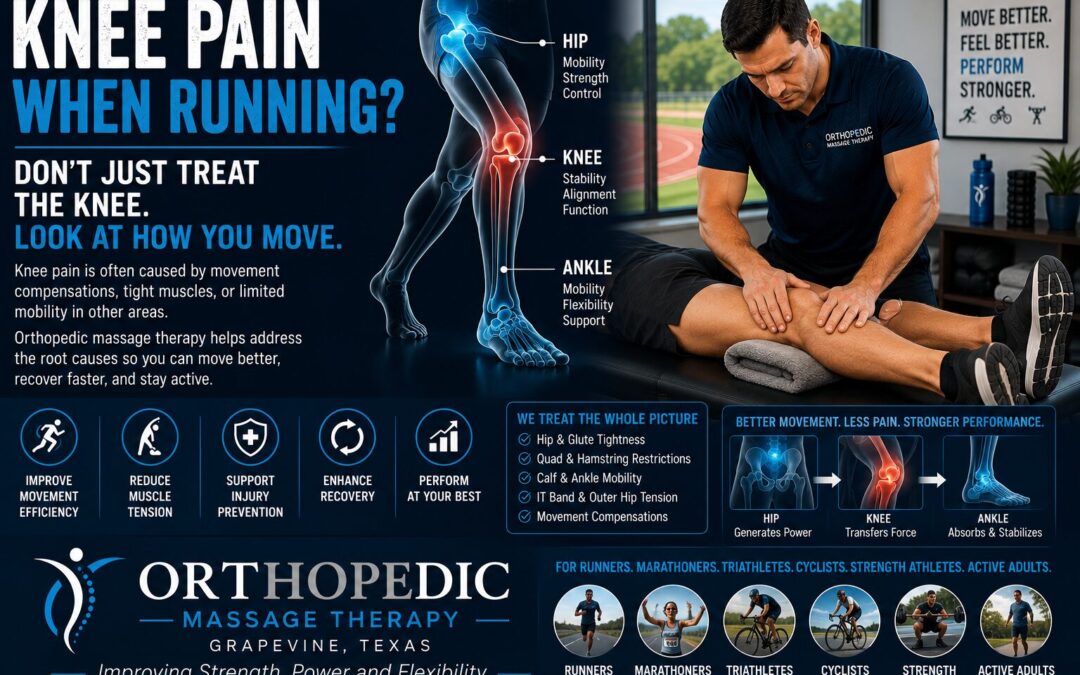
The knee functions between the hip and the ankle.
That means movement restrictions, muscular tightness, strength differences, or compensation patterns above or below the knee may influence how forces move through it.
At Orthopedic Massage Therapy in Grapevine, Texas, we take a targeted approach to muscular restrictions and movement.
Instead of focusing only on where an athlete feels discomfort, we consider how the muscles and soft tissues surrounding the entire lower body may be working together.
Because when it comes to athletic movement, everything is connected.
Why Is Knee Pain So Common in Runners?
Running is repetitive.
Extremely repetitive.
During a single run, each leg may contact the ground thousands of times.
With every stride, the body must absorb force, stabilize the leg, move forward, and prepare for the next step.
The knee plays an important role in this process.
When training volume, movement mechanics, muscular fatigue, or other factors begin changing how forces move through the leg, knee discomfort may develop.
Possible contributing factors can include:
-
Rapid increases in running mileage
-
Changes in training intensity
-
Hill training
-
Limited hip mobility
-
Limited ankle mobility
-
Muscular fatigue
-
Strength differences
-
Previous injuries
-
Inadequate recovery
-
Changes in running mechanics
-
Repetitive training stress
Often, more than one factor is involved.
This is why simply treating the knee itself may not always address the complete picture.
What Is Runner’s Knee?
“Runner’s knee” is a general term commonly used to describe pain around the front of the knee or kneecap.
One condition frequently associated with this type of discomfort is patellofemoral pain.
Athletes may notice symptoms during activities such as:
-
Running
-
Squatting
-
Going up or down stairs
-
Jumping
-
Sitting with the knees bent for long periods
There can be many factors associated with knee pain.
That is why persistent symptoms deserve appropriate assessment rather than assuming every runner has exactly the same problem.
Orthopedic massage therapy does not diagnose every source of knee pain.
Instead, it may help address muscular and soft-tissue restrictions that could be affecting movement around the knee.
Your Knee Does Not Work Alone
Think of the knee as part of a chain.
Above it is the hip.
Below it is the ankle and foot.
All of these areas must coordinate during running and athletic movement.
If movement changes at one area, another area may compensate.
For example:
If the hip is restricted, the thigh may move differently.
If the ankle lacks mobility, the knee may have to adapt.
If certain muscles become fatigued, other muscles may take on more work.
This does not mean that every knee problem originates somewhere else.
The knee itself can certainly be injured.
But when athletes experience recurring knee discomfort, it can be helpful to consider the entire lower-body movement system.
The Hip-Knee Connection
The muscles surrounding the hip help control the position and movement of the thigh.
This is important during:
-
Running
-
Jumping
-
Landing
-
Squatting
-
Cutting
-
Changing direction
The gluteal muscles, hip rotators, and other surrounding muscles contribute to stability and movement.
If the hips are restricted, fatigued, or not controlling movement efficiently, mechanics at the knee may also change.
For runners, these small changes are repeated thousands of times.
That is why treatment for recurring knee problems may sometimes involve addressing muscular restrictions around the hips and glutes rather than focusing exclusively on the knee.
Tight Quadriceps and Knee Discomfort
The quadriceps are the large muscles located along the front of the thigh.
They play a major role in extending the knee and controlling movement.
Runners, cyclists, strength athletes, and athletes who perform repetitive jumping may place significant demands on these muscles.
The quadriceps connect to structures surrounding the kneecap.
When these muscles become excessively tight or restricted, they may influence how the area feels and moves.
Orthopedic massage therapy may focus on soft-tissue restrictions involving the quadriceps when appropriate.
However, simply massaging the quadriceps is not always the entire solution.
The hips, hamstrings, calves, and ankle mobility may also need to be considered.
Can Tight Hamstrings Affect the Knee?
The hamstrings cross the knee joint and help control movement.
They also work closely with the hips and pelvis.
Recurring hamstring tightness may influence how an athlete moves.
If one hamstring is significantly tighter than the other, or if the muscles are constantly fatigued, movement mechanics may change.
Again, this does not mean tight hamstrings automatically cause knee pain.
The relationship is more complex.
But because the hamstrings contribute directly to knee and hip movement, they are often worth considering when evaluating lower-body muscular restrictions.
What Do the Calves Have to Do With Knee Pain?
More than many athletes realize.
The calf muscles influence ankle movement.
And ankle movement can influence what happens at the knee.
For example, if ankle mobility is restricted, the body may compensate when running, squatting, or landing.
That compensation may occur at the:
-
Foot
-
Knee
-
Hip
-
Pelvis
This is one reason recurring knee problems should sometimes be viewed from a broader perspective.
An athlete may feel pain at the knee while also having significant calf tightness or limited ankle mobility.
Addressing lower-leg restrictions may therefore be part of improving overall movement.
IT Band-Related Knee Pain
Runners frequently talk about the IT band, especially when experiencing discomfort along the outside of the knee.
The iliotibial band is a thick band of connective tissue running along the outside of the thigh.
Athletes often attempt to aggressively foam roll directly over it.
But simply applying more pressure to the IT band may not address all of the factors contributing to discomfort.
Muscles around the hip and thigh influence movement and tension in this region.
Treatment may therefore focus on related muscular structures and overall movement rather than trying to aggressively “loosen” the IT band itself.
The goal should be to understand the athlete’s individual pattern.
Why Does My Knee Hurt Only After a Certain Mileage?
This is an important clue.
Some runners feel completely fine for the first few miles.
Then, at mile four, six, ten, or fifteen, the knee begins hurting.
Why?
One possibility is fatigue.
As muscles become fatigued, movement may change.
Small differences that were not noticeable at the beginning of a run may become more significant later.
The hips may stabilize differently.
Stride mechanics may change.
Certain muscles may become overloaded.
The body may begin compensating.
This does not identify one specific cause, but it highlights an important point:
Pain that consistently appears at the same stage of training is a pattern worth paying attention to.
Why Rest Alone May Not Solve Recurring Knee Pain
Rest can be extremely important.
If training is irritating an area, reducing the activity may allow symptoms to settle.
But athletes often experience a frustrating cycle:
Run.
Pain develops.
Rest.
Pain disappears.
Run again.
Pain returns.
If this continues repeatedly, rest may be reducing the irritation without addressing all of the factors contributing to it.
The athlete returns to the same activity with the same movement restrictions or training pattern.
And the problem returns.
This is where a more comprehensive approach may be helpful.
How Orthopedic Massage Therapy May Help
Orthopedic massage therapy focuses on muscular and soft-tissue restrictions that may influence movement.
For an athlete experiencing knee discomfort, treatment may involve areas such as the:
-
Quadriceps
-
Hamstrings
-
Gluteal muscles
-
Hip rotators
-
Adductors
-
Calves
-
Muscles surrounding the lower leg
Why treat areas that are not directly on the knee?
Because these muscles influence how the hip, thigh, knee, and ankle move.
Treatment is individualized.
Two runners can experience knee pain in nearly the same location but have very different muscular restrictions and movement patterns.
The goal is not to follow the same routine for everyone.
The goal is to identify what may be relevant for the individual athlete.
Massage Is Not a Substitute for Strength
This is important.
Massage therapy can help address muscular and soft-tissue restrictions.
But athletes also need strength.
The muscles surrounding the hips, knees, and ankles must be capable of controlling the forces created during running and competition.
A comprehensive approach may include:
-
Orthopedic massage therapy
-
Appropriate strength training
-
Mobility exercises
-
Gradual training progression
-
Adequate recovery
-
Professional rehabilitation when necessary
Massage can complement these strategies.
It should not replace them.
Knee Pain in Cyclists
Runners are not the only athletes who experience knee discomfort.
Cyclists repeat the same pedaling motion thousands of times during long rides.
Small changes in bike setup, training volume, movement mechanics, or muscular fatigue can influence how the knees feel.
Cyclists may also develop tightness involving the:
-
Quadriceps
-
Hip flexors
-
Glutes
-
Hamstrings
-
Calves
Because cycling is so repetitive, minor restrictions may become increasingly noticeable as training volume rises.
Orthopedic massage therapy may help address muscular restrictions associated with these repetitive demands.
Persistent knee pain should also be appropriately evaluated, particularly when it continues despite changes in training or recovery.
Knee Pain in Strength Athletes
Squats, lunges, Olympic lifts, and other strength exercises place significant demands on the knees.
These movements also require coordinated mobility through the:
-
Ankles
-
Knees
-
Hips
If mobility is limited somewhere in the chain, the athlete may compensate.
For example, limited ankle mobility may change squat mechanics.
Restricted hip movement may influence knee position.
Orthopedic massage therapy may help address muscular restrictions that interfere with comfortable movement.
But strength athletes should also work on appropriate technique, mobility, and strength.
When Knee Pain Needs Medical Evaluation
Not every knee problem is muscular.
Some symptoms should be evaluated by an appropriate healthcare professional.
These may include:
-
Significant swelling
-
Inability to bear weight
-
Knee locking
-
Repeated buckling or instability
-
Significant trauma
-
A popping sensation associated with injury
-
Severe or worsening pain
-
Loss of normal movement
-
Persistent symptoms that do not improve
Massage therapy should not be used to delay necessary medical evaluation.
The goal is always appropriate care.
Don’t Wait Until You Cannot Run
Athletes often wait too long before addressing recurring problems.
At first, the knee only hurts after ten miles.
Then after six.
Then after three.
Eventually, discomfort may appear during normal daily activities.
Pay attention to patterns early.
Ask yourself:
Does the same knee always hurt?
Does discomfort begin at the same mileage?
Is one hip tighter than the other?
Are your calves constantly tight?
Has your ankle mobility changed?
Did the problem begin after increasing mileage?
These details can provide useful information.
Recovery Matters More Than You Think
Training is only one part of athletic improvement.
Recovery is another.
Athletes who continually increase training without allowing adequate recovery may experience accumulating fatigue.
A comprehensive recovery strategy may include:
-
Adequate sleep
-
Proper nutrition
-
Hydration
-
Rest days
-
Strength training
-
Mobility work
-
Gradual training progression
-
Targeted orthopedic massage therapy
Recovery is not wasted training time.
Recovery supports the ability to train consistently.
And consistency matters.
Orthopedic Massage Therapy for Knee Pain and Athletic Recovery in Grapevine, Texas
Athletes throughout Grapevine, Southlake, Colleyville, and the surrounding Dallas-Fort Worth area depend on healthy lower-body movement to train and compete.
Whether you are a:
-
Runner
-
Marathoner
-
Sprinter
-
Triathlete
-
Cyclist
-
Strength athlete
-
Competitive athlete
-
Active adult
recurring knee discomfort can interfere with your training and performance.
At Orthopedic Massage Therapy in Grapevine, Texas, we provide targeted orthopedic massage therapy focused on muscular restrictions, mobility, sports recovery, and injury rehabilitation.
Instead of automatically focusing only on where discomfort is felt, we consider how surrounding muscles and movement may be contributing to the problem.
Because your knee does not move alone.
Your body works as a system.
Don’t Just Chase the Pain—Look at How You Move
If your knee hurts every time you run, repeatedly waiting for the pain to disappear may not provide the complete answer.
Look at the bigger picture.
Your hips.
Your quadriceps.
Your hamstrings.
Your calves.
Your ankle mobility.
Your training volume.
Your recovery.
Your movement patterns.
All of these factors can influence how your lower body handles the demands of running and athletic activity.
At Orthopedic Massage Therapy in Grapevine, Texas, our goal is to help athletes address muscular restrictions, improve functional mobility, support recovery, and continue pursuing the sports and activities they love.
Improving Strength, Power and Flexibility.
Contact Orthopedic Massage Therapy in Grapevine, Texas to learn how targeted orthopedic massage therapy may help address muscular restrictions associated with knee discomfort, improve lower-body mobility, support athletic recovery, and help you keep moving toward your goals.