Orthopedic Massage Therapy OmassageT.com
You step out of bed in the morning and immediately feel a sharp or uncomfortable sensation under your heel.
After walking around for a few minutes, it may begin to loosen up.
Later, you go for a run.
At first, your foot feels manageable.
But as the miles accumulate—or after you finish—the discomfort returns.
For runners and active adults, persistent heel and foot pain can quickly become frustrating.
You may try stretching your foot.
Rolling it on a ball.
Changing shoes.
Taking a few days off.
The symptoms improve temporarily, but as soon as your training increases, the problem comes back.
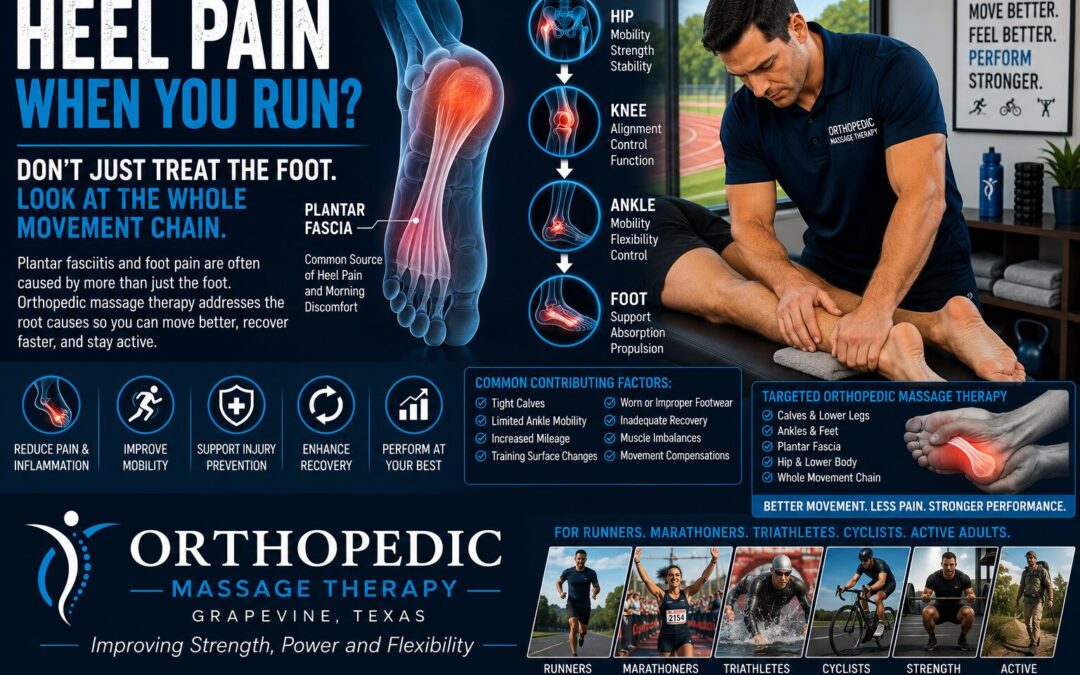
One of the most common conditions associated with heel and foot pain is plantar fasciitis, sometimes more broadly discussed as plantar heel pain.
But just like many other running-related problems, focusing only on where you feel pain may not always tell the complete story.
Your foot is connected to your ankle.
Your ankle is influenced by your calf.
Your lower leg interacts with your knee.
Your knee works with your hip.
And all of these areas coordinate every time your foot hits the ground.
At Orthopedic Massage Therapy in Grapevine, Texas, we take a targeted approach to muscular and soft-tissue restrictions that may influence movement.
When runners experience recurring foot or heel discomfort, we consider more than the bottom of the foot.
We look at the bigger movement picture.
What Is Plantar Fasciitis?
The plantar fascia is a strong band of connective tissue located along the bottom of the foot.
It extends from the heel toward the toes and helps support the arch of the foot.
The plantar fascia also plays an important role in how the foot handles forces during walking and running.
When this tissue becomes irritated, people may experience pain near the heel or along the bottom of the foot.
Common symptoms associated with plantar heel pain may include:
-
Heel pain with the first steps in the morning
-
Discomfort after sitting for long periods
-
Pain after running or exercise
-
Tenderness along the bottom of the foot
-
Tightness through the foot or calf
-
Pain that improves temporarily as you move but returns later
Not every case of heel pain is plantar fasciitis.
Other conditions can cause similar symptoms.
Persistent, severe, or unexplained foot pain should be appropriately evaluated by a qualified healthcare professional.
Why Is Plantar Fasciitis So Common in Runners?
Running places repetitive forces through the feet.
Every time your foot contacts the ground, your body must absorb and manage force.
Then your foot and lower leg help prepare your body for the next stride.
This process repeats thousands of times during a run.
Several factors may contribute to increased stress around the foot and plantar fascia, including:
-
Increased running mileage
-
Sudden changes in training volume
-
Hill training
-
Changes in running surfaces
-
Limited ankle mobility
-
Tight or fatigued calf muscles
-
Changes in footwear
-
Previous injuries
-
Inadequate recovery
-
Repetitive training stress
Often, there is not one single factor.
That is why recurring foot pain may require looking beyond the foot itself.
Your Foot Does Not Work Alone
The human body functions as a connected movement system.
Your foot interacts with the ground, but what happens above the foot matters too.
Consider the chain:
Foot → Ankle → Calf → Knee → Hip
All of these areas influence movement.
If the ankle is restricted, the foot or knee may compensate.
If the calf is excessively tight, ankle movement may be affected.
If hip mechanics change, the way the leg interacts with the ground may also change.
This does not mean every case of plantar fasciitis is caused by tight calves or restricted hips.
But when symptoms repeatedly return, it may be helpful to consider the entire lower-body movement system rather than focusing only on the painful location.
The Calf-Plantar Fascia Connection
One of the most important areas to consider when dealing with recurring heel or foot discomfort is the calf.
The gastrocnemius and soleus muscles make up much of the calf complex.
These muscles connect through the Achilles tendon toward the heel.
The calf, Achilles tendon, ankle, and foot all work together during walking and running.
If the calf muscles become excessively tight or fatigued, ankle movement may change.
That may influence how forces are managed through the foot.
This is one reason treatment for foot discomfort may sometimes involve working on the calves and lower legs rather than focusing exclusively on the bottom of the foot.
Limited Ankle Mobility and Foot Pain
Ankle mobility is essential for efficient movement.
During walking, running, lunging, and squatting, the ankle needs to move appropriately.
One important motion is dorsiflexion—the ability of the shin to move forward over the foot.
If this movement is restricted, the body may find another way to complete the task.
Compensation may occur at the:
-
Foot
-
Knee
-
Hip
-
Pelvis
For runners, those compensations are repeated thousands of times.
Orthopedic massage therapy may help address muscular and soft-tissue restrictions around the calf and lower leg that could be limiting comfortable ankle movement.
Improving soft-tissue mobility may help create better conditions for more efficient movement.
Why Does Heel Pain Hurt So Much in the Morning?
One of the classic complaints associated with plantar heel pain is discomfort during the first few steps after waking up.
Someone may feel significant heel pain when first standing.
After walking around, the discomfort may gradually improve.
This pattern can also occur after sitting for an extended period.
The exact cause of foot pain varies between individuals, but symptoms like these are useful clues.
Rather than simply ignoring the pain because it “warms up,” athletes should pay attention to recurring patterns.
A problem that improves during activity but repeatedly returns afterward may still deserve attention.
Why Rolling a Ball Under Your Foot May Not Be Enough
Many runners use a tennis ball, massage ball, or frozen water bottle under the foot.
This may provide temporary relief.
But if symptoms repeatedly return, focusing only on the bottom of the foot may not address all contributing factors.
Ask yourself:
Are your calves constantly tight?
Is one ankle less mobile than the other?
Did your symptoms begin after increasing mileage?
Did you recently change shoes?
Are you recovering adequately between runs?
Do you have a history of lower-leg injuries?
The painful area matters.
But so does the reason that area may be experiencing repeated stress.
How Orthopedic Massage Therapy May Help
Orthopedic massage therapy is a targeted approach to muscular and soft-tissue restrictions.
For runners experiencing foot or heel discomfort, treatment may involve areas such as the:
-
Calves
-
Soleus
-
Muscles of the lower leg
-
Ankle region
-
Soft tissues of the foot
-
Hamstrings
-
Hips and glutes when relevant
The exact approach depends on the individual.
Why might treatment extend beyond the foot?
Because the body works as a connected system.
A runner with significant calf restrictions and limited ankle mobility may require a different approach than someone whose primary issue is localized foot tension.
Treatment should be individualized.
Should You Massage Directly on a Painful Plantar Fascia?
More pressure is not always better.
When tissue is irritated, aggressively pressing directly into the most painful area may not always be appropriate.
Effective orthopedic massage therapy is not about causing as much discomfort as possible.
Treatment should be purposeful.
The therapist should consider:
-
The location of symptoms
-
Tissue sensitivity
-
Training demands
-
Injury history
-
Movement restrictions
-
Stage of recovery
Sometimes the surrounding muscular structures may require more attention than the most painful spot itself.
The goal is improved function—not simply intense pressure.
Plantar Fasciitis and Marathon Training
Heel and foot pain can become particularly frustrating during marathon training.
As race day approaches, weekly mileage often increases.
Long runs become longer.
Recovery becomes more important.
A small problem that was manageable at lower mileage may become increasingly noticeable.
Runners may experience a cycle:
Run.
Heel hurts.
Rest.
Heel feels better.
Increase mileage.
Heel hurts again.
If this pattern continues, repeatedly taking short periods of rest may not address all of the factors contributing to the problem.
The athlete may need to consider training load, recovery, footwear, mobility, strength, and muscular restrictions.
Orthopedic massage therapy can be one part of that larger strategy.
Foot Pain in Sprinters and Field Athletes
Distance runners are not the only athletes who place significant stress through their feet.
Sprinters generate extremely high forces against the ground.
Football players, soccer players, tennis players, and other field or court athletes repeatedly:
-
Accelerate
-
Decelerate
-
Jump
-
Land
-
Cut
-
Change direction
These movements require the feet and ankles to respond quickly.
Muscular restrictions in the calves and lower legs may influence how comfortably athletes perform these movements.
Recurring foot discomfort should not automatically be ignored simply because the athlete can still compete.
The Importance of Foot and Ankle Strength
Massage therapy is not the entire solution.
Athletes need adequate strength and control throughout the lower body.
The muscles of the feet, ankles, calves, knees, and hips all contribute to athletic movement.
A comprehensive approach may include:
-
Appropriate foot and ankle strengthening
-
Calf strengthening
-
Hip and lower-body strength training
-
Mobility work
-
Gradual training progression
-
Appropriate footwear
-
Adequate recovery
-
Orthopedic massage therapy
Massage can help address soft-tissue restrictions.
Strength and conditioning help the athlete control movement and tolerate athletic demands.
These strategies can complement each other.
Are Your Shoes Causing Your Foot Pain?
Footwear is one factor worth considering, but shoes are not always the entire explanation.
Athletes sometimes immediately blame their shoes whenever pain develops.
In some cases, footwear changes may contribute to symptoms.
For example, problems may appear after:
-
Switching shoe styles
-
Changing heel-to-toe drop significantly
-
Transitioning to minimalist footwear too quickly
-
Running in worn-out shoes
-
Dramatically changing running surfaces
However, buying a new pair of shoes does not automatically solve every case of foot pain.
Training volume, recovery, strength, mobility, and previous injuries may also matter.
The best approach considers the entire picture.
When Foot or Heel Pain Needs Medical Evaluation
Not all foot pain is plantar fasciitis.
Seek appropriate medical evaluation when symptoms include:
-
Significant swelling
-
Severe or worsening pain
-
Inability to bear weight
-
Pain following significant trauma
-
Numbness or unusual neurological symptoms
-
Significant bruising
-
Sudden loss of strength
-
Pain that persists despite appropriate rest and care
Stress fractures and other conditions can sometimes cause foot pain in athletes.
Massage therapy should never be used to delay necessary medical assessment.
Stop Ignoring Your First Steps in the Morning
Athletes often tolerate symptoms for far too long.
If your heel hurts every morning but improves after walking, you may simply learn to live with it.
But recurring symptoms are information.
Your body is telling you something.
Ask yourself:
When did the pain begin?
Did your mileage recently increase?
Are your calves constantly tight?
Is one ankle less mobile?
Does the pain worsen after long runs?
Does it return every time you increase training?
Patterns matter.
Understanding those patterns can help guide a more appropriate approach.
Recovery Matters for Your Feet Too
Athletes often think about recovery for large muscle groups.
Quads.
Hamstrings.
Glutes.
Back.
But the feet and lower legs also need to recover.
During running, your feet absorb and transfer force with every stride.
A comprehensive recovery strategy may include:
-
Adequate sleep
-
Proper nutrition
-
Hydration
-
Appropriate rest
-
Gradual training progression
-
Strength training
-
Mobility work
-
Targeted orthopedic massage therapy
Your feet carry you through every mile.
They deserve attention too.
Orthopedic Massage Therapy for Plantar Fasciitis and Foot Pain in Grapevine, Texas
Runners and athletes throughout Grapevine, Southlake, Colleyville, and the surrounding Dallas-Fort Worth area rely on healthy feet and ankles to train, compete, and stay active.
Whether you are a:
-
Runner
-
Marathoner
-
Sprinter
-
Triathlete
-
Cyclist
-
Competitive athlete
-
Strength athlete
-
Active adult
recurring heel and foot discomfort can interfere with your performance and quality of life.
At Orthopedic Massage Therapy in Grapevine, Texas, we provide targeted orthopedic massage therapy focused on muscular restrictions, mobility, sports recovery, and injury rehabilitation.
For foot-related problems, that may mean looking beyond the foot.
We may consider the calves.
The ankles.
The lower legs.
And how those areas interact with the rest of your movement.
Because the location where you feel pain may only be one part of the picture.
Don’t Just Treat the Foot—Look at the Whole Movement Chain
If you keep rolling the bottom of your foot but the same heel pain continues returning, it may be time to look at the bigger picture.
Your feet.
Your ankles.
Your calves.
Your knees.
Your hips.
Your training volume.
Your recovery.
Your body works as a connected system from the ground up.
At Orthopedic Massage Therapy in Grapevine, Texas, our goal is to help athletes address muscular restrictions, improve functional mobility, support recovery, and continue doing the sports and activities they love.
Improving Strength, Power and Flexibility.
Contact Orthopedic Massage Therapy in Grapevine, Texas to learn how targeted orthopedic massage therapy may help address muscular and soft-tissue restrictions associated with recurring heel and foot discomfort, improve lower-leg mobility, support athletic recovery, and help keep you moving toward your next finish line.