Your Title Goes Here
You reach overhead and your shoulder feels tight.
You throw a ball and notice discomfort.
Your swimming stroke does not feel as smooth as it used to.
Maybe your shoulder bothers you during a bench press, overhead press, pull-up, tennis serve, pickleball swing, or golf swing.
You rest for a few days and it feels better.
Then you return to training—and the same tightness or discomfort comes back.
For athletes, shoulder problems can be especially frustrating because the shoulder is involved in so many movements.
But there is something important to understand about recurring shoulder discomfort:
The shoulder does not work alone.
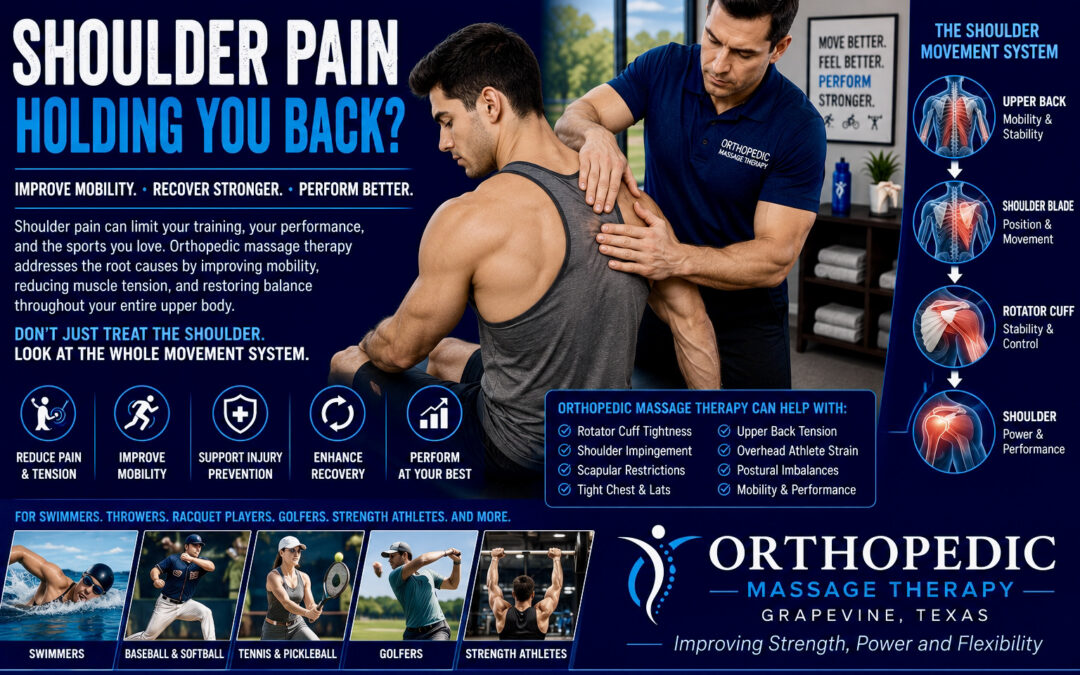
Healthy shoulder movement depends on coordination between the shoulder joint, shoulder blade, upper back, chest, neck, and surrounding muscles.
If one part of that system becomes restricted or begins moving differently, other areas may compensate.
At Orthopedic Massage Therapy in Grapevine, Texas, we use targeted orthopedic massage therapy to help address muscular and soft-tissue restrictions that may interfere with mobility, recovery, and athletic performance.
Instead of focusing only on where an athlete feels discomfort, we look at the larger movement picture.
Because better shoulder function begins with understanding how the entire upper body works together.
Why Is the Shoulder So Complex?
The shoulder is designed for mobility.
Think about how many directions you can move your arm.
Forward.
Backward.
Overhead.
Across your body.
Behind your back.
Rotationally.
That incredible range of motion allows athletes to throw, swim, swing, lift, reach, and perform explosive overhead movements.
But mobility comes with a challenge.
The shoulder requires excellent muscular coordination and control.
Several structures work together to create efficient shoulder movement, including the:
-
Shoulder joint
-
Shoulder blade, or scapula
-
Rotator cuff muscles
-
Upper-back muscles
-
Chest muscles
-
Latissimus dorsi
-
Neck and upper-trapezius muscles
-
Muscles of the arm
When these structures coordinate efficiently, movement can feel smooth and powerful.
When mobility becomes restricted or certain muscles begin compensating, athletes may notice tightness, weakness, discomfort, or changes in performance.
Why Do Athletes Develop Shoulder Pain?
There is no single cause of shoulder pain.
Athletic shoulder problems may be influenced by:
-
Repetitive overhead movement
-
High training volume
-
Throwing
-
Swimming
-
Racquet sports
-
Strength training
-
Limited upper-back mobility
-
Muscular fatigue
-
Previous injuries
-
Changes in technique
-
Inadequate recovery
-
Soft-tissue restrictions
Sometimes discomfort develops gradually.
An athlete may first notice that one shoulder simply feels tighter.
Then a particular movement becomes uncomfortable.
Eventually, performance begins to change.
Paying attention to these early patterns may help athletes address problems before they become more limiting.
The Shoulder Blade Matters More Than You Think
The shoulder blade plays an essential role in upper-body movement.
When you raise your arm overhead, your shoulder blade must move with your arm.
This coordinated movement helps position the shoulder for efficient motion.
If the muscles surrounding the shoulder blade become tight, fatigued, or restricted, movement may change.
Athletes may notice:
-
Difficulty reaching overhead
-
One shoulder moving differently than the other
-
Tightness between the shoulder blades
-
Upper-trapezius tension
-
A feeling of restricted shoulder motion
This is one reason treatment for shoulder discomfort may involve more than working directly on the shoulder joint.
The muscles around the shoulder blade and upper back may also need attention.
The Rotator Cuff and Athletic Performance
The rotator cuff is a group of muscles and tendons that help stabilize and control the shoulder.
These muscles are especially important during overhead and rotational movements.
Athletes who repeatedly throw, serve, swim, or lift overhead place significant demands on the rotator cuff.
This includes:
-
Baseball players
-
Softball players
-
Swimmers
-
Tennis players
-
Pickleball players
-
Volleyball players
-
Strength athletes
-
Cross-training athletes
The rotator cuff must work together with larger muscles around the shoulder and shoulder blade.
If surrounding muscles become restricted or movement mechanics change, the rotator cuff may experience different demands.
Persistent shoulder pain or significant weakness should be appropriately evaluated, especially when an athlete has difficulty lifting the arm or performing normal movements.
Shoulder Pain in Swimmers
Swimming is one of the most repetitive upper-body sports.
During a long training session, a swimmer may perform thousands of arm strokes.
The shoulder repeatedly moves overhead while the muscles of the upper back, chest, rotator cuff, and shoulder blade coordinate each movement.
Over time, swimmers may develop tightness involving the:
-
Chest
-
Lats
-
Upper back
-
Shoulders
-
Neck
If mobility becomes restricted, the athlete may begin changing the way they perform their stroke.
Even small changes can become significant when repeated thousands of times.
Orthopedic massage therapy may help address muscular restrictions associated with repetitive swimming and support more comfortable movement.
Baseball and Softball Players
Throwing is one of the fastest and most demanding movements the shoulder performs.
Pitchers and position players repeatedly generate and absorb tremendous forces.
The shoulder does not create this movement alone.
An effective throw involves the entire body.
Force is generated through the legs and hips, transferred through the trunk, and eventually expressed through the shoulder, arm, and hand.
This is known as the kinetic chain.
If mobility or coordination changes somewhere in that chain, the shoulder may experience different demands.
That is why shoulder care for throwing athletes should not always focus exclusively on the shoulder itself.
The upper back, chest, lats, hips, and trunk may also influence throwing mechanics.
Tennis and Pickleball Shoulder Pain
Tennis and pickleball involve repeated swinging, serving, reaching, and rotational movements.
Serving places particularly high demands on the shoulder.
Players may develop muscular tightness from:
-
Repetitive serves
-
Overhead shots
-
Forehand and backhand swings
-
High playing volume
-
Strength training
-
Limited recovery
Pickleball players may also underestimate how much repetitive movement occurs during frequent play.
An athlete who plays several days per week may accumulate significant muscular fatigue.
Recurring shoulder tightness should not automatically be accepted as normal.
If one shoulder continually feels restricted, it may be worth addressing before the problem begins limiting performance.
Shoulder Mobility for Golfers
Golf may not look like an overhead sport, but the shoulders play an important role in the swing.
The golf swing requires coordinated rotation through the:
-
Hips
-
Trunk
-
Upper back
-
Shoulders
If upper-back or shoulder mobility is restricted, the body may compensate somewhere else.
A golfer may notice:
-
Reduced backswing
-
Shoulder tightness
-
Neck tension
-
Upper-back stiffness
-
Changes in swing mechanics
Orthopedic massage therapy may help address muscular restrictions that interfere with comfortable rotational movement.
Better mobility can help create better conditions for an efficient swing.
Shoulder Pain in Strength Athletes
Strength training places significant demands on the shoulders.
Exercises such as:
-
Bench press
-
Overhead press
-
Pull-ups
-
Dips
-
Push-ups
-
Olympic lifts
-
Kettlebell exercises
require coordinated shoulder movement.
If the chest, lats, upper back, or shoulder muscles become restricted, an athlete may notice changes in technique.
For example, reaching overhead may become difficult.
One shoulder may move differently.
The athlete may arch the lower back excessively to compensate for limited overhead mobility.
The body will often find a way to complete a movement.
But completing the movement does not always mean the movement is efficient.
The Chest-Shoulder Connection
Athletes often focus on the back of the shoulder when experiencing discomfort.
But the muscles on the front of the body may also influence shoulder movement.
The chest muscles attach around the shoulder and upper arm.
When these tissues become restricted, they may influence the position and movement of the shoulder.
This can be particularly relevant for athletes who:
-
Bench press frequently
-
Perform high-volume push-ups
-
Spend long periods sitting
-
Work at a computer
-
Participate in repetitive forward-reaching activities
Targeted orthopedic massage therapy may address restrictions in the chest when they are relevant to the athlete’s movement.
Your Lats Can Affect Overhead Mobility
The latissimus dorsi, commonly called the lats, are large muscles of the back.
They play an important role in pulling movements and athletic performance.
But restricted lats may also influence overhead arm movement.
Athletes with tight lats may notice difficulty comfortably reaching both arms overhead.
This can affect movements such as:
-
Overhead pressing
-
Swimming
-
Throwing
-
Pull-ups
-
Olympic lifting
An athlete may compensate by arching the lower back or changing shoulder position.
Addressing lat restrictions may therefore be part of improving overhead mobility.
Don’t Forget the Upper Back
The thoracic spine—the upper and middle portion of the back—plays an important role in shoulder movement.
Athletes need adequate upper-back mobility for many overhead and rotational activities.
If the upper back becomes stiff, the shoulder may have to compensate.
This is especially relevant for:
-
Swimmers
-
Throwing athletes
-
Golfers
-
Tennis players
-
Strength athletes
Although massage therapy does not directly change the structure of the spine, targeted soft-tissue treatment may help address muscular restrictions around the upper back that interfere with comfortable movement.
Why Stretching the Shoulder May Not Be Enough
When a shoulder feels tight, many athletes simply stretch it.
Stretching may help.
But recurring tightness can involve more than a lack of flexibility.
A muscle may feel tight because it is:
-
Overworked
-
Fatigued
-
Compensating
-
Protecting another area
-
Responding to repetitive training
-
Working around restricted movement elsewhere
If stretching provides only temporary relief, it may be worth asking:
Why does this keep coming back?
The answer may involve several areas rather than one tight muscle.
How Orthopedic Massage Therapy May Help Athletes With Shoulder Tightness
Orthopedic massage therapy takes a targeted approach to muscular and soft-tissue restrictions.
Depending on the athlete, treatment may involve the:
-
Rotator cuff muscles
-
Chest
-
Lats
-
Upper back
-
Shoulder blade muscles
-
Upper trapezius
-
Neck
-
Muscles of the arm
The exact treatment depends on the individual’s sport, symptoms, mobility, and training demands.
A swimmer may require a different approach than a baseball pitcher.
A golfer may have different restrictions than a powerlifter.
A pickleball player may have different demands than a competitive swimmer.
There is no single shoulder massage routine that is appropriate for every athlete.
Mobility and Stability Must Work Together
The shoulder needs mobility.
But it also needs stability and control.
More flexibility is not always better.
Athletes need enough mobility to perform their sport while maintaining muscular control.
Think of it as:
Mobility + Stability + Strength = Better Athletic Movement
Orthopedic massage therapy may help address muscular restrictions that limit comfortable movement.
Strength and rehabilitation exercises can then help athletes control and use that movement effectively.
This is why massage often works best as part of a broader performance or rehabilitation strategy.
When Shoulder Pain Needs Medical Evaluation
Not every shoulder problem is muscular.
Seek appropriate medical evaluation when symptoms include:
-
Significant weakness
-
Inability to raise the arm normally
-
Shoulder instability or repeated dislocation
-
Significant swelling
-
Severe pain after trauma
-
A sudden popping sensation associated with injury
-
Persistent numbness or tingling
-
Significant loss of movement
-
Pain that continues to worsen
Massage therapy should not be used to delay necessary medical care.
The goal should always be appropriate treatment for the condition.
Recovery Is Important for the Upper Body Too
Athletes often think about recovery primarily in terms of their legs.
But upper-body athletes need recovery just as much.
Throwing.
Swimming.
Serving.
Swinging.
Pressing.
Pulling.
These movements create repetitive muscular stress.
A comprehensive recovery strategy may include:
-
Adequate sleep
-
Proper nutrition
-
Hydration
-
Appropriate rest
-
Strength training
-
Mobility work
-
Intelligent training progression
-
Targeted orthopedic massage therapy
Recovery supports consistent training.
And consistent training supports performance.
Orthopedic Massage Therapy for Athletes in Grapevine, Texas
Athletes throughout Grapevine, Southlake, Colleyville, and the surrounding Dallas-Fort Worth area depend on healthy shoulder movement for training and competition.
Whether you are a:
-
Swimmer
-
Baseball or softball player
-
Tennis player
-
Pickleball player
-
Golfer
-
Volleyball player
-
Strength athlete
-
Competitive athlete
-
Active adult
recurring shoulder tightness or restricted mobility can interfere with performance.
At Orthopedic Massage Therapy in Grapevine, Texas, we provide targeted orthopedic massage therapy focused on muscular restrictions, functional mobility, sports recovery, and injury rehabilitation.
We look beyond the painful area.
We consider the shoulder.
The shoulder blade.
The chest.
The lats.
The upper back.
And how those areas work together.
Because athletic movement is connected.
Don’t Just Treat the Shoulder—Look at the Whole Movement System
If your shoulder keeps becoming tight every time you train, simply stretching the same area may not provide the complete answer.
Consider the bigger picture.
Your shoulder blade.
Your rotator cuff.
Your chest.
Your lats.
Your upper back.
Your training volume.
Your recovery.
Your body works as a coordinated system.
At Orthopedic Massage Therapy in Grapevine, Texas, our goal is to help athletes address muscular restrictions, improve functional mobility, recover effectively, and continue performing the sports and activities they love.
Improving Strength, Power and Flexibility.
Contact Orthopedic Massage Therapy in Grapevine, Texas to learn how targeted orthopedic massage therapy may help address muscular restrictions associated with shoulder discomfort, improve upper-body mobility, support athletic recovery, and help you perform at your best.