Orthopedic Massage Therapy OmassageT.com
Maybe opening a jar, carrying groceries, lifting weights, shaking someone’s hand, or even using a computer mouse has started becoming uncomfortable.
You rest.
The discomfort improves.
Then you return to your sport or activity—and it comes back.
Recurring elbow and forearm pain can be frustrating, particularly for athletes who depend on grip strength, repetitive arm movement, and powerful upper-body mechanics.
Two conditions commonly associated with this type of discomfort are known as tennis elbow and golfer’s elbow.
But despite their names, you do not have to play tennis or golf to experience them.
Pickleball players, baseball and softball players, strength athletes, climbers, manual workers, and active adults can all develop recurring elbow and forearm problems.
At Orthopedic Massage Therapy in Grapevine, Texas, we take a targeted approach to muscular and soft-tissue restrictions.
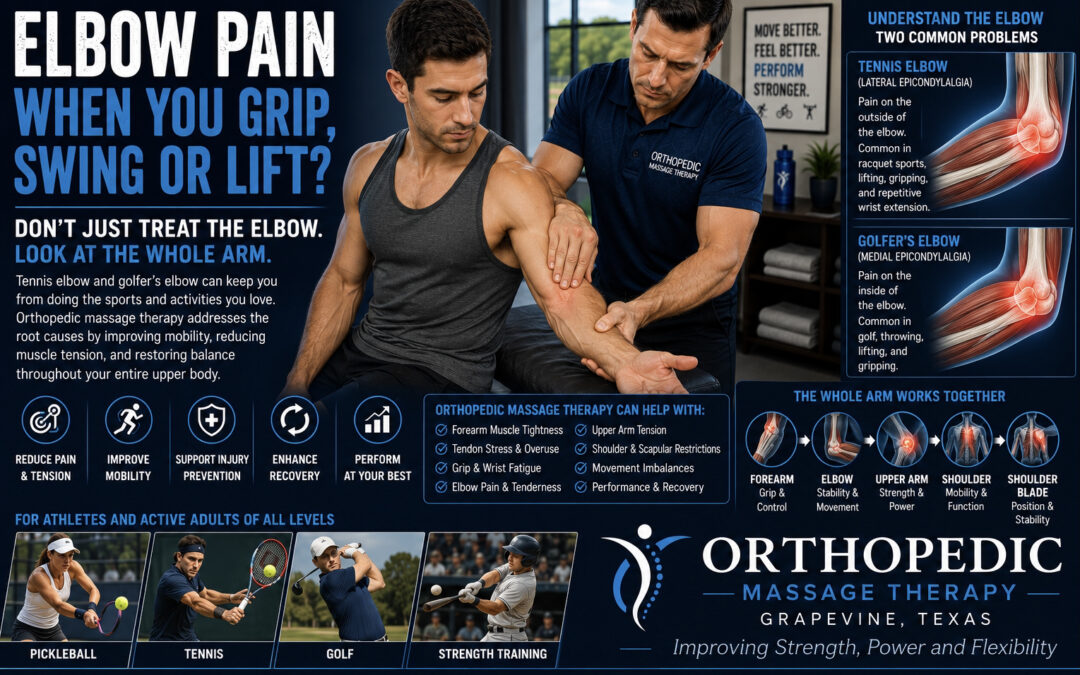
Rather than focusing only on the painful spot at the elbow, we consider how the forearm, upper arm, shoulder, shoulder blade, and upper body work together.
Because when it comes to repetitive athletic movement, the location where you feel pain may only be one part of the story.
What Is Tennis Elbow?
Tennis elbow commonly refers to pain involving the outside of the elbow.
The medical term often associated with this condition is lateral epicondylalgia or lateral epicondylitis, although the nature of persistent tendon problems can be more complex than simple inflammation.
The muscles that extend the wrist and fingers connect through tendons near the outside of the elbow.
Repeated gripping and wrist movements can place significant demands on these tissues.
People with tennis-elbow-type symptoms may notice discomfort when:
-
Gripping objects
-
Shaking hands
-
Lifting something with the palm facing down
-
Playing tennis or pickleball
-
Using tools
-
Performing certain strength exercises
-
Extending the wrist against resistance
The discomfort may begin near the outside of the elbow and sometimes extend into the forearm.
What Is Golfer’s Elbow?
Golfer’s elbow typically refers to discomfort around the inside of the elbow.
It is often associated with the muscles and tendons involved in gripping and wrist flexion.
Athletes may notice symptoms during:
-
Golf swings
-
Throwing
-
Weightlifting
-
Racquet sports
-
Pulling exercises
-
Repetitive gripping
Like tennis elbow, golfer’s elbow is not limited to people who play the sport in its name.
Any repetitive activity involving the hand, wrist, forearm, and elbow can potentially place stress on these tissues.
Why Do These Problems Keep Coming Back?
This is one of the most important questions an athlete can ask.
Many people experience a familiar cycle:
Pain develops.
They stop the irritating activity.
The pain decreases.
They return to the activity.
The pain returns.
Rest can be valuable because it reduces the immediate workload on irritated tissues.
But if the same problem repeatedly returns, it may be important to consider why those tissues are continually being overloaded.
Possible contributing factors may include:
-
Sudden increases in training or playing volume
-
Repetitive gripping
-
Changes in technique
-
Equipment changes
-
Muscular fatigue
-
Limited shoulder mobility
-
Forearm muscular restrictions
-
Inadequate recovery
-
Strength or load-management issues
Often, there is not one single cause.
The Elbow Does Not Work Alone
Think about swinging a tennis racket.
Your fingers grip the racket.
Your wrist controls its position.
Your forearm transfers force.
Your elbow moves.
Your shoulder helps position the arm.
Your shoulder blade moves.
Your trunk rotates.
Your hips and legs help generate force.
The entire body contributes.
This is the kinetic chain.
If movement changes somewhere in that chain, another area may have to work differently.
This does not mean that every case of elbow pain is caused by a shoulder or movement problem elsewhere.
But it does mean that treating only the painful point may not always address the complete picture.
Tennis Elbow in Pickleball Players
Pickleball has become extremely popular, and players often participate several times per week.
Although the paddle is relatively light, the sport involves repeated:
-
Gripping
-
Forehand shots
-
Backhand shots
-
Volleys
-
Serves
-
Quick reactions
Repetition matters.
A player may perform hundreds of similar movements during a session.
Add several playing days each week, and the total workload can become significant.
Players who suddenly increase how often they play may notice forearm fatigue or elbow discomfort.
Some continue playing because the symptoms are initially mild.
But recurring discomfort should not automatically be ignored.
Pay attention to patterns.
Does the pain appear after a certain amount of playing time?
Is your grip becoming tighter as you fatigue?
Did you recently increase your playing frequency?
Did you change paddles or technique?
These details may provide useful clues.
Tennis Players and Repetitive Forearm Stress
Tennis places substantial demands on the hand, wrist, forearm, elbow, and shoulder.
Serving, groundstrokes, volleys, and repeated gripping all require muscular coordination.
Technique and equipment can influence these demands.
Athletes may experience increased stress after:
-
Increasing playing frequency
-
Changing racket setup
-
Changing string tension
-
Modifying technique
-
Returning after a long break
Muscular fatigue can also change how an athlete moves.
As the shoulder and larger muscles fatigue, smaller muscles may take on different workloads.
This is another reason elbow problems should sometimes be considered in the context of the entire upper extremity.
Golfer’s Elbow and the Golf Swing
A golf swing requires coordinated movement throughout the body.
The legs generate force.
The hips rotate.
The trunk transfers energy.
The shoulders and arms guide the club.
The hands and forearms control the grip.
If timing or movement changes, certain tissues may experience increased stress.
Golfers may develop elbow discomfort related to:
-
High practice volume
-
Repetitive range sessions
-
Grip pressure
-
Swing mechanics
-
Strength training
-
Sudden increases in playing frequency
Hitting hundreds of balls at the driving range can create significant repetitive workload.
Athletes should consider both technique and recovery.
Baseball and Softball Players
Throwing athletes also place substantial demands on the elbow and forearm.
Pitching and throwing involve rapid movement and high forces.
The elbow does not generate all of this force independently.
The entire kinetic chain contributes.
Legs.
Hips.
Trunk.
Shoulder blade.
Shoulder.
Elbow.
Wrist.
Hand.
If one area is not contributing efficiently, another area may experience different demands.
Throwing-related elbow pain—especially in younger athletes—should be taken seriously and appropriately evaluated.
Massage therapy should never be used to delay assessment of a potentially significant throwing injury.
Elbow Pain in Strength Athletes
Strength athletes frequently perform movements requiring strong gripping.
Examples include:
-
Deadlifts
-
Pull-ups
-
Rows
-
Curls
-
Kettlebell exercises
-
Olympic lifts
-
Farmer’s carries
High-volume gripping can fatigue the muscles of the forearms.
Athletes may notice that elbow discomfort develops during pulling exercises or curls.
Sometimes modifying training temporarily is necessary.
But athletes should also consider whether forearm restrictions, shoulder mobility, technique, or total training volume may be contributing.
Why Forearm Muscles Matter
Many of the muscles that move the wrist and fingers originate near the elbow.
That means repeated hand and wrist activity can create significant workload near the elbow.
The forearm contains muscles responsible for:
-
Wrist flexion
-
Wrist extension
-
Finger movement
-
Grip
-
Rotation of the forearm
These muscles work constantly during sports involving rackets, paddles, clubs, bats, weights, and throwing.
When they become excessively tight or fatigued, athletes may notice discomfort near the elbow.
Targeted orthopedic massage therapy may help address muscular restrictions within the forearm when appropriate.
What Does the Shoulder Have to Do With Elbow Pain?
Quite a bit.
The shoulder positions the arm during athletic movement.
If shoulder mobility or control changes, the elbow and forearm may experience different demands.
Imagine throwing or swinging when the shoulder cannot move comfortably through the required range.
The body still needs to complete the movement.
So compensation may occur elsewhere.
The elbow.
The wrist.
The trunk.
This does not mean every elbow problem comes from the shoulder.
But recurring elbow symptoms may justify looking beyond the elbow itself.
The Shoulder Blade-Elbow Connection
The shoulder blade helps create a stable platform for arm movement.
During throwing, serving, swinging, and lifting, the scapula must coordinate with the shoulder.
Muscles around the shoulder blade help position the arm efficiently.
If these muscles are fatigued or restricted, mechanics may change farther down the arm.
This is why targeted treatment may sometimes involve:
-
Upper back
-
Shoulder blade muscles
-
Shoulder
-
Upper arm
-
Forearm
The body works as a system.
Why Stretching Your Forearm May Not Be Enough
Forearm stretches are commonly recommended for elbow tightness.
They may provide temporary relief.
But if the discomfort repeatedly returns, stretching alone may not address all contributing factors.
A muscle may feel tight because it is:
-
Overworked
-
Fatigued
-
Compensating
-
Responding to repetitive gripping
-
Working around limited movement elsewhere
Instead of only asking:
“How can I stretch this more?”
Consider asking:
“Why does this tissue keep getting overloaded?”
That question encourages a more complete approach.
How Orthopedic Massage Therapy May Help
Orthopedic massage therapy focuses on muscular and soft-tissue restrictions that may influence movement and function.
For athletes experiencing elbow and forearm discomfort, treatment may involve areas such as the:
-
Forearm flexor muscles
-
Forearm extensor muscles
-
Upper arm
-
Shoulder
-
Rotator cuff region
-
Shoulder blade muscles
-
Upper back
The exact treatment depends on the individual.
A golfer may have different demands than a pickleball player.
A strength athlete may require a different approach than a tennis player.
A throwing athlete may have completely different movement patterns.
Treatment should reflect those differences.
Should You Massage Directly Over a Painful Tendon?
Not automatically.
More pressure is not always better.
When a tendon is irritated, aggressive pressure directly over the most painful location may not be appropriate.
Treatment should consider:
-
Tissue sensitivity
-
Stage of recovery
-
Training demands
-
Injury history
-
Symptoms
-
Functional limitations
Sometimes surrounding muscles may be a more appropriate focus.
Effective orthopedic massage is not about seeing how much pain an athlete can tolerate.
It is about purposeful treatment.
Tendons Need Appropriate Loading
Massage therapy is only one part of managing many tendon-related problems.
Tendons need the ability to tolerate load.
Depending on the condition, an appropriate rehabilitation program may involve progressive strengthening.
A comprehensive strategy may include:
-
Load management
-
Strengthening exercises
-
Technique adjustments
-
Mobility work
-
Appropriate recovery
-
Orthopedic massage therapy
-
Medical or rehabilitation care when necessary
Massage can help address muscular restrictions.
Strength and progressive loading help prepare tissues for the demands of sport.
When Elbow Pain Needs Medical Evaluation
Not every elbow problem is muscular or tendon-related.
Seek appropriate medical evaluation when symptoms include:
-
Significant swelling
-
Severe pain following trauma
-
Loss of normal movement
-
Significant weakness
-
Numbness or tingling
-
Locking of the elbow
-
Sudden popping associated with injury
-
Persistent symptoms that continue worsening
Throwing athletes should be particularly cautious with significant elbow pain.
Massage therapy should never delay necessary medical assessment.
Recovery Matters for Your Forearms Too
Athletes often think about recovering their legs, shoulders, and back.
Forearms receive much less attention.
But think about how often athletes grip.
Rackets.
Paddles.
Golf clubs.
Baseball bats.
Barbells.
Dumbbells.
Kettlebells.
Repeated gripping creates workload.
Recovery strategies may include:
-
Appropriate rest
-
Gradual training progression
-
Strength training
-
Mobility work
-
Sleep
-
Nutrition
-
Hydration
-
Targeted orthopedic massage therapy
Small muscles need recovery too.
Orthopedic Massage Therapy for Tennis Elbow and Golfer’s Elbow in Grapevine, Texas
Athletes and active adults throughout Grapevine, Southlake, Colleyville, and the surrounding Dallas-Fort Worth area rely on healthy arms and elbows for sports, exercise, work, and everyday activities.
Whether you are a:
-
Tennis player
-
Pickleball player
-
Golfer
-
Baseball or softball player
-
Strength athlete
-
Climber
-
Competitive athlete
-
Active adult
recurring elbow and forearm discomfort can interfere with performance.
At Orthopedic Massage Therapy in Grapevine, Texas, we provide targeted orthopedic massage therapy focused on muscular restrictions, mobility, sports recovery, and injury rehabilitation.
We look beyond the painful spot.
We consider the:
Forearm → Elbow → Upper Arm → Shoulder → Shoulder Blade
Because athletic movement is connected.
Don’t Just Treat the Elbow—Look at the Whole Arm
If elbow pain keeps returning every time you play, lift, grip, throw, or swing, temporary relief may not be the complete answer.
Look at the bigger picture.
Your forearm.
Your grip.
Your shoulder.
Your shoulder blade.
Your technique.
Your training volume.
Your recovery.
Recurring symptoms are a pattern—and patterns can provide valuable information.
At Orthopedic Massage Therapy in Grapevine, Texas, our goal is to help athletes address muscular restrictions, improve functional movement, support recovery, and continue performing the sports and activities they love.
Improving Strength, Power and Flexibility.
Contact Orthopedic Massage Therapy in Grapevine, Texas to learn how targeted orthopedic massage therapy may help address muscular restrictions associated with recurring elbow and forearm discomfort, improve upper-body mobility, support athletic recovery, and help you perform at your best.