Orthopedic Massage Therapy OmassageT.com
Gymnastics requires the body to perform movements that most people will never attempt.
Back handsprings.
Back walkovers.
Bridges.
Tumbling passes.
Leaps.
Twists.
Landings.
These skills require an extraordinary combination of strength, flexibility, power, mobility, and control.
They also place significant demands on the lower back.
For gymnasts, occasional muscular soreness after a demanding practice may not be unusual. But recurring lower-back tightness or pain—especially discomfort that repeatedly appears during backbends, tumbling, landings, or other skills—should not simply be accepted as part of the sport.
One of the most important things to understand is this:
The location where a gymnast feels tightness or discomfort may not be the only area contributing to the problem.
The lower back works together with the hips, glutes, core, upper back, shoulders, and surrounding muscles.
When movement becomes restricted in one area, another area may compensate.
At Orthopedic Massage Therapy in Grapevine, Texas, we use targeted orthopedic massage therapy to help athletes address muscular restrictions, improve functional mobility, support recovery, and complement appropriate injury rehabilitation.
For gymnasts, that means looking beyond the painful area and considering how the entire movement system works together.
Why Gymnastics Places So Much Demand on the Lower Back
The spine is designed to move.
But gymnastics often requires repeated movement through significant ranges of motion.
Gymnasts repeatedly perform combinations of:
- Spinal extension
- Rotation
- Flexion
- Rapid changes in position
- High-impact landings
- Explosive tumbling
A single skill may combine several of these movements.
Now consider how many times a competitive gymnast repeats those skills during practice.
The cumulative training load can become significant.
Muscles surrounding the lower back must repeatedly stabilize and control these movements.
As fatigue develops, movement patterns may change.
That is why recovery, strength, mobility, and appropriate training progression are so important.
Why Does My Lower Back Always Feel Tight After Gymnastics?
A gymnast may describe their lower back as:
“Tight.”
“Stiff.”
“Compressed.”
“Overworked.”
“Always needing to be stretched.”
But the sensation of tightness does not automatically tell us why the area feels that way.
Possible contributing factors may include:
- High training volume
- Repetitive back extension
- Muscular fatigue
- Hip restrictions
- Tight hip flexors
- Limited shoulder mobility
- Upper-back restrictions
- Compensation patterns
- Previous injuries
- Inadequate recovery
Sometimes the muscles around the lower back themselves may be tight or fatigued.
Other times, the lower back may be doing extra work because another part of the body is not contributing efficiently.
That distinction matters.
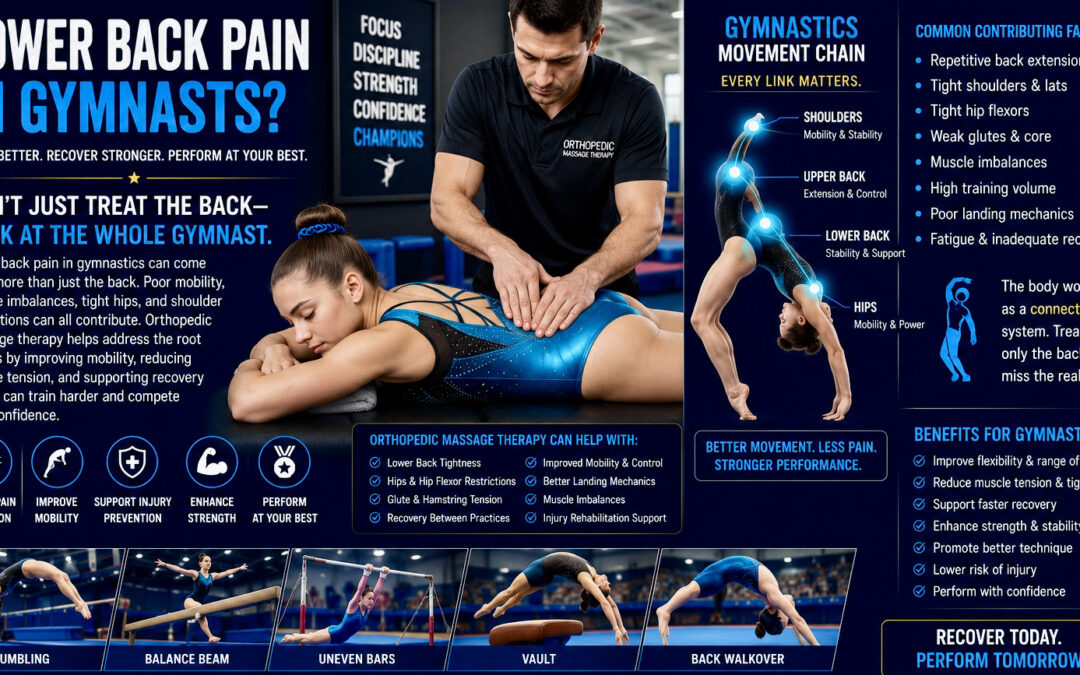
The Lower Back Does Not Work Alone
Imagine a gymnast performing a bridge.
It may look like one large arch through the body.
But that movement should not come from only one location.
The gymnast needs mobility through multiple areas, including the:
Shoulders → Upper Back → Spine → Hips
If one area contributes less movement, another area may contribute more.
For example, if shoulder mobility is limited, the gymnast may create additional arching elsewhere to achieve the required position.
The lower back may compensate.
This is why repeatedly treating only the lower back may not always address the complete movement pattern.
The Shoulder-Lower Back Connection
At first, shoulders and lower-back discomfort may seem unrelated.
But in gymnastics, they can be closely connected through movement.
Consider skills requiring the arms to reach fully overhead.
If a gymnast has restricted overhead shoulder mobility, the body still needs to achieve the required position.
One way the body may compensate is by increasing extension through the lower back.
This may become especially noticeable during:
- Bridges
- Back walkovers
- Handstands
- Back handsprings
- Overhead positions
This does not mean limited shoulder mobility automatically causes lower-back pain.
However, it demonstrates why evaluating movement as a whole can be valuable.
For some athletes, addressing restrictions around the:
- Lats
- Chest
- Shoulders
- Upper back
may help improve the overall movement available for gymnastics positions.
Tight Hip Flexors and the Lower Back
The hip flexors are another important area to consider.
Gymnasts use their hip flexors constantly.
They contribute to:
- Leg lifts
- Pike positions
- Kicks
- Leaps
- Tumbling
- Core-intensive skills
These muscles can become fatigued or restricted during demanding training.
The hips and pelvis interact closely with the lower back.
When muscular tension or movement changes around the hips, the position and movement of the pelvis may also change.
This can influence how the lower back feels during athletic activity.
A gymnast experiencing recurring lower-back tightness may therefore benefit from considering the hips and surrounding muscles rather than focusing exclusively on the back.
Glutes, Hips, and Lower-Back Control
The gluteal muscles are powerful muscles that contribute to:
- Hip extension
- Pelvic stability
- Jumping
- Landing
- Tumbling
- Running
They work closely with the muscles surrounding the hips and trunk.
During explosive gymnastics skills, these areas must coordinate effectively.
If movement patterns change or certain muscles become fatigued, other muscles may take on additional work.
The lower-back muscles may become part of that compensation strategy.
Orthopedic massage therapy may help address muscular restrictions involving the hips, glutes, and surrounding tissues when appropriate.
But athletes also need adequate strength and control.
Massage and strength training serve different purposes and can complement each other.
Core Strength Is More Than Doing Sit-Ups
Gymnasts need tremendous core strength.
But “core” does not simply mean abdominal muscles.
The trunk involves a coordinated system of muscles that help control the spine and transfer force throughout the body.
A gymnast’s core must work during:
- Handstands
- Tumbling
- Bars
- Vault
- Balance beam
- Landings
The goal is not simply to make these muscles stronger.
They need to coordinate efficiently with the hips, shoulders, and rest of the body.
Massage therapy does not replace core strengthening.
Instead, orthopedic massage may help address muscular restrictions that interfere with comfortable movement while appropriate training develops strength and control.
Why Stretching the Lower Back May Not Be the Answer
When the lower back feels tight, the natural response is often:
“I need to stretch my back.”
But gymnasts already perform significant amounts of spinal movement.
In some cases, the lower back may not need more flexibility.
It may need less compensation.
If another area—such as the shoulders, upper back, or hips—is restricted, repeatedly stretching the lower back may not address the underlying movement pattern.
The better question may be:
“Why does my lower back keep feeling like it has to do so much work?”
That question encourages us to look at the entire athlete.
Backbends and Repetitive Extension
Backbends are fundamental to many gymnastics skills.
They require significant mobility throughout the body.
A well-distributed backbend involves movement through multiple areas rather than concentrating excessive movement in one location.
Repeated extension-based skills may include:
- Bridges
- Back walkovers
- Front walkovers
- Back handsprings
- Certain dance elements
If a gymnast consistently feels discomfort in the same location during these movements, it should not automatically be ignored.
Technique, mobility, strength, training volume, and recovery may all need consideration.
Persistent pain with repeated spinal extension deserves appropriate professional evaluation.
Tumbling and Lower-Back Stress
Tumbling combines speed, power, coordination, and impact.
A gymnast may perform multiple skills within seconds.
Running.
Round-off.
Back handspring.
Salto.
Twist.
Landing.
The body rapidly generates and absorbs force.
The trunk must stabilize throughout the sequence.
As fatigue increases, technique may change.
A gymnast who begins practice with excellent control may move differently after dozens of repetitions.
This is one reason training load and recovery matter.
The goal is not only to perform the skill.
It is to maintain movement quality throughout training.
Landings Matter Too
Lower-back discomfort is not always related only to backbends.
Landings can also create significant forces.
When a gymnast lands, the body must absorb impact through the:
Feet → Ankles → Knees → Hips → Trunk
If one area is restricted or fatigued, force may be managed differently.
Landing control requires coordinated strength throughout the entire lower body.
A gymnast experiencing recurring back discomfort may therefore benefit from considering lower-body movement and landing mechanics in addition to spinal mobility.
Growth and Young Gymnasts
Many competitive gymnasts train intensely while their bodies are still growing.
This requires special consideration.
Periods of rapid growth can temporarily affect:
- Flexibility
- Coordination
- Strength
- Movement patterns
A gymnast who previously performed certain skills comfortably may suddenly feel tighter or less coordinated.
Training may need to adapt.
Most importantly, persistent back pain in a young gymnast should never automatically be dismissed as normal soreness.
Some back conditions in young athletes require medical evaluation and appropriate management.
Pain is information.
It should be taken seriously.
When Lower-Back Pain Needs Medical Evaluation
Not every case of back discomfort is muscular.
Gymnasts should receive appropriate medical evaluation when symptoms include:
- Persistent or worsening pain
- Significant pain during spinal extension
- Pain that interferes with normal daily activities
- Numbness or tingling
- Weakness
- Pain following significant trauma
- Symptoms that do not improve with appropriate rest
- Significant changes in athletic performance
Young gymnasts with recurring back pain deserve particular attention.
Massage therapy should never be used to delay necessary medical assessment.
The goal should always be appropriate care.
How Orthopedic Massage Therapy May Help Gymnasts
When muscular and soft-tissue restrictions are contributing to limited or uncomfortable movement, orthopedic massage therapy may be useful as part of a broader care strategy.
Depending on the gymnast, treatment may involve areas such as the:
- Muscles surrounding the lower back
- Hip flexors
- Glutes
- Deep hip muscles
- Hamstrings
- Lats
- Upper back
- Shoulder region
Notice that treatment may involve much more than the lower back.
Why?
Because gymnastics movement is connected.
A shoulder restriction may influence an overhead position.
A hip restriction may influence pelvic movement.
Fatigued glutes may affect how force is controlled.
Treatment should be based on the individual athlete rather than following the same routine for everyone.
Orthopedic Massage Is Not About Maximum Pressure
Athletes sometimes believe deeper pressure automatically means better treatment.
That is not always true.
Especially when an athlete is already sore from training, aggressive treatment may not be appropriate.
Effective orthopedic massage should consider:
- The athlete’s age
- Training schedule
- Competition schedule
- Tissue sensitivity
- Injury history
- Current symptoms
- Treatment goals
The goal is not to see how much discomfort a gymnast can tolerate.
The goal is to support better movement and recovery.
Recovery Between Practices
Competitive gymnasts may train multiple days each week.
Sometimes there is very little recovery time between sessions.
A gymnast may finish a demanding evening practice and return to training the following day.
Recovery becomes extremely important.
A comprehensive recovery strategy may include:
- Adequate sleep
- Proper nutrition
- Hydration
- Appropriate rest
- Strength and conditioning
- Mobility work
- Smart training progression
- Targeted orthopedic massage therapy
Massage should complement these fundamentals—not replace them.
Competition Season and Lower-Back Tightness
During competition season, athletes may face additional demands.
Practices.
Meets.
Travel.
School.
Stress.
Reduced sleep.
The body must manage all of it.
As fatigue accumulates, muscular tightness may become more noticeable.
Orthopedic massage therapy can be strategically incorporated into a gymnast’s recovery plan when appropriate.
Treatment timing matters.
Aggressive treatment immediately before a major competition may not always be ideal.
The approach should support the athlete’s competition schedule and performance goals.
Parents and Coaches: Watch for Changes
Young athletes do not always communicate discomfort immediately.
They may worry about missing practice.
They may not want to lose a spot in competition.
They may assume pain is simply part of being a gymnast.
Parents and coaches can watch for changes such as:
- Avoiding certain skills
- Frequently rubbing the lower back
- Difficulty with movements that were previously comfortable
- Changes in posture
- Reduced confidence during tumbling
- Complaints of recurring tightness
- Pain that repeatedly returns after practice
These changes may be worth investigating.
Early attention is often better than waiting until the athlete can no longer train comfortably.
Orthopedic Massage Therapy for Gymnasts in Grapevine, Texas
Competitive gymnasts throughout Grapevine, Southlake, Colleyville, Keller, and the surrounding Dallas-Fort Worth area place extraordinary demands on their bodies.
At Orthopedic Massage Therapy in Grapevine, Texas, we provide targeted orthopedic massage therapy focused on:
- Muscular restrictions
- Functional mobility
- Sports recovery
- Injury rehabilitation support
- Athletic performance
- Strength and flexibility
For a gymnast experiencing lower-back tightness, treatment may involve looking beyond the back itself.
We consider how the:
Shoulders → Upper Back → Lower Back → Hips → Lower Body
work together.
Because gymnastics is a whole-body sport.
Treatment should consider the whole athlete.
Don’t Just Treat the Back—Look at the Whole Gymnast
Recurring lower-back tightness should not automatically mean:
“Stretch your back more.”
Sometimes the better questions are:
Are the shoulders moving well?
Are the hips restricted?
Are the hip flexors overworked?
Is fatigue changing technique?
Is the athlete recovering adequately?
Is the same area compensating repeatedly?
Understanding the why behind a recurring movement problem can be just as important as identifying where the athlete feels it.
At Orthopedic Massage Therapy in Grapevine, Texas, our goal is to help athletes address muscular restrictions, improve functional movement, support recovery, and continue pursuing the sport they love.
Improving Strength, Power and Flexibility.
Contact Orthopedic Massage Therapy in Grapevine, Texas to learn how targeted orthopedic massage therapy may support a gymnast’s mobility, recovery, injury rehabilitation, and athletic performance.
Back handsprings.
Back walkovers.
Bridges.
Tumbling passes.
Leaps.
Twists.
Landings.
These skills require an extraordinary combination of strength, flexibility, power, mobility, and control.
They also place significant demands on the lower back.
For gymnasts, occasional muscular soreness after a demanding practice may not be unusual. But recurring lower-back tightness or pain—especially discomfort that repeatedly appears during backbends, tumbling, landings, or other skills—should not simply be accepted as part of the sport.
One of the most important things to understand is this:
The location where a gymnast feels tightness or discomfort may not be the only area contributing to the problem.
The lower back works together with the hips, glutes, core, upper back, shoulders, and surrounding muscles.
When movement becomes restricted in one area, another area may compensate.
At Orthopedic Massage Therapy in Grapevine, Texas, we use targeted orthopedic massage therapy to help athletes address muscular restrictions, improve functional mobility, support recovery, and complement appropriate injury rehabilitation.
For gymnasts, that means looking beyond the painful area and considering how the entire movement system works together.
Why Gymnastics Places So Much Demand on the Lower Back
The spine is designed to move.
But gymnastics often requires repeated movement through significant ranges of motion.
Gymnasts repeatedly perform combinations of:
- Spinal extension
- Rotation
- Flexion
- Rapid changes in position
- High-impact landings
- Explosive tumbling
A single skill may combine several of these movements.
Now consider how many times a competitive gymnast repeats those skills during practice.
The cumulative training load can become significant.
Muscles surrounding the lower back must repeatedly stabilize and control these movements.
As fatigue develops, movement patterns may change.
That is why recovery, strength, mobility, and appropriate training progression are so important.
Why Does My Lower Back Always Feel Tight After Gymnastics?
A gymnast may describe their lower back as:
“Tight.”
“Stiff.”
“Compressed.”
“Overworked.”
“Always needing to be stretched.”
But the sensation of tightness does not automatically tell us why the area feels that way.
Possible contributing factors may include:
- High training volume
- Repetitive back extension
- Muscular fatigue
- Hip restrictions
- Tight hip flexors
- Limited shoulder mobility
- Upper-back restrictions
- Compensation patterns
- Previous injuries
- Inadequate recovery
Sometimes the muscles around the lower back themselves may be tight or fatigued.
Other times, the lower back may be doing extra work because another part of the body is not contributing efficiently.
That distinction matters.
The Lower Back Does Not Work Alone
Imagine a gymnast performing a bridge.
It may look like one large arch through the body.
But that movement should not come from only one location.
The gymnast needs mobility through multiple areas, including the:
Shoulders → Upper Back → Spine → Hips
If one area contributes less movement, another area may contribute more.
For example, if shoulder mobility is limited, the gymnast may create additional arching elsewhere to achieve the required position.
The lower back may compensate.
This is why repeatedly treating only the lower back may not always address the complete movement pattern.
The Shoulder-Lower Back Connection
At first, shoulders and lower-back discomfort may seem unrelated.
But in gymnastics, they can be closely connected through movement.
Consider skills requiring the arms to reach fully overhead.
If a gymnast has restricted overhead shoulder mobility, the body still needs to achieve the required position.
One way the body may compensate is by increasing extension through the lower back.
This may become especially noticeable during:
- Bridges
- Back walkovers
- Handstands
- Back handsprings
- Overhead positions
This does not mean limited shoulder mobility automatically causes lower-back pain.
However, it demonstrates why evaluating movement as a whole can be valuable.
For some athletes, addressing restrictions around the:
- Lats
- Chest
- Shoulders
- Upper back
may help improve the overall movement available for gymnastics positions.
Tight Hip Flexors and the Lower Back
The hip flexors are another important area to consider.
Gymnasts use their hip flexors constantly.
They contribute to:
- Leg lifts
- Pike positions
- Kicks
- Leaps
- Tumbling
- Core-intensive skills
These muscles can become fatigued or restricted during demanding training.
The hips and pelvis interact closely with the lower back.
When muscular tension or movement changes around the hips, the position and movement of the pelvis may also change.
This can influence how the lower back feels during athletic activity.
A gymnast experiencing recurring lower-back tightness may therefore benefit from considering the hips and surrounding muscles rather than focusing exclusively on the back.
Glutes, Hips, and Lower-Back Control
The gluteal muscles are powerful muscles that contribute to:
- Hip extension
- Pelvic stability
- Jumping
- Landing
- Tumbling
- Running
They work closely with the muscles surrounding the hips and trunk.
During explosive gymnastics skills, these areas must coordinate effectively.
If movement patterns change or certain muscles become fatigued, other muscles may take on additional work.
The lower-back muscles may become part of that compensation strategy.
Orthopedic massage therapy may help address muscular restrictions involving the hips, glutes, and surrounding tissues when appropriate.
But athletes also need adequate strength and control.
Massage and strength training serve different purposes and can complement each other.
Core Strength Is More Than Doing Sit-Ups
Gymnasts need tremendous core strength.
But “core” does not simply mean abdominal muscles.
The trunk involves a coordinated system of muscles that help control the spine and transfer force throughout the body.
A gymnast’s core must work during:
- Handstands
- Tumbling
- Bars
- Vault
- Balance beam
- Landings
The goal is not simply to make these muscles stronger.
They need to coordinate efficiently with the hips, shoulders, and rest of the body.
Massage therapy does not replace core strengthening.
Instead, orthopedic massage may help address muscular restrictions that interfere with comfortable movement while appropriate training develops strength and control.
Why Stretching the Lower Back May Not Be the Answer
When the lower back feels tight, the natural response is often:
“I need to stretch my back.”
But gymnasts already perform significant amounts of spinal movement.
In some cases, the lower back may not need more flexibility.
It may need less compensation.
If another area—such as the shoulders, upper back, or hips—is restricted, repeatedly stretching the lower back may not address the underlying movement pattern.
The better question may be:
“Why does my lower back keep feeling like it has to do so much work?”
That question encourages us to look at the entire athlete.
Backbends and Repetitive Extension
Backbends are fundamental to many gymnastics skills.
They require significant mobility throughout the body.
A well-distributed backbend involves movement through multiple areas rather than concentrating excessive movement in one location.
Repeated extension-based skills may include:
- Bridges
- Back walkovers
- Front walkovers
- Back handsprings
- Certain dance elements
If a gymnast consistently feels discomfort in the same location during these movements, it should not automatically be ignored.
Technique, mobility, strength, training volume, and recovery may all need consideration.
Persistent pain with repeated spinal extension deserves appropriate professional evaluation.
Tumbling and Lower-Back Stress
Tumbling combines speed, power, coordination, and impact.
A gymnast may perform multiple skills within seconds.
Running.
Round-off.
Back handspring.
Salto.
Twist.
Landing.
The body rapidly generates and absorbs force.
The trunk must stabilize throughout the sequence.
As fatigue increases, technique may change.
A gymnast who begins practice with excellent control may move differently after dozens of repetitions.
This is one reason training load and recovery matter.
The goal is not only to perform the skill.
It is to maintain movement quality throughout training.
Landings Matter Too
Lower-back discomfort is not always related only to backbends.
Landings can also create significant forces.
When a gymnast lands, the body must absorb impact through the:
Feet → Ankles → Knees → Hips → Trunk
If one area is restricted or fatigued, force may be managed differently.
Landing control requires coordinated strength throughout the entire lower body.
A gymnast experiencing recurring back discomfort may therefore benefit from considering lower-body movement and landing mechanics in addition to spinal mobility.
Growth and Young Gymnasts
Many competitive gymnasts train intensely while their bodies are still growing.
This requires special consideration.
Periods of rapid growth can temporarily affect:
- Flexibility
- Coordination
- Strength
- Movement patterns
A gymnast who previously performed certain skills comfortably may suddenly feel tighter or less coordinated.
Training may need to adapt.
Most importantly, persistent back pain in a young gymnast should never automatically be dismissed as normal soreness.
Some back conditions in young athletes require medical evaluation and appropriate management.
Pain is information.
It should be taken seriously.
When Lower-Back Pain Needs Medical Evaluation
Not every case of back discomfort is muscular.
Gymnasts should receive appropriate medical evaluation when symptoms include:
- Persistent or worsening pain
- Significant pain during spinal extension
- Pain that interferes with normal daily activities
- Numbness or tingling
- Weakness
- Pain following significant trauma
- Symptoms that do not improve with appropriate rest
- Significant changes in athletic performance
Young gymnasts with recurring back pain deserve particular attention.
Massage therapy should never be used to delay necessary medical assessment.
The goal should always be appropriate care.
How Orthopedic Massage Therapy May Help Gymnasts
When muscular and soft-tissue restrictions are contributing to limited or uncomfortable movement, orthopedic massage therapy may be useful as part of a broader care strategy.
Depending on the gymnast, treatment may involve areas such as the:
- Muscles surrounding the lower back
- Hip flexors
- Glutes
- Deep hip muscles
- Hamstrings
- Lats
- Upper back
- Shoulder region
Notice that treatment may involve much more than the lower back.
Why?
Because gymnastics movement is connected.
A shoulder restriction may influence an overhead position.
A hip restriction may influence pelvic movement.
Fatigued glutes may affect how force is controlled.
Treatment should be based on the individual athlete rather than following the same routine for everyone.
Orthopedic Massage Is Not About Maximum Pressure
Athletes sometimes believe deeper pressure automatically means better treatment.
That is not always true.
Especially when an athlete is already sore from training, aggressive treatment may not be appropriate.
Effective orthopedic massage should consider:
- The athlete’s age
- Training schedule
- Competition schedule
- Tissue sensitivity
- Injury history
- Current symptoms
- Treatment goals
The goal is not to see how much discomfort a gymnast can tolerate.
The goal is to support better movement and recovery.
Recovery Between Practices
Competitive gymnasts may train multiple days each week.
Sometimes there is very little recovery time between sessions.
A gymnast may finish a demanding evening practice and return to training the following day.
Recovery becomes extremely important.
A comprehensive recovery strategy may include:
- Adequate sleep
- Proper nutrition
- Hydration
- Appropriate rest
- Strength and conditioning
- Mobility work
- Smart training progression
- Targeted orthopedic massage therapy
Massage should complement these fundamentals—not replace them.
Competition Season and Lower-Back Tightness
During competition season, athletes may face additional demands.
Practices.
Meets.
Travel.
School.
Stress.
Reduced sleep.
The body must manage all of it.
As fatigue accumulates, muscular tightness may become more noticeable.
Orthopedic massage therapy can be strategically incorporated into a gymnast’s recovery plan when appropriate.
Treatment timing matters.
Aggressive treatment immediately before a major competition may not always be ideal.
The approach should support the athlete’s competition schedule and performance goals.
Parents and Coaches: Watch for Changes
Young athletes do not always communicate discomfort immediately.
They may worry about missing practice.
They may not want to lose a spot in competition.
They may assume pain is simply part of being a gymnast.
Parents and coaches can watch for changes such as:
- Avoiding certain skills
- Frequently rubbing the lower back
- Difficulty with movements that were previously comfortable
- Changes in posture
- Reduced confidence during tumbling
- Complaints of recurring tightness
- Pain that repeatedly returns after practice
These changes may be worth investigating.
Early attention is often better than waiting until the athlete can no longer train comfortably.
Orthopedic Massage Therapy for Gymnasts in Grapevine, Texas
Competitive gymnasts throughout Grapevine, Southlake, Colleyville, Keller, and the surrounding Dallas-Fort Worth area place extraordinary demands on their bodies.
At Orthopedic Massage Therapy in Grapevine, Texas, we provide targeted orthopedic massage therapy focused on:
- Muscular restrictions
- Functional mobility
- Sports recovery
- Injury rehabilitation support
- Athletic performance
- Strength and flexibility
For a gymnast experiencing lower-back tightness, treatment may involve looking beyond the back itself.
We consider how the:
Shoulders → Upper Back → Lower Back → Hips → Lower Body
work together.
Because gymnastics is a whole-body sport.
Treatment should consider the whole athlete.
Don’t Just Treat the Back—Look at the Whole Gymnast
Recurring lower-back tightness should not automatically mean:
“Stretch your back more.”
Sometimes the better questions are:
Are the shoulders moving well?
Are the hips restricted?
Are the hip flexors overworked?
Is fatigue changing technique?
Is the athlete recovering adequately?
Is the same area compensating repeatedly?
Understanding the why behind a recurring movement problem can be just as important as identifying where the athlete feels it.
At Orthopedic Massage Therapy in Grapevine, Texas, our goal is to help athletes address muscular restrictions, improve functional movement, support recovery, and continue pursuing the sport they love.
Improving Strength, Power and Flexibility.
Contact Orthopedic Massage Therapy in Grapevine, Texas to learn how targeted orthopedic massage therapy may support a gymnast’s mobility, recovery, injury rehabilitation, and athletic performance.