Orthopedic Massage Therapy OmassageT.com
Gymnasts ask their arms to do something extraordinary.
They use them like legs.
During a handstand, the hands and wrists become the athlete’s connection to the ground.
During a back handspring, the shoulders and wrists help receive and transfer tremendous forces in a fraction of a second.
On the uneven bars, the hands grip while the shoulders move through large ranges of motion.
During vault, the gymnast explosively contacts the apparatus through the hands and upper body.
Few sports place this combination of weight-bearing, impact, flexibility, strength, and repetition on the upper extremities.
That is why shoulder and wrist health is so important for gymnasts.
Recurring tightness or discomfort should not simply be accepted as:
“That’s just part of gymnastics.”
At Orthopedic Massage Therapy in Grapevine, Texas, we use targeted orthopedic massage therapy to help athletes address muscular restrictions, improve functional mobility, support recovery, and complement appropriate injury rehabilitation.
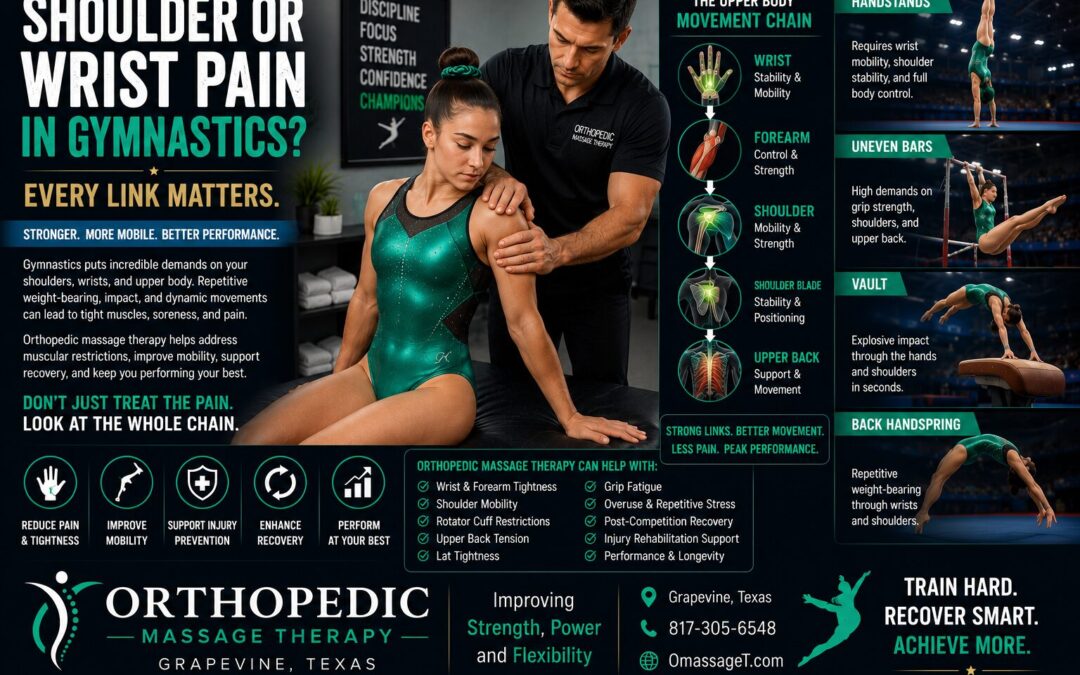
For gymnasts experiencing shoulder or wrist problems, we look beyond the painful area.
Because the:
Hands → Wrists → Forearms → Elbows → Shoulders → Shoulder Blades → Upper Back
all work together.
Understanding that connection can be an important part of helping a gymnast move and perform at their best.
Why Gymnastics Is So Demanding on the Upper Body
Most athletes primarily use their legs to support their body weight.
Gymnasts frequently support their body weight through their arms.
Consider how often a gymnast performs:
- Handstands
- Cartwheels
- Round-offs
- Back handsprings
- Front handsprings
- Vault
- Uneven bars
- Press handstands
The upper body must repeatedly support, stabilize, absorb force, and generate movement.
The shoulders need exceptional mobility.
The wrists need sufficient range of motion.
The forearms must control the hands and grip.
The shoulder blades must move and stabilize efficiently.
The upper back must contribute to overhead positions.
All of these areas must coordinate.
When one area becomes restricted, fatigued, or overloaded, another area may compensate.
Why Do Gymnasts Get Wrist Pain?
The wrist is not typically designed to function exactly like the ankle.
Yet gymnastics frequently requires the wrist to bear significant body weight.
During a handstand, the gymnast places substantial force through the:
Hands → Wrists → Forearms
During tumbling, those forces can become even greater because the athlete contacts the floor dynamically.
Repeated weight-bearing may place significant demands on the wrist.
Gymnasts may notice:
- Wrist soreness after practice
- Discomfort during handstands
- Pain during back handsprings
- Stiffness after training
- Reduced wrist mobility
- Forearm tightness
Occasional muscular fatigue is different from persistent pain.
Recurring or worsening wrist pain deserves attention—especially in young gymnasts.
Young Gymnasts and Wrist Pain
Competitive gymnasts often begin intense training while they are still growing.
This makes persistent wrist pain particularly important to evaluate appropriately.
Young athletes have developing bones and growth plates.
Repeated weight-bearing through the wrists may create specific concerns that should not be dismissed as simple muscle soreness.
A young gymnast who repeatedly complains of wrist pain should receive appropriate assessment from a qualified healthcare professional.
Massage therapy should never be used to delay necessary medical evaluation.
When muscular restrictions in the forearms or surrounding areas are appropriate for massage, treatment may complement a broader care plan.
The Forearm-Wrist Connection
Many muscles controlling the wrist and fingers are located in the forearm.
These muscles help:
- Flex the wrist
- Extend the wrist
- Move the fingers
- Control grip
- Stabilize the hand
During gymnastics, the forearm muscles work constantly.
Think about gripping the uneven bars.
Or controlling the hands during a handstand.
Or stabilizing the wrist during tumbling.
High training volume can create significant muscular fatigue in the forearms.
When these muscles become restricted or overworked, the wrist may feel different.
Targeted orthopedic massage therapy may help address muscular restrictions in the forearms when appropriate.
Handstands Require More Than Strong Arms
A handstand may look like a simple upside-down position.
But mechanically, it requires the entire body to coordinate.
The gymnast needs:
- Wrist mobility
- Shoulder mobility
- Shoulder stability
- Upper-back control
- Core strength
- Hip control
- Balance
If one part of this system is restricted, another area may compensate.
For example, if the shoulders cannot comfortably reach a fully overhead position, the gymnast may compensate through the rib cage or lower back.
If wrist mobility is limited, the gymnast may change hand position or loading.
A good handstand is a whole-body skill.
That is why treatment should consider the whole movement chain.
Why Shoulder Mobility Is Essential for Gymnasts
Gymnasts require significant overhead shoulder mobility.
This is essential for:
- Handstands
- Bars
- Bridges
- Back handsprings
- Walkovers
- Tumbling
- Vault
But mobility alone is not enough.
The shoulders must also be strong and stable.
This creates an important balance:
Mobility + Stability + Strength
A gymnast needs enough mobility to achieve the required position.
They also need enough muscular control to safely manage that position under load.
Simply stretching the shoulders more aggressively may not always be the answer.
The goal is functional movement.
The Shoulder Blade Is Part of the Shoulder
When people think about the shoulder, they often focus only on the ball-and-socket joint.
But the shoulder blade—or scapula—is essential to healthy upper-body movement.
When the arm moves overhead, the shoulder blade must move too.
Muscles surrounding the scapula help:
- Position the shoulder
- Stabilize the upper body
- Control overhead movement
- Transfer force
During gymnastics, these muscles work intensely.
They contribute to:
- Handstands
- Bars
- Tumbling
- Vault
- Pressing movements
If the muscles surrounding the shoulder blade become fatigued or restricted, shoulder mechanics may change.
This is why targeted treatment may involve the upper back and scapular muscles rather than focusing only on the front of the shoulder.
Tight Lats Can Affect Overhead Position
The latissimus dorsi—the lats—are large muscles of the back.
They are extremely important for gymnastics strength, particularly during pulling and bar skills.
But muscular restrictions in the lats may also influence overhead shoulder mobility.
A gymnast with restricted lats may have difficulty comfortably achieving a straight overhead position.
The body may compensate.
Often, additional movement may occur through the lower back.
This creates an important connection:
Shoulder mobility can influence spinal positioning.
That is one reason the shoulder article and our previous lower-back article fit together so closely.
Sometimes the area that appears to be compensating is not the area that originally lacked movement.
The Shoulder-Lower Back Connection
Imagine a gymnast performing a bridge or back handspring.
The arms need to reach overhead.
If the shoulders cannot comfortably achieve enough range, the body still needs to complete the skill.
One possible compensation is increased arching through the lower back.
The gymnast may look flexible overall.
But the movement may not be evenly distributed.
This does not mean shoulder tightness automatically causes back pain.
It means the body works as a system.
When evaluating a gymnast with recurring muscular tightness, it can be useful to ask:
Where is movement available?
Where is movement restricted?
And where is the body compensating?
Uneven Bars and Shoulder Stress
The uneven bars place unique demands on the upper body.
Gymnasts must:
- Grip strongly
- Swing dynamically
- Support body weight
- Absorb forces
- Move through large shoulder ranges
The shoulders and upper back must repeatedly coordinate at high speed.
Forearms may also become fatigued from gripping.
Gymnasts training high-level bar skills may experience muscular tightness around the:
- Lats
- Shoulders
- Upper back
- Forearms
- Chest
Orthopedic massage therapy may help address muscular restrictions associated with these repetitive demands.
Persistent joint pain or significant weakness, however, requires appropriate evaluation.
Vault and Upper-Body Impact
Vault is explosive.
The gymnast runs at high speed, contacts the springboard, reaches the vaulting table, and rapidly transfers force through the upper body.
The hands, wrists, elbows, shoulders, and trunk must manage tremendous forces in a very short period.
This requires:
- Strength
- Timing
- Mobility
- Stability
- Technique
A restriction somewhere in the upper-body chain may influence how the athlete handles these forces.
Recurring discomfort during vault should not simply be ignored because it disappears after practice.
Patterns matter.
Back Handsprings and Repetitive Wrist Loading
A gymnast may perform dozens of back handsprings during a single training session.
Each repetition requires the hands to contact the floor while the wrists and shoulders manage body weight and force.
Now multiply those repetitions across:
Weeks.
Months.
Years.
The cumulative training volume can be significant.
This is why recovery and load management matter.
A gymnast may tolerate a certain training volume comfortably but begin experiencing problems when repetitions increase dramatically.
More practice is not always better if movement quality and recovery begin declining.
Why Stretching the Wrist May Not Be Enough
If a gymnast’s wrist feels tight, stretching may help.
But recurring wrist discomfort may involve more than flexibility.
Consider:
- Forearm muscular tension
- Training volume
- Previous wrist injuries
- Technique
- Strength
- Recovery
- Growth and development
If stretching provides only temporary relief and symptoms return during every practice, the problem deserves a closer look.
Persistent pain should not simply be stretched harder.
How Orthopedic Massage Therapy May Help
When muscular and soft-tissue restrictions are contributing to limited or uncomfortable movement, orthopedic massage therapy may help address those restrictions.
Depending on the gymnast, treatment may involve the:
- Forearm flexors
- Forearm extensors
- Upper arms
- Shoulders
- Rotator cuff region
- Lats
- Chest
- Shoulder blade muscles
- Upper back
The exact approach depends on the athlete.
A gymnast with restricted overhead mobility may require different treatment than one experiencing forearm fatigue.
A gymnast returning from a wrist injury may have different needs than an athlete struggling with muscular tightness from high-volume bar training.
Treatment should always be individualized.
Massage Should Not Mean Maximum Pressure
Gymnasts are tough athletes.
They are accustomed to discomfort.
But massage does not need to be extremely painful to be effective.
More pressure is not automatically better.
Treatment should consider:
- The gymnast’s age
- Tissue sensitivity
- Training schedule
- Competition schedule
- Injury history
- Current symptoms
- Treatment goals
Especially with young athletes, treatment should always be professional, appropriate, and clearly explained.
The goal is improved function—not testing pain tolerance.
Mobility Without Strength Is Not Enough
A gymnast can have exceptional flexibility and still need better control.
This is especially important at the shoulder.
The athlete needs enough mobility to reach overhead.
But they also need strength to stabilize that position while:
- Supporting body weight
- Swinging
- Tumbling
- Vaulting
This is why a comprehensive approach may combine:
- Appropriate strength training
- Mobility work
- Technical coaching
- Recovery
- Orthopedic massage therapy
Each serves a different purpose.
Together, they support athletic performance.
When Shoulder or Wrist Pain Needs Medical Evaluation
Not every shoulder or wrist problem is muscular.
Appropriate medical evaluation is important when symptoms include:
- Persistent or worsening pain
- Significant swelling
- Loss of normal movement
- Significant weakness
- Pain following trauma
- Numbness or tingling
- Joint instability
- Pain that prevents normal weight-bearing
- Symptoms that repeatedly interfere with gymnastics
Young athletes with recurring wrist or shoulder pain deserve particular attention.
Massage therapy should not delay appropriate medical assessment.
Recovery Between Gymnastics Practices
The upper body needs recovery just like the legs.
Gymnasts may finish a demanding practice with tired:
Shoulders.
Forearms.
Wrists.
Upper back.
Then return the next day and repeat the same skills.
Recovery becomes increasingly important as training volume increases.
A comprehensive strategy may include:
- Adequate sleep
- Nutrition
- Hydration
- Appropriate rest
- Strength and conditioning
- Mobility work
- Smart training progression
- Targeted orthopedic massage therapy
Recovery helps athletes prepare for the next training session.
Orthopedic Massage Therapy for Gymnasts in Grapevine, Texas
Gymnasts throughout Grapevine, Southlake, Colleyville, Keller, and the surrounding Dallas-Fort Worth area dedicate countless hours to developing strength, flexibility, technique, and confidence.
Their shoulders, wrists, and upper bodies must handle demands rarely seen in other sports.
At Orthopedic Massage Therapy in Grapevine, Texas, we provide targeted orthopedic massage therapy focused on:
- Muscular restrictions
- Functional mobility
- Sports recovery
- Injury rehabilitation support
- Athletic performance
- Strength and flexibility
When a gymnast experiences shoulder or wrist problems, we look beyond a single painful location.
We consider the entire chain:
Hands → Wrists → Forearms → Elbows → Shoulders → Shoulder Blades → Upper Back
Because every link matters.
Strong Hands. Mobile Shoulders. Better Gymnastics.
Gymnastics requires the arms to do much more than move the body.
They must support it.
Catch it.
Stabilize it.
Swing it.
And sometimes absorb tremendous forces in fractions of a second.
Recurring shoulder and wrist problems should not automatically be accepted as the price of being a gymnast.
Pay attention to patterns.
Look at mobility.
Consider muscular restrictions.
Manage training volume.
Prioritize recovery.
And when pain persists, seek appropriate evaluation.
At Orthopedic Massage Therapy in Grapevine, Texas, our goal is to help athletes address muscular restrictions, improve functional movement, support recovery, and continue pursuing the sport they love.
Improving Strength, Power and Flexibility.
Contact Orthopedic Massage Therapy in Grapevine, Texas to learn how targeted orthopedic massage therapy may support a gymnast’s shoulder and wrist mobility, athletic recovery, injury rehabilitation, and performance.