Your Title Goes Here
Every gymnast learns how to fly.
But they also have to learn how to land.
Vault.
Floor exercise.
Balance beam.
Dismounts.
Tumbling passes.
Jumps and leaps.
Each time a gymnast returns to the ground, the body must absorb and control force—often in a fraction of a second.
One landing may not seem like much.
But competitive gymnastics is built on repetition.
A gymnast may perform dozens of jumps, tumbling skills, and landings during a single practice.
Multiply that by several practices each week.
Then multiply it across months and years of training.
The cumulative demands on the lower body can become significant.
The feet, ankles, calves, knees, hips, and surrounding muscles must work together every time a gymnast lands.
When one part of that system becomes fatigued, restricted, injured, or less efficient, another area may have to compensate.
That is why recurring knee or ankle discomfort should not always be viewed as an isolated problem.
At Orthopedic Massage Therapy in Grapevine, Texas, we use targeted orthopedic massage therapy to help athletes address muscular restrictions, improve functional mobility, support recovery, and complement appropriate injury rehabilitation.
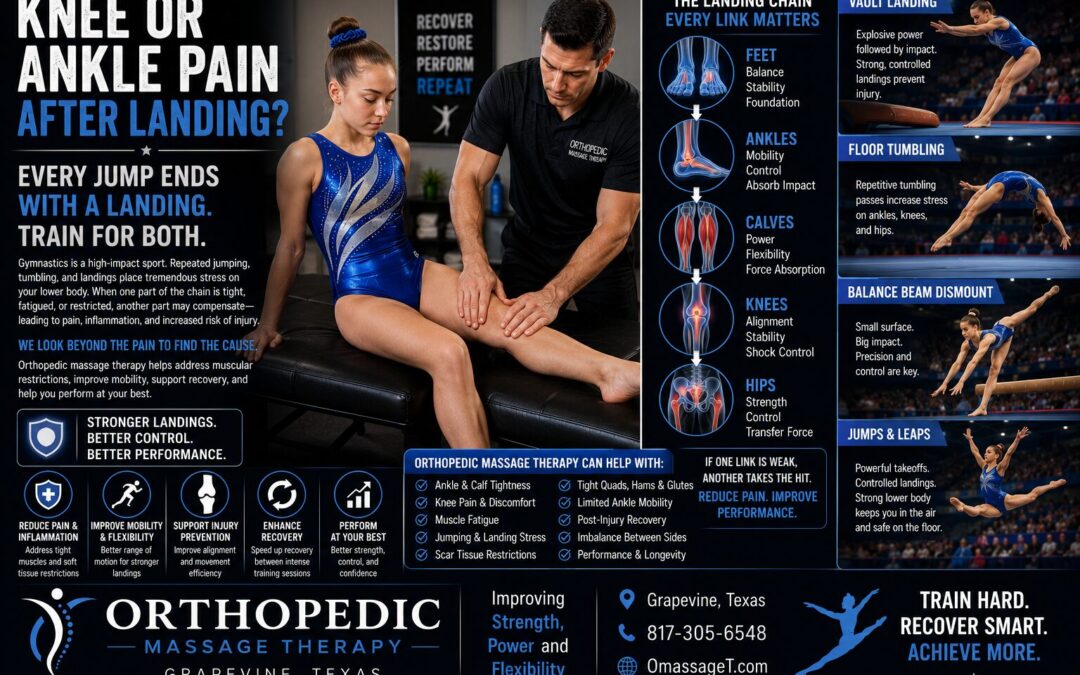
For gymnasts, we look at the entire landing chain:
Feet → Ankles → Calves → Knees → Hips
Because every landing involves the whole athlete.
Gymnastics Is a High-Impact Sport
Gymnastics combines extraordinary athletic qualities.
Strength.
Power.
Speed.
Flexibility.
Balance.
Coordination.
But it also involves impact.
When a gymnast lands after a jump, tumbling pass, or dismount, the body must manage forces created by gravity, momentum, body weight, and the speed of the movement.
The lower body helps absorb and control those forces.
This requires coordinated movement through the:
-
Feet
-
Ankles
-
Knees
-
Hips
-
Trunk
The muscles surrounding these areas must respond quickly.
A successful landing is not simply about “sticking it.”
It is about controlling force efficiently.
What Happens When a Gymnast Lands?
Think about a gymnast finishing a tumbling pass.
The feet contact the floor.
Immediately, the ankles begin helping absorb force.
The knees bend.
The hips contribute.
Muscles throughout the lower body contract to control the landing.
The trunk stabilizes the athlete.
All of this happens extremely quickly.
An efficient landing requires:
Mobility + Strength + Stability + Coordination
If one part of the system is limited, another area may compensate.
For example, if ankle mobility is restricted, movement at the knee or hip may change.
If the hips are fatigued, knee control may change.
If the calves are tight, ankle mechanics may be affected.
The body works as a connected system.
Why Do Gymnasts Experience Knee Pain?
There is no single reason a gymnast may experience knee discomfort.
Possible contributing factors may include:
-
Repetitive jumping
-
High training volume
-
Repeated landings
-
Muscular fatigue
-
Rapid increases in training
-
Growth and development
-
Limited ankle mobility
-
Muscular restrictions
-
Previous injuries
-
Changes in landing mechanics
The knee sits between the hip and ankle.
That means movement above and below the knee can influence how forces travel through the lower body.
This does not mean every knee problem originates somewhere else.
The knee itself can certainly be injured.
But recurring knee discomfort may require looking beyond the knee.
The Ankle-Knee Connection
The ankle plays an important role in landing mechanics.
When a gymnast lands, the ankle needs enough mobility to help the body absorb force.
One important movement is ankle dorsiflexion—the ability of the shin to move forward over the foot.
If ankle mobility is restricted, the body may find another way to complete the movement.
Compensation may occur through the:
-
Foot
-
Knee
-
Hip
-
Trunk
For example, a gymnast may land with different knee mechanics because the ankle cannot move comfortably through the required range.
This is why recurring knee discomfort may sometimes involve looking at the calves and ankles as well.
Tight Calves and Landing Mechanics
The calf complex plays an important role in jumping and landing.
The gastrocnemius and soleus muscles contribute to:
-
Jumping
-
Running
-
Ankle control
-
Force absorption
-
Propulsion
Gymnasts use these muscles constantly.
Tumbling.
Vault approaches.
Jumps.
Leaps.
Beam work.
Repeated training can create muscular fatigue and tightness.
If the calves become restricted, ankle mobility may also be affected.
This does not automatically mean tight calves cause knee pain.
But it demonstrates how one area of the movement chain may influence another.
Orthopedic massage therapy may help address muscular restrictions in the calves and lower legs when appropriate.
Ankle Pain in Gymnasts
The ankles experience enormous demands in gymnastics.
They must be:
Strong enough to jump.
Mobile enough to land.
Stable enough to balance.
Powerful enough to tumble.
Precise enough for beam.
Gymnasts may experience ankle discomfort related to:
-
Repetitive landings
-
Previous ankle sprains
-
High training volume
-
Muscular fatigue
-
Restricted mobility
-
Impact
-
Changes in technique
A gymnast may also continue training after an ankle injury has “healed” but still have differences in mobility or muscular function between sides.
Those differences may influence movement.
Previous Ankle Sprains Matter
Ankle sprains are common in many sports.
After an ankle sprain, pain and swelling may eventually disappear.
But that does not always mean movement has completely returned to normal.
An athlete may still have:
-
Reduced ankle mobility
-
Muscular tightness
-
Balance differences
-
Strength differences
-
Compensation patterns
A gymnast may unconsciously shift more weight toward the uninjured side.
Or one landing may consistently feel less stable.
Over time, these patterns may influence other areas.
Appropriate rehabilitation is important after an ankle injury.
Orthopedic massage therapy may complement rehabilitation by addressing muscular and soft-tissue restrictions when appropriate.
Why One Ankle May Feel Different From the Other
Gymnastics is not perfectly symmetrical.
Athletes often develop a preferred:
-
Takeoff leg
-
Landing pattern
-
Turning direction
-
Twisting direction
-
Lead leg
Previous injuries can also create differences between sides.
One ankle may have less mobility.
One calf may feel tighter.
One leg may absorb force differently.
Some asymmetry is normal.
But significant differences may be worth addressing—especially if the gymnast repeatedly experiences discomfort on the same side.
Patterns matter.
The Hip-Knee Connection
The hips play an important role in controlling the position of the legs during landing.
Muscles surrounding the hips and glutes contribute to:
-
Pelvic stability
-
Hip control
-
Jumping
-
Landing
-
Direction changes
-
Tumbling
As these muscles fatigue, movement may change.
A gymnast who demonstrates excellent landing control early in practice may move differently after hours of training.
The knees may position differently.
Balance may change.
Landings may become heavier.
This is one reason recovery and conditioning matter so much.
The athlete needs enough strength and endurance to maintain movement quality throughout practice—not just during the first few repetitions.
Fatigue Changes Movement
This is one of the most important concepts for gymnasts, parents, and coaches.
Fatigue is not simply feeling tired.
Fatigue can influence movement.
Imagine a gymnast practicing a tumbling pass.
The first five repetitions are powerful and controlled.
Then come repetitions:
As the athlete becomes fatigued, small changes may appear.
Jump height may decrease.
Timing may change.
Landing control may decline.
Muscles may not absorb force exactly the same way.
This does not automatically mean the athlete should stop training whenever they feel tired.
Training requires appropriate challenge.
But fatigue should be managed intelligently.
More repetitions are not always better if technique is deteriorating significantly.
Why Does My Knee Hurt Only After Practice?
Some gymnasts feel fine while training.
Then later that evening—or the next morning—the knee begins to ache.
Others only experience discomfort after a certain number of landings.
These patterns provide useful information.
Ask:
Does discomfort appear after floor practice?
After vault?
After repeated beam dismounts?
Only after long practices?
At the end of the training week?
Patterns may help identify when the body is struggling to manage current demands.
The question should not only be:
“Where does it hurt?”
Also ask:
“When does it hurt, and what happened before it started?”
Vault and Landing Forces
Vault is one of the most explosive events in gymnastics.
The gymnast sprints.
Hits the springboard.
Contacts the vaulting table.
Launches into the air.
Then lands.
The entire sequence happens rapidly.
The landing requires the lower body to absorb substantial force while maintaining control.
The:
Feet → Ankles → Knees → Hips
must work together.
A gymnast who repeatedly lands with muscular fatigue or limited mobility may experience different stress patterns.
Recovery between high-impact training sessions matters.
Floor Exercise and Repeated Impact
Floor routines combine:
-
Tumbling
-
Leaps
-
Jumps
-
Dance
-
Landings
A gymnast may perform numerous high-impact movements during a single routine.
During practice, those elements may be repeated many times.
The cumulative workload can become significant.
Muscular tightness in the calves, quadriceps, hamstrings, and hips may develop as training volume increases.
Orthopedic massage therapy may help address these muscular restrictions as part of an athlete’s recovery strategy.
Balance Beam: Small Surface, Big Demands
The balance beam adds another challenge.
Precision.
A gymnast must land on an extremely narrow surface.
This requires exceptional:
-
Foot control
-
Ankle stability
-
Balance
-
Hip control
-
Coordination
Small differences between sides may become noticeable.
A previous ankle injury may affect confidence or stability.
Muscular fatigue may influence balance.
The entire lower-body chain contributes to successful beam performance.
Growth Spurts and Knee Pain
Young gymnasts are often training intensely while their bodies are growing.
Growth can temporarily change:
-
Flexibility
-
Coordination
-
Strength
-
Limb proportions
-
Movement patterns
A gymnast may suddenly feel awkward performing skills that previously felt natural.
Knee discomfort during growth should not automatically be ignored.
Young athletes can experience growth-related conditions and other injuries that require appropriate evaluation.
Pain should not simply be dismissed as:
“Growing pains.”
Persistent symptoms deserve attention.
How Orthopedic Massage Therapy May Help
Orthopedic massage therapy focuses on muscular and soft-tissue restrictions that may influence movement.
For a gymnast experiencing lower-body tightness associated with jumping and landing, treatment may involve the:
-
Calves
-
Lower-leg muscles
-
Quadriceps
-
Hamstrings
-
Hip flexors
-
Glutes
-
Deep hip muscles
Notice that treatment may involve areas both above and below the knee.
Why?
Because landing is a whole-body movement.
The exact treatment depends on the individual athlete.
A gymnast with limited ankle mobility may require a different approach than one experiencing significant quadriceps tightness.
An athlete returning from an ankle injury may have different needs than a gymnast dealing primarily with muscular fatigue during competition season.
Treatment should be individualized.
Massage Does Not Replace Strength Training
Massage therapy may help address muscular restrictions.
But gymnasts also need strength.
Strong muscles help control landings.
Important areas include the:
-
Feet and ankles
-
Calves
-
Quadriceps
-
Hamstrings
-
Glutes
-
Hips
-
Core
A comprehensive approach may include:
-
Strength and conditioning
-
Mobility work
-
Technical coaching
-
Appropriate rehabilitation
-
Recovery
-
Orthopedic massage therapy
Each component serves a different purpose.
Together, they can support better athletic movement.
Should Massage Be Painful?
Not necessarily.
More pressure does not automatically create better results.
Treatment should consider:
-
The gymnast’s age
-
Current soreness
-
Training schedule
-
Competition schedule
-
Injury history
-
Tissue sensitivity
-
Treatment goals
A gymnast who completed a demanding floor and vault practice may not need extremely aggressive treatment immediately afterward.
Treatment should support recovery—not create unnecessary additional stress.
When Knee or Ankle Pain Needs Medical Evaluation
Not every knee or ankle problem is muscular.
Appropriate medical evaluation may be necessary when symptoms include:
-
Significant swelling
-
Inability to bear weight normally
-
Knee locking
-
Repeated buckling or instability
-
Significant ankle instability
-
Severe pain after a landing
-
A popping sensation associated with injury
-
Significant bruising
-
Loss of normal movement
-
Persistent or worsening pain
Massage therapy should not be used to delay necessary medical assessment.
Young athletes with persistent pain deserve particular attention.
Recovery Is Part of Landing Better
Gymnasts often spend enormous amounts of time practicing how to land.
But recovery also influences landing quality.
A fatigued athlete may not move the same way as a recovered athlete.
Recovery strategies may include:
-
Adequate sleep
-
Proper nutrition
-
Hydration
-
Appropriate rest
-
Strength and conditioning
-
Mobility work
-
Smart training progression
-
Targeted orthopedic massage therapy
Recovery is not separate from performance.
Recovery helps create performance.
Parents and Coaches: Watch the Landings
Parents and coaches can sometimes notice movement changes before an athlete reports significant discomfort.
Watch for:
-
Repeatedly favoring one leg
-
Landing more heavily than usual
-
Shifting weight to one side
-
Frequently rubbing the knee or ankle
-
Avoiding certain tumbling passes
-
Changes in confidence during landings
-
Reduced ankle mobility
-
Complaints that the legs always feel tight
These signs do not automatically indicate a serious injury.
But they may be worth paying attention to.
Orthopedic Massage Therapy for Gymnasts in Grapevine, Texas
Competitive gymnasts throughout Grapevine, Southlake, Colleyville, Keller, and the surrounding Dallas-Fort Worth area perform thousands of jumps, tumbling skills, and landings throughout their training.
Their lower bodies must repeatedly generate power and absorb force.
At Orthopedic Massage Therapy in Grapevine, Texas, we provide targeted orthopedic massage therapy focused on:
-
Muscular restrictions
-
Functional mobility
-
Sports recovery
-
Injury rehabilitation support
-
Athletic performance
-
Strength and flexibility
For gymnasts experiencing knee or ankle problems, we consider the entire landing chain:
Feet → Ankles → Calves → Knees → Hips
Because the location where an athlete feels discomfort may only be one part of the movement picture.
Every Jump Ends With a Landing—Train for Both
Gymnasts spend countless hours learning how to jump higher.
Tumble harder.
Flip faster.
Twist farther.
But every airborne skill eventually comes back to the ground.
The body must be prepared for both sides of the equation:
Generating force—and absorbing force.
If knee or ankle discomfort repeatedly returns, do not simply focus on the painful joint.
Look at the whole athlete.
The feet.
The ankles.
The calves.
The knees.
The hips.
The athlete’s strength.
Their mobility.
Their training volume.
Their recovery.
Every link matters.
At Orthopedic Massage Therapy in Grapevine, Texas, our goal is to help athletes address muscular restrictions, improve functional movement, support recovery, and continue pursuing the sport they love.
Improving Strength, Power and Flexibility.
Contact Orthopedic Massage Therapy in Grapevine, Texas to learn how targeted orthopedic massage therapy may support a gymnast’s lower-body mobility, athletic recovery, injury rehabilitation, and performance.
Grapevine, Texas | 817-305-6548 | OmassageT.com