Orthopedic Massage Therapy OmassageT.com
A dancer’s feet tell a story.
Every step.
Every turn.
Every jump.
Every landing.
Every rehearsal.
Every performance.
The feet are where movement meets the floor.
For dancers, they must be strong enough to generate power, mobile enough to create beautiful lines, and stable enough to control the body during demanding choreography.
And they have to do it repeatedly.
That is why foot and ankle discomfort can become such a frustrating problem for dancers and performing artists.
When the foot hurts, it is natural to focus on the foot.
When the ankle feels tight, it is natural to focus on the ankle.
But sometimes, the location where a dancer feels discomfort is only one part of the story.
The:
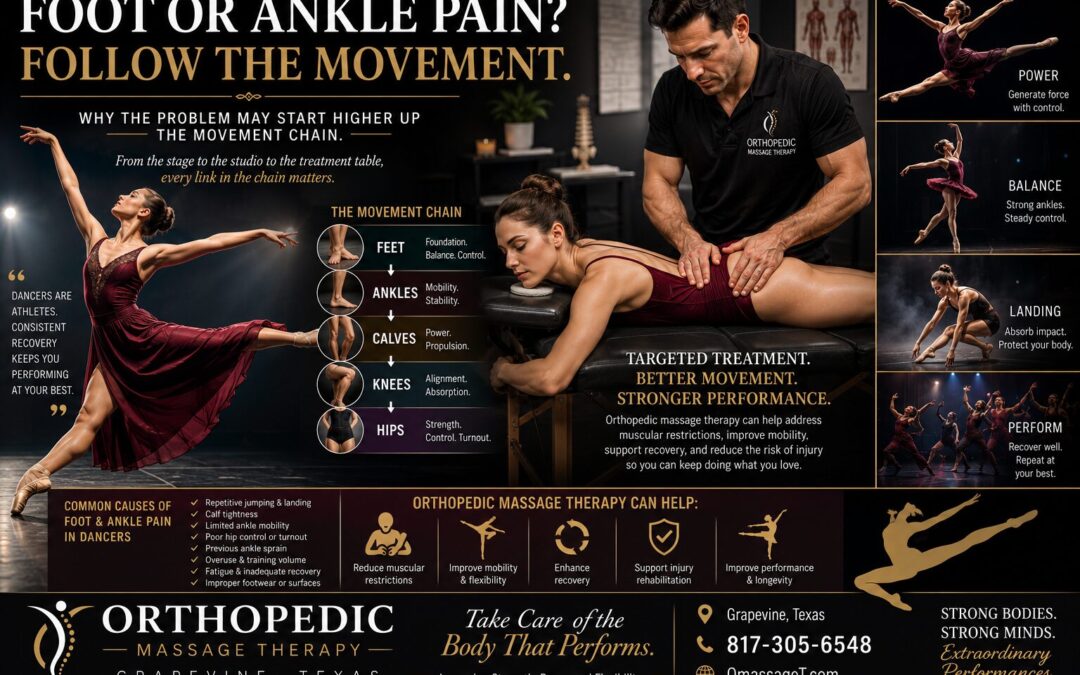
Feet → Ankles → Calves → Knees → Hips
all work together.
A restriction, weakness, compensation, or movement change in one area may influence another.
At Orthopedic Massage Therapy in Grapevine, Texas, we use targeted orthopedic massage therapy to help dancers and athletes address muscular restrictions, improve functional mobility, support recovery, and complement appropriate injury rehabilitation.
The goal is not simply to ask:
“Where does it hurt?”
We also want to understand:
“How is the entire movement chain working?”
Dancers Ask More From Their Feet
Most people walk through their daily lives without thinking much about their feet.
Dancers cannot afford to ignore them.
The feet play an essential role in:
-
Balance
-
Propulsion
-
Jumping
-
Landing
-
Turning
-
Pointing
-
Direction changes
-
Artistic lines
Depending on the style of dance, performers may spend significant time:
On the balls of their feet.
Pointing through the toes.
Landing from jumps.
Turning repeatedly.
Moving barefoot.
Wearing specialized dance shoes.
Performing choreography on hard stages.
The demands are significant.
And unlike a single athletic event, professional dancers may need to repeat those demands show after show.
What Touring With CATS Taught Me About Performers’ Feet
When I traveled across North America with the musical CATS, working with members of the cast gave me a firsthand look at how physically demanding professional performance can be.
Audiences saw the finished production.
They saw extraordinary choreography and performers moving effortlessly across the stage.
Behind the curtain, however, those performers had to manage the physical reality of doing demanding choreography repeatedly.
The feet and ankles were part of that reality.
A performer might finish one show and need to be ready again soon afterward.
That experience reinforced something I still believe today:
Treatment has to support what the performer needs their body to do next.
A dancer does not need a foot that simply feels better while lying on a treatment table.
They need a foot and ankle that can help them:
Move.
Balance.
Jump.
Land.
Turn.
Perform.
The Foot Is Not an Isolated Structure
The foot is the foundation of the lower-body movement chain.
But it does not work alone.
Consider what happens during a landing.
The foot contacts the floor.
The ankle moves.
The knee bends.
The hip helps control the leg.
The trunk stabilizes the body.
This happens almost instantly.
That is why a foot or ankle problem may require looking beyond the exact location of discomfort.
The body is connected.
The Foot-Ankle-Calf Connection
Many muscles that control the foot and ankle originate in the lower leg.
The calf and surrounding muscles contribute to:
-
Ankle movement
-
Foot control
-
Pointing
-
Jumping
-
Landing
-
Balance
Dancers use these muscles constantly.
High training and performance volume can create muscular fatigue and restrictions.
A dancer may say:
“My ankle feels stiff.”
But the calf may also be involved.
Or:
“The bottom of my foot always feels tight.”
But muscular tension higher in the lower leg may be influencing movement.
This is why treatment should consider the entire region.
Tight Calves in Dancers
Calf tightness is extremely common among athletes and performers.
For dancers, the calves work during:
-
Relevé
-
Jumps
-
Turns
-
Landings
-
Pointing
-
Traveling movements
They may perform hundreds of repetitions during rehearsals and performances.
A tight calf may influence ankle mobility.
Reduced ankle mobility may influence how the foot, knee, or hip moves.
This does not mean every foot problem comes from tight calves.
But it demonstrates why the body should be evaluated as a system.
Why Ankle Mobility Matters
Ankles need both mobility and stability.
This can seem contradictory.
But dancers require both.
The ankle must move enough to allow:
-
Deep plié positions
-
Controlled landings
-
Smooth transitions
At the same time, it must remain stable during:
-
Balance
-
Turns
-
Jumps
-
Direction changes
Too little movement can create problems.
But mobility without adequate strength and control can also be problematic.
The goal is not simply:
“Make the ankle more flexible.”
The goal is:
Create usable mobility with strength and control.
The Knee Can Influence What Happens Below
The knee sits between the ankle and hip.
Movement at the knee can influence how forces travel through the lower body.
During a plié or landing, the:
Foot → Ankle → Knee → Hip
must coordinate.
If one area moves differently, the others may adapt.
A dancer experiencing recurring foot or ankle discomfort may benefit from looking at knee mechanics as part of the larger picture.
Again, this does not mean the knee is automatically the cause.
It means movement should be considered as a chain.
The Hip-Foot Connection
The hips may seem far away from the feet.
But hip strength and control can influence the position of the entire leg.
Muscles surrounding the hips help control:
-
Pelvic position
-
Leg rotation
-
Knee position
-
Balance
-
Landing mechanics
Dancers require exceptional hip mobility.
But they also need exceptional hip strength.
If hip control changes, movement throughout the leg may change.
That may influence how the foot contacts the floor.
This is why treating only the foot may sometimes be incomplete.
Turnout Is a Whole-Leg Movement
Turnout is fundamental in many forms of dance.
But turnout should not simply be forced through the feet.
True turnout involves movement throughout the lower-body chain, particularly at the hips.
When a dancer tries to create more turnout than the hips comfortably allow, the body may compensate.
The feet may change position.
The knees may rotate differently.
The ankles may experience different stresses.
This is an excellent example of why:
Where you see the movement is not always where the movement should come from.
The entire chain matters.
Pointing the Foot Requires More Than the Toes
A beautifully pointed foot is part of the aesthetic of many dance styles.
But pointing is not simply curling the toes.
It involves coordinated movement through the:
-
Foot
-
Ankle
-
Lower leg
Dancers who repeatedly grip or curl their toes excessively may create additional muscular tension.
The goal is controlled movement.
Not simply forcing the foot into a position.
Repetitive Jumping and Landing
Dance can involve tremendous amounts of jumping.
Every jump has two phases:
Takeoff and landing.
The takeoff requires force production.
The landing requires force absorption.
The feet, ankles, calves, knees, and hips all contribute.
As fatigue increases, landing mechanics may change.
A dancer who lands beautifully early in rehearsal may move differently after hours of choreography.
This is one reason recovery matters.
Hard Stages and Changing Venues
Touring performers may encounter different stages and performance environments.
When I traveled with CATS, one of the realities of touring was constant change.
New city.
New theater.
New backstage environment.
Yet the performance still had to remain consistent.
Different surfaces can feel different to performers.
The body has to adapt.
That adaptability is one of the remarkable qualities of professional dancers.
But it also reinforces the importance of recovery and body awareness.
Previous Ankle Sprains Matter
A dancer may say:
“I sprained that ankle years ago, but it healed.”
The pain may be gone.
But sometimes differences remain.
The athlete may still have:
-
Reduced mobility
-
Balance differences
-
Strength differences
-
Muscular restrictions
-
Compensation patterns
A dancer may unconsciously rely more heavily on the opposite side.
Over time, that pattern may influence movement.
Appropriate rehabilitation after an ankle injury is important.
Orthopedic massage therapy may complement rehabilitation by addressing muscular and soft-tissue restrictions when appropriate.
One Foot May Be Different From the Other
Dancers often have preferences.
A preferred turning side.
A stronger balance leg.
A favored takeoff leg.
A more flexible side.
Over thousands of repetitions, differences can develop.
One calf may be tighter.
One ankle may have more mobility.
One foot may feel stronger.
Some asymmetry is normal.
But significant or increasing differences may be worth paying attention to.
Especially when discomfort repeatedly occurs on the same side.
Why Stretching the Foot May Not Fix the Problem
If the foot feels tight, stretching may provide temporary relief.
But if the same tightness returns every day, ask why.
Possible contributors may include:
-
Calf tightness
-
High rehearsal volume
-
Foot muscular fatigue
-
Limited ankle mobility
-
Previous injury
-
Compensation patterns
-
Hip or knee mechanics
Simply stretching harder may not address the complete picture.
Recurring symptoms deserve curiosity.
How Orthopedic Massage Therapy May Help Dancers
Orthopedic massage therapy focuses on muscular and soft-tissue restrictions that may influence movement.
For a dancer experiencing foot or ankle problems, treatment may involve the:
-
Foot musculature when appropriate
-
Calves
-
Muscles surrounding the lower leg
-
Hamstrings
-
Quadriceps
-
Hips
-
Glutes
The exact treatment depends on the individual performer.
A dancer experiencing calf tightness after repeated jumps may require a different approach than someone returning from an ankle injury.
A touring performer may have different recovery needs than a recreational dancer.
Treatment should be individualized.
Massage Should Support the Performance Schedule
Professional performers often cannot simply stop everything for several days after treatment.
They may have:
Rehearsal tomorrow.
A show tonight.
Two performances on the weekend.
Treatment should consider those demands.
Aggressive treatment that creates excessive soreness may not always be appropriate immediately before a performance.
The goal is not maximum pressure.
The goal is appropriate treatment.
What does this performer need right now?
That is the question.
When Foot or Ankle Pain Needs Medical Evaluation
Not every foot or ankle problem is muscular.
Appropriate evaluation may be necessary when symptoms include:
-
Significant swelling
-
Inability to bear weight normally
-
Severe pain after an injury
-
Significant bruising
-
Persistent or worsening pain
-
Repeated ankle instability
-
Numbness or tingling
-
Significant loss of movement
Dancers may be tempted to perform through pain.
But persistent pain should not simply be hidden.
Massage therapy should never delay necessary medical evaluation.
Recovery Is Part of Dance Training
Dancers spend countless hours improving:
Technique.
Flexibility.
Strength.
Choreography.
But recovery deserves the same attention.
A comprehensive recovery strategy may include:
-
Adequate sleep
-
Proper nutrition
-
Hydration
-
Appropriate rest
-
Strength and conditioning
-
Mobility work
-
Intelligent training progression
-
Targeted orthopedic massage therapy
Recovery is not time away from becoming a better dancer.
Recovery helps make better dancing possible.
Orthopedic Massage Therapy for Dancers in Grapevine, Texas
Dancers and performers throughout Grapevine, Southlake, Colleyville, Keller, and the Dallas-Fort Worth area place extraordinary demands on their bodies.
At Orthopedic Massage Therapy in Grapevine, Texas, we bring a performance-focused approach to muscular restrictions, mobility, recovery, and injury rehabilitation support.
My experience traveling throughout North America with CATS and working with cast members reinforced an important principle that continues to guide my work:
Treatment should support what you need your body to do.
For dancers experiencing foot or ankle discomfort, that means looking at more than one isolated area.
We consider the movement chain:
Feet → Ankles → Calves → Knees → Hips
Because every link contributes to the performance.
Don’t Just Treat the Foot—Follow the Movement
When a dancer’s foot hurts, the foot deserves attention.
But do not stop asking questions there.
How is the ankle moving?
Are the calves restricted?
How does the knee control movement?
Are the hips providing enough mobility and stability?
Was there a previous injury?
Has rehearsal volume increased?
Is the performer recovering adequately?
The goal is not to chase symptoms around the body.
The goal is to understand movement.
At Orthopedic Massage Therapy in Grapevine, Texas, our goal is to help dancers, performers, and athletes address muscular restrictions, improve functional movement, support recovery, and continue doing what they love.
Take care of the body that performs.
Improving Strength, Power and Flexibility.
Contact Orthopedic Massage Therapy in Grapevine, Texas to learn how targeted orthopedic massage therapy may support a dancer’s foot and ankle mobility, recovery, injury rehabilitation, and performance.
Grapevine, Texas | 817-305-6548 | OmassageT.com