Orthopedic Massage Therapy OmassageT.com
You wake up with a tight neck.
Your shoulders feel heavy.
There is a knot at the top of your shoulder that never seems to completely disappear.
Maybe turning your head feels restricted.
So you massage the painful area.
Stretch your neck.
Use a massage gun.
Roll on a ball.
Maybe you get a massage focused entirely on your neck and shoulders.
And it feels better.
For a while.
Then the tightness comes back.
Sometimes in the exact same spot.
Why?
Because a tight or painful muscle may be only one part of the problem.
At Orthopedic Massage Therapy in Grapevine, Texas, I often work with people who have recurring neck and shoulder tension.
And one of the most important questions I ask is not simply:
“Where does it hurt?”
I also want to know:
“Why does this area keep having to work so hard?”
The answer may involve more than the neck.
The:
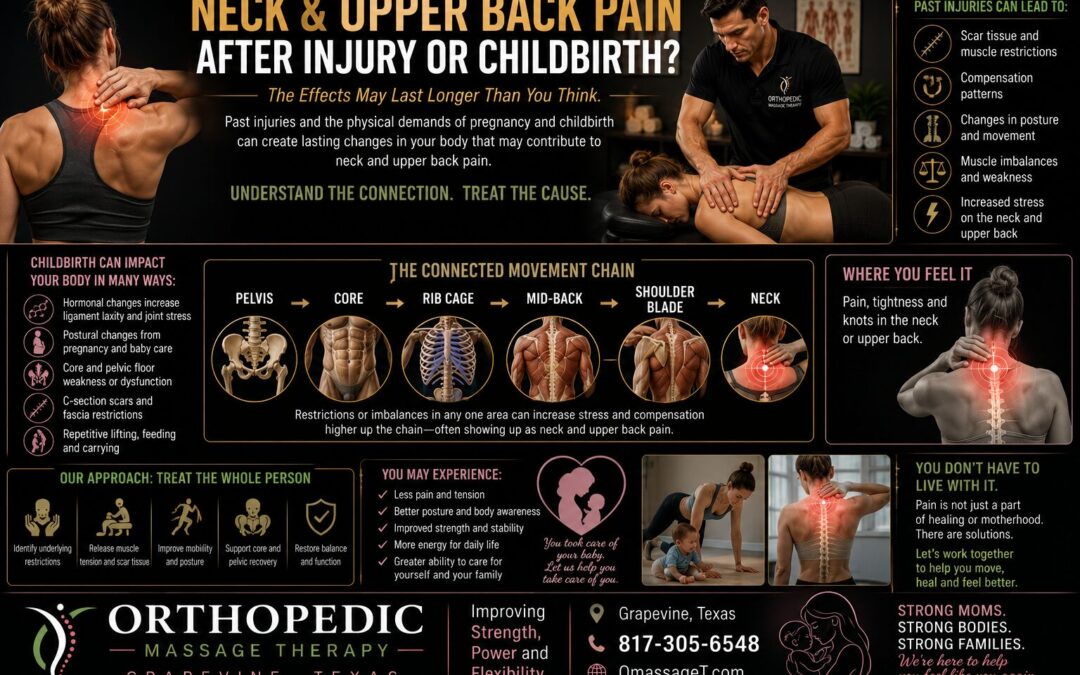
PELVIS → CORE → RIB CAGE → MID-BACK → SHOULDER BLADES → NECK
all interact during movement and posture.
That does not mean every case of neck pain starts at the pelvis.
It does not mean everyone with shoulder tension has a weak core.
Neck and shoulder pain can have many causes.
But when the same muscular tension keeps returning, looking at the entire movement chain may help us understand why.
Because sometimes:
The tight muscle is doing exactly what your body is asking it to do.
The better question may be:
Why is your body asking it to work so hard?
The Knot That Never Goes Away
Almost everyone knows the spot or spots.
That stubborn area between the neck and shoulder.
You press on it.
It hurts.
Someone massages it.
It feels good.
Then it comes back.
People often describe this as a “knot.”
The temptation is to attack it.
More pressure.
Harder massage.
More stretching.
But what if that muscle is not simply tight for no reason?
What if it is working overtime?
Muscles often increase their activity when the body needs:
- Stability
- Support
- Protection
- Compensation
If the same muscle repeatedly becomes tight, we should consider what demands are being placed on it.
Your Neck Does Not Work Alone
The neck sits on top of the thoracic spine.
The thoracic spine interacts with the rib cage.
The shoulder blades move across the rib cage.
The trunk supports the entire upper body.
Everything is connected mechanically.
Think of the chain:
CORE → RIB CAGE → THORACIC SPINE → SHOULDER BLADES → NECK
When you turn your head, your neck moves.
But your upper back may also contribute.
When you reach overhead, your shoulder does not move alone.
The shoulder blade and rib cage are involved.
When you sit at a computer, your trunk must provide support while your arms and head perform tasks.
This is why neck and shoulder problems should not always be viewed as isolated muscles.
The Shoulder Blade Is a Major Part of the Story
The shoulder blade—or scapula—is extremely important.
It serves as a connection between the arm and trunk.
Many muscles attach to or influence the shoulder blade.
These muscles help control:
- Reaching
- Pulling
- Pushing
- Lifting
- Overhead movement
The shoulder blade moves over the rib cage.
That means shoulder function is influenced by the relationship between the:
Shoulder Blade + Rib Cage + Thoracic Spine
If one part of that system is restricted or not functioning efficiently, other muscles may work harder.
Sometimes those muscles are the ones at the top of the shoulders.
Why Your Upper Trapezius May Always Feel Tight
The upper trapezius is one of the most commonly blamed muscles in the body.
“My traps are always tight.”
People stretch them.
Massage them.
Use massage guns on them.
But the upper trapezius is not a bad muscle.
It has a job.
It contributes to movement and control of the shoulder blade and neck.
If it feels constantly overworked, ask:
Why?
Is the shoulder blade moving efficiently?
Is the thoracic spine contributing?
Is the rib cage moving well?
Are you holding your arms in one position for hours?
Are you under significant physical or mental stress?
Is the muscle simply fatigued from repeated use?
The goal should not be to “turn off” the trapezius.
The goal is to understand why it may be working excessively.
The Mid-Back and Neck Connection
Try turning your head while keeping your entire upper body completely rigid.
Now allow your upper body to move naturally.
Movement feels different.
The thoracic spine contributes to many everyday activities involving the head, shoulders, and arms.
If the mid-back is stiff, the neck may need to contribute more movement.
This may be especially relevant during:
- Driving
- Sports
- Looking behind you
- Reaching
- Overhead activity
A person may repeatedly stretch the neck without addressing limited movement through the thoracic spine.
That is why the mid-back may be an important part of neck treatment.
The Rib Cage Matters Too
The rib cage is often forgotten.
But the shoulder blades sit and move over it.
The thoracic spine interacts with it.
Breathing moves it.
If rib-cage movement is limited, shoulder and upper-back mechanics may also be affected.
This is why orthopedic massage therapy may sometimes involve areas that initially seem unrelated to the exact painful spot.
We are looking at movement relationships.
Breathing Can Influence Neck Tension
Your primary breathing muscle is the diaphragm.
But other muscles can assist with breathing.
Some of these accessory breathing muscles are located around the:
- Neck
- Upper chest
- Rib cage
During stress or increased respiratory demand, these muscles may become more active.
Now consider someone who:
Works at a computer all day.
Holds tension in the shoulders.
Feels stressed.
Breathes primarily through the upper chest.
Then wonders why the neck always feels tight.
Breathing may not be the only factor.
But it may be one piece of the larger pattern.
Sitting at a Computer: The Problem Is Not Just “Bad Posture”
Many people blame neck pain on bad posture.
But posture is more complicated than:
Good posture.
Bad posture.
There is no single perfect position you should hold for eight hours.
The bigger problem is often:
Lack of movement variety.
Imagine sitting at a computer for several hours.
Your eyes remain focused forward.
Your arms stay near the keyboard.
Your head stays in a similar position.
Your shoulders perform small repetitive movements.
Even a “good” posture can become uncomfortable if you hold it long enough.
The body likes movement.
Change positions.
Stand.
Walk.
Move your arms.
Rotate your trunk.
Movement variety matters.
Forward Head Posture Is Not Automatically the Problem
You may have seen diagrams showing a head positioned slightly forward with warnings about how dangerous it is.
Human posture varies.
Many people have a forward head position and no pain.
Others have neck pain with seemingly “perfect” posture.
Posture alone does not determine pain.
Instead of trying to force your head backward all day, ask:
Can your neck move comfortably?
Can your thoracic spine rotate and extend?
Can your shoulders move well?
Do you have adequate strength and endurance?
How long are you staying in one position?
Function matters more than chasing a perfect photograph of posture.
Desk Workers and Mouse-Side Shoulder Pain
A common pattern occurs in people who spend hours using a computer mouse.
One shoulder may feel tighter.
The neck may ache more on that side.
The muscles around the shoulder blade may become fatigued.
Why?
The arm performs thousands of small movements.
The shoulder must stabilize those movements.
Over time, muscular fatigue may accumulate.
The solution may involve more than simply massaging the shoulder.
Consider:
Workstation setup.
Movement breaks.
Shoulder endurance.
Thoracic mobility.
Recovery.
All may matter.
Drivers and Neck Tension
People who drive extensively may experience similar problems.
Truck drivers.
Sales professionals.
Delivery drivers.
Commuters.
Hours behind the wheel create prolonged positioning.
The arms remain forward.
The head stays relatively still.
The hips remain seated.
The trunk moves very little.
Then the neck and shoulders become tight.
Again, sitting itself is not automatically harmful.
But prolonged lack of movement can become demanding.
The Core-Neck Connection
What does your core have to do with your neck?
Potentially more than you think.
Your trunk provides a base for movement of the upper body.
When you reach, lift, push, or pull, forces travel through the body.
The trunk helps manage those forces.
If trunk control is inefficient during a particular activity, muscles elsewhere may contribute more.
That can include muscles around the shoulders and neck.
This does not mean:
“Do more crunches and your neck pain will disappear.”
Core function is more complex than abdominal strength.
It involves:
Coordination + Stability + Breathing + Movement Control
The Pelvis May Be Part of the Bigger Picture
The pelvis provides an important foundation for the trunk.
If pelvic position or control changes during sitting, standing, or athletic movement, the spine above adapts.
Again, there is no single perfect pelvic position.
Bodies are meant to move.
But recurring compensation patterns may influence how the trunk and upper body function.
This is why I sometimes look much farther away from the neck when evaluating recurring neck and shoulder tension.
Not because the pelvis is automatically “out of alignment.”
But because the entire movement chain matters.
Stress Is Physical Too
People often separate physical stress and emotional stress.
The body does not always make that distinction.
When people are stressed, they may:
Clench the jaw.
Raise the shoulders.
Breathe differently.
Sleep poorly.
Move less.
These changes may contribute to muscular tension.
Massage therapy can help address muscular restrictions.
But long-term management may also involve recognizing lifestyle factors.
Sleep.
Stress management.
Movement.
Recovery.
They all matter.
Jaw Tension and Neck Pain
The jaw and neck can also interact.
People who clench or grind their teeth may experience tension involving muscles around the:
Jaw.
Head.
Neck.
Shoulders.
This is another example of why simply treating one painful spot may not tell the entire story.
Persistent jaw symptoms should be appropriately evaluated, especially when dental or temporomandibular joint issues are suspected.
Athletes and Neck/Shoulder Compensation
Athletes place different demands on the neck and shoulders.
Swimmers.
Golfers.
Baseball players.
Tennis players.
Pickleball players.
Weightlifters.
Gymnasts.
Dancers.
All use the upper body differently.
A golfer needs thoracic rotation.
A swimmer needs shoulder mobility and control.
A weightlifter needs trunk stability.
A gymnast needs exceptional shoulder mobility and strength.
When one area does not contribute efficiently, another may compensate.
This is why treatment should reflect the activity.
Why Stretching the Neck May Not Be Enough
Stretching may feel great.
But if the same tension returns, ask why.
Maybe the muscle is repeatedly working overtime.
Maybe the thoracic spine needs mobility.
Maybe the shoulder blade needs better control.
Maybe the person needs more movement during the workday.
Maybe stress is contributing.
Maybe there is an underlying condition requiring medical evaluation.
Stretching can be useful.
But recurring problems often deserve broader questions.
How Orthopedic Massage Therapy May Help
At Orthopedic Massage Therapy in Grapevine, Texas, treatment for recurring neck and shoulder tension may involve more than working directly on the painful area.
Depending on the individual, treatment may address muscular restrictions involving the:
- Neck
- Upper trapezius
- Shoulder blades
- Upper and mid-back
- Shoulders
- Chest
- Latissimus dorsi
- Rib cage region
- Lower back or hips when relevant to the movement pattern
The goal is not to randomly massage the entire body.
The goal is to identify relevant muscular restrictions and movement relationships.
Treatment should be targeted.
Why I May Not Spend the Entire Session Where You Hurt
If your neck hurts, you may expect the entire session to focus on your neck.
Sometimes direct neck treatment is appropriate.
But if I identify restrictions in the upper back, shoulders, chest, or other areas that may be influencing movement, those areas may also need attention.
The painful area matters.
But:
Pain location does not always equal problem location.
We follow the movement.
Massage Plus Movement
Massage can help address muscular restrictions.
But long-term improvement may require more.
Depending on the person, that may include:
- Strengthening
- Mobility work
- Ergonomic changes
- Movement breaks
- Breathing strategies
- Rehabilitation
- Stress management
- Better recovery
The goal should not be:
“Come back every week so I can loosen the same knot forever.”
The better goal is:
Understand why the knot keeps returning.
When Neck Pain Needs Medical Evaluation
Not every neck problem is muscular.
Seek appropriate medical evaluation for symptoms such as:
- Significant pain following trauma
- Progressive weakness
- Significant numbness or tingling
- Loss of coordination
- Severe or worsening headaches
- Fever with neck stiffness
- Chest pain or difficulty breathing
- Persistent unexplained pain
Massage therapy should never delay necessary medical evaluation.
Orthopedic Massage Therapy for Neck and Shoulder Pain in Grapevine, Texas
At Orthopedic Massage Therapy in Grapevine, Texas, we work with clients experiencing muscular restrictions and movement limitations associated with:
- Recurring neck tension
- Shoulder tightness
- Upper-back discomfort
- Desk and computer work
- Athletic overuse
- Work-related muscular fatigue
- Injury rehabilitation and recovery
We look beyond one isolated muscle.
We consider the movement chain:
PELVIS → CORE → RIB CAGE → MID-BACK → SHOULDER BLADES → NECK
Not because every neck problem begins somewhere else.
But because your neck is part of a larger system.
Understanding that system can help us develop a more thoughtful approach to treatment.
Stop Fighting the Same Knot
If you have been stretching, rubbing, and massaging the same tight muscle for months, consider asking a different question.
Not:
“How do I make this knot disappear?”
Ask:
“Why does it keep coming back?”
Is the muscle fatigued?
Is your upper back restricted?
How are your shoulder blades moving?
Are you sitting too long without changing position?
Is your trunk supporting your activities effectively?
Is stress contributing?
Does something require medical evaluation?
Sometimes the tight muscle needs treatment.
But sometimes it is simply the messenger.
At Orthopedic Massage Therapy in Grapevine, Texas, our goal is to look beyond the symptom, address relevant muscular restrictions, improve functional movement, and help you get back to doing what matters.
DON’T JUST TREAT THE KNOT. FIND OUT WHY IT KEEPS COMING BACK.
Don’t Just Chase the Pain. Follow the Movement.
Improving Strength, Power and Flexibility.
Contact Orthopedic Massage Therapy in Grapevine, Texas to learn how targeted orthopedic massage therapy may support neck and shoulder mobility, recovery, injury rehabilitation, and better movement.
Grapevine, Texas | 817-305-6548 | OmassageT.com