Orthopedic Massage Therapy OmassageT.com
“I hurt that ankle 15 years ago.”
“But it doesn’t hurt anymore.”
“I don’t think that has anything to do with my back.”
Maybe.
But maybe it deserves another look.
One of the most interesting things I see at Orthopedic Massage Therapy in Grapevine, Texas, is how the human body adapts.
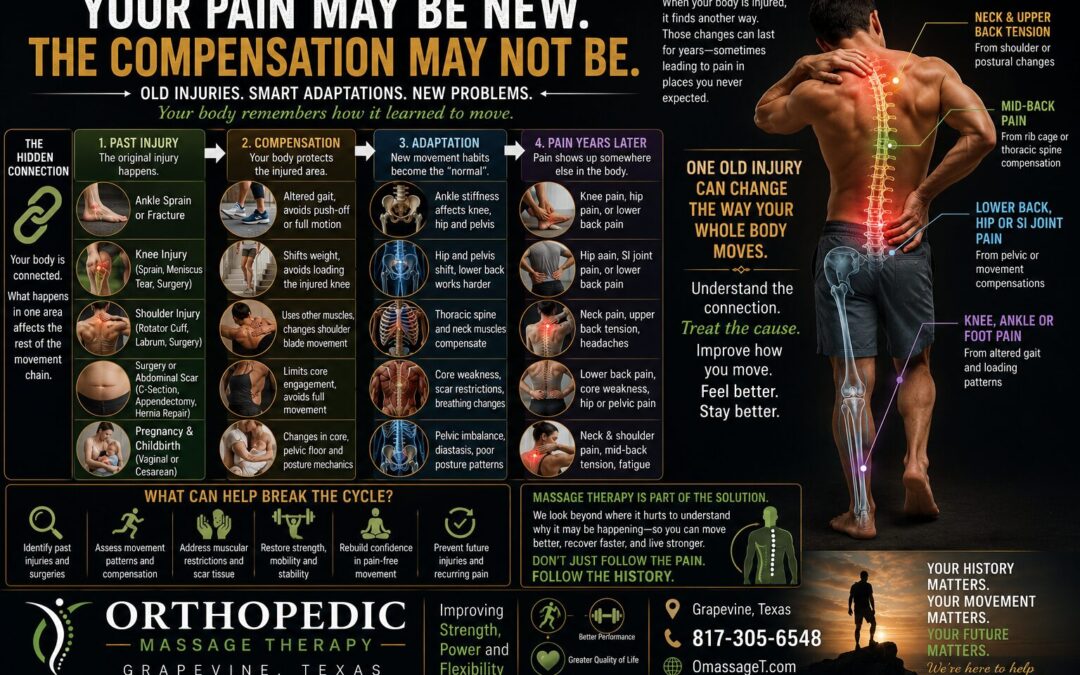
When something hurts, we naturally find another way to move.
We limp.
Shift our weight.
Protect one side.
Use the opposite arm.
Rotate differently.
Avoid certain movements.
These adaptations can be incredibly useful.
They allow us to keep functioning while an injured area heals.
But sometimes the original pain goes away while aspects of the compensation remain.
Months pass.
Years pass.
Eventually, discomfort may appear somewhere else.
The new painful area may seem completely unrelated to the original injury.
But when we look at the entire movement history, sometimes we find an interesting pattern.
This does not mean every old injury causes future pain.
And it does not mean that pain in one area can always be traced back to something that happened years ago.
Pain is complex and can have many causes.
But previous injuries can sometimes leave changes in:
Mobility → Strength → Stability → Coordination → Movement
And those changes may influence how the rest of the body functions.
That is why one of the questions I like to ask is:
“What happened to your body before this started hurting?”
Sometimes the answer goes back much further than expected.
Your Body Is Excellent at Compensation
The human body is remarkably adaptable.
Imagine spraining your right ankle.
It hurts to put weight on it.
What do you do?
You shift toward the left.
Your walking pattern changes.
You take shorter steps.
Maybe you turn the injured foot slightly.
Perhaps you avoid bending the ankle.
These changes make sense.
Your body is trying to protect you.
That is compensation.
Compensation is not automatically bad.
In the short term, it can be extremely helpful.
The question is:
What happens after the injury heals?
Does normal movement return completely?
Or does some part of the protective pattern remain?
Pain Gone Does Not Always Mean Function Fully Restored
This is an important distinction.
People often judge recovery by pain.
“My ankle doesn’t hurt anymore, so it’s fine.”
And maybe it is.
But pain is only one measurement.
After an injury, there may still be differences involving:
-
Mobility
-
Strength
-
Balance
-
Coordination
-
Confidence
-
Movement habits
For example, someone may have no ankle pain but still have less ankle mobility on one side.
They may not notice it during normal daily life.
But the body notices.
Every time they squat.
Walk downstairs.
Run.
Jump.
Play sports.
The movement may be slightly different.
Over thousands of repetitions, small differences can matter.
The Body Remembers How You Learned to Move
This does not mean muscles literally “remember” an injury in the way your brain remembers an event.
But movement patterns can become habitual.
If you limped for several months after an injury, your nervous system became very familiar with that pattern.
If you protected one shoulder for a year, you learned ways to perform tasks without using it normally.
If you avoided rotating through one hip, another area may have contributed more.
Once a movement strategy becomes familiar, it may continue even after the original reason for it has improved.
That is why rehabilitation should involve more than simply waiting for pain to disappear.
The goal is to restore function.
Old Ankle Injury → Knee, Hip, or Back Problems?
Consider an old ankle sprain.
Years later, the person develops recurring knee or hip discomfort.
Are they automatically connected?
No.
But should we ignore the old ankle?
Probably not.
The lower-body movement chain works together:
FOOT → ANKLE → KNEE → HIP → PELVIS → LOWER BACK
If ankle mobility remains limited, the body may find movement somewhere else.
The foot may compensate.
The knee may move differently.
The hip may contribute differently.
The pelvis may adapt.
This is why I may examine an ankle when someone comes in complaining about a knee or hip.
Not because the ankle is definitely the cause.
Because it is part of the chain.
Old Knee Injuries Can Change How You Load the Body
After a knee injury, people often shift weight away from the injured side.
That makes sense during recovery.
But sometimes the person continues favoring the opposite leg.
They may:
Stand more heavily on one side.
Push harder with one leg.
Climb stairs differently.
Squat asymmetrically.
Years later, they may not even realize they are doing it.
The body has simply adopted the pattern.
That does not guarantee future pain.
But asymmetrical loading may contribute to muscular fatigue and movement differences.
Hip Injuries and the Rest of the Body
The hips sit at a major crossroads.
Below them are the legs.
Above them are the pelvis and spine.
Hip movement influences:
Walking.
Running.
Squatting.
Rotating.
Athletic performance.
If one hip loses mobility or strength after an injury, the body may adapt.
The pelvis may move differently.
The lower back may contribute additional movement.
The opposite hip may work harder.
Again:
Where it hurts today may not tell us the entire movement history.
Old Lower-Back Injuries Can Change Movement
After experiencing significant lower-back pain, people often become protective.
They may stop bending.
Avoid rotation.
Move more rigidly.
Tighten the trunk excessively.
This can be understandable during an acute episode.
But sometimes fear of movement remains after the tissues have recovered.
The person continues moving as if the back is still injured.
Other areas may compensate.
The hips may become stiff.
The upper back may move differently.
Muscles may remain guarded.
This is why restoring confidence in movement can be an important part of rehabilitation.
Shoulder Injuries and Compensation
Imagine injuring your right shoulder.
Reaching overhead hurts.
So you stop using that arm normally.
You use your left arm more.
Maybe you elevate the shoulder differently.
Rotate your trunk to reach.
Move your shoulder blade differently.
These adaptations help you function.
But after the shoulder improves, some of those movement strategies may remain.
Years later, recurring neck or upper-back tension may develop.
Does the old shoulder injury automatically explain it?
No.
But it may be relevant.
The movement chain might look like:
CORE → RIB CAGE → THORACIC SPINE → SHOULDER BLADE → SHOULDER → NECK
Everything interacts.
Surgery Changes More Than the Area of the Incision
Surgery can be necessary and life-changing.
But surgery also creates a healing process.
Depending on the procedure, recovery may involve:
-
Scar tissue
-
Temporary movement restrictions
-
Weakness
-
Protective movement
-
Changes in loading
The body adapts during recovery.
Appropriate rehabilitation helps restore function.
But sometimes people complete the initial healing process without fully restoring their previous mobility or strength.
Years later, those differences may still be relevant.
This is one reason a complete health and injury history matters.
Scar Tissue May Influence Movement
Scar tissue is a normal part of healing.
The body creates scar tissue after injuries and surgical procedures.
Scars are not automatically problematic.
Many scars cause no functional issues at all.
But in some cases, restrictions around scarred tissues may influence comfort or movement.
This may be particularly relevant after certain surgeries or significant injuries.
Treatment should always respect the type of surgery, healing status, and medical recommendations.
Massage therapy should not make exaggerated claims about “breaking up” all scar tissue.
The goal is to assess whether soft-tissue restrictions may be influencing function and address them appropriately when indicated.
Childbirth Is Also a Major Physical Event
Pregnancy and childbirth create significant changes in the body.
Whether delivery is vaginal or by cesarean section, the body goes through a major physical experience.
Pregnancy may involve changes in:
-
Abdominal wall function
-
Pelvic floor function
-
Pelvic mechanics
-
Breathing
-
Posture and movement strategies
-
Strength
After delivery come new physical demands:
Holding the baby.
Feeding.
Carrying car seats.
Lifting.
Sleeping in unusual positions.
Often while recovering and getting very little sleep.
Months or years later, someone may present with:
Lower-back discomfort.
Mid-back tension.
Neck pain.
Shoulder tightness.
Again, we should not assume childbirth automatically caused those symptoms.
But pregnancy, delivery, recovery, and caregiving demands are absolutely relevant parts of the person’s movement history.
Cesarean Delivery and Abdominal Recovery
A cesarean section is major abdominal surgery.
Recovery deserves appropriate respect.
After healing, some individuals may experience changes in:
-
Abdominal wall function
-
Scar mobility
-
Trunk strength
-
Movement confidence
The trunk is part of the larger movement chain:
PELVIS → CORE → RIB CAGE → MID-BACK → SHOULDERS → NECK
If trunk function changes, the body may develop new strategies for lifting, carrying, and movement.
This is why someone experiencing recurring upper-back or neck tension years after childbirth may benefit from looking at more than the neck alone.
This does not mean a C-section scar is automatically “causing” neck pain.
It means the entire recovery history may be relevant.
The Injury You Forgot About May Still Be Worth Mentioning
When I ask clients about previous injuries, sometimes they say:
“Nothing important.”
Then later:
“Well, I did break my ankle in high school.”
Or:
“I had knee surgery 20 years ago.”
Or:
“I was in a car accident.”
Or:
“I had two C-sections.”
These details matter.
Not because every old injury is responsible for current symptoms.
But because they help us understand the body’s history.
Your movement today is influenced by everything your body has experienced.
Compensation Can Travel Through the Body
Think of compensation as a chain reaction.
An old ankle injury may influence how you walk.
Walking changes may influence the knee.
The hip adapts.
The pelvis adapts.
The trunk adapts.
This does not happen in a simple, predictable formula.
Human bodies are far more complex.
But the principle is useful:
When one area changes, the rest of the body adapts.
That is why orthopedic massage therapy should consider the person as a whole.
Athletes Are Masters of Compensation
Athletes are especially good at finding ways to perform.
If one area hurts, they often find another way.
A runner changes stride.
A golfer changes rotation.
A tennis player changes a serve.
A gymnast favors one leg.
A dancer modifies movement.
Sometimes the athlete does not even realize it.
The body simply solves the problem.
That adaptability can keep someone performing.
But over time, repeated compensation may create additional muscular demands.
This is why previous injuries matter when evaluating athletes.
Why the Opposite Side May Eventually Hurt
This surprises people.
They injure the right leg.
Years later, the left hip hurts.
They assume there cannot possibly be a connection.
Maybe there isn’t.
But consider what may have happened.
During recovery, the left leg did more work.
More standing.
More pushing.
More stabilization.
More loading.
The opposite side became the reliable side.
Sometimes that pattern remains.
This does not prove causation.
But it is worth considering.
Why Massage Only Where It Hurts May Miss the Bigger Picture
Suppose your right hip hurts.
We can massage the right hip.
That may help.
But what if you have an old left ankle injury and have been shifting your movement for years?
Should we ignore the ankle?
Probably not.
The painful area deserves treatment.
But the movement chain deserves attention too.
At Orthopedic Massage Therapy in Grapevine, Texas, my goal is not simply to chase pain.
It is to understand relevant muscular restrictions and movement relationships.
How Orthopedic Massage Therapy May Help
Depending on the individual, orthopedic massage therapy may help address:
-
Muscular restrictions
-
Soft-tissue mobility
-
Differences between sides
-
Areas of chronic muscular compensation
-
Functional mobility
-
Recovery
Treatment may involve areas away from the current painful spot when those areas appear relevant to the movement pattern.
The approach should be individualized.
No two injury histories are exactly the same.
Massage Cannot Replace Rehabilitation
This is important.
If an old injury left significant weakness, instability, or coordination deficits, massage alone may not correct those problems.
A comprehensive approach may involve:
-
Strength training
-
Physical therapy or rehabilitation
-
Mobility work
-
Balance training
-
Movement retraining
-
Medical evaluation when necessary
-
Orthopedic massage therapy
Massage can help address muscular and soft-tissue restrictions.
Strength and rehabilitation help the body learn what to do with improved movement.
Both can be important.
When New Pain Needs Medical Evaluation
Do not automatically assume new pain is “just compensation” from an old injury.
New or worsening symptoms deserve appropriate evaluation, particularly when there is:
-
Significant weakness
-
Numbness or tingling
-
Severe or unexplained pain
-
Significant swelling
-
Loss of coordination
-
New pain following trauma
-
Persistent symptoms that continue to worsen
Massage therapy should never delay necessary medical care.
Orthopedic Massage Therapy in Grapevine, Texas
At Orthopedic Massage Therapy in Grapevine, Texas, your history matters.
The ankle injury from high school.
The knee surgery years ago.
The car accident.
The shoulder injury.
The abdominal surgery.
Pregnancy and childbirth.
The C-section.
The sport you played.
The job you worked.
The repetitive movements you performed for years.
Not because every past event is responsible for your current symptoms.
But because your body has a history.
Understanding that history may help us better understand how you move today.
Our approach focuses on:
-
Muscular restrictions
-
Functional mobility
-
Injury rehabilitation support
-
Sports and performance recovery
-
Strength and flexibility
-
Looking beyond the painful spot
Your Body Adapted for a Reason
Compensation is not failure.
Your body adapted because it needed to.
After an injury, those adaptations may have helped you walk.
Work.
Care for your family.
Train.
Compete.
Perform.
Live your life.
The question is whether you still need those same movement strategies today.
If pain keeps returning, consider looking backward.
What injuries have you had?
What surgeries?
What changed after childbirth?
Did one side become stronger than the other?
Did you ever fully restore your mobility?
Your strength?
Your confidence in movement?
Sometimes understanding where you have been helps explain how your body moves now.
THE PAIN MAY BE NEW. THE COMPENSATION MAY NOT BE.
At Orthopedic Massage Therapy in Grapevine, Texas, our goal is to look beyond the symptom, understand relevant movement patterns, address muscular restrictions, and help you move better.
Don’t Just Chase the Pain. Follow the History. Follow the Movement.
Improving Strength, Power and Flexibility.
Contact Orthopedic Massage Therapy in Grapevine, Texas to learn how targeted orthopedic massage therapy may support mobility, recovery, injury rehabilitation, and better movement.
Grapevine, Texas | 817-305-6548 | OmassageT.com