ORTHOPEDIC MASSAGE THERAPY OmassageT.com
Your hip hurts.
So naturally, you focus on the hip.
You stretch it.
Massage it.
Roll it.
Maybe you use a massage gun on it.
You find a tender spot and think:
“There it is. That must be the problem.”
You work on it.
It feels better.
Then the pain or tightness comes back.
Sometimes the problem is primarily local to the hip.
But sometimes the hip is only one part of a much larger movement pattern.
At Orthopedic Massage Therapy in Grapevine, Texas, one of the most important concepts I try to help people understand is:
Where you feel pain is not always the only place we should look.
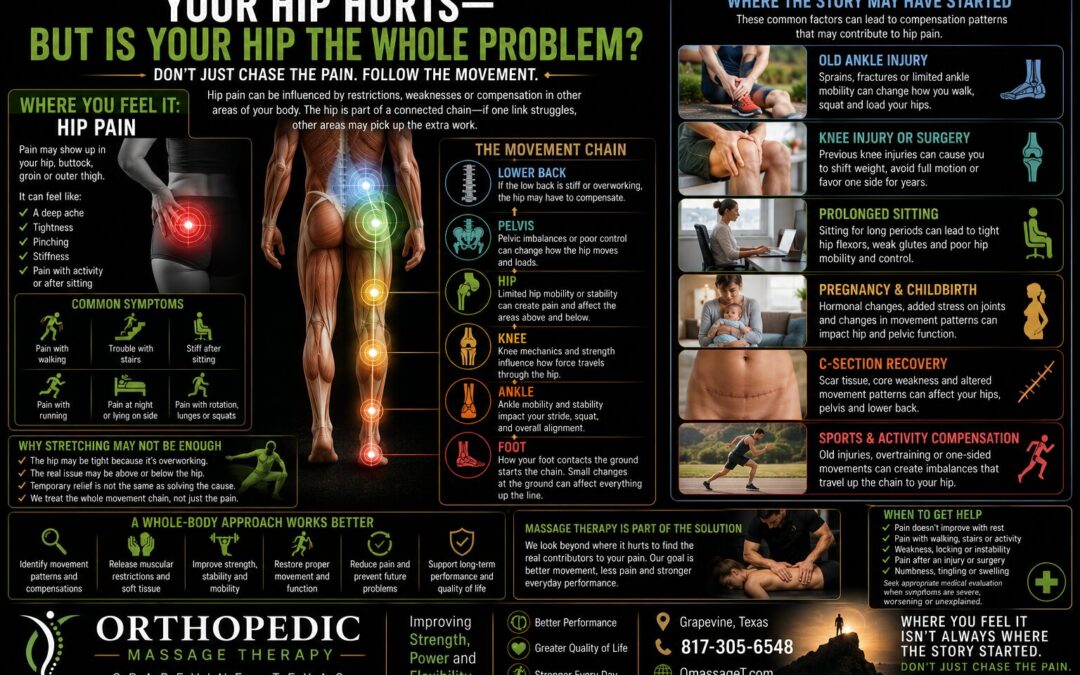
The hip sits in the middle of an important movement chain:
FOOT → ANKLE → KNEE → HIP → PELVIS → LOWER BACK
Every part influences how you stand, walk, run, squat, rotate, climb stairs, play sports, and move through daily life.
If something changes somewhere in that chain, the body adapts.
And sometimes the hip becomes the area that picks up the extra work.
Your Hip Is in the Middle of Everything
Think about where the hip is located.
Below it:
The knee.
Ankle.
Foot.
Above it:
The pelvis.
Core.
Spine.
The hip helps transfer force between the lower and upper body.
Every step you take involves the hip.
Every time you stand from a chair, the hip contributes.
When you climb stairs, run, jump, rotate, or bend, the hip is involved.
This makes the hip incredibly important.
But it also means hip symptoms may sometimes be influenced by what is happening above or below it.
Start at the Ground: Your Feet Matter
Your feet are where your body meets the ground.
They help:
Absorb force.
Adapt to surfaces.
Create stability.
Transfer force upward.
If the way your foot interacts with the ground changes, movement above may also change.
That does not mean every hip problem begins in the foot.
But if someone has recurring hip symptoms, the feet may be worth considering.
Especially if there is a history of:
-
Foot injury
-
Ankle injury
-
Significant differences between sides
-
Changes in walking or running mechanics
The body works as a chain.
The Old Ankle Injury You Forgot About
This is a pattern worth asking about.
Someone comes in with hip discomfort.
During their history, they mention:
“Oh, I sprained my ankle badly about ten years ago.”
The ankle no longer hurts.
So they assume it is irrelevant.
Maybe it is.
But maybe some limitation remained.
After an ankle injury, a person may temporarily:
Limp.
Shift weight.
Avoid pushing through the injured side.
Reduce ankle movement.
Those changes help protect the injury.
But if full mobility, strength, balance, or confidence never completely returns, the movement pattern may remain slightly different.
The knee and hip may adapt.
Years later, the hip is the area complaining.
That does not prove the ankle caused the hip pain.
But it gives us an important reason to examine the entire chain.
Ankle Mobility Can Influence Movement Above
Try performing a squat without allowing your ankles to move normally.
Something else has to change.
You may:
Turn the feet outward.
Shift your weight.
Change knee movement.
Move differently through the hips.
Lean the trunk.
Your body finds a solution.
That is what bodies do.
If one area has limited movement, another area may contribute more.
Compensation is often the body’s way of completing a task.
The question is whether that compensation eventually creates excessive demand somewhere else.
The Knee Is the Link Between the Ankle and Hip
The knee sits directly between two highly mobile regions:
The ankle.
And the hip.
During walking, running, squatting, and stairs, all three areas must coordinate.
A previous knee injury or surgery may influence:
-
Strength
-
Mobility
-
Confidence
-
Weight distribution
-
Movement habits
Someone may unconsciously favor one leg for years.
They may always stand with more weight on the opposite side.
Push harder with one leg.
Use one side more when climbing stairs.
Eventually, the hip on either side may experience different demands.
Again:
The painful hip may be where the compensation shows up—not necessarily where the story began.
One Leg Often Becomes the “Good Leg”
After an injury, people naturally develop a reliable side.
“My good leg.”
That leg does more.
It supports more weight.
Pushes harder.
Helps you get out of chairs.
Takes the first step upstairs.
Over time, “the good leg” may actually become the overworked leg.
Years later, the person may develop discomfort on the side that was never originally injured.
This can be confusing.
“My injury was on the right. Why does my left hip hurt?”
The answer is not always simple.
But compensation history may be relevant.
The Hip-Pelvis Connection
The hip and pelvis work closely together.
You cannot fully understand one without considering the other.
Muscles around the hip influence:
-
Pelvic stability
-
Rotation
-
Walking
-
Single-leg balance
-
Force transfer
If one hip moves differently, the pelvis may adapt.
If pelvic control changes, the hip may experience different muscular demands.
This relationship becomes especially important during:
Running.
Walking.
Stairs.
Lunging.
Athletic rotation.
Single-leg activity.
The hip does not function in isolation.
Pelvic “Imbalance” Does Not Mean Your Pelvis Is Out of Place
People sometimes hear:
“Your pelvis is out.”
That language can create unnecessary fear.
The human body is not a machine whose bones constantly pop out of alignment during normal life.
People naturally have asymmetries.
One side may sit slightly differently.
One hip may move differently.
The more useful questions are:
How well do you move?
Do you have adequate mobility?
Strength?
Control?
Are there meaningful differences between sides?
Are certain muscles constantly compensating?
The goal is not to create a mathematically perfect pelvis.
The goal is functional movement.
The Core Is Part of Hip Function
Your core does more than create abdominal definition.
The trunk helps provide stability while your hips and legs move.
Imagine standing on one leg.
Your hip is working.
But so is your trunk.
Now imagine running.
The legs are moving rapidly while the pelvis and trunk control rotational forces.
The:
HIP + PELVIS + CORE
must coordinate.
If trunk control changes, the hip may experience different demands.
That does not mean doing hundreds of crunches will cure hip pain.
Core function involves:
Strength + Coordination + Breathing + Movement Control
The Lower Back and Hip Often Share the Work
Clients sometimes have difficulty determining whether discomfort is coming from the:
Lower back.
Hip.
Glute.
Or sacroiliac region.
That makes sense.
These areas are close together and interact mechanically.
The lower back and hips often share movement.
If hip mobility is limited, the lower back may contribute more.
If the lower back is guarded, the hips may move differently.
This is why a complete assessment matters.
Treating only one tender muscle may not reveal the whole picture.
Sitting and Hip Tightness
Many people say:
“My hip flexors are tight because I sit all day.”
Prolonged sitting may certainly influence how the hips feel.
But sitting is not inherently bad.
The bigger issue is often:
Too much time in one position.
If you sit for eight hours with very little movement, the hips spend a long time in a similar position.
Then you stand and expect them to immediately:
Walk.
Run.
Lift.
Exercise.
Play sports.
Movement variety matters.
Instead of trying to maintain one perfect posture, change positions throughout the day.
Hip Flexors: Tight or Overworked?
A muscle that feels tight is not always simply shortened.
Sometimes it may be working hard.
Hip flexors contribute to:
Walking.
Running.
Climbing stairs.
Lifting the leg.
Stabilizing movement.
If other areas are not contributing efficiently, hip flexors may take on additional work.
Stretching may provide temporary relief.
But if the tightness returns every day, ask:
Why does this muscle keep feeling like it has to work so hard?
That question may be more useful than simply stretching harder.
Glutes and Hip Pain
The gluteal muscles play major roles in:
-
Hip extension
-
Rotation
-
Pelvic control
-
Walking
-
Running
-
Single-leg stability
People sometimes say:
“My glutes aren’t firing.”
Usually, the situation is more complex than a muscle simply being “off.”
The glutes may be:
Weak.
Fatigued.
Poorly coordinated.
Working differently because of pain.
Compensating for another area.
The goal is not just to “activate” one muscle.
The goal is coordinated movement.
Childbirth Can Change the Movement Story
Pregnancy and childbirth create major physical demands.
During pregnancy, the body adapts to:
-
Changing body mass
-
Changes in abdominal wall function
-
Pelvic floor demands
-
Different loading patterns
-
Changes in movement strategies
Then comes childbirth and recovery.
Afterward, many parents immediately begin:
Holding.
Feeding.
Carrying.
Lifting.
Often while sleep-deprived.
Whether delivery is vaginal or by cesarean section, this is a significant physical transition.
Years later, someone may experience hip, pelvic, back, or upper-body symptoms.
This does not mean childbirth automatically caused the pain.
But pregnancy, delivery, and postpartum recovery are important parts of the movement history.
Cesarean Recovery and the Hip-Core Connection
A cesarean section is major abdominal surgery.
After appropriate healing, some people may still experience differences in:
-
Scar mobility
-
Abdominal function
-
Trunk strength
-
Movement confidence
The trunk interacts with the pelvis and hips.
CORE → PELVIS → HIP
If movement strategies change during recovery, the body may adapt.
Again, this does not mean a C-section scar automatically causes hip pain.
But surgical and childbirth history may be relevant when we are trying to understand recurring symptoms.
Runners and Hip Pain
Running involves thousands of repeated single-leg movements.
Every step requires coordination through the:
FOOT → ANKLE → KNEE → HIP → PELVIS → CORE
A small difference repeated thousands of times can create significant muscular demand.
When a runner develops hip pain, it may be useful to consider:
Training volume.
Previous injuries.
Ankle mobility.
Strength.
Running mechanics.
Recovery.
Footwear changes.
Running surface.
The hip deserves attention.
But so does the rest of the runner.
Golf, Tennis, and Pickleball
Rotational sports place unique demands on the hips.
Golfers rotate through the hips and trunk.
Tennis and pickleball players repeatedly accelerate, decelerate, and change direction.
If one hip has less mobility, another region may contribute more.
The knee.
Lower back.
Opposite hip.
Again, movement is a chain.
The Athlete With an Old Injury
Athletes often tell me:
“That injury was years ago.”
But an old injury can still be relevant if it changed:
Mobility.
Strength.
Balance.
Confidence.
Movement.
The original tissue may be completely healed.
But the movement strategy developed during recovery may have remained.
That is why injury history matters.
Why Stretching the Hip May Not Fix It
You stretch the hip.
It feels better.
Then it tightens again.
Instead of stretching harder, ask:
Is the ankle moving well?
Is there a difference between legs?
Did I have an old knee injury?
How is the pelvis moving?
How is my trunk controlling movement?
Am I sitting for long periods?
Did my movement change after pregnancy, surgery, or injury?
Am I recovering adequately from training?
Sometimes stretching is helpful.
But sometimes recurring tightness is a clue.
How Orthopedic Massage Therapy May Help
At Orthopedic Massage Therapy in Grapevine, Texas, treatment for hip-related muscular problems may involve more than the exact painful spot.
Depending on the individual, we may address muscular restrictions involving the:
-
Glutes
-
Hip flexors
-
Deep hip muscles
-
Adductors
-
Hamstrings
-
Quadriceps
-
Lower back
-
Calves
-
Lower leg when relevant
The goal is not to randomly treat everything.
The goal is to identify relevant restrictions and movement relationships.
Why I May Look at Your Ankle When Your Hip Hurts
This sometimes surprises people.
“My hip hurts. Why are you looking at my ankle?”
Because I want to understand the chain.
Did you have an old ankle injury?
Is one side moving differently?
Is ankle mobility limited?
Does your walking pattern change?
The ankle may have nothing significant to do with the hip symptoms.
But if we never look, we may miss useful information.
Assessment should follow the movement—not just the pain.
Massage Is Only One Part of the Solution
If the problem involves significant weakness, instability, or movement-control deficits, massage alone may not solve everything.
A comprehensive approach may involve:
-
Strength training
-
Physical therapy or rehabilitation
-
Mobility work
-
Movement retraining
-
Training modifications
-
Recovery
-
Medical evaluation when appropriate
-
Orthopedic massage therapy
Massage may help address muscular and soft-tissue restrictions.
Training and rehabilitation help build the capacity to use movement effectively.
When Hip Pain Needs Medical Evaluation
Not every hip problem is muscular.
Seek appropriate medical evaluation when symptoms include:
-
Significant pain following trauma
-
Inability to bear weight normally
-
Severe or worsening pain
-
Significant weakness
-
Persistent numbness or tingling
-
Significant loss of motion
-
Unexplained or persistent symptoms
Massage therapy should never delay necessary medical evaluation.
Orthopedic Massage Therapy for Hip Pain in Grapevine, Texas
At Orthopedic Massage Therapy in Grapevine, Texas, we work with people experiencing muscular restrictions and movement limitations involving the hips and surrounding movement chain.
We consider:
Previous injuries.
Surgical history.
Pregnancy and childbirth history when relevant.
Work demands.
Sports.
Training.
Movement patterns.
Differences between sides.
Because your body has a history.
And that history may help us understand how you move today.
We follow the chain:
FOOT → ANKLE → KNEE → HIP → PELVIS → LOWER BACK
Not because every hip problem starts somewhere else.
But because the hip is part of a connected body.
Don’t Just Chase the Hip Pain—Follow the Movement
If you have been stretching and massaging the same hip for months and the problem keeps returning, consider asking a different question.
Not simply:
“What muscle is tight?”
Ask:
“Why might this muscle keep getting tight?”
Was there an old injury?
Is one ankle restricted?
Are you favoring one leg?
Did your movement change after surgery or childbirth?
Is the pelvis or trunk contributing?
Has your training changed?
Are you recovering?
Sometimes the hip itself is the primary problem.
Sometimes it is part of a much larger story.
At Orthopedic Massage Therapy in Grapevine, Texas, our goal is to look beyond the symptom, identify relevant muscular restrictions and movement patterns, and help you move better.
WHERE YOU FEEL IT ISN’T ALWAYS WHERE THE STORY STARTED.
Don’t Just Chase the Pain. Follow the Movement.
Improving Strength, Power and Flexibility.
Contact Orthopedic Massage Therapy in Grapevine, Texas to learn how targeted orthopedic massage therapy may support hip mobility, recovery, injury rehabilitation, and better movement.
Grapevine, Texas | 817-305-6548 | OmassageT.com