ORTHOPEDIC MASSAGE THERAPY OmassageT.com
Your knee hurts.
So naturally, you focus on the knee.
You rub it.
Stretch it.
Ice it.
Maybe you wear a brace.
Perhaps you avoid stairs, squats, running, or anything else that seems to aggravate it.
But what happens when the knee keeps hurting?
What if treatment focused only on the knee provides temporary relief—but the problem keeps coming back?
Sometimes the knee itself is the primary source of the problem.
But sometimes, the knee may be responding to what is happening above it, below it, or both.
At Orthopedic Massage Therapy in Grapevine, Texas, one of the most important principles behind my approach is:
Where you feel pain is not always the only place we should look.
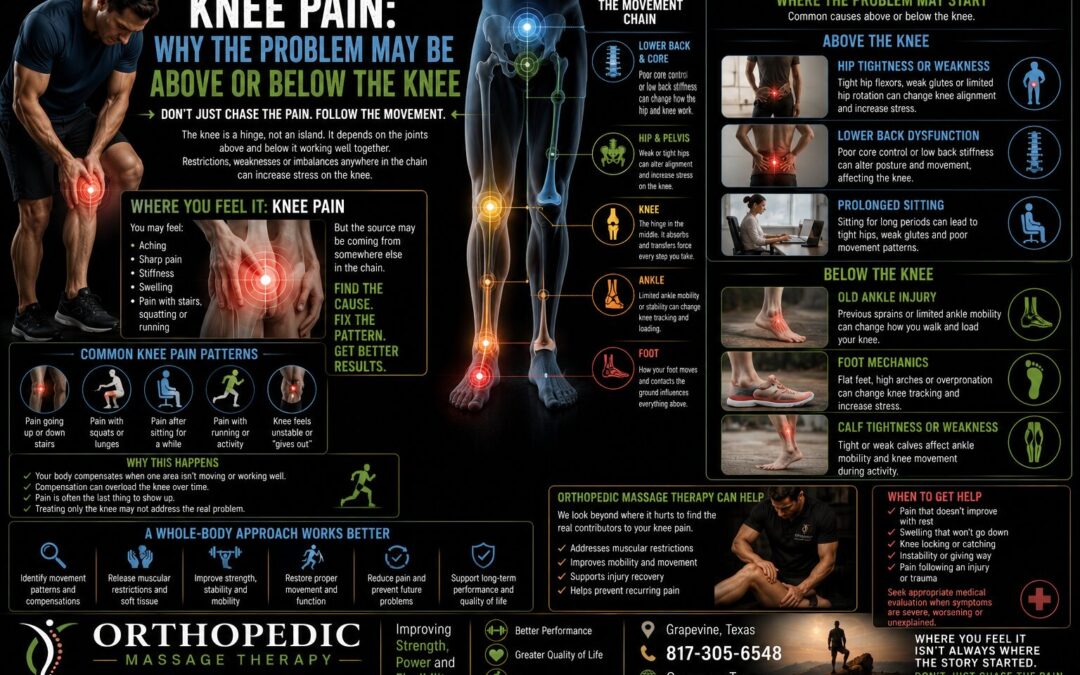
The knee sits in the middle of a connected movement chain:
FOOT → ANKLE → KNEE → HIP → PELVIS → CORE
Your foot interacts with the ground.
Your ankle helps absorb and transfer force.
Your knee helps control movement between the ankle and hip.
Your hips and pelvis help stabilize and generate movement.
Your core helps control the trunk above it all.
When these areas work together efficiently, force can travel through the body.
When one area becomes restricted, weak, injured, fatigued, or poorly controlled, another area may have to compensate.
And sometimes:
The knee is where that compensation eventually becomes noticeable.
The Knee Is a Hinge in the Middle of a Movement Chain
People often think of the knee as an isolated joint.
But your knee never really works alone.
Every time you walk, the knee coordinates with the foot, ankle, hip, and pelvis.
Every time you climb stairs, squat, run, jump, or change direction, multiple areas of the body must work together.
Think of the knee as a link in a chain.
Above the knee:
HIP → PELVIS → CORE
Below the knee:
ANKLE → FOOT
If movement changes on either side, the knee may experience different forces.
That is why treating knee pain may sometimes require looking beyond the knee itself.
Start Below the Knee: Your Foot Meets the Ground First
Every step begins with your foot interacting with the ground.
The foot helps provide:
- Stability
- Adaptability
- Balance
- Force absorption
- Propulsion
How your foot contacts and moves against the ground may influence movement farther up the leg.
The ankle responds.
The knee responds.
The hip responds.
This does not mean that a particular foot shape automatically causes knee pain.
People have tremendous natural variation in their feet and movement.
But when someone has recurring knee problems, the foot may be worth considering as part of the larger picture.
Your Ankle Can Influence Your Knee
The ankle needs enough mobility and stability to support walking, running, squatting, jumping, and many other movements.
Consider a squat.
As you lower your body, the ankle needs to move.
If ankle mobility is limited, your body still has to find a way to complete the movement.
You might:
Turn your feet outward.
Shift your weight.
Lift your heels.
Change how your knees move.
Lean your trunk differently.
Your body finds a solution.
That is compensation.
Compensation is not automatically bad.
It is one of the reasons the human body is so adaptable.
But if the same compensation occurs thousands of times, certain tissues may experience additional demand.
Sometimes the knee becomes one of those areas.
That Old Ankle Sprain May Still Be Worth Mentioning
A common conversation sounds something like this:
“Have you ever injured this leg?”
“No.”
“Any ankle injuries?”
“Well, I sprained my ankle badly playing sports about ten years ago—but that healed.”
That history may matter.
Not because every old ankle sprain causes knee pain.
But because after an ankle injury, there can sometimes be lasting differences in:
- Mobility
- Strength
- Balance
- Stability
- Confidence
- Movement habits
During the injury, you may have limped.
Shifted your weight.
Avoided pushing through that foot.
Changed how you walked.
Those adaptations helped protect the injury.
But did normal movement completely return afterward?
That is an important question.
Pain Gone Does Not Always Mean Function Fully Restored
People often judge recovery by one thing:
Pain.
“My ankle doesn’t hurt anymore, so it’s fine.”
Maybe it is.
But the absence of pain does not automatically tell us everything about function.
An area can be pain-free while still having differences in:
Mobility.
Strength.
Balance.
Coordination.
Movement.
Those differences may be subtle.
You might not notice them during everyday activities.
But over thousands of steps, workouts, runs, or athletic movements, they may become more important.
This is one reason your injury history matters when evaluating recurring knee discomfort.
The Calf-Ankle-Knee Connection
The calf muscles contribute to ankle movement and help manage forces during:
Walking.
Running.
Jumping.
Landing.
Climbing stairs.
If the calf is significantly restricted or fatigued, ankle mechanics may change.
That may influence how the knee moves.
This is why someone with knee pain may sometimes benefit from having the calf and lower leg assessed.
Again:
The calf is not automatically causing the knee problem.
We are simply following the movement chain.
Foot Mechanics and Knee Movement
Your foot is adaptable.
It changes shape as you move and interact with different surfaces.
Those movements can influence rotation farther up the leg.
That means the:
FOOT → ANKLE → KNEE → HIP
must coordinate.
If there is a significant difference between sides, a previous injury, or a meaningful mobility restriction, movement at the knee may also change.
This is why focusing exclusively on the painful knee may sometimes miss useful information.
Now Look Above the Knee: The Hip Matters
The hip is one of the most important areas to consider when looking at knee movement.
Muscles surrounding the hip help control:
- The thigh
- Pelvic stability
- Rotation
- Single-leg balance
- Walking and running mechanics
When you stand on one leg, your hip muscles are working.
When you run, every step briefly becomes a single-leg activity.
When you climb stairs, the hip helps generate and control force.
If hip strength, mobility, or control changes, knee mechanics may also change.
This does not mean every person with knee pain has “weak hips.”
But hip function may be an important part of the picture.
Your Glutes Do More Than Move the Hip
The gluteal muscles play major roles in controlling the lower body.
They contribute to:
- Hip extension
- Rotation
- Pelvic control
- Stability
- Force production
People sometimes say:
“My glutes aren’t firing.”
Usually, the reality is more complicated.
Muscles do not simply switch off like a light.
They may be:
Weak.
Fatigued.
Poorly coordinated.
Working differently because of pain.
Compensating for another area.
The goal is not simply to “activate” one muscle.
The goal is coordinated movement throughout the chain.
The Pelvis Can Influence the Knee
The pelvis sits above the hips and helps connect the lower body to the trunk.
During walking and running, the pelvis moves.
During single-leg activity, muscles around the hips and trunk help control that movement.
If pelvic control changes, the position and movement of the thigh may also change.
That may influence what happens at the knee.
This is why the movement chain can extend farther than people expect:
CORE → PELVIS → HIP → KNEE → ANKLE → FOOT
The knee may be where you feel the symptom.
But the entire chain contributes to movement.
Pelvic Imbalance Does Not Mean Your Bones Are “Out”
This is important.
People are sometimes told:
“Your pelvis is out of alignment.”
That can make it sound like the body is a machine with bones constantly slipping out of place.
Human bodies naturally have asymmetries.
One hip may move slightly differently.
One leg may be stronger.
One side may be more flexible.
That does not automatically mean something is wrong.
Rather than chasing perfect alignment, I prefer to consider:
Mobility + Strength + Stability + Control
How well can your body adapt to the demands you place on it?
That is often a more useful question.
The Core May Matter More Than You Think
What does the core have to do with knee pain?
The trunk provides a base for movement.
Imagine running.
Your legs are moving rapidly underneath you.
Your pelvis is rotating.
Your arms are moving.
Your trunk helps coordinate everything.
Core function involves more than having strong abdominal muscles.
It includes:
- Stability
- Coordination
- Breathing
- Force transfer
- Movement control
If trunk control changes during athletic or everyday movement, the lower body may adapt.
That can influence the hips.
Which can influence the knees.
Again:
The body works as a system.
Why One Knee May Hurt After an Injury to the Other Leg
This surprises people.
Imagine injuring your right ankle or knee.
During recovery, you rely more heavily on your left leg.
The left becomes your:
“Good leg.”
It does more work.
You stand on it more.
Push through it more.
Use it more on stairs.
Over time, the movement pattern may become habitual.
Years later, the left knee starts hurting.
Could the old right-side injury be relevant?
Possibly.
That does not prove causation.
But it is worth asking whether the person continued favoring one side after the original injury healed.
Sometimes:
The side that was never injured becomes the side that was always compensating.
Previous Knee Injuries Matter Too
Of course, sometimes the knee itself has a history.
Previous:
- Sprains
- Ligament injuries
- Meniscus injuries
- Fractures
- Surgery
- Repetitive athletic stress
may influence future movement.
Even after appropriate healing, some people may retain differences in strength, mobility, or confidence.
A person may unconsciously avoid loading the previously injured knee.
That changes how the rest of the body moves.
This is why rehabilitation should aim for more than simply reducing pain.
The goal is restoring function.
Sitting and Knee Stiffness
Some people say:
“My knee feels fine until I sit for a long time.”
Then they stand up and feel stiff or uncomfortable.
Sitting itself is not inherently bad.
The body is capable of sitting.
The problem may be staying in one position for too long without enough movement variety.
The hips remain bent.
The knees remain bent.
The ankles move very little.
Then suddenly, you stand and expect the entire chain to move normally.
For many people, regular movement throughout the day can be helpful.
The goal is not perfect posture.
The goal is movement variety.
Knee Pain Going Up or Down Stairs
Stairs place greater demands on the lower body than level walking.
The:
Ankles.
Knees.
Hips.
Glutes.
all have to contribute.
If one area is not contributing efficiently, another may pick up more of the load.
This is why knee pain on stairs should not automatically be viewed as only a knee problem.
We may want to consider:
Ankle mobility.
Calf function.
Hip strength.
Pelvic control.
Previous injuries.
Movement patterns.
The knee is part of the task—but not the only part.
Knee Pain During Squats
Squatting requires coordinated movement through the entire lower body.
FOOT → ANKLE → KNEE → HIP → PELVIS → TRUNK
If someone experiences knee discomfort during squats, we should not immediately assume one specific cause.
We may want to look at:
How the foot interacts with the ground.
Ankle mobility.
Knee movement.
Hip mobility.
Strength.
Load.
Technique.
Training volume.
There is rarely one universal explanation for everyone.
Runners and Knee Pain
Running involves thousands of repeated steps.
Every step sends forces through the movement chain.
FOOT → ANKLE → KNEE → HIP → PELVIS → CORE
A small movement difference repeated thousands of times may create significant muscular demand.
When a runner develops knee pain, relevant factors may include:
- Training volume
- Sudden mileage increases
- Previous injuries
- Strength
- Recovery
- Running mechanics
- Footwear changes
- Terrain
Simply massaging the painful knee may not address all of those factors.
Cyclists and Knee Pain
Cycling involves repeated knee motion.
Thousands of repetitions during a ride.
Because the movement is so repetitive, small differences in:
Bike setup.
Hip mobility.
Ankle position.
Training volume.
Strength.
may become significant over time.
Cyclists with recurring knee symptoms may benefit from looking at both the body and the bike.
Pickleball, Tennis, and Court Sports
Court sports require:
Acceleration.
Deceleration.
Lateral movement.
Rotation.
Sudden stops.
Direction changes.
These movements place significant demands on the entire lower body.
The knee must respond to forces generated from both the ground and the rest of the body.
Strong, coordinated movement through the:
Feet.
Ankles.
Hips.
Core.
can all be important.
Why Stretching the Knee May Not Solve the Problem
Technically, you are often stretching muscles around the knee rather than the knee itself.
The quadriceps.
Hamstrings.
Calves.
Stretching may help when appropriate.
But if the same symptoms keep returning, ask why.
Is ankle mobility limited?
Are the calves restricted?
Is one hip moving differently?
Is one leg stronger?
Was there an old injury?
Did training volume suddenly increase?
Stretching may be part of the solution.
But recurring pain often deserves a broader investigation.
Why I May Work on Your Hip When Your Knee Hurts
A client may understandably ask:
“My knee hurts. Why are you working on my hip?”
Because muscles around the hip influence the position and control of the thigh.
The thigh connects directly to the knee.
If there are significant muscular restrictions around the hip, they may influence movement throughout the leg.
That does not mean the hip is automatically causing the knee pain.
It means:
We are following the movement.
Why I May Work on Your Calf or Ankle
The same principle applies below the knee.
If there is:
Calf tightness.
Ankle restriction.
A history of ankle injury.
Differences between sides.
those factors may be relevant.
The painful area deserves attention.
But so does the movement chain surrounding it.
How Orthopedic Massage Therapy May Help
At Orthopedic Massage Therapy in Grapevine, Texas, treatment for muscular issues associated with knee discomfort may involve more than working directly around the knee.
Depending on the individual, treatment may address muscular restrictions involving the:
- Quadriceps
- Hamstrings
- Calves
- Lower leg
- Hip flexors
- Glutes
- Deep hip muscles
- Lower back when relevant
Treatment should be individualized.
The goal is not to massage every possible area.
The goal is to identify relevant muscular restrictions and movement relationships.
Massage Is Part of the Solution—Not Always the Entire Solution
If knee symptoms involve significant:
Weakness.
Instability.
Movement-control deficits.
Structural injury.
Massage alone may not be enough.
A comprehensive approach may include:
- Appropriate strength training
- Physical therapy or rehabilitation
- Mobility work
- Balance and stability training
- Movement retraining
- Training modifications
- Medical evaluation when necessary
- Orthopedic massage therapy
Massage may help address muscular and soft-tissue restrictions.
Strength and rehabilitation help improve the body’s capacity to move and manage force.
When Knee Pain Needs Medical Evaluation
Not every knee problem is muscular.
Seek appropriate medical evaluation for symptoms such as:
- Significant swelling
- Inability to bear weight normally
- Knee locking
- Significant instability or giving way
- Severe pain following trauma
- Significant loss of movement
- Persistent or worsening pain
- Redness, warmth, or unexplained swelling
Massage therapy should never delay necessary medical evaluation.
Orthopedic Massage Therapy for Knee Pain in Grapevine, Texas
At Orthopedic Massage Therapy in Grapevine, Texas, we work with active adults, athletes, and individuals experiencing muscular restrictions and movement limitations associated with knee discomfort and recovery.
We look at more than one isolated joint.
We consider:
Your injury history.
Your activities.
Your sports.
Your work.
Your mobility.
Your strength.
Differences between sides.
And the entire movement chain:
FOOT → ANKLE → KNEE → HIP → PELVIS → CORE
Not because every knee problem comes from somewhere else.
Sometimes the knee itself is the primary issue.
But if we only look at where it hurts, we may miss important information about how the body is moving.
The Knee May Be the Messenger
If you keep treating the same knee and the same problem keeps returning, consider asking a different question.
Instead of only:
“What is wrong with my knee?”
Ask:
“What is happening above and below my knee?”
How is the foot interacting with the ground?
Is the ankle moving well?
Are the calves restricted?
Did I have an old ankle injury?
How are my hips functioning?
Am I favoring one side?
Did a previous injury change the way I move?
Has my training increased?
Am I recovering adequately?
Sometimes the knee is the primary problem.
Sometimes it is the area caught in the middle.
At Orthopedic Massage Therapy in Grapevine, Texas, our goal is to look beyond the symptom, identify relevant muscular restrictions and movement patterns, support recovery, and help you move better.
YOUR KNEE IS IN THE MIDDLE OF THE STORY. LOOK ABOVE IT. LOOK BELOW IT.
Don’t Just Chase the Pain. Follow the Movement.
Improving Strength, Power and Flexibility.
Contact Orthopedic Massage Therapy in Grapevine, Texas to learn how targeted orthopedic massage therapy may support knee mobility, sports recovery, injury rehabilitation, strength, flexibility, and better movement.
Grapevine, Texas | 817-305-6548 | OmassageT.com