ORTHOPEDIC MASSAGE THERAPY OmassageT.com
Your foot hurts.
Your ankle feels stiff.
Maybe you have recurring pain when you walk, run, exercise, or stand for long periods.
So naturally, you focus on where it hurts.
You stretch your foot.
Massage your arch.
Roll your foot on a ball.
Work on your calf.
Maybe you change shoes or add inserts.
Sometimes that is exactly where the problem needs attention.
But what happens when the discomfort keeps returning?
Sometimes the foot or ankle itself is the primary problem.
Other times, what you feel at the bottom of the body may be influenced by what is happening higher up the movement chain.
At Orthopedic Massage Therapy in Grapevine, Texas, one of the principles behind our approach is simple:
Where you feel pain is not always the only place we should look.
Your feet do not function independently.
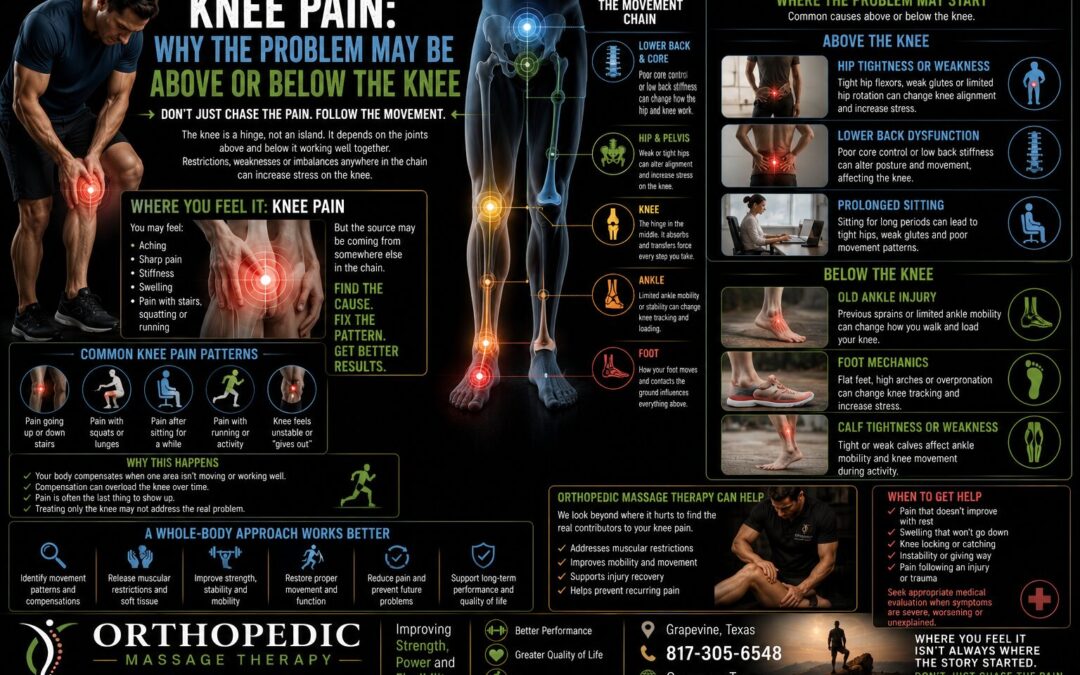
They are part of a connected movement chain:
CORE → PELVIS → HIP → KNEE → CALF → ANKLE → FOOT
Every time you walk, run, climb stairs, exercise, or play a sport, these areas must work together.
If movement changes somewhere in that chain, the body adapts.
And sometimes:
The foot or ankle becomes the place where you eventually feel the result.
Your Feet Are the Foundation—But They Don’t Work Alone
Your feet are where your body interacts with the ground.
They help you:
-
Balance
-
Absorb and transfer force
-
Walk
-
Run
-
Jump
-
Change direction
-
Push forward
Considering how much we ask of our feet, it is not surprising that foot and ankle discomfort is common.
But your feet are connected to everything above them.
The ankle influences the lower leg.
The knee coordinates with the ankle and hip.
The hip helps control the leg.
The pelvis and core help control the body above it all.
Think of it as a conversation happening throughout your body:
CORE → PELVIS → HIP → KNEE → CALF → ANKLE → FOOT
The foot may be at the bottom of the chain.
But it is not alone.
When Foot Pain Keeps Coming Back
Maybe your foot hurts first thing in the morning.
Or after a long day at work.
Perhaps it bothers you when running.
You massage it.
Stretch it.
It feels better.
Then it returns.
When symptoms repeatedly return, it may be worth asking:
Why does this area keep becoming overloaded?
Possibilities can include local issues within the foot or ankle.
But other factors may also be relevant:
-
Calf restrictions
-
Ankle mobility
-
Previous injuries
-
Knee mechanics
-
Hip strength and control
-
Pelvic and trunk function
-
Training volume
-
Work demands
-
Recovery
The goal is not to blame every foot problem on another body part.
The goal is to look at the complete picture.
Start With the Calf
The calf is closely connected to foot and ankle function.
Muscles of the lower leg help control movement at the ankle and foot.
They work when you:
Walk.
Run.
Climb stairs.
Jump.
Push off the ground.
Stand on your toes.
If the calf is fatigued, restricted, or working harder than usual, you may notice changes farther down the chain.
A person may say:
“My foot always feels tight.”
But when we look more closely, there may also be significant muscular restriction throughout the calf and lower leg.
This is why targeted orthopedic massage therapy may involve more than the exact location of pain.
Calf Tightness and Ankle Mobility
The calf and ankle have a close relationship.
If muscular restrictions around the calf limit comfortable ankle movement, your body may adapt.
That adaptation may influence:
Walking.
Running.
Squatting.
Stairs.
Balance.
Athletic movement.
You may still complete the activity.
The human body is excellent at finding another way.
But another area may have to work harder.
Sometimes that is the foot.
Your Knee Can Influence What Happens at Your Foot
The knee sits between the ankle and hip.
During walking and running, all three regions coordinate.
The position and movement of the knee may influence how the lower leg and foot interact with the ground.
This is especially important during:
-
Running
-
Jumping
-
Landing
-
Squatting
-
Single-leg activities
-
Direction changes
If movement at the knee changes, the foot may adapt.
This does not mean knee mechanics automatically cause foot pain.
It means the knee is part of the movement chain and may deserve consideration when symptoms keep returning.
The Hip-Foot Connection
Your hip may seem far away from your foot.
But mechanically, they are closely connected.
Muscles around the hips help control the thigh and pelvis.
That influences the knee.
The knee influences the lower leg.
The lower leg interacts with the ankle and foot.
Follow the chain:
HIP → KNEE → LOWER LEG → ANKLE → FOOT
This is why someone with recurring foot or ankle discomfort may sometimes benefit from looking at hip function.
Especially during single-leg movement.
Every Step Is a Single-Leg Activity
Walking may seem simple.
But for part of every step, your body is supported primarily by one leg.
Running makes this even more obvious.
Every stride involves repeatedly:
Landing on one leg.
Controlling your body.
Transferring force.
Pushing away from the ground.
Your hip and pelvis play important roles in controlling that single-leg movement.
If control higher in the chain changes, the leg and foot may adapt.
Again, the foot may be where you feel the symptom.
But it may not be the only area involved.
Hip Strength Is More Than Having Strong Glutes
People often hear:
“Strengthen your glutes.”
That may be useful in some situations.
But movement is more complex than one muscle.
Hip function involves:
-
Strength
-
Mobility
-
Endurance
-
Coordination
-
Pelvic control
A person can have strong muscles but still use them inefficiently during a specific activity.
The goal is coordinated movement.
Not simply making one muscle stronger.
The Pelvis Is Part of the Foundation Too
We often call the feet the foundation of the body.
But the pelvis also provides an important foundation for the trunk and lower extremities.
The pelvis helps connect:
CORE → HIPS → LEGS
During walking and running, the pelvis moves.
That movement must be controlled.
If pelvic or trunk control changes, movement throughout the leg may change too.
Eventually, those changes may influence how the foot interacts with the ground.
This is why I may sometimes look much higher than the ankle when someone comes in with recurring foot symptoms.
Core Function Can Influence the Lower Body
What could your core possibly have to do with your foot?
Think about walking or running.
Your legs are moving beneath you.
Your arms are moving.
Your pelvis rotates.
Your trunk helps control those forces.
The core is not simply your abdominal muscles.
It is part of a coordinated system that helps provide:
Stability + Force Transfer + Movement Control
If trunk control changes, the pelvis may adapt.
The hips may adapt.
The legs may adapt.
Movement changes can travel through the chain.
That does not mean doing more crunches will fix foot pain.
It means the body should be viewed as a connected system.
The Injury That Started Years Ago
One of the most important questions when evaluating recurring foot or ankle problems is:
“Have you ever injured this leg before?”
The answer may reveal:
A previous ankle sprain.
A knee injury.
Hip surgery.
A fracture.
A sports injury.
Sometimes the person says:
“That happened years ago.”
But old injuries can still be relevant if they left changes in:
Mobility.
Strength.
Balance.
Coordination.
Movement habits.
The original injury may be completely healed.
But the movement pattern developed during recovery may have remained.
An Old Knee Injury Can Change What Happens at the Foot
Imagine injuring your knee.
During recovery, you may:
Walk differently.
Shift your weight.
Avoid bending the knee.
Push differently through the foot.
Those strategies help protect the knee.
But if normal movement does not fully return, the foot may continue functioning differently.
Years later, the foot becomes painful.
Are the two automatically connected?
No.
But the old injury may be worth considering.
Your body has a history.
Hip or Back Problems Can Change How You Walk
Pain changes movement.
If your hip hurts, you may shorten your stride.
If your lower back hurts, you may move more rigidly.
If one side feels weak, you may spend less time on that leg.
Those changes can influence how the foot contacts the ground.
This is why the foot may sometimes be the end of a compensation chain that began higher up.
Again:
Don’t assume. Assess.
Pregnancy, Childbirth, and Changes in Movement
Pregnancy and childbirth create significant physical changes.
During pregnancy, the body adapts to changes involving:
-
Body mass
-
Pelvic mechanics
-
Abdominal function
-
Balance
-
Walking patterns
After childbirth, the body goes through another period of adaptation and recovery.
Whether delivery is vaginal or by cesarean section, the body has experienced a major event.
Years later, some people may have changes in movement or strength that are worth considering when evaluating recurring lower-body symptoms.
This does not mean childbirth causes foot pain.
It means pregnancy, delivery, recovery, and movement history may all be relevant pieces of the larger picture.
People Who Stand All Day
Foot pain is not limited to athletes.
Teachers.
Nurses.
Healthcare workers.
Retail employees.
Restaurant workers.
Hairstylists.
Warehouse workers.
Anyone who spends long hours standing may experience foot and ankle fatigue.
But standing involves more than the feet.
Your calves work.
Your hips contribute.
Your trunk maintains position.
If you stand primarily on one leg or repeatedly shift toward one side, muscular demands may become uneven.
When addressing foot discomfort in someone who stands all day, it can be useful to look at how the entire body manages prolonged standing.
Runners and Foot Pain
Runners place enormous repetitive demands on the feet and ankles.
A single run may involve thousands of steps.
Each step requires coordination through:
CORE → PELVIS → HIP → KNEE → ANKLE → FOOT
When a runner develops recurring foot or ankle symptoms, relevant factors may include:
-
Training volume
-
Sudden mileage increases
-
Running terrain
-
Recovery
-
Footwear changes
-
Previous injuries
-
Calf restrictions
-
Strength
-
Movement mechanics
This is why sports massage and orthopedic massage therapy for runners should consider more than the exact painful spot.
Achilles and Calf Complaints
The Achilles tendon connects the calf muscles to the heel.
Problems in this region should be evaluated appropriately, especially when there is significant pain, swelling, weakness, or a sudden injury.
From a muscular perspective, calf function and ankle mobility may be relevant to how the area is loaded.
Orthopedic massage therapy may help address appropriate muscular restrictions around the lower leg.
But massage should not be used as a substitute for proper evaluation of a suspected tendon injury.
Arch and Heel Discomfort
People with arch or heel discomfort often focus intensely on the bottom of the foot.
They roll on a ball.
Stretch the arch.
Massage the heel.
Those strategies may sometimes help.
But it may also be useful to consider:
Calf mobility.
Ankle function.
Walking patterns.
Training volume.
Previous injuries.
Strength and control farther up the chain.
The foot deserves attention.
But so does the body attached to it.
Balance Is a Whole-Body Skill
Standing on one foot may seem like a foot-and-ankle activity.
But try it.
You will feel muscles working throughout your body.
The foot adjusts.
The ankle responds.
The knee stabilizes.
The hip controls the pelvis.
The trunk helps maintain balance.
Balance is a whole-body skill.
That is why recurring ankle instability may require more than simply strengthening the ankle.
The entire movement system may need attention.
Repeated Ankle Sprains
Some people say:
“I’ve sprained this ankle five times.”
Repeated ankle injuries deserve appropriate evaluation and rehabilitation.
After an ankle sprain, restoring:
-
Mobility
-
Strength
-
Balance
-
Stability
-
Confidence
can be important.
If rehabilitation is incomplete, a person may continue to feel unstable or develop movement compensations.
Orthopedic massage therapy may complement rehabilitation by addressing muscular restrictions when appropriate.
But massage alone cannot restore all aspects of ankle stability.
Why Stretching the Foot May Not Be Enough
If your foot feels tight, stretching may provide temporary relief.
But if it feels tight every day, ask:
Why?
Are the calves restricted?
Is the ankle moving well?
Did you have an old injury?
Is one knee moving differently?
How are the hips functioning?
Are you standing all day?
Has your running volume increased?
Is your body recovering?
The question should not always be:
“How do I stretch this more?”
Sometimes the better question is:
“Why does this keep getting tight?”
How Orthopedic Massage Therapy May Help Foot and Ankle Problems
At Orthopedic Massage Therapy in Grapevine, Texas, treatment for muscular restrictions associated with foot and ankle discomfort may involve more than the exact painful area.
Depending on the individual, treatment may address the:
-
Foot musculature when appropriate
-
Calves
-
Lower leg
-
Hamstrings
-
Quadriceps
-
Hip flexors
-
Glutes
-
Hips
-
Lower back when relevant
The goal is not to treat every muscle.
The goal is to identify relevant muscular restrictions and understand how they may relate to movement.
Why I May Work on Your Hip When Your Foot Hurts
This can surprise people.
“My foot hurts. Why are you looking at my hip?”
Because your hip helps control the leg attached to that foot.
I may want to understand:
How you move on one leg.
Whether there are significant differences between sides.
Whether you have an old injury.
How the pelvis is controlled.
Whether muscular restrictions higher in the chain may be relevant.
The hip may have nothing significant to do with your symptoms.
But we should not assume.
Follow the movement.
Massage Is Not the Entire Solution
Some foot and ankle problems require more than massage.
Depending on the condition, a comprehensive approach may include:
-
Medical evaluation
-
Physical therapy or rehabilitation
-
Strength training
-
Balance training
-
Mobility work
-
Training modifications
-
Footwear considerations
-
Orthopedic massage therapy
Massage can help address muscular and soft-tissue restrictions.
But structural injuries, significant instability, or rehabilitation needs require appropriate care.
When Foot or Ankle Pain Needs Medical Evaluation
Seek appropriate medical evaluation for symptoms such as:
-
Significant swelling
-
Inability to bear weight
-
Severe pain after an injury
-
Significant bruising
-
Sudden weakness
-
A popping sensation followed by pain or loss of function
-
Persistent numbness or tingling
-
Redness, warmth, or unexplained swelling
-
Persistent or worsening symptoms
Massage therapy should never delay necessary medical evaluation.
Orthopedic Massage Therapy for Foot and Ankle Pain in Grapevine, Texas
At Orthopedic Massage Therapy in Grapevine, Texas, we work with active adults, athletes, runners, and individuals experiencing muscular restrictions and movement limitations associated with foot and ankle discomfort.
Our approach may be especially helpful for people looking for support with:
-
Sports recovery
-
Running-related muscular tightness
-
Calf tightness
-
Foot and ankle mobility
-
Injury rehabilitation support
-
Strength and flexibility
-
Muscular compensation patterns
We serve clients from Grapevine, Southlake, Colleyville, Keller, and throughout the Dallas-Fort Worth area who want a more movement-focused approach to massage therapy and recovery.
We look at the entire chain:
CORE → PELVIS → HIP → KNEE → CALF → ANKLE → FOOT
Not because every foot problem begins somewhere else.
But because the foot is connected to the rest of you.
Your Foot May Be Where the Story Ends—Not Where It Started
If you keep massaging the same painful foot or stretching the same tight ankle and the problem keeps returning, consider asking a bigger question.
What is happening higher up?
Is the calf restricted?
Was there an old ankle or knee injury?
Is one hip moving differently?
Are you favoring one leg?
Did your movement change after an injury, surgery, pregnancy, or childbirth?
Are you standing for long hours?
Did your running or training volume suddenly increase?
Are you recovering adequately?
Sometimes the foot itself is the primary problem.
Sometimes it is the final link in a longer compensation pattern.
YOUR FOOT MAY BE WHERE YOU FEEL IT. BUT THE STORY MAY START HIGHER UP.
At Orthopedic Massage Therapy in Grapevine, Texas, our goal is to look beyond the symptom, address relevant muscular restrictions, support injury rehabilitation and sports recovery, and help improve functional movement.
Don’t Just Chase the Pain. Follow the Movement.
Improving Strength, Power and Flexibility.
Contact Orthopedic Massage Therapy in Grapevine, Texas for targeted orthopedic massage therapy, sports massage, injury rehabilitation support, mobility, strength and flexibility, and athletic recovery.
Serving Grapevine, Southlake, Colleyville, Keller and the Dallas-Fort Worth area
817-305-6548 | OmassageT.com