ORTHOPEDIC MASSAGE THERAPY OmassageT.com
Screenshot
Screenshot
Sometimes a client walks through the door with a story that reminds you why it is so important to listen.
Not just to where someone hurts.
But to everything that happened before they arrived.
In April 2024, a mother brought her 17-year-old daughter to Orthopedic Massage Therapy after years of struggling with significant discomfort associated with eating.
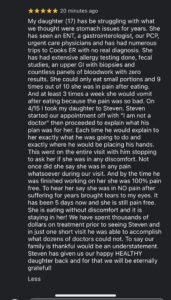
According to the Google review her mother later shared, the family had spent years searching for answers.
Her daughter had been evaluated by multiple healthcare professionals and had undergone extensive medical testing.
Yet the family was still struggling to understand what was happening.
When she came to see me, one of the first things I made clear was:
“I am not a doctor.”
That statement matters.
Massage therapists do not diagnose gastrointestinal diseases.
We do not replace physicians.
We do not interpret medical testing as proof that nothing is wrong.
And we should never promise that massage therapy can cure unexplained abdominal pain, vomiting, or digestive disorders.
But there was still something I could do.
I could listen.
I could look at the body from a musculoskeletal perspective.
And I could ask a different set of questions.
When Medical Testing Hasn’t Provided an Answer
Persistent or recurring abdominal pain—especially when accompanied by vomiting, difficulty eating, unexplained weight changes, bleeding, fever, or other concerning symptoms—deserves appropriate medical evaluation.
That should always come first.
In this particular family’s experience, they had already pursued extensive medical care.
According to the mother’s review, her daughter had seen multiple healthcare providers and undergone numerous tests.
Despite that extensive process, they still did not feel they had an explanation for what she was experiencing.
Situations like this require humility.
A massage therapist should never look at negative or inconclusive medical testing and say:
“That means it must be muscular.”
It doesn’t.
But once serious medical concerns have been appropriately evaluated, it may sometimes be useful to consider whether the musculoskeletal system could be contributing to how someone feels.
That means looking beyond the symptom.
The Abdomen Does Not Exist in Isolation
When someone says:
“My stomach hurts,”
it is natural to think only about the digestive system.
And gastrointestinal symptoms absolutely can originate from the digestive system.
But the region we casually call the “stomach” is also surrounded by an incredibly complex musculoskeletal system.
Consider what is nearby:
The diaphragm.
Rib cage.
Thoracic spine.
Abdominal wall.
Lower back.
Pelvis.
Hip musculature.
Breathing mechanics.
All of these structures interact.
This gives us another movement chain to consider:
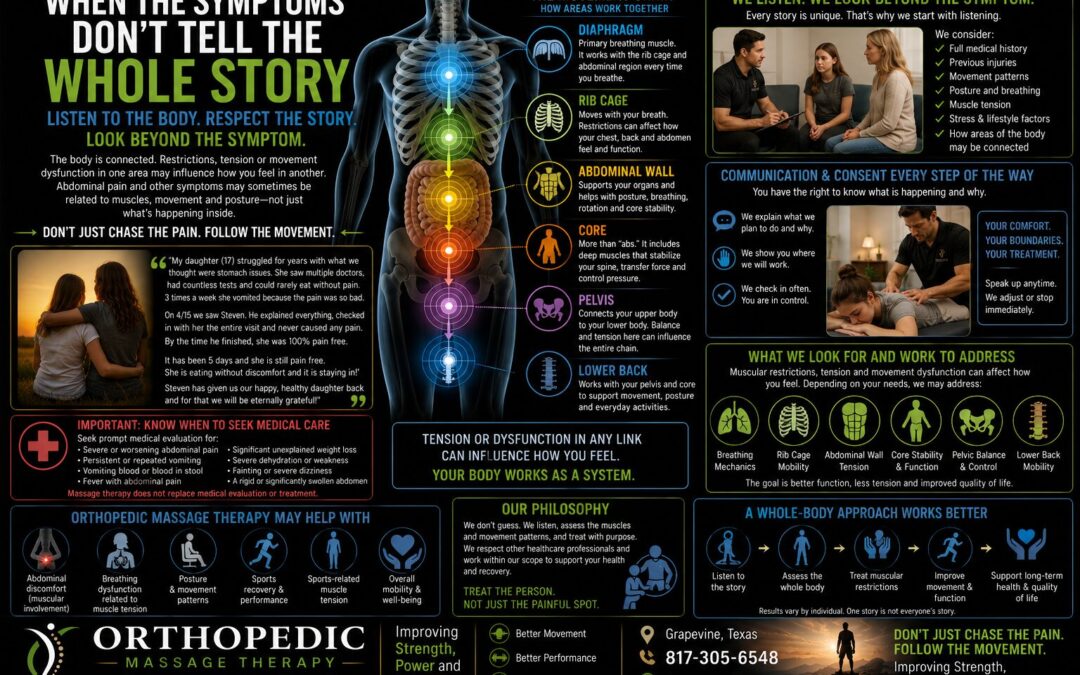
DIAPHRAGM → RIB CAGE → ABDOMINAL WALL → CORE → PELVIS → LOWER BACK
That does not mean dysfunction in this chain causes gastrointestinal disease.
It means muscular and movement-related symptoms in this region can sometimes be complex—and may deserve a broader perspective.
The Diaphragm Is More Than a Breathing Muscle
The diaphragm is the primary muscle involved in breathing.
Every day, you take thousands of breaths.
Each breath involves coordinated movement between the:
DIAPHRAGM + RIB CAGE + ABDOMINAL REGION
The diaphragm also interacts mechanically with the trunk.
This is one reason breathing, posture, rib-cage movement, and abdominal muscular tension should not always be viewed as completely separate systems.
If muscular restrictions are present around the trunk, they may influence how someone experiences movement, pressure, or tension in the area.
Again, this is not the same as saying the diaphragm causes digestive disease.
It is simply recognizing that the body is connected.
The Rib Cage May Be Part of the Story
Your ribs do not simply form a rigid cage.
They move.
Every time you breathe, the rib cage changes shape.
The thoracic spine interacts with the ribs.
Muscles attach throughout this region.
The diaphragm interacts with the lower rib cage.
This means restrictions involving the thoracic region may potentially influence how comfortable someone feels through the trunk.
A person may describe sensations as:
Tightness.
Pressure.
Pulling.
Discomfort.
Difficulty taking a comfortable deep breath.
These sensations can sometimes be difficult for people to describe.
And because the body is complex, where someone feels a symptom does not automatically tell us what structure is responsible.
The Abdominal Wall Is Muscular Too
When we hear “abdominal,” we often think only about internal organs.
But the abdominal wall contains muscles that play important roles in:
- Trunk stability
- Rotation
- Breathing mechanics
- Force transfer
- Movement
These muscles coordinate with the:
Diaphragm.
Pelvis.
Spine.
Rib cage.
They are part of your core.
And your core is not simply your “abs.”
It is a coordinated system.
Core Function Is About More Than Strength
People often think core problems can be solved by doing more sit-ups.
But core function involves much more than raw strength.
It includes:
Coordination + Breathing + Stability + Mobility + Pressure Management
The trunk needs to adapt to many situations.
Eating.
Breathing.
Walking.
Running.
Lifting.
Sitting.
Sports.
Stress.
Everything happens within the same body.
This is why I prefer to look at how different regions interact rather than assuming one isolated muscle is always responsible.
The Pelvis and Abdomen Are Connected Mechanically
Below the abdominal region sits the pelvis.
The pelvis connects the trunk to the lower body.
Muscles and connective tissues throughout this region interact with the:
Abdominal wall.
Hips.
Lower back.
Pelvic floor.
This creates another important relationship:
RIB CAGE → CORE → PELVIS
If one region is moving or functioning differently, the body may adapt elsewhere.
This is the same principle we have discussed with:
Foot pain.
Knee pain.
Hip pain.
Upper-back pain.
Neck pain.
Where you feel something may not tell you the entire story.
Why Listening to the Client Matters
Before treatment begins, the story matters.
What has the person experienced?
When did it begin?
What makes it worse?
What makes it better?
What medical evaluation has already occurred?
What surgeries or injuries have they had?
How do they breathe?
How do they move?
Where do they feel tension?
A good history does not give a massage therapist permission to diagnose.
It gives us context.
Sometimes the most useful clue is something the client mentions almost casually.
That is why listening is part of treatment.
Consent Matters—Especially When Working With a Minor
One detail from this mother’s review is especially important to me.
She described how I explained to her daughter what I planned to do and where I would place my hands.
That should not be considered an extra.
It is part of professional treatment.
This is especially important when working with a minor or when treatment involves sensitive areas of the body.
The client should understand:
What is being treated.
Why it is being treated.
Where contact will occur.
What they may feel.
And that they can ask to stop at any time.
Throughout treatment, communication should continue.
“Are you comfortable?”
“Is this painful?”
“Is this pressure okay?”
Treatment is something we do with a client.
Not something we simply do to them.
“I Am Not a Doctor”
The mother’s review specifically remembered that I began by saying:
“I am not a doctor.”
I am glad she remembered that.
Because scope matters.
Orthopedic massage therapy can be a valuable part of someone’s healthcare and recovery team.
But massage therapy has limits.
My job is not to diagnose gastrointestinal disease.
My job is not to tell someone to stop seeing their physician.
My job is not to promise a cure.
My role is to evaluate and address muscular and soft-tissue restrictions within my scope of practice and consider how those restrictions may relate to movement and function.
Sometimes the results can be meaningful.
But we should always remain clear about what we know—and what we do not know.
What Happened After That Session
According to the mother’s Google review, her daughter experienced a remarkable change following the session.
She reported that her daughter was pain-free at the end of treatment.
Five days later, when the review was written, her mother reported that she remained pain-free and was eating without the discomfort she had previously experienced.
For their family, that was an emotional experience after years of searching for answers.
Their story is meaningful.
But it is important to understand what one story can—and cannot—tell us.
A testimonial describes one person’s experience.
It does not prove that orthopedic massage therapy treats or cures gastrointestinal conditions.
It does not mean another person with similar symptoms will have the same result.
And it should never be used as a reason to avoid appropriate medical care.
What the story does demonstrate is the value of remaining curious when dealing with a complex body.
One Session Is Not a Scientific Conclusion
This is an important point.
If someone improves after treatment, we can celebrate that improvement.
But we should be careful about claiming exactly why it happened unless we have appropriate evidence.
Was muscular tension contributing?
Did changes in breathing or movement help?
Did several factors interact?
We should not pretend to know more than we know.
The responsible conclusion is:
She experienced significant improvement following the session, according to her mother’s review.
That is meaningful without exaggerating it.
Why Symptoms Sometimes Require a Broader Perspective
The human body does not organize itself according to professional specialties.
We divide healthcare into:
Gastroenterology.
Orthopedics.
Neurology.
Physical therapy.
Massage therapy.
And many other specialties.
Those divisions are necessary because healthcare requires expertise.
But your body does not know those divisions.
Your diaphragm is involved in breathing but also interacts with the trunk.
Your rib cage protects organs but also moves with respiration.
Your abdominal muscles help stabilize the body.
Your pelvis connects the trunk and legs.
Everything interacts.
This does not mean one system explains every symptom.
It means complex symptoms sometimes require us to consider the whole person.
Stress and the Body
Stress can influence how people:
Breathe.
Sleep.
Move.
Hold muscular tension.
Eat.
Recover.
That does not mean symptoms are “all in someone’s head.”
Stress produces real physiological responses.
Muscles may tighten.
Breathing patterns may change.
The nervous system may become more alert.
Sleep may suffer.
For someone already experiencing discomfort, these factors can become part of a larger cycle.
This is another reason treatment should consider the person rather than simply one painful spot.
The Nervous System and Protective Tension
Pain can change how the body moves.
When something hurts repeatedly, people may begin protecting the area.
They brace.
Tighten.
Avoid movement.
Hold their breath.
Move cautiously.
These responses can be completely understandable.
The nervous system is trying to protect the body.
Over time, however, protective patterns may sometimes remain even when circumstances change.
Appropriate hands-on treatment, movement, rehabilitation, and other healthcare strategies may help depending on the individual situation.
Why “Nothing Showed Up” Does Not Mean “Nothing Is Wrong”
This is extremely important.
If someone has undergone medical testing and results are normal or inconclusive, that does not mean:
“The pain is imaginary.”
It also does not automatically mean:
“The problem must be muscular.”
It means the testing performed did not identify a clear explanation.
Persistent symptoms still deserve respect.
Sometimes additional medical evaluation is necessary.
Sometimes another healthcare specialty may provide useful insight.
And sometimes musculoskeletal factors may be worth exploring as one part of a larger picture.
The correct response is curiosity—not dismissal.
When Abdominal Symptoms Require Medical Care
Abdominal pain and vomiting can have serious causes.
Seek appropriate medical care for symptoms including:
- Severe or worsening abdominal pain
- Persistent or repeated vomiting
- Vomiting blood
- Blood in the stool
- Significant unexplained weight loss
- Fever with significant abdominal pain
- Severe dehydration
- Fainting or significant weakness
- A rigid or significantly swollen abdomen
- New or unexplained persistent symptoms
For children and teenagers, persistent abdominal symptoms should be evaluated by an appropriate healthcare professional.
Massage therapy should never replace necessary medical evaluation.
Orthopedic Massage Therapy Is About Asking Better Questions
When someone comes to Orthopedic Massage Therapy in Grapevine, Texas, I do not want to simply ask:
“Where does it hurt?”
I want to understand the story.
What happened before?
What has already been evaluated?
How does the person move?
Where are the muscular restrictions?
How is one area influencing another?
Sometimes we follow a familiar chain:
FOOT → ANKLE → KNEE → HIP → PELVIS
Other times:
PELVIS → CORE → RIB CAGE → MID-BACK → SHOULDERS → NECK
And sometimes we need to consider:
DIAPHRAGM → RIB CAGE → ABDOMINAL WALL → CORE → PELVIS → LOWER BACK
We do not assume the answer.
We follow the movement.
Orthopedic Massage Therapy in Grapevine, Texas
At Orthopedic Massage Therapy in Grapevine, Texas, we provide targeted massage therapy focused on muscular restrictions, functional mobility, recovery, strength and flexibility, and injury rehabilitation support.
We work with clients from Grapevine, Southlake, Colleyville, Keller, and throughout the Dallas-Fort Worth area.
Our approach is built around an important principle:
Treat the person—not just the painful spot.
That means listening.
Looking at history.
Respecting medical boundaries.
Communicating throughout treatment.
And considering how different areas of the body may interact.
When You Don’t Have an Answer, Keep Asking Good Questions
Some of the most meaningful client experiences begin with uncertainty.
“I don’t know why this keeps happening.”
“No one has been able to explain why I hurt.”
“Everything they tested was normal, but I still don’t feel right.”
Those experiences deserve to be taken seriously.
The answer is not to promise a miracle.
The answer is not to claim that every unexplained symptom is muscular.
The answer is to remain curious while staying within the appropriate scope of practice.
Sometimes another medical opinion is needed.
Sometimes rehabilitation is needed.
Sometimes nutrition or other specialized healthcare is appropriate.
And sometimes muscular restrictions and movement patterns may be another piece worth considering.
WHERE YOU FEEL THE SYMPTOM MAY NOT TELL THE WHOLE STORY.
Don’t Just Chase the Pain. Follow the Movement.
Listen to the Body. Respect the Story.
Improving Strength, Power and Flexibility.
Orthopedic Massage Therapy — Grapevine, Texas
Serving Grapevine, Southlake, Colleyville, Keller and the Dallas-Fort Worth area
817-305-6548 | OmassageT.com
This article is for educational purposes and is not intended to diagnose or treat gastrointestinal disease or replace evaluation or treatment by a qualified healthcare professional. Individual experiences and results vary.