OTHOPEDIC MASSAGE THERAPY OmassageT.com
Screenshot
Screenshot
One moment, you are moving normally.
Then suddenly, your back goes out.
The pain is intense.
Moving feels almost impossible.
Getting off the floor may feel like an enormous challenge.
And immediately, one question takes over:
“How am I going to get back to normal?”
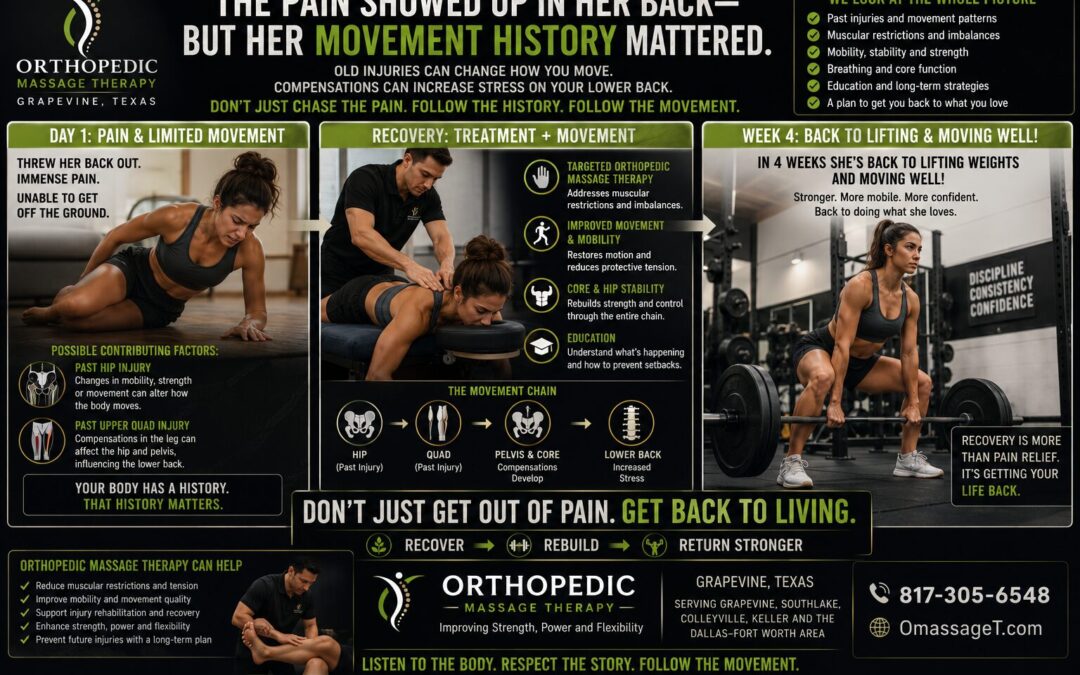
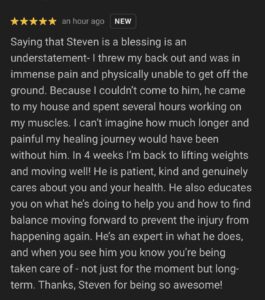
In July 2024, a client shared a Google review describing an experience like this.
She wrote that she had “thrown her back out” and was experiencing immense pain—so much that she reported being physically unable to get off the ground.
Because she could not come to me, I went to her.
Four weeks later, according to her review, she was:
“Back to lifting weights and moving well.”
That is the part of her story I want to focus on.
Not because one person’s experience proves that orthopedic massage therapy can cure acute back pain.
It cannot.
And severe or sudden back pain can sometimes require medical evaluation.
But her experience illustrates something I believe strongly:
Recovery should be about more than making the pain disappear.
The goal is to help you get back to living.
Moving.
Working.
Training.
Lifting.
And doing the things that matter to you.
“I Threw My Back Out”—What Does That Actually Mean?
People commonly say:
“I threw my back out.”
But that phrase is not a medical diagnosis.
It usually describes a sudden episode of significant back pain, often accompanied by:
- Muscle guarding or spasms
- Difficulty standing upright
- Difficulty bending or rotating
- Pain when changing positions
- A feeling that the back has “locked up”
There can be many possible causes of sudden back pain.
Some are muscular.
Others may involve joints, discs, nerves, or other structures.
That is why we should never automatically assume:
“It is just a tight muscle.”
Severe or unexplained back pain deserves appropriate consideration.
First Question: Does This Need Medical Evaluation?
Before thinking about massage, stretching, exercise, or anything else, we need to consider whether symptoms may require medical attention.
Seek prompt medical evaluation for back pain associated with symptoms such as:
- Significant trauma
- Progressive leg weakness
- Significant numbness
- Loss of bladder or bowel control
- Numbness around the groin or saddle region
- Fever or unexplained illness
- Severe abdominal symptoms
- Unexplained weight loss
- Severe or rapidly worsening pain
If you are unsure whether symptoms are appropriate for massage therapy, medical evaluation may be the safest first step.
Massage should never delay necessary healthcare.
When Pain Makes the Body Guard
When something hurts suddenly, the body often responds protectively.
Muscles tighten.
Movement becomes cautious.
You may hold your breath.
Your entire body may feel rigid.
This is sometimes called muscular guarding.
Guarding is not necessarily the enemy.
Your nervous system is trying to protect you.
Imagine touching a hot surface.
You pull your hand away immediately.
Your body protects itself before you even consciously think about it.
Back pain can create its own protective responses.
The challenge is that sometimes the protective tension becomes part of the problem.
Pain leads to guarding.
Guarding makes movement more difficult.
Difficult movement creates fear.
Fear can lead to even more guarding.
A cycle may develop:
PAIN → GUARDING → LESS MOVEMENT → MORE TENSION → MORE FEAR OF MOVEMENT
Breaking that cycle often requires patience.
You Are More Than the Painful Spot
When someone says:
“My lower back hurts,”
it is natural to focus entirely on the lower back.
But the lower back does not function alone.
Consider the movement chain:
FEET → LEGS → HIPS → PELVIS → CORE → LOWER BACK → RIB CAGE
Your hips influence movement.
Your pelvis helps connect the trunk and legs.
Your abdominal and trunk muscles help provide stability.
Your rib cage interacts with breathing and the spine.
Muscles throughout this system may respond when the lower back becomes painful.
This is why a whole-body approach may be useful.
Not because every back problem starts somewhere else.
But because:
When one area hurts, the rest of the body adapts.
The Hips and Lower Back Share Movement
Your hips and lower back often work together.
Bending.
Squatting.
Lifting.
Walking.
Getting out of a chair.
Picking something off the floor.
All involve coordination between the hips, pelvis, and spine.
If the hips are significantly restricted, the lower back may contribute more movement.
If the lower back is painful, the hips may move differently to protect it.
The relationship works both ways.
This is why orthopedic massage therapy for back pain may sometimes include appropriate work around the:
- Hips
- Glutes
- Pelvis
- Lower extremities
- Thoracic region
depending on the individual.
The Core Is Not Just Your Abs
People with back pain are often told:
“You need a stronger core.”
Maybe.
But core function is more complicated than abdominal strength.
Your core includes a coordinated system that helps manage:
- Stability
- Movement
- Breathing
- Pressure
- Force transfer
The trunk needs to know when to create stability and when to allow movement.
Simply doing hundreds of crunches does not automatically create better core function.
The goal is:
Strength + Coordination + Breathing + Movement Control
Breathing Changes When We Hurt
Pay attention to what happens when you experience sudden pain.
Many people hold their breath.
Or begin breathing shallowly.
The body becomes tense.
The diaphragm, rib cage, abdominal wall, and trunk all interact during breathing.
If someone is guarding heavily, breathing mechanics may change as part of that protective response.
This does not mean breathing exercises cure back injuries.
But comfortable breathing and reduced unnecessary tension may be useful parts of restoring normal movement.
Why I Don’t Believe in Simply “Beating Up” a Painful Muscle
When a muscle feels tight, people often assume harder pressure is better.
Especially with severe back tension.
But aggressive treatment is not always appropriate.
A body in significant pain may already be highly protective.
The goal should not be to force tissues to surrender.
Treatment should be:
Thoughtful.
Progressive.
Responsive.
Communicative.
The amount of pressure used should match the person and the situation.
Sometimes less is more.
Communication Is Part of Treatment
One thing this client mentioned in her review was education.
She wrote that I explained what I was doing and helped her understand how to find better balance moving forward.
That is important to me.
Treatment should not feel mysterious.
You should understand:
Why an area is being treated.
What we are trying to accomplish.
How it may relate to your movement.
What you can do afterward.
Education gives people something extremely valuable:
Understanding.
And understanding can reduce fear.
Pain Can Make People Afraid to Move
After a severe episode of back pain, it is completely understandable to become cautious.
You remember what happened.
You do not want it to happen again.
So you stop bending.
Stop lifting.
Stop exercising.
Avoid certain movements.
Some temporary activity modification may be appropriate depending on the injury.
But long-term fear of movement can become its own obstacle.
The goal of recovery should eventually include rebuilding confidence.
Not:
“Never move your back again.”
But:
“Let’s help your body regain the capacity to move.”
Pain Relief Is Step One—Not the Finish Line
Imagine your pain decreases from severe to mild.
That is progress.
But ask:
Can you walk normally?
Can you bend?
Can you sit comfortably?
Can you return to work?
Can you exercise?
Can you lift?
Can you do what you did before?
Pain reduction matters.
But function matters too.
A useful recovery pathway might look like:
PAIN CONTROL → COMFORTABLE MOVEMENT → MOBILITY → STRENGTH → CONFIDENCE → RETURN TO ACTIVITY
The exact pathway varies from person to person.
But the destination should be bigger than simply:
“My pain is gone.”
Four Weeks Later: Back to Lifting Weights
The most powerful sentence in this client’s review may be:
“In 4 weeks I’m back to lifting weights and moving well!”
That is a functional outcome.
She was not simply describing a lower pain number.
She was describing returning to something meaningful.
Lifting weights.
Moving well.
That is what recovery should ultimately support.
Again, her timeline is her individual experience.
Not everyone with acute back pain will recover in four weeks.
Some people recover faster.
Some take much longer.
The diagnosis, severity, health history, rehabilitation, and many other factors influence recovery.
Individual results vary.
But the principle remains:
The goal is to get back to life.
Returning to Strength Training After Back Pain
Returning to lifting after an episode of back pain should be progressive and appropriate to the individual.
Depending on the situation, this may involve guidance from a physician, physical therapist, or other qualified healthcare professional.
The return may include gradually rebuilding:
Mobility.
Strength.
Load tolerance.
Technique.
Confidence.
The goal should not be:
“I feel slightly better, so I’m immediately going to lift my maximum weight.”
The body needs time to rebuild capacity.
Think:
RECOVER → REBUILD → RELOAD → RETURN
Strength Is Part of Resilience
Massage can help address muscular restrictions.
But massage does not replace strength.
A body that needs to:
Lift.
Run.
Work.
Compete.
Care for children.
Exercise.
needs capacity.
Strength training can be an important part of building that capacity when medically appropriate.
This is why I like the phrase:
Improving Strength, Power and Flexibility.
Flexibility alone is not enough.
Mobility alone is not enough.
Massage alone is not always enough.
The body needs the ability to handle the demands of life.
Massage and Strength Training Can Complement Each Other
People sometimes think they must choose:
Massage.
Or exercise.
But they can serve different purposes.
Orthopedic massage therapy may help address:
- Muscular restrictions
- Soft-tissue mobility
- Recovery
- Movement comfort
Appropriate strength training may help improve:
- Capacity
- Strength
- Load tolerance
- Confidence
- Physical resilience
When necessary, physical therapy or medical care may also be part of the process.
The best approach depends on the individual.
Don’t Become Dependent on Treatment
This is important to me.
The goal of orthopedic massage therapy should not be:
“You need me forever.”
The goal should be to help you move toward greater independence.
That means understanding your body.
Learning what may contribute to your symptoms.
Improving movement.
Building strength when appropriate.
Recognizing warning signs.
Knowing when you need help.
A successful outcome is not someone who becomes afraid to move without treatment.
It is someone who feels more capable.
Preventing Another Episode Is More Complicated Than One Exercise
People naturally ask:
“How do I make sure this never happens again?”
Unfortunately, no one can guarantee that.
Back pain is common and complex.
There is no single stretch, exercise, posture, or massage technique that guarantees prevention.
But you can work on factors that may improve physical capacity:
- Regular movement
- Appropriate strength training
- Recovery
- Gradual progression of activity
- Mobility when needed
- Managing training load
- Addressing relevant muscular restrictions
The goal is not creating an invincible back.
The goal is building a more capable body.
There Is No Perfect Posture That Prevents Back Pain
People often believe:
“If I could just sit perfectly, my back would never hurt.”
Human bodies are designed to move.
There is no single posture you need to maintain all day.
Even a theoretically “perfect” posture can become uncomfortable if held for hours.
Instead, think:
Movement variety.
Sit.
Stand.
Walk.
Change positions.
Move.
Your next posture may be more important than your perfect posture.
Old Injuries May Matter
When evaluating recurring back problems, injury history matters.
An old:
Ankle injury.
Knee injury.
Hip problem.
Previous back injury.
Surgery.
may have influenced how you learned to move.
This does not mean an old injury automatically caused your current back pain.
But it may provide useful context.
Remember the chain:
FOOT → ANKLE → KNEE → HIP → PELVIS → LOWER BACK
The body has a history.
Pregnancy and Childbirth May Be Relevant Too
Pregnancy and childbirth create major changes in:
Abdominal function.
Pelvic floor demands.
Movement.
Loading.
Breathing mechanics.
Recovery.
Whether delivery is vaginal or by cesarean section, the body goes through a significant physical transition.
Years later, this history may still be worth discussing when evaluating recurring back symptoms.
Not because childbirth automatically causes back pain.
But because:
Your history helps us understand your movement today.
Orthopedic Massage Therapy for Back Pain in Grapevine, Texas
At Orthopedic Massage Therapy in Grapevine, Texas, we work with active adults, athletes, weightlifters, and individuals experiencing muscular restrictions associated with back discomfort, injury recovery, and movement limitations.
Our approach may include addressing relevant muscular restrictions involving the:
- Lower back
- Hips
- Glutes
- Pelvic region
- Hamstrings
- Thoracic region
- Other areas of the movement chain when appropriate
We focus on:
Orthopedic massage therapy
Sports massage and recovery
Injury rehabilitation support
Mobility
Strength and flexibility
Return to activity
We serve clients from Grapevine, Southlake, Colleyville, Keller, and throughout the Dallas-Fort Worth area.
The Goal Is Not Just to Feel Better on the Table
A massage can feel great.
But what happens after you get off the table?
Can you move better?
Can you return to your activities?
Do you understand more about your body?
Do you have a plan moving forward?
Those questions matter.
The client who shared this July 2024 review described going from an extremely painful episode to lifting weights and moving well four weeks later.
Her experience was individual to her.
But the philosophy behind it applies broadly:
Don’t stop at pain relief. Build your way back to function.
From Pain to Possibility
When severe back pain hits, it can feel like your body has betrayed you.
You may wonder whether you will ever:
Lift again.
Exercise again.
Move normally again.
Sometimes recovery takes time.
Sometimes it requires a team.
Medical care.
Physical therapy.
Massage therapy.
Strength training.
Lifestyle changes.
Every situation is different.
But the goal remains:
PAIN → MOVEMENT → STRENGTH → CONFIDENCE → LIFE
At Orthopedic Massage Therapy in Grapevine, Texas, our goal is not simply to chase the painful spot.
We want to understand the movement.
Support recovery.
Address relevant muscular restrictions.
Educate you about what we are doing.
And help you move toward the activities that matter to you.
DON’T JUST GET OUT OF PAIN. GET BACK TO LIVING.
Don’t Just Chase the Pain. Follow the Movement.
Recover. Rebuild. Return Stronger.
Improving Strength, Power and Flexibility.
Orthopedic Massage Therapy — Grapevine, Texas
Serving Grapevine, Southlake, Colleyville, Keller and the Dallas-Fort Worth area
817-305-6548 | OmassageT.com
This article is for educational purposes and does not diagnose or treat a specific medical condition. Severe, sudden, unexplained, or worsening back pain may require medical evaluation. The experience described is an individual client testimonial, and individual results and recovery timelines vary.