ORTHOPEDIC MASSAGE THERAPY OmassageT.com
Most people think about massage when something hurts.
Their back goes out.
A shoulder becomes painful.
Their hip starts bothering them.
They develop a running injury.
Then they make an appointment.
But what if you didn’t wait until something hurt?
What if you paid attention to how your body was moving before pain or injury forced you to stop?
At Orthopedic Massage Therapy in Grapevine, Texas, working with pain and injury recovery is an important part of what we do.
But there is another side of orthopedic massage therapy:
PERFORMANCE.
For athletes and active adults, the goal is not simply to be pain-free.
You want to:
Move better.
Train consistently.
Recover effectively.
Develop strength.
Generate power.
Maintain mobility.
And perform at your best.
That requires more than waiting for something to break down.
It requires taking care of the body you expect to perform.
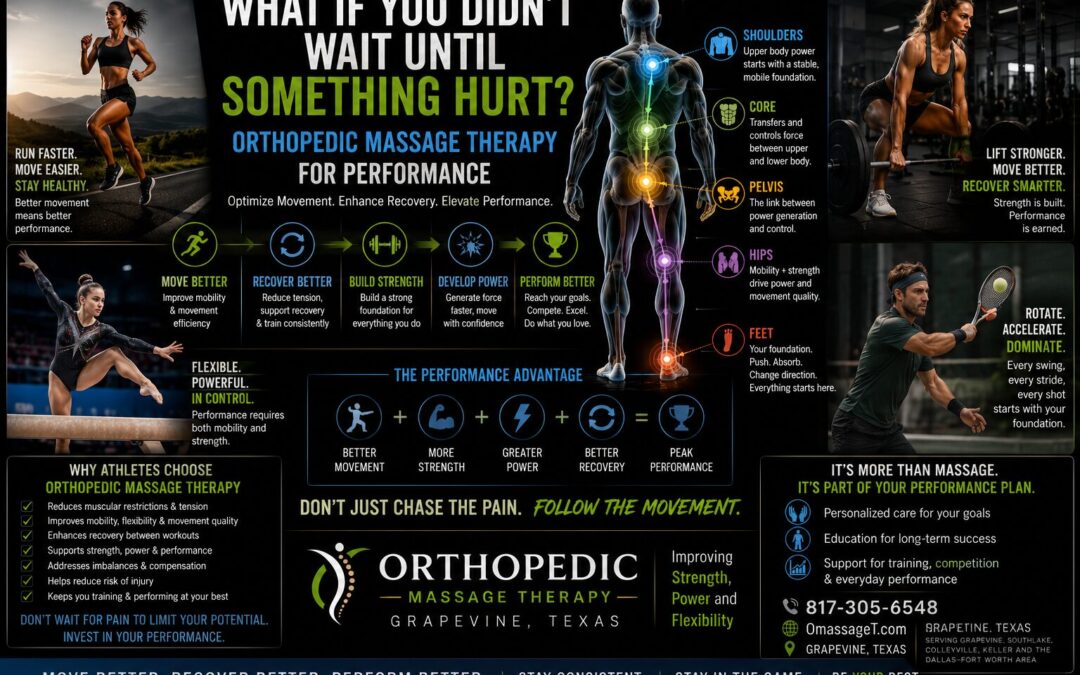
MOVE BETTER → RECOVER BETTER → BUILD STRENGTH → DEVELOP POWER → PERFORM BETTER
Performance Is More Than Strength
When people think about athletic performance, they often think about strength.
How much can you lift?
How fast can you run?
How high can you jump?
But performance is much more complex.
A high-performing body needs a combination of:
Strength
Power
Mobility
Flexibility
Coordination
Stability
Recovery
These qualities work together.
Being extremely strong does not automatically mean you move efficiently.
Being extremely flexible does not automatically make you powerful.
Having excellent endurance does not mean you recover well.
Performance requires balance between multiple physical qualities.
Mobility and Strength Need Each Other
Mobility without control may not be useful.
Strength without adequate movement options may also limit performance.
The body needs both.
Think about a deep squat.
You need enough mobility through the:
Ankles.
Knees.
Hips.
Pelvis.
But you also need strength and control to use that range effectively.
The same principle applies to:
Running.
Jumping.
Throwing.
Lifting.
Dancing.
Gymnastics.
Golf.
Tennis.
Pickleball.
Performance is not just about how far you can move.
It is about:
How well can you control that movement?
Flexibility Is Not the Same as Mobility
These words are often used interchangeably.
But they describe different concepts.
Flexibility generally refers to how much a muscle or tissue can lengthen.
Mobility involves your ability to move through a range of motion with control.
An athlete may be flexible but lack strength in certain positions.
Another athlete may be strong but restricted in movement.
The goal is not simply:
“Become more flexible.”
The goal is:
Develop the movement your activity requires—and have the strength to control it.
Tight Muscles Are Not Always Muscles That Need More Stretching
Athletes often say:
“My hamstrings are always tight.”
“My hips are tight.”
“My calves are tight.”
“My shoulders are tight.”
The automatic response is:
Stretch more.
But a muscle that feels tight is not always simply too short.
Sometimes it may be:
Fatigued.
Overworked.
Protective.
Compensating.
Lacking strength in a certain range.
Responding to restrictions elsewhere.
This is why endlessly stretching the same muscle may provide only temporary relief.
The better question may be:
Why does this muscle keep feeling tight?
Performance Begins With Movement Quality
Before adding:
More weight.
More speed.
More mileage.
More repetitions.
Ask:
How well am I moving?
Your body transfers force through connected regions.
For lower-body movement:
FOOT → ANKLE → KNEE → HIP → PELVIS → CORE
For upper-body athletic movement:
PELVIS → CORE → RIB CAGE → SHOULDER BLADE → SHOULDER → ARM
Performance depends on how these areas coordinate.
If one area becomes restricted or fatigued, another may compensate.
You may still perform.
Athletes are excellent at finding another way.
But compensation can change how force moves through the body.
Your Body Doesn’t Care Which Muscle You Are Training
The body performs movements.
Not isolated anatomy diagrams.
When you sprint, your glutes do not work alone.
When you throw, your shoulder does not work alone.
When you swing a golf club, your arms do not generate all the power.
When you jump, your quadriceps are not the only muscles involved.
Athletic movement requires coordination throughout the body.
Consider a powerful movement chain:
GROUND → FEET → LEGS → HIPS → PELVIS → CORE → UPPER BODY
Force travels through the system.
Performance depends on how efficiently that force is transferred.
Power Starts at the Ground
Many athletic movements begin with the ground.
Running.
Jumping.
Throwing.
Swinging.
Changing direction.
You push into the ground.
The ground pushes back.
Force travels upward through the body.
The feet interact with the surface.
The legs generate and absorb force.
The hips contribute power.
The pelvis and core help transfer that force.
The upper body expresses it.
This is why a shoulder problem may sometimes involve more than the shoulder.
Or why a runner’s performance may involve more than the legs.
Performance is a whole-body event.
The Core Is a Force-Transfer System
Athletes often train the core by doing:
Crunches.
Sit-ups.
Planks.
Those exercises may have value.
But the core’s role in performance is much broader.
Your trunk helps transfer force between the lower and upper body.
Imagine throwing a ball.
Power begins from the ground.
The legs contribute.
The hips rotate.
The pelvis moves.
The trunk transfers force.
Then the shoulder and arm complete the movement.
If the trunk cannot efficiently manage that force, performance may be affected elsewhere.
Think:
LEGS → HIPS → CORE → SHOULDERS → ARMS
The core connects the chain.
Runners: Performance Is More Than Mileage
Runners often focus on one number:
Mileage.
More miles.
Longer runs.
Faster pace.
But running performance also depends on:
Mobility.
Strength.
Recovery.
Training progression.
Movement efficiency.
Every run involves thousands of repeated steps.
Each step moves through:
FOOT → ANKLE → KNEE → HIP → PELVIS → CORE
Small movement restrictions repeated thousands of times may become significant.
Orthopedic massage therapy and sports massage may help address muscular restrictions and support recovery as part of a runner’s overall training strategy.
Strength Athletes: More Weight Requires More Capacity
Weightlifters, powerlifters, bodybuilders, and recreational strength athletes place significant demands on the body.
As load increases, movement quality becomes increasingly important.
Consider a squat.
You need:
Ankle mobility.
Hip mobility.
Trunk stability.
Strength.
Coordination.
Now add hundreds of pounds.
Small limitations become more important.
Orthopedic massage therapy may help address muscular restrictions that influence movement comfort and mobility.
But massage does not replace strength training.
The goal is to complement training.
Improve movement so you can better use the strength you build.
Gymnasts: Mobility Must Come With Control
Gymnastics requires extraordinary:
Strength.
Mobility.
Power.
Coordination.
Flexibility.
Body awareness.
Gymnasts often have ranges of motion far beyond the average person.
But greater flexibility does not eliminate the need for strength.
In fact, large ranges of motion require exceptional control.
For gymnasts, orthopedic massage therapy may help address muscular restrictions associated with intense training and support recovery between practices and competitions.
Dancers: Flexibility Is Only Part of Performance
Dancers are often extremely flexible.
But dance also requires:
Strength.
Balance.
Control.
Endurance.
Power.
Precision.
Repeated choreography can create significant muscular demands.
And dancers often continue performing despite discomfort.
A performance-focused approach should not simply make a dancer “more flexible.”
It should support:
Usable mobility + Strength + Control + Recovery
Golfers: Power Doesn’t Start in the Arms
Watch a powerful golf swing.
The entire body is involved.
Feet.
Legs.
Hips.
Pelvis.
Core.
Thoracic spine.
Shoulders.
Arms.
The club is simply the final part of the chain.
A golfer who cannot rotate effectively through one area may find another way to create movement.
That compensation may influence performance.
This is why improving movement through the hips and thoracic spine may be relevant to golfers—not just working on the shoulders.
Tennis and Pickleball Players: Rotation, Speed and Recovery
Tennis and pickleball require repeated:
Rotation.
Acceleration.
Deceleration.
Lateral movement.
Reaching.
Overhead movement.
The body repeatedly transfers force from the ground through the trunk into the arm.
Performance requires the entire chain.
FEET → LEGS → HIPS → CORE → SHOULDER → ARM
Orthopedic massage therapy may help address muscular restrictions associated with these repetitive demands and support recovery between matches and training sessions.
Competitive Athletes: Small Limitations Can Matter
The higher the level of competition, the smaller the differences between athletes.
A slight reduction in:
Mobility.
Recovery.
Training consistency.
Movement efficiency.
may influence performance.
That does not mean every athlete needs constant treatment.
It means athletes should pay attention to how their bodies are functioning.
Waiting until something becomes painful enough to stop training may not always be the best strategy.
Recovery Is Training
Athletes often believe progress happens during the workout.
But training creates stress.
Adaptation happens during recovery.
Your body needs time to:
Repair.
Adapt.
Rebuild.
Recover.
Then you train again.
Think:
TRAIN → RECOVER → ADAPT → PERFORM
If recovery is inadequate, training quality may decline.
You may feel:
Heavy.
Tight.
Fatigued.
Slower.
Less powerful.
Recovery is not laziness.
Recovery is part of performance.
What Does Sports Massage Do for Performance?
Sports massage and orthopedic massage therapy may help address muscular and soft-tissue restrictions associated with training.
Depending on the athlete and activity, treatment may focus on:
-
Muscular tension
-
Mobility restrictions
-
Recovery between training sessions
-
Areas of repetitive overload
-
Movement limitations
-
Differences between sides
The goal is not simply relaxation.
The goal is to support the athlete’s ability to move and recover.
Massage Does Not Make You Stronger
This distinction matters.
Massage does not replace:
Strength training.
Conditioning.
Skill practice.
Nutrition.
Sleep.
Rehabilitation.
A massage therapist cannot massage someone into becoming faster or stronger.
Performance improvements come from appropriate training and adaptation.
Where orthopedic massage therapy may fit is in helping address muscular restrictions and supporting movement and recovery.
Think of it as one part of a larger performance system.
The Performance System
High performance requires multiple pieces:
TRAINING
Builds strength, endurance, skill, and power.
MOBILITY
Provides movement options.
RECOVERY
Allows adaptation.
NUTRITION
Provides fuel.
SLEEP
Supports recovery and performance.
BODYWORK
May help address muscular restrictions and support movement.
No single piece does everything.
The athlete is the system.
Don’t Wait Until Pain Forces You to Stop
Many people ignore small changes.
“My hip has felt tight for three months.”
“My shoulder doesn’t move like the other one.”
“My calf always tightens after five miles.”
“My back only hurts after heavy squats.”
They keep training.
Until the body finally forces them to stop.
Pain is not always predictable, and not every injury can be prevented.
But paying attention to changes in movement may provide an opportunity to address problems earlier.
Ask:
Has my mobility changed?
Am I recovering?
Is one side moving differently?
Has my training volume increased?
Am I repeatedly experiencing the same tightness?
You do not need to panic about every sensation.
But you should pay attention to patterns.
Your Previous Injuries Matter
Athletes often return to sport after an injury and say:
“It doesn’t hurt anymore.”
Great.
But ask:
Did mobility fully return?
Strength?
Balance?
Confidence?
Movement?
Previous injuries may sometimes influence future movement patterns even after pain is gone.
An old ankle injury may influence running mechanics.
A previous hip or upper-quadriceps injury may influence the pelvis and lower back.
A shoulder injury may change how someone lifts or throws.
This is why injury history matters in performance work.
Your body has a history.
Performance Is Also About Longevity
The goal is not simply:
Perform well today.
The bigger goal is:
Keep performing.
Athletes need durability.
That means managing:
Training.
Recovery.
Strength.
Mobility.
Workload.
Injury history.
A great training session means little if you cannot train consistently.
Consistency builds performance.
Orthopedic Massage Therapy for Athletic Performance in Grapevine, Texas
At Orthopedic Massage Therapy in Grapevine, Texas, we work with athletes and active adults who want to support:
-
Sports performance
-
Sports recovery
-
Mobility
-
Strength and flexibility
-
Injury rehabilitation
-
Movement quality
-
Return to activity
We work with:
Runners.
Weightlifters.
Gymnasts.
Dancers.
Golfers.
Tennis players.
Pickleball players.
Competitive athletes.
Active adults.
Our approach is not simply:
“Where does it hurt?”
We also ask:
“What are you trying to do?”
Run faster?
Lift stronger?
Move more freely?
Return from injury?
Compete?
Perform?
Your goals help guide the approach.
Move Better. Recover Better. Perform Better.
You do not have to wait until you are injured to pay attention to your body.
Performance is built through preparation.
Training.
Recovery.
Movement.
Strength.
Mobility.
Consistency.
Orthopedic massage therapy may be one tool within that larger performance strategy.
Not because massage magically makes you stronger.
But because the body you train is the same body you need to recover.
And the body you recover is the body you ask to perform again tomorrow.
MOVE BETTER → RECOVER BETTER → BUILD STRENGTH → DEVELOP POWER → PERFORM BETTER
At Orthopedic Massage Therapy in Grapevine, Texas, our goal is to help athletes and active adults address muscular restrictions, support recovery, improve functional movement, and continue doing what they love.
DON’T WAIT FOR PAIN TO LIMIT YOUR PERFORMANCE.
Move Better. Recover Better. Perform Better.
Improving Strength, Power and Flexibility.
Orthopedic Massage Therapy — Grapevine, Texas
Serving athletes and active adults in Grapevine, Southlake, Colleyville, Keller and throughout the Dallas-Fort Worth area.
817-305-6548 | OmassageT.com
Orthopedic massage therapy and sports massage are not substitutes for medical diagnosis, physical therapy, strength and conditioning, or appropriate medical care. Individual needs and results vary.