ORTHOPEDIC MASSAGE THERAPY OmassageT.com
“I feel taller.”
It is something I hear surprisingly often after an orthopedic massage therapy session.
Other clients say:
“I feel so open.”
“I feel lighter.”
“I feel balanced.”
“I feel more stable.”
“I feel relaxed.”
And one of my favorites:
“I feel like I’m floating.”
When someone tells me:
“I feel taller!”
I explain something important.
I didn’t make you taller.
Your bones did not suddenly grow during your massage session.
Rather, when muscular tension and protective holding patterns change, you may stand and carry yourself differently.
You may feel less compressed.
Less guarded.
More open.
More balanced.
More comfortable standing upright.
In other words:
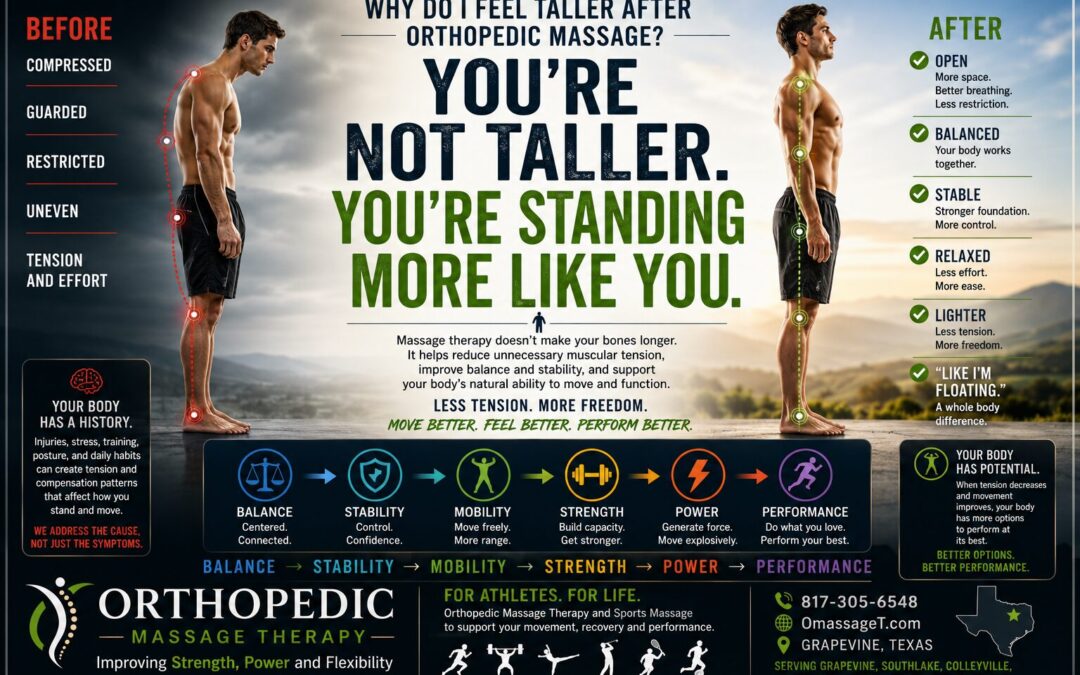
You’re not suddenly taller. You may simply be standing more like you.
At Orthopedic Massage Therapy in Grapevine, Texas, this is one of the reasons I believe massage therapy should be about more than chasing pain.
Sometimes the most meaningful change is not simply:
“My pain is better.”
It is:
“My whole body feels different.”
What Does “I Feel Taller” Actually Mean?
First, let’s be clear.
Orthopedic massage therapy does not make your bones longer.
It does not permanently increase your skeletal height.
So why do people sometimes genuinely feel taller after treatment?
One possible explanation is that changes in muscular tension, comfort, movement, breathing, and body awareness may influence how a person naturally holds themselves.
Imagine spending months or years feeling:
Tight.
Guarded.
Compressed.
Stiff.
Uneven.
Now imagine some of that unnecessary muscular tension decreasing.
You stand up.
And suddenly you notice:
“Wow. I feel taller.”
You may not have gained height.
You may simply feel more comfortable occupying your natural upright position.
Your Height and How You Hold Yourself Are Not Exactly the Same Thing
Your skeletal structure helps determine your height.
But how you stand can influence how that height is expressed in the moment.
Think about someone who spends all day:
Looking down at a computer.
Driving.
Working with their hands in front of them.
Training intensely.
Protecting an old injury.
Sitting for long periods.
Their body may gradually become accustomed to certain positions.
That does not necessarily mean their bones are “out of alignment.”
And it does not mean they need to force themselves into some imaginary perfect posture.
But muscular tension and habitual positioning may influence how upright, open, or comfortable they feel.
When some of those restrictions change, standing may feel different.
The person may say:
“This feels like my actual height.”
You Are Not a Stack of Bones That Needs to Be Put Back Into Place
This distinction is important.
Sometimes people are told:
“Your hips are out.”
“Your spine is out of alignment.”
“One leg is out.”
That language can make the body sound fragile.
The human body is not a stack of blocks constantly falling out of place.
Bodies are adaptable.
They move.
Rotate.
Shift.
Compensate.
Adjust.
The goal of orthopedic massage therapy is not to force every person into one supposedly perfect alignment.
The goal is to address relevant muscular restrictions and help support more comfortable, functional movement.
I am less interested in making someone look mathematically symmetrical.
I am more interested in:
How do you move?
How do you feel?
How stable are you?
How balanced do you feel?
Can your body do what you need it to do?
Why Someone May Feel “Compressed”
Clients sometimes describe themselves as:
Compressed.
Collapsed.
Hunched.
Pulled forward.
Tight.
Heavy.
These are descriptions of how they feel, not necessarily medical diagnoses.
There may be many contributing factors.
Muscular fatigue.
Stress.
Training.
Work posture.
Previous injuries.
Protective movement.
Breathing patterns.
Lack of movement variety.
The body adapts to what we repeatedly ask it to do.
If you spend hours in one position, your body becomes familiar with that position.
If you protect an injury for months, your body learns that strategy.
If you repeatedly train certain movements, your body adapts to those demands.
Over time, you may begin to feel as though your body is being pulled into familiar patterns.
Your Body Has a History
This connects directly with something we discuss often at Orthopedic Massage Therapy:
Your body has a history.
An old ankle injury.
A previous upper-quadriceps or hip injury.
Knee surgery.
Pregnancy and childbirth.
A C-section.
A shoulder injury.
Years of sitting.
Years of lifting.
Years of athletics.
Your body adapts.
Those adaptations are not automatically bad.
Many of them helped you continue functioning.
But sometimes a compensation that was useful during an injury remains after the original injury has healed.
That can influence how you stand and move today.
The Body Works as a Chain
Standing upright involves your entire body.
Consider the chain:
FEET → ANKLES → KNEES → HIPS → PELVIS → CORE → RIB CAGE → SHOULDERS → HEAD
Every region interacts.
If you change how you stand on your feet, movement above may change.
If one hip is guarded, the pelvis may adapt.
If the trunk is tense, breathing and rib-cage movement may feel different.
If the shoulders are constantly elevated, the neck may work differently.
This is why someone may come in complaining about one area but leave saying:
“My whole body feels more open.”
What Does “Open” Mean?
Clients use this word frequently.
“I feel open.”
They may describe:
Their chest feeling less restricted.
Their shoulders sitting more comfortably.
Breathing feeling easier.
Their hips moving more freely.
Standing feeling less effortful.
Again, “open” is not a medical measurement.
It is a subjective experience.
But subjective experiences matter.
If someone feels that movement requires less effort, that is meaningful to them.
The goal is to understand what changed functionally.
Can they move more comfortably?
Does a previously restricted movement feel easier?
Do they feel more confident?
Those are useful questions.
Why Do Some People Feel Lighter?
Another common reaction is:
“I feel lighter.”
Of course, massage did not suddenly remove pounds of body weight.
What may have changed is the person’s perception of effort.
Imagine carrying a heavy backpack all day.
Then take it off.
Your body suddenly feels light.
You did not become weightless.
The load changed.
Something similar may happen when someone has been carrying unnecessary muscular tension.
If that tension decreases, movement may feel less effortful.
Walking may feel easier.
Standing may feel easier.
The person may describe that sensation as:
“I feel light.”
“I Feel Like I’m Floating”
This is one of the more interesting descriptions clients give me.
They stand up after treatment and say:
“I feel like I’m floating.”
Obviously, they are not literally floating.
But the sensation may reflect a combination of:
Reduced muscular tension.
Relaxation.
Changes in body awareness.
Comfortable movement.
A sense of lightness.
Improved confidence in movement.
Sometimes people become so accustomed to carrying tension that they do not realize how much effort they are using.
When that effort decreases, the contrast can feel dramatic.
Relaxed Does Not Mean Weak
This is especially important for athletes.
Some athletes are afraid that feeling relaxed means they will lose:
Strength.
Stability.
Power.
But excessive tension is not the same as useful strength.
An athlete needs to create tension when tension is required.
And release unnecessary tension when it is not.
Think about sprinting.
The athlete produces enormous force.
But efficient sprinting also requires relaxation between muscular contractions.
Think about throwing.
The body must generate power.
But if every muscle is maximally tense throughout the entire movement, speed may suffer.
Performance requires:
TENSION WHEN NEEDED + RELAXATION WHEN POSSIBLE
That is coordination.
Stability Does Not Mean Stiffness
People often confuse stability with stiffness.
They are not the same.
A stiff body may resist movement.
A stable body can control movement.
That distinction matters.
Good stability allows you to:
Move.
Adapt.
Change direction.
Absorb force.
Generate force.
Maintain control.
You do not want your body to be rigid.
You want it to be capable.
STABILITY IS CONTROL—NOT RIGIDITY.
Balance Is More Than Standing on One Foot
When people hear “balance,” they often imagine standing on one leg.
But balance involves much more.
Your nervous system constantly gathers information from:
Your eyes.
Your inner ear.
Your muscles and joints.
Your feet interacting with the ground.
Your brain integrates all of that information to help control your body.
Balance is dynamic.
Every step requires balance.
Every squat.
Every golf swing.
Every tennis shot.
Every gymnastics landing.
Every weightlifting movement.
Performance requires your body to know where it is and respond appropriately.
Why the Feet Matter
Your feet are your connection to the ground.
When standing, walking, running, or lifting, your feet provide important sensory information.
They also help manage force.
If someone feels more balanced after treatment, they may describe feeling:
“Grounded.”
“Centered.”
“Stable.”
That does not necessarily mean something was physically “put back into place.”
It may mean their experience of standing and movement has changed.
The feet are part of a much larger system:
GROUND → FEET → LEGS → HIPS → PELVIS → CORE
Balance and Stability Are Foundations for Performance
This is where the conversation becomes especially important for athletes.
Performance is not simply about being strong.
You need a foundation.
Consider lifting weights.
If your body cannot control the position, adding more weight may expose limitations.
Consider gymnastics.
Extraordinary mobility without adequate stability can be difficult to control.
Consider running.
Every step requires you to repeatedly control your body on one leg.
Consider golf.
Powerful rotation requires a stable foundation from which to generate force.
The performance chain looks something like:
BALANCE → STABILITY → MOBILITY → STRENGTH → POWER → PERFORMANCE
Each quality supports the next.
Mobility Without Stability Has Limitations
Imagine having tremendous range of motion.
But no control.
That range may not be very useful.
An athlete needs the ability to control movement.
This is why simply becoming “more flexible” is not always the goal.
You want:
USABLE RANGE OF MOTION.
That means having enough mobility for your activity—and enough strength and stability to control it.
Orthopedic massage therapy may help address muscular restrictions that limit comfortable movement.
Then appropriate exercise and training help develop strength and control through that movement.
Stability Without Mobility Has Limitations Too
Now imagine the opposite.
You are very strong.
Very stable.
But you cannot comfortably move through the ranges required by your activity.
The body may find another way.
Compensation.
Athletes are incredibly good at compensation.
A golfer who lacks movement in one area may rotate more somewhere else.
A weightlifter may change technique.
A runner may alter stride.
A gymnast may use another region to create range.
The body finds a solution.
But performance may become less efficient.
The goal is balance:
MOBILITY + STABILITY + STRENGTH
Why Orthopedic Massage Therapy May Influence How You Stand and Move
Orthopedic massage therapy focuses on muscular and soft-tissue restrictions that may influence movement and comfort.
Depending on the individual, treatment may help address:
- Muscular tension
- Mobility restrictions
- Differences between sides
- Areas of repetitive muscular overload
- Recovery from training
- Movement comfort
After treatment, some people report feeling:
Taller.
More open.
More balanced.
More stable.
Lighter.
Relaxed.
These are individual experiences.
Not guaranteed outcomes.
But they can tell us something important:
The person’s experience of their body has changed.
Posture Should Be Dynamic
There is no single perfect posture that everyone should maintain all day.
The best posture is often:
Your next posture.
Sit.
Stand.
Walk.
Move.
Change positions.
The body likes variety.
Trying to hold yourself rigidly upright all day can create its own unnecessary tension.
The goal is not:
“Stand perfectly.”
The goal is:
Have enough mobility, strength, and control to comfortably use different positions.
You Shouldn’t Have to Force Yourself to Look Taller
This is an important distinction.
Standing tall should not mean:
Pull your shoulders back as hard as possible.
Suck in your stomach.
Arch your lower back.
Lift your chest aggressively.
Hold your breath.
That is not relaxed posture.
That is another form of muscular effort.
A comfortable upright position should feel sustainable.
You should be able to:
Breathe.
Move.
Relax.
Adapt.
GOOD POSTURE SHOULD NOT FEEL LIKE A FULL-TIME WORKOUT.
Breathing Can Change How “Open” You Feel
The diaphragm and rib cage move with every breath.
If the trunk is heavily guarded, people may breathe differently.
Sometimes breathing becomes shallow.
The shoulders may contribute more.
The chest may feel restricted.
When muscular tension around the trunk changes, some clients report feeling that breathing is more comfortable or that the chest feels more “open.”
Again, massage is not treating respiratory disease.
But muscular comfort and rib-cage movement can influence how someone experiences breathing and posture.
Body Awareness Matters
Another important factor is proprioception.
Proprioception is your body’s sense of where it is in space.
You do not need to look at your arm to know where your arm is.
Your nervous system constantly receives information from muscles and joints.
Hands-on treatment provides sensory input.
Movement provides sensory input.
Exercise provides sensory input.
After treatment, some people become more aware of:
How they are standing.
Where they are holding tension.
How one side feels compared with the other.
How their feet contact the ground.
That change in awareness may contribute to the feeling of being:
Balanced.
Centered.
Grounded.
Performance Is About Efficiency
A high-performing body does not simply produce more effort.
It uses effort effectively.
Imagine two athletes performing the same movement.
One uses excessive muscular tension everywhere.
The other creates tension exactly where and when needed.
Which athlete is likely to move more efficiently?
Performance requires coordination.
MORE TENSION IS NOT ALWAYS MORE PERFORMANCE.
Sometimes the goal is:
Better timing.
Better movement.
Better control.
Better recovery.
From Relaxation to Performance
This creates an interesting progression:
RELAX UNNECESSARY TENSION
↓
MOVE MORE FREELY
↓
IMPROVE CONTROL
↓
BUILD STRENGTH THROUGH THE AVAILABLE MOVEMENT
↓
DEVELOP POWER
↓
PERFORM
Massage is not responsible for every step.
Training is essential.
Strength is built through resistance.
Power is developed through appropriate training.
Skill comes through practice.
But orthopedic massage therapy may be one tool that supports movement and recovery within that larger performance system.
Orthopedic Massage Therapy for Balance, Stability and Performance in Grapevine, Texas
At Orthopedic Massage Therapy in Grapevine, Texas, we work with athletes and active adults who want more than temporary relaxation.
Our approach focuses on:
- Orthopedic massage therapy
- Sports massage
- Athletic recovery
- Mobility
- Balance and movement
- Muscular restrictions
- Injury rehabilitation support
- Strength and flexibility
- Performance
We work with:
Runners.
Weightlifters.
Gymnasts.
Dancers.
Golfers.
Tennis players.
Pickleball players.
Competitive athletes.
Active adults.
And people who simply want to move and feel better.
We serve clients from Grapevine, Southlake, Colleyville, Keller, and throughout the Dallas-Fort Worth area.
“You Feel Taller?”
The next time someone stands up after treatment and tells me:
“Steven, I feel taller!”
My response is simple.
You didn’t suddenly grow.
But you may be experiencing your body differently.
Less guarded.
More open.
More comfortable upright.
More aware of how you’re standing.
Closer to the way your body naturally wants to carry itself in that moment.
And sometimes that difference feels dramatic.
You may say:
“I feel taller.”
“I feel balanced.”
“I feel stable.”
“I feel open.”
“I feel relaxed.”
“I feel like I’m floating.”
Those words describe something important.
Not a magical structural change.
But a different experience of movement.
And ultimately, that is what performance is about.
Not forcing the body into a perfect position.
But giving it the ability to:
MOVE.
ADAPT.
STABILIZE.
GENERATE FORCE.
RELAX.
AND PERFORM.
YOU’RE NOT TALLER. YOU’RE STANDING MORE LIKE YOU.
BALANCE → STABILITY → MOBILITY → STRENGTH → POWER → PERFORMANCE
Move Better. Feel Better. Perform Better.
Improving Strength, Power and Flexibility.
Orthopedic Massage Therapy — Grapevine, Texas
Serving Grapevine, Southlake, Colleyville, Keller and the Dallas-Fort Worth area
817-305-6548 | OmassageT.com
Individual experiences following massage therapy vary. Orthopedic massage therapy does not permanently increase skeletal height or replace appropriate medical evaluation, physical therapy, or strength and conditioning.