ORTHOPEDIC MASSAGE THERAPY OmassageT.com
You can be strong.
You can be flexible.
You can have powerful muscles.
But can your body control and use what you have?
That question is at the heart of athletic performance.
At Orthopedic Massage Therapy in Grapevine, Texas, clients sometimes stand up after a session and say things like:
“I feel balanced.”
“I feel more stable.”
“I feel grounded.”
“I feel taller.”
“I feel open.”
“I feel lighter.”
Those words are interesting because they describe more than relaxation.
They describe how someone experiences their entire body.
And for athletes and active adults, two of those qualities deserve special attention:
BALANCE + STABILITY
Because before you can efficiently produce:
STRENGTH.
POWER.
SPEED.
AGILITY.
You need the ability to control your body.
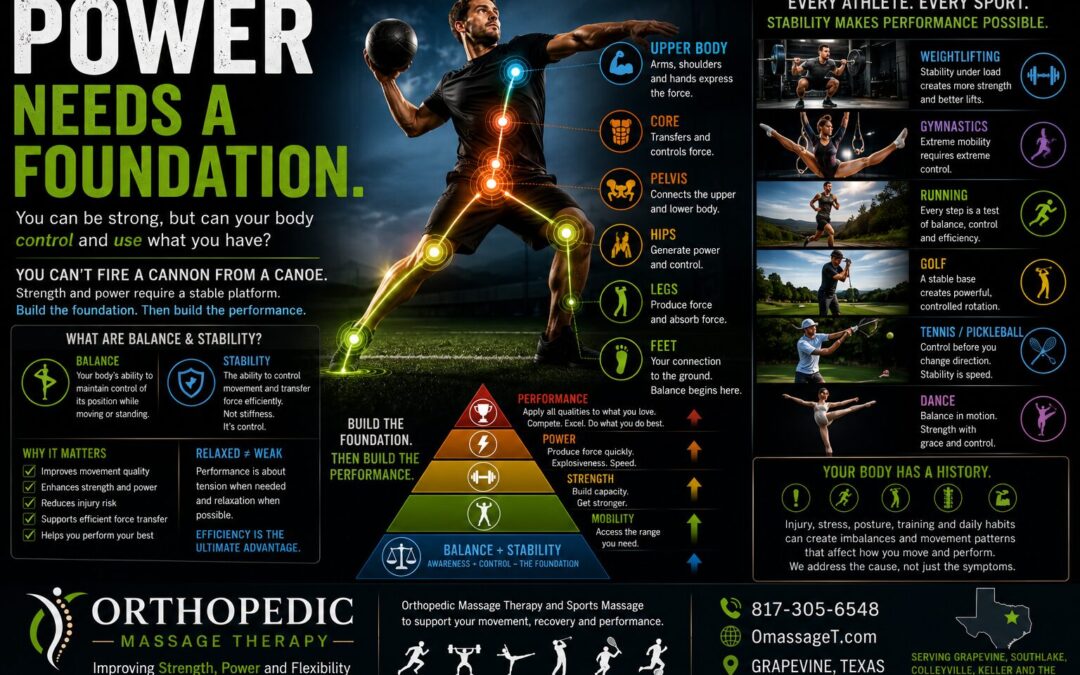
Think of performance as a progression:
BALANCE → STABILITY → MOBILITY → STRENGTH → POWER → PERFORMANCE
Each quality supports the next.
The strongest engine in the world cannot perform well if it is sitting on an unstable foundation.
Your body is no different.
What Is Balance?
When most people hear the word “balance,” they imagine standing on one leg.
That is certainly one example.
But balance is much more complex.
Balance is your body’s ability to control its position while:
Standing.
Walking.
Running.
Jumping.
Landing.
Changing direction.
Lifting.
Rotating.
Reaching.
Your nervous system constantly gathers information from:
Your eyes.
Your inner ear.
Your muscles.
Your joints.
Your feet interacting with the ground.
Your brain processes all of that information and continuously adjusts your body.
Balance is not something you “have.”
It is something your body is constantly doing.
Balance Is Dynamic
A statue has excellent stillness.
But an athlete needs dynamic balance.
Think about a runner.
For much of each stride, the runner is essentially balancing on one leg.
Think about a gymnast landing.
The body must absorb enormous forces while controlling position.
Think about a tennis player changing direction.
The athlete must decelerate, control momentum, and immediately accelerate again.
Think about a weightlifter under a heavy barbell.
Small changes in position can dramatically affect the lift.
Performance requires balance while moving.
What Is Stability?
People often confuse stability with stiffness.
They are not the same.
Stiffness resists movement.
Stability controls movement.
A stable body is not frozen.
It can move while maintaining control.
Imagine a tree.
A completely rigid tree may break in strong wind.
A healthy tree can move with the wind while remaining rooted.
The human body also needs this combination:
MOVEMENT + CONTROL
That is functional stability.
Stability Is Not About Bracing Every Muscle
Some athletes try to create stability by tightening everything.
Abs tight.
Shoulders tight.
Jaw tight.
Glutes tight.
Breath held.
Everything braced.
That may create temporary rigidity.
But performance requires something more sophisticated.
The body needs to know:
When to create tension.
Where to create tension.
How much tension to create.
And when to relax.
STABILITY IS COORDINATED TENSION—NOT CONSTANT TENSION.
That distinction matters enormously for performance.
Relaxation Is Part of Athletic Performance
This may sound contradictory.
How can relaxation improve performance?
Watch elite athletes.
A world-class sprinter generates tremendous force.
But watch the athlete’s face and hands.
Often, they appear surprisingly relaxed.
A powerful golfer generates enormous club-head speed.
But the swing is not created by maximally tightening every muscle.
A boxer needs explosive force.
But staying rigid throughout the entire fight would waste energy.
Performance requires:
TENSION WHEN NEEDED + RELAXATION WHEN POSSIBLE
That is efficiency.
Why Your Feet Matter
Balance begins with your relationship to the ground.
Your feet provide important sensory information.
They help your nervous system understand:
Where you are.
How your weight is distributed.
How the ground is changing beneath you.
The feet also help manage force.
Consider the performance chain:
GROUND → FEET → ANKLES → KNEES → HIPS → PELVIS → CORE
Every athletic movement begins somewhere within this system.
If you are standing, running, jumping, lifting, or changing direction, your interaction with the ground matters.
You Cannot Fire a Cannon From a Canoe
This is a useful way to think about stability and power.
Imagine trying to fire a powerful cannon from an unstable canoe.
The cannon may be extremely powerful.
But without a stable platform, much of that force is difficult to control.
Your muscles can be incredibly strong.
But strength must be expressed through a coordinated foundation.
That foundation includes:
Feet.
Legs.
Hips.
Pelvis.
Core.
If the system cannot control force efficiently, simply adding more strength may not solve the problem.
POWER NEEDS A PLATFORM.
The Hips Are Major Players in Stability
The hips play an enormous role in athletic movement.
Muscles surrounding the hips help control:
The thigh.
The pelvis.
Rotation.
Single-leg movement.
Acceleration.
Deceleration.
Think about standing on one leg.
Your hip muscles are working to help control the pelvis.
Now imagine running.
Every stride repeatedly places your body into a single-leg situation.
The demands increase dramatically.
Hip stability is not simply about having strong glutes.
It requires:
Strength + Endurance + Coordination + Timing
Pelvic Control Connects the Lower and Upper Body
The pelvis sits at an important crossroads.
Below:
The legs.
Above:
The trunk.
The pelvis helps transfer force between them.
Consider throwing a ball.
The movement does not begin at the shoulder.
Force begins from the ground.
The legs contribute.
The hips rotate.
The pelvis moves.
The trunk transfers force.
Then the shoulder and arm complete the movement.
GROUND → LEGS → HIPS → PELVIS → CORE → SHOULDER → ARM
If force cannot transfer efficiently through the middle of the chain, another area may have to work harder.
The Core Is Not Just Your Abs
When people hear “core stability,” they often think:
Planks.
Crunches.
Sit-ups.
Those exercises may have a place.
But the core is much more than visible abdominal muscles.
The trunk helps:
Transfer force.
Control movement.
Manage pressure.
Coordinate breathing.
Connect the lower and upper body.
Your core should not simply make you stiff.
It should help you move.
THE CORE IS A FORCE-TRANSFER SYSTEM.
Balance Before Strength?
This does not mean you must have “perfect balance” before strength training.
There is no perfect balance.
Strength training itself can improve stability and control.
But consider what happens when you add load.
If you squat with body weight, movement errors may be relatively easy to manage.
Now add:
100 pounds.
200 pounds.
300 pounds.
As load increases, the demand for control increases.
Strength amplifies what your movement system is doing.
This is why:
CONTROL + STRENGTH
work together.
Strength Without Stability
Imagine someone who can produce enormous muscular force but struggles to control position.
They may be strong in a machine.
But athletic movement requires something different.
Free weights.
Running.
Jumping.
Changing direction.
Sports.
These activities require the body to stabilize itself.
Strength is important.
But usable strength requires control.
Mobility Without Stability
Now imagine someone who is extremely flexible.
They can move into impressive positions.
But can they control those positions?
This is especially relevant for:
Gymnasts.
Dancers.
Cheerleaders.
Martial artists.
Highly flexible athletes.
Large ranges of motion require strength and stability.
Flexibility alone does not equal performance.
MOBILITY GIVES YOU OPTIONS.
STABILITY GIVES YOU CONTROL OF THOSE OPTIONS.
Stability Without Mobility
The opposite can also be limiting.
An athlete may be strong and stable but lack the mobility required for the activity.
The body still has to complete the movement.
So it compensates.
A golfer may rotate more through another region.
A weightlifter may change squat mechanics.
A runner may alter stride.
A swimmer may change shoulder movement.
The body finds another way.
Performance requires balance between:
MOBILITY + STABILITY
Too little control can be limiting.
Too little movement can also be limiting.
Weightlifters: Stability Under Load
Strength athletes provide a perfect example.
Consider a heavy squat.
The athlete must manage:
Foot pressure.
Ankle movement.
Knee position.
Hip movement.
Pelvic control.
Trunk stability.
Bar position.
Breathing.
All at once.
The body must create enough stability to manage the load while still allowing movement.
That is why stability does not mean becoming rigid.
The athlete must be:
STABLE ENOUGH TO CONTROL THE LOAD + MOBILE ENOUGH TO COMPLETE THE MOVEMENT
Runners: Every Step Tests Stability
Running is essentially a repeated series of single-leg landings.
Step after step.
Mile after mile.
The runner must repeatedly:
Absorb force.
Stabilize.
Transfer force.
Push forward.
Consider the chain:
FOOT → ANKLE → KNEE → HIP → PELVIS → CORE
Thousands of times.
A runner’s performance is not simply about cardiovascular endurance.
It also involves movement efficiency and the ability to control repeated forces.
Gymnasts: Extreme Mobility Requires Extreme Control
Gymnastics may be one of the clearest examples of the relationship between mobility and stability.
Gymnasts require extraordinary range of motion.
But they also need tremendous:
Strength.
Power.
Balance.
Coordination.
Body awareness.
A gymnast does not simply reach an extreme position.
They must control it.
Whether:
Landing.
Flipping.
Swinging.
Holding a handstand.
Performing on a beam.
THE GREATER THE MOVEMENT OPTIONS, THE MORE IMPORTANT CONTROL BECOMES.
Dancers: Balance Is Movement
Dancers demonstrate that balance is not static.
A dancer may:
Turn.
Leap.
Land.
Rotate.
Balance on one leg.
Move through large ranges of motion.
Then transition immediately into another movement.
Balance is constantly changing.
Performance requires the nervous system and muscular system to continuously adapt.
Golfers: Stability Creates a Base for Rotation
Golf requires rotation.
But powerful rotation needs a stable base.
The golfer interacts with the ground.
Force moves through:
Feet.
Legs.
Hips.
Pelvis.
Core.
Upper body.
Arms.
Club.
A golfer who tries to generate all power from the arms may lose efficiency.
The entire body contributes.
STABILITY DOESN’T STOP ROTATION.
STABILITY HELPS CONTROL ROTATION.
Tennis and Pickleball: Control Before Direction Change
Court sports require rapid transitions.
Accelerate.
Stop.
Change direction.
Rotate.
Reach.
Recover.
Repeat.
Every direction change requires the body to first manage existing momentum.
Before accelerating in a new direction, you must control where you are.
This is why deceleration is an important part of athletic performance.
YOU CANNOT EFFICIENTLY CHANGE DIRECTION IF YOU CANNOT CONTROL THE DIRECTION YOU ARE ALREADY MOVING.
Balance and Injury History
Previous injuries may influence balance and stability.
Consider an old ankle sprain.
During recovery, you may have:
Shifted weight.
Limped.
Avoided loading the injured side.
Lost confidence in that leg.
Those strategies were protective.
But did normal balance and control fully return?
Maybe.
Maybe not.
This is why injury history matters.
An old:
Ankle injury.
Knee injury.
Upper-quadriceps or hip injury.
Back injury.
Shoulder injury.
may influence movement long after the original pain has resolved.
YOUR BODY HAS A HISTORY.
Pain Changes Balance
Pain can change how we move.
If your right hip hurts, you may spend more time on your left leg.
If your ankle hurts, you may avoid pushing through that foot.
If your back hurts, you may move more rigidly.
The body adapts.
Again:
Compensation is not automatically bad.
It is often protective.
The important question is:
Does the compensation remain after it is no longer needed?
Why Clients Sometimes Feel More Balanced After Massage
Some clients stand up after an orthopedic massage session and say:
“I feel centered.”
“I feel even.”
“I feel grounded.”
“I feel more stable.”
Massage did not magically realign their skeleton.
But changes in:
Muscular tension.
Comfort.
Movement.
Body awareness.
may influence how they experience standing and moving.
If one area was heavily guarded and that guarding decreases, movement may feel different.
The person may distribute weight differently.
They may feel more comfortable upright.
Their body may feel less effortful.
That experience can be described as:
BALANCED.
Orthopedic Massage Therapy and Performance
Orthopedic massage therapy does not directly create athletic skill.
It does not replace strength training.
It does not replace balance training.
It does not replace physical therapy when rehabilitation is needed.
But it may help address muscular restrictions that influence:
Movement comfort.
Mobility.
Recovery.
Training consistency.
Body awareness.
The goal is to support the larger performance system.
The Performance Pyramid
Think of athletic performance as a pyramid.
At the foundation:
BALANCE + STABILITY
Then:
MOBILITY + CONTROL
Then:
STRENGTH
Then:
POWER
Then:
SPORT-SPECIFIC PERFORMANCE
If the foundation is limited, adding more intensity may expose limitations.
The goal is not perfection.
The goal is capacity.
More Strength Is Not Always the First Answer
Athletes love adding more.
More weight.
More miles.
More training.
More intensity.
But sometimes the better question is:
Can I better use the strength I already have?
Can you control your movement?
Can you access the range you need?
Can you transfer force efficiently?
Can you relax unnecessary tension?
Can you recover?
Performance is not always about adding more.
Sometimes it is about improving how the system works together.
Stability and Relaxation Can Exist Together
This is one of the most important ideas in this article.
You can feel:
RELAXED AND STABLE.
Those qualities are not opposites.
A well-coordinated body does not need to hold maximum tension everywhere.
It creates stability where needed.
Then allows movement elsewhere.
This may be why some clients describe feeling:
Grounded.
But light.
Stable.
But relaxed.
Strong.
But open.
That combination is valuable.
From Balance to Performance
Here is the progression:
BALANCE
Know where your body is.
↓
STABILITY
Control your position.
↓
MOBILITY
Access the movement you need.
↓
STRENGTH
Produce and control force.
↓
POWER
Produce force quickly.
↓
PERFORMANCE
Apply those qualities to what you love.
Running.
Lifting.
Gymnastics.
Dance.
Golf.
Tennis.
Pickleball.
Sports.
Life.
BALANCE → STABILITY → MOBILITY → STRENGTH → POWER → PERFORMANCE
Orthopedic Massage Therapy for Athletic Performance in Grapevine, Texas
At Orthopedic Massage Therapy in Grapevine, Texas, we work with athletes and active adults who want to improve how they move, recover, and perform.
Our work may support people looking for:
-
Orthopedic massage therapy
-
Sports massage
-
Athletic recovery
-
Mobility and flexibility
-
Muscular balance
-
Movement quality
-
Injury rehabilitation support
-
Strength and performance
We work with:
Runners.
Weightlifters.
Gymnasts.
Dancers.
Golfers.
Tennis players.
Pickleball players.
Competitive athletes.
Active adults.
And people who simply want to move with greater confidence.
Serving Grapevine, Southlake, Colleyville, Keller, and throughout the Dallas-Fort Worth area.
Build the Foundation Before You Ask for More Power
Everyone wants performance.
Run faster.
Lift heavier.
Jump higher.
Hit harder.
Swing faster.
But power needs something underneath it.
A foundation.
Not a perfectly symmetrical body.
Not a rigid body.
A body that can:
Sense.
Adapt.
Move.
Stabilize.
Generate force.
Relax.
And respond.
That is why performance begins before the weight gets heavy.
Before the race starts.
Before the competition.
Before the first swing.
It begins with your ability to control your body.
BALANCE CREATES AWARENESS.
STABILITY CREATES CONTROL.
MOBILITY CREATES OPTIONS.
STRENGTH CREATES CAPACITY.
POWER CREATES EXPLOSIVENESS.
PERFORMANCE PUTS IT ALL TOGETHER.
At Orthopedic Massage Therapy in Grapevine, Texas, we don’t just ask:
“Where does it hurt?”
We also ask:
“What do you want your body to be able to do?”
Because the goal isn’t simply to feel better lying on a massage table.
The goal is to:
GET UP.
MOVE.
TRAIN.
COMPETE.
LIVE.
AND PERFORM.
BUILD THE FOUNDATION. THEN BUILD THE PERFORMANCE.
BALANCE → STABILITY → MOBILITY → STRENGTH → POWER → PERFORMANCE
Move Better. Recover Better. Perform Better.
Improving Strength, Power and Flexibility.
Orthopedic Massage Therapy — Grapevine, Texas
Serving athletes and active adults in Grapevine, Southlake, Colleyville, Keller and throughout the Dallas-Fort Worth area.
817-305-6548 | OmassageT.com
Orthopedic massage therapy and sports massage may support mobility, muscular comfort, and recovery but do not replace appropriate medical evaluation, physical therapy, rehabilitation, or strength and conditioning. Individual needs and results vary.