A Connected Approach to Movement
When people think about massage therapy, they usually think about muscles. Muscles are important, but they are only one part of the body’s movement system.
Fascia is the connective tissue that surrounds, supports, separates, and connects structures throughout the body. It is found beneath the skin, around and within muscles, and around many other anatomical structures. Fascia helps create continuity between different areas of the body rather than allowing every muscle to operate as an isolated unit.
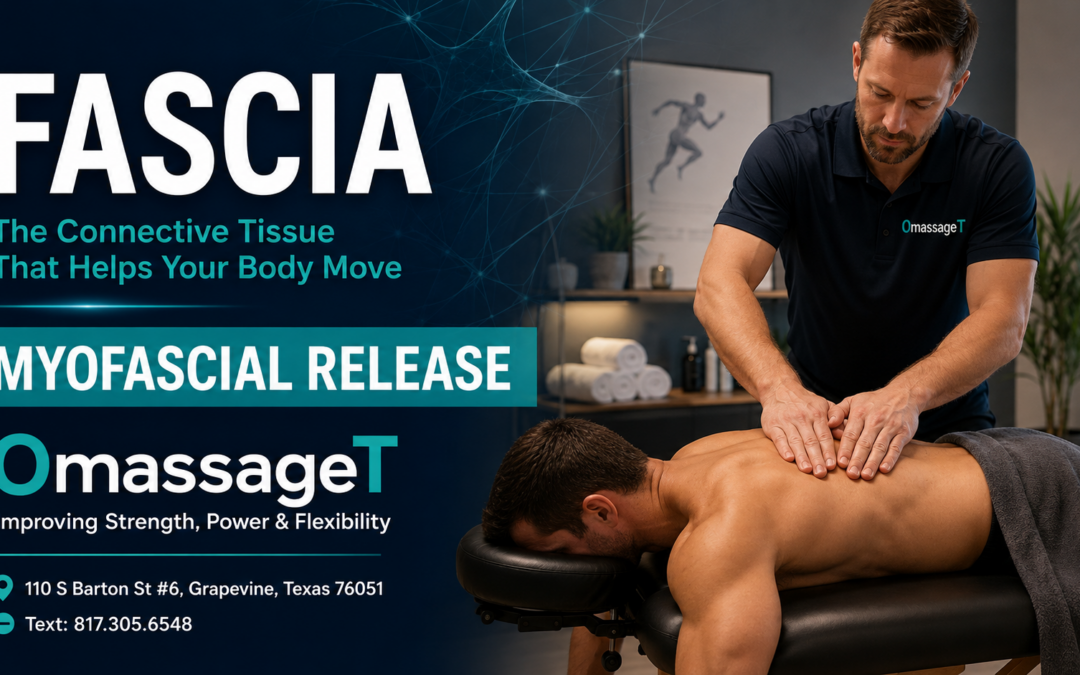
At OmassageT in Grapevine, Texas, Steven works with fascia through a hands-on technique known as myofascial release. This approach focuses on areas of soft-tissue restriction that may be influencing flexibility, mobility, posture, comfort, or movement quality.
Myofascial release is not about forcing the body into a position. It involves carefully working with the tissues while paying attention to how the client’s body responds.
What Is Fascia?
Fascia is a type of connective tissue found throughout the body.
In simple terms, it forms layers and networks that surround and support muscles and other structures. It helps separate tissues while also connecting different regions into a continuous system.
The National Library of Medicine describes fascia as connective tissue that can enclose and separate muscles and organs. It contributes to support, protection, attachment, and the reduction of friction between moving structures. Researchers continue to study its classification and functions because there is not one universally accepted definition covering every use of the word “fascia.” NCBI Bookshelf: Physiology, Fascia
Fascia can be described in several layers:
- Superficial fascia lies beneath the skin.
- Deep fascia surrounds muscles and helps form muscular compartments.
- Visceral fascia supports and surrounds internal structures.
Fascial tissue is also woven into muscles. It surrounds individual muscle fibers, groups of fibers, and entire muscles. This creates a connected myofascial system through which the body can transmit and manage force.
This is one reason a restriction in one part of the body may influence movement somewhere else.
Fascia Is More Than Wrapping
Fascia is sometimes described as though it were simply plastic wrapping around the muscles. That comparison can help people visualize its location, but fascia is a living and responsive tissue—not an inactive covering.
It contains collagen, elastin, water, cells, and sensory nerve endings. Fascial tissues help support structures, allow tissues to glide, and contribute to the transmission of force.
Research also describes fascia as being richly innervated, meaning that it contains or is closely associated with sensory receptors involved in body awareness and the perception of mechanical changes. NCBI Bookshelf: Anatomy, Fascia
The condition of this connective-tissue environment may influence how movement feels. When tissues glide and coordinate well, movement may feel open and efficient. When an area feels restricted or guarded, movement may feel stiff, uneven, or uncomfortable.
What Can Affect Fascia?
Fascia and the surrounding soft tissues are continually responding to movement, load, position, and recovery.
Factors that may influence how the myofascial system feels or functions include:
- Repetitive physical activity
- Prolonged sitting or standing
- Previous injuries
- Surgery and scar tissue
- Sudden increases in training
- Limited movement
- Muscular overuse
- Protective guarding
- Differences between the right and left sides
- Stress and inadequate recovery
- Normal changes associated with aging
Not every area of stiffness represents a damaged or “stuck” fascia. Tightness is a sensation that may involve muscles, connective tissue, joints, the nervous system, or several factors working together.
For that reason, it is better to assess the person’s overall movement than to assume that every symptom is caused by a fascial restriction.
What Is Myofascial Release?
The term myofascial refers to muscles and their associated fascial tissues.
Myofascial release is a form of hands-on therapy that applies pressure or tension to the soft tissues. The amount, direction, and duration of contact may vary depending on the practitioner, the area being addressed, and the client’s response.
Some techniques use gentle, sustained pressure. Others involve slow movement, stretching, or working with the tissue while the client changes position.
The goal is not to tear, break, or aggressively force fascia. It is to provide a mechanical and sensory input that may help reduce guarding, improve comfort, and allow easier movement.
Researchers are still studying the exact mechanisms behind myofascial release. Some benefits may involve changes in pain perception, nervous-system activity, muscular tension, tissue hydration, or tolerance to movement rather than a permanent physical reshaping of fascia.
A systematic review found that research on myofascial release varied considerably in quality and results. This means the treatment should be discussed with reasonable expectations rather than promoted as a guaranteed cure. PubMed: Effectiveness of Myofascial Release—Systematic Review
How Steven Uses Myofascial Release
At OmassageT, myofascial release is one part of Steven’s orthopedic massage therapy approach.
Steven does not look only at the area where a client reports tightness or discomfort. He considers how the surrounding muscles, fascia, joints, and movement patterns may be working together.
For example:
- A restriction around the hips may influence the pelvis or lower back.
- Limited tissue mobility in the chest may affect shoulder movement.
- Restrictions through the upper back may influence the neck or shoulders.
- Tightness in the calves may affect movement through the feet and ankles.
- A previous thigh or hip injury may contribute to a different movement pattern later.
- Scar tissue from an injury or surgery may influence how nearby tissues move.
This does not mean that one area automatically causes symptoms somewhere else. It means that the body should be evaluated as a connected system.
During treatment, Steven explains what he is doing, communicates about hand placement, and checks the client’s comfort. The client’s feedback helps guide the session.
Myofascial Release and Range of Motion
One reason athletes and active adults seek myofascial work is to improve how freely they move.
Some research on myofascial techniques reports short-term improvements in range of motion. However, results vary based on the technique, body area, population, and study design. Research on self-myofascial release, such as foam rolling, has also found possible short-term range-of-motion improvements without necessarily reducing muscular performance. Systematic review of self-myofascial release in athletes
An improvement in range of motion does not automatically mean that the tissue has been permanently lengthened. Changes may involve decreased guarding, greater stretch tolerance, relaxation, altered sensory input, or improved coordination.
For lasting functional improvement, hands-on work may need to be combined with appropriate movement, stability, strengthening, and changes to repetitive habits.
Fascia, Mobility, and Athletic Performance
Athletic movement requires force to travel through the body.
A runner transfers force through the feet, ankles, knees, hips, pelvis, and torso with every stride. A gymnast must create and absorb force during takeoffs and landings. A golfer produces rotation through the legs, hips, torso, shoulders, and arms.
Fascial tissues are part of this connected movement system. Anatomical research describes fascia as contributing to continuity between tissues and helping transmit and resist mechanical forces. Review of fascia morphology and classification
When an athlete feels restricted, the body may change how it performs a movement. Another area may move more, work harder, or create additional tension.
Myofascial release may help prepare an athlete for more comfortable movement, but it does not replace sport-specific training. Performance still requires balance, stability, mobility, flexibility, strength, power, coordination, and recovery.
Why the Tight Area May Not Be the Only Area to Address
The body works through relationships.
Someone with lower-back tightness may also have relevant restrictions through the hips, pelvis, thighs, or upper back. A client with neck tension may have limitations involving the chest, shoulders, or rib cage.
This does not mean that every symptom comes from a distant location. It means the entire movement pattern can provide useful information.
If treatment focuses only on the place that hurts without considering why that area is working so hard, relief may be temporary.
Steven’s approach is to examine how different parts of the body may be contributing to the client’s movement and symptoms. Myofascial release can then be directed toward the areas that appear relevant to the larger pattern.
Acute Injuries and Chronic Restrictions Are Different
Myofascial restriction, chronic tightness, and an acute injury should not be treated as interchangeable conditions.
An acute injury may occur during a fall, collision, sudden movement, or other trauma. Symptoms may include severe pain, swelling, bruising, numbness, weakness, or difficulty bearing weight.
A new or serious injury should be evaluated by the appropriate healthcare professional before receiving massage or returning to exercise. Myofascial release is not a substitute for medical diagnosis, imaging, or emergency care.
Chronic restrictions generally develop or remain present over a longer period. They may be associated with repetitive activity, previous injury, surgery, work posture, training habits, or long-term compensation.
A prior injury may continue to influence the myofascial system after the original tissues have healed, but the timing, symptoms, and condition of the tissues must always be considered.
What Might a Client Feel During Treatment?
Myofascial release may feel different from traditional massage.
Instead of repeated gliding strokes, the practitioner may maintain contact with an area and work slowly. The client might feel gentle pressure, stretching, warmth, or a gradual change in tension.
Treatment should remain within the client’s tolerance. More pressure is not always more effective, and severe pain is not required to create a useful response.
After treatment, some clients report feeling:
- Less restricted
- More open
- Better balanced
- Relaxed
- Lighter
- More aware of their posture
- Able to move more freely
- As though they are standing taller
Clients have not physically grown taller. Reduced guarding and a change in postural organization may allow them to stand closer to their natural height.
A Connected Approach to Movement in
Fascia helps connect the body, but it should not be used as the explanation for every pain or movement problem.
Pain is complex. It may involve muscles, joints, nerves, connective tissue, injury, health conditions, stress, sleep, training load, and many other factors.
Myofascial release is therefore most responsibly used as one part of a broader approach. Depending on the person, that approach may also include mobility work, strengthening, stability exercises, activity modification, rest, or medical care.
At OmassageT, the purpose of myofascial work is not to promise a cure. It is to help clients explore how soft-tissue restrictions may be affecting their comfort and movement.
Myofascial Release in Grapevine, Texas
If you feel restricted, unbalanced, or unable to move as comfortably as you would like, myofascial release may be a useful part of your orthopedic massage therapy session.
Steven works with athletes and active adults who want to improve movement, support recovery, and better understand how different areas of their bodies work together.
Every session is based on the individual’s history, activities, symptoms, and goals. Treatment is adjusted according to the client’s comfort and response.
To learn more or schedule an orthopedic massage therapy and myofascial release session in Grapevine, Texas, contact OmassageT:
110 S Barton St #6, Grapevine, Texas 76051
Text: 817.305.6548
OmassageT — Improving Strength, Power & Flexibility