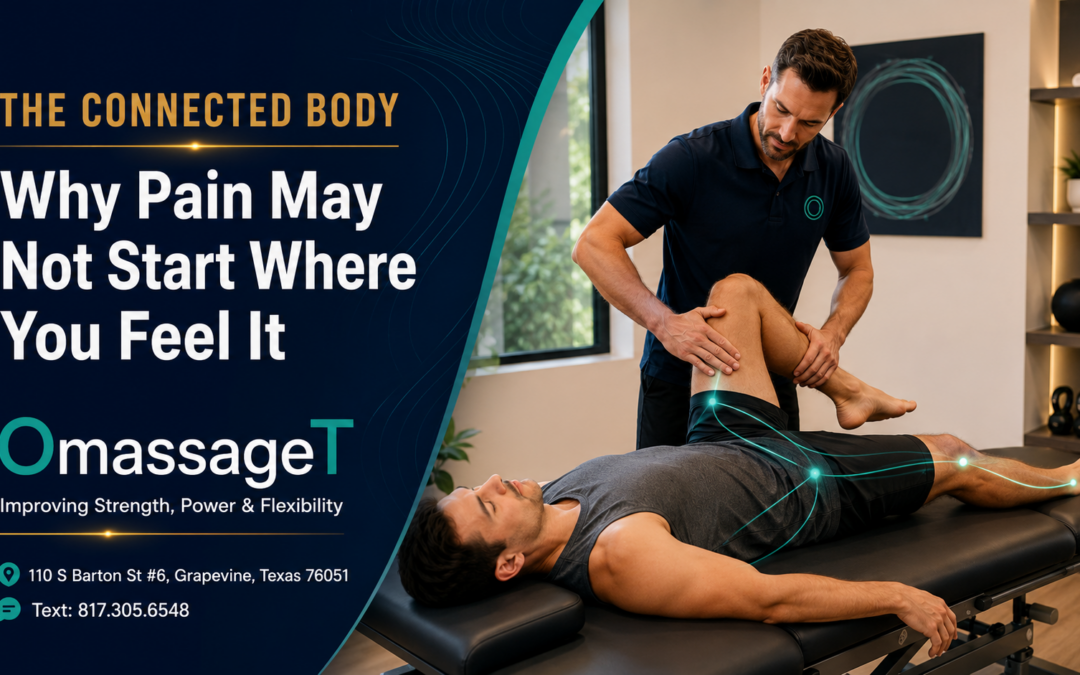
Why Pain May Not Start Where You Feel It: The Connected Body
When something hurts, it is natural to assume that the problem began in that exact location.
Knee discomfort must mean something is wrong only at the knee. Lower-back tightness must come entirely from the back. Neck tension must start in the neck.
Sometimes the painful area is the primary problem. In other situations, however, the discomfort may be influenced by muscular tension, restricted movement, or compensation somewhere else in the body.
This does not mean that every symptom comes from a distant area or that fascia explains every type of pain. It means the human body works as a connected movement system and should not always be evaluated as a collection of isolated parts.
At OmassageT in Grapevine, Texas, Steven uses orthopedic massage therapy and myofascial release to consider how different areas of the body may be working together. Instead of concentrating only on where discomfort is felt, he looks for restrictions and movement patterns that may be contributing to the problem.
The Body Is a Connected System
Muscles, bones, joints, nerves, and connective tissues work together to create movement.
Fascia is part of this system. It surrounds and supports muscles and other anatomical structures. Deep fascia is connected to underlying muscles through numerous expansions, creating an additional pathway through which force may be transferred. Current research on the myofascial unit
When you walk, run, reach, lift, or rotate, the movement is not produced by a single muscle. Multiple body regions must coordinate.
During running, for example, force travels through the feet, ankles, knees, hips, pelvis, and torso. If one area does not move or stabilize efficiently, another area may adjust to keep the person moving.
This ability to adapt is helpful. Without compensation, many people would be unable to continue an activity after developing stiffness, weakness, or an injury.
The challenge occurs when a temporary compensation becomes a repeated movement pattern.
What Is Compensation?
Compensation is the body’s way of finding another route to complete a task.
Suppose someone has limited movement in one ankle. The foot may turn outward during a squat, the heel may lift, or the knee and hip may move differently.
If the hips do not rotate comfortably, a golfer may create additional rotation through the lower back. If the upper back is restricted, someone reaching overhead may compensate through the shoulders or lumbar spine.
Compensation does not automatically mean that damage is occurring. It is simply a change in how the body organizes movement.
Over time, however, the muscles performing the additional work may become tired, guarded, or persistently tight. The person may feel discomfort in the compensating area rather than in the region where the movement limitation began.
Referred Pain Is Real
Pain can also be felt in a location other than the tissue producing the signal. This is known as referred pain.
Myofascial trigger points are tender areas within taut bands of muscle that may produce both local and referred discomfort when stimulated. Referred pain patterns have been observed clinically and experimentally, although pain is complex and trigger points are not the explanation for every symptom. NCBI Bookshelf: Anatomy and Physiology of Pain
Nerves, joints, and internal medical conditions may also produce referred symptoms. This is one reason a massage therapist should not assume that pain felt away from its source is always muscular or fascial.
Unexplained, severe, or persistent pain may require evaluation by an appropriate healthcare professional.
How Fascia May Influence Connected Movement
Fascial tissues help create mechanical continuity between muscles and other structures.
Some research supports force transmission between neighboring muscles and fascial tissues. Broader “myofascial chain” models propose connections across larger areas of the body, but researchers continue to investigate how clinically important these long-distance relationships are. These models should be used as helpful ways to consider movement—not as proof that one restriction automatically causes pain somewhere else. Review of theoretical fascial models
A responsible whole-body approach recognizes both possibilities:
-
A nearby or distant restriction may influence the painful area.
-
The painful area may still have a local issue requiring direct attention.
Assessment helps determine which relationships appear relevant for the individual client.
When Knee Pain May Involve More Than the Knee
The knee is positioned between the hip and ankle. Its movement is influenced by both.
Limited ankle mobility may affect how the knee moves during walking, running, squatting, or landing. Restricted hip movement or reduced pelvic stability may also change the direction and amount of force traveling through the knee.
This does not mean all knee pain comes from the hip or ankle. Knee discomfort can involve many conditions that require medical diagnosis.
From a movement perspective, however, examining the areas above and below the knee may provide useful information.
Steven may consider:
-
Foot position
-
Ankle mobility
-
Calf restrictions
-
Hip movement
-
Pelvic stability
-
Differences between the right and left sides
-
Previous lower-body injuries
-
The activity that produces the discomfort
The purpose is to understand the movement pattern—not diagnose a medical condition.
When Lower-Back Tightness May Involve the Hips or Pelvis
The lower back frequently compensates when the hips and pelvis are not moving or stabilizing efficiently.
Restricted hip flexors, previous thigh injuries, limited hip rotation, or differences between the two sides may influence pelvic movement. The lower-back muscles may then perform additional work to stabilize or create motion.
Someone may feel recurring lower-back tightness even though part of the movement pattern involves the hips, upper legs, or core.
Steven has observed clients whose current lower-back symptoms may be related to a history of hip or upper-quadriceps injury. That history does not prove the cause, but it provides an important clue when evaluating how the person moves.
Treating only the lower back may provide temporary relief. Addressing relevant restrictions around the hips, pelvis, or thighs may help create a more complete approach.
When Neck and Shoulder Tension May Involve the Upper Back
The neck, shoulders, shoulder blades, chest, ribs, and upper back all contribute to upper-body movement.
A person who spends long hours at a desk may develop stiffness through the chest or upper back. When the upper back does not move comfortably, the neck and shoulders may work harder during reaching, lifting, or overhead activity.
A previous injury, surgery, or pregnancy and childbirth may also be part of the person’s movement history. These experiences can influence breathing, posture, strength, and how the body organizes movement.
It would be inappropriate to assume that every case of neck pain is caused by posture or fascia. However, considering the chest, shoulders, ribs, and upper back may help reveal why the neck continues to feel overworked.
Why the Tightest Muscle May Not Need More Stretching
A muscle can feel tight because it is shortened, but that is not the only possibility.
It may also be:
-
Working harder to stabilize an area
-
Protecting a sensitive region
-
Compensating for restricted movement elsewhere
-
Fatigued from repetitive activity
-
Responding to stress
-
Lacking strength or coordination
-
Part of a long-established movement habit
If a muscle is creating tension because the body depends on it for stability, repeatedly stretching it may provide only temporary relief.
The complete plan may need to include myofascial release, mobility work, strengthening, stability training, activity changes, or professional medical care.
How Myofascial Release Fits Into a Whole-Body Approach
Myofascial release is a hands-on technique that works with muscles and their surrounding connective tissues.
The practitioner may use slow, sustained contact or gentle directional pressure while observing how the tissues and client respond. Treatment should remain within the client’s tolerance. More force is not automatically more effective.
Myofascial release does not physically “break” fascia or guarantee that pain will disappear. The exact mechanisms behind manual therapy continue to be studied. Possible effects may include changes in muscular guarding, sensory input, stretch tolerance, comfort, and short-term range of motion.
At OmassageT, Steven uses myofascial release as part of an individualized orthopedic massage session. He considers the client’s history, activities, symptoms, and movement goals before deciding which areas may need attention.
Communication Is Part of the Session
Whole-body treatment requires trust and communication.
Steven explains his plan and hand placement, especially when working near sensitive or unfamiliar areas. He checks the client’s comfort and adjusts the session according to the client’s response.
A client should understand what is being done and why it may be relevant. The client may also decline or modify any technique.
This communication is particularly important when the area being treated is different from where the client initially reported discomfort.
Acute Injuries Require a Different Approach
A chronic movement compensation is different from an acute injury.
An acute injury may follow a fall, collision, sudden movement, or other trauma. Symptoms may include severe pain, swelling, bruising, weakness, numbness, or difficulty bearing weight.
A new or serious injury should be evaluated by the appropriate healthcare professional before massage or exercise is used. Orthopedic massage and myofascial release do not replace medical diagnosis, imaging, or emergency care.
Chronic tightness usually develops or persists over a longer period. It may be connected to repetitive movement, old injuries, work positions, training habits, or long-term compensation.
An old injury may influence a current movement pattern, but acute pain and chronic restrictions should never be treated as interchangeable problems.
Looking Beyond the Painful Area in Grapevine, Texas
Pain is complex, and no single approach explains every person’s symptoms.
Sometimes the painful area needs direct attention. Sometimes another region appears to be contributing to the way the body moves. Frequently, several factors are involved.
At OmassageT in Grapevine, Texas, Steven looks beyond isolated symptoms to consider the relationships between muscles, fascia, joints, posture, and movement.
The goal is not to chase pain around the body or make unsupported claims about its source. The goal is to identify muscular and myofascial restrictions that may be influencing comfort, balance, mobility, strength, and performance.
If recurring tightness or movement restrictions are limiting your activities, a whole-body orthopedic massage assessment may help you better understand how different areas are working together.
To learn more or schedule an appointment, contact OmassageT:
110 S Barton St #6, Grapevine, Texas 76051
Text: 817.305.6548
OmassageT — Improving Strength, Power & Flexibility