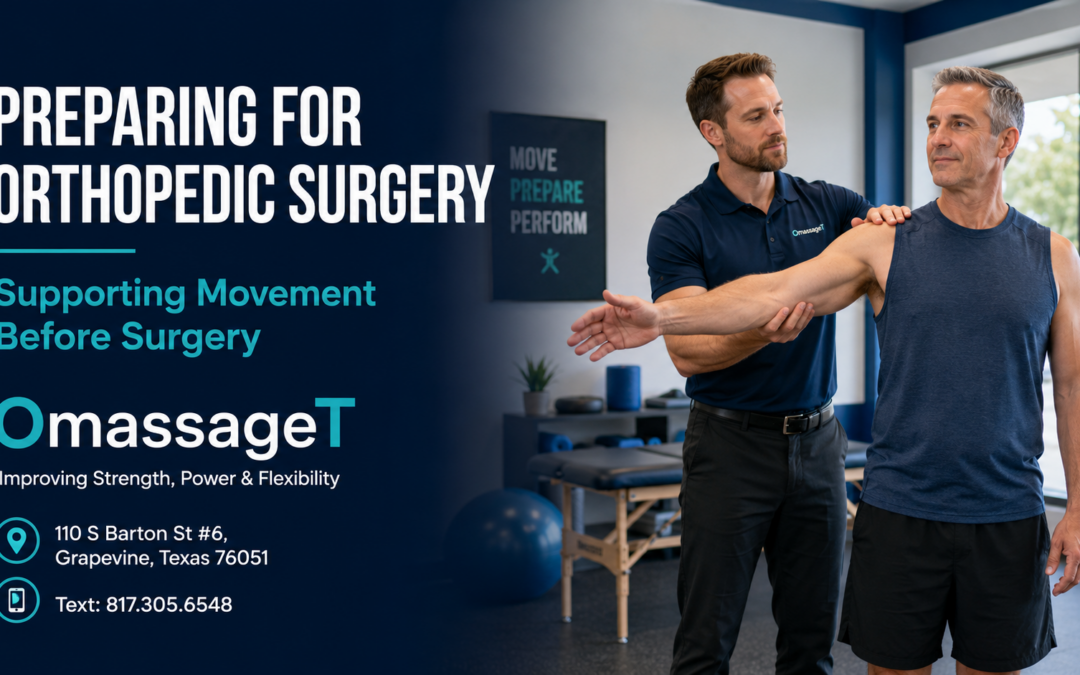
Preparing for Orthopedic Surgery: How Massage May Support Prehabilitation
Preparing for orthopedic surgery involves more than choosing a procedure date. The condition of your body before surgery may influence how prepared you feel when rehabilitation begins.
This preparation is often called prehabilitation, or “prehab.” It can include surgeon-approved exercise, education, nutrition, home preparation, and planning for the recovery period.
Orthopedic massage therapy may also be a supportive part of that plan for some people. Before surgery, massage can focus on muscular tension, movement restrictions, body awareness, and areas compensating for the injured or arthritic joint.
Massage does not replace medical treatment, physical therapy, or the surgeon’s instructions. It should complement the established plan and be adjusted to the person’s health, procedure, medications, and restrictions.
At OmassageT in Grapevine, Texas, Steven works with clients before orthopedic surgery to help them prepare for the movement and recovery challenges ahead.
What Is Prehabilitation?
Prehabilitation is the process of preparing the body and mind before a surgical procedure.
The exact plan depends on the operation, the person’s current abilities, and the instructions provided by the surgical team. It may include:
- Strengthening appropriate muscles
- Maintaining safe joint movement
- Improving cardiovascular fitness
- Learning postoperative exercises
- Practicing the use of crutches or a walker
- Preparing the home for limited mobility
- Improving nutrition and sleep
- Understanding postoperative precautions
- Planning transportation and assistance
- Managing stress before surgery
Research on prehabilitation before hip and knee replacement has found possible improvements in strength and function, particularly during the early recovery period. However, results vary, and benefits are not identical for every person or procedure. Systematic review of prehabilitation before hip or knee replacement
The surgeon and physical therapist should determine which exercises and activities are appropriate.
Why Your Condition Before Surgery Matters
Orthopedic surgery commonly involves a joint or structure that has already affected movement for months or years.
Someone waiting for a knee replacement may have reduced the amount of weight placed on one leg. A person preparing for shoulder surgery may have stopped reaching overhead. Someone with hip pain may have shortened their stride or shifted their weight to the opposite side.
These changes are understandable. The body adapts so the person can continue functioning.
However, repeated compensation may contribute to:
- Muscular tightness
- Differences between the right and left sides
- Reduced range of motion
- Loss of strength
- Changes in balance
- Increased work in neighboring areas
- Reduced confidence in movement
- General deconditioning
The procedure may address the damaged joint or tissue, but rehabilitation must also help the body relearn how to move afterward.
Recognizing these compensations before surgery can give the client and rehabilitation team useful information.
How Massage May Fit Into Surgery Preparation
Orthopedic massage before surgery is not intended to correct the medical condition requiring the procedure.
Instead, it may be used to address muscular and myofascial restrictions surrounding the larger movement pattern. It may also help the client relax, become more aware of differences between sides, and move more comfortably within medically permitted limits.
For example, massage before knee surgery might consider the muscles of the hips, thighs, lower legs, and feet. Before shoulder surgery, relevant areas might include the chest, upper back, neck, arm, and shoulder blade.
Treatment does not need to be performed directly on an injured or highly sensitive structure to be useful. Frequently, the surrounding and compensating regions deserve attention.
Potential goals may include:
- Reducing the sensation of muscular tension
- Supporting comfortable, permitted movement
- Addressing muscles that have been compensating
- Improving awareness of posture and movement
- Encouraging relaxation before the procedure
- Helping the client enter rehabilitation with a clearer understanding of their body
These are supportive goals. Massage cannot guarantee a faster recovery or a better surgical outcome.
Massage Should Coordinate With the Medical Plan
The surgeon’s instructions take priority.
Before receiving massage, clients should tell Steven:
- What procedure is planned
- The scheduled surgery date
- Which joint or tissue is involved
- What restrictions the surgeon has provided
- Whether a recent injection was performed
- Whether blood-thinning medication is being used
- Whether there is swelling, infection, skin damage, or a blood-clot concern
- Whether the surgeon has advised against massage or particular movements
Massage should not be used to push through significant pain or test the limits of an injured structure.
The National Center for Complementary and Integrative Health advises people not to use massage therapy to postpone seeing a healthcare provider about a medical problem. It also recommends discussing complementary care with healthcare professionals. NCCIH: Massage Therapy—What You Need to Know
Communication helps keep treatment aligned with the surgical plan.
Preparing the Areas That Have Been Compensating
Pain and joint restriction can change how force travels through the entire body.
A person with knee pain may shift weight toward the other leg. The hips and lower back may then work differently. Someone with an injured shoulder may rely more heavily on the other arm, rotate the torso differently, or elevate the shoulder to avoid a painful range.
These adaptations can produce tightness in locations away from the surgical area.
Before surgery, Steven may examine:
- The opposite side of the body
- The joints above and below the affected area
- Posture and weight distribution
- Areas of repeated muscular guarding
- Previous injuries that may affect rehabilitation
- How the client walks, reaches, bends, or stands
This whole-body assessment does not diagnose the orthopedic condition. It helps identify muscular and myofascial patterns that may affect comfort and movement.
Strength and Flexibility Before Surgery
When approved by the surgeon or physical therapist, maintaining strength and flexibility before surgery may help prepare the client for rehabilitation.
The American Academy of Orthopaedic Surgeons explains that after knee injury or surgery, a structured conditioning program can help people return to daily and recreational activities. It emphasizes that exercises should be performed under the supervision of a doctor or physical therapist. AAOS knee conditioning guidance
The same safety principle applies before surgery: exercises must be appropriate for the individual.
Massage does not replace strengthening. However, if muscular tension or restricted soft tissue makes an approved exercise uncomfortable, orthopedic massage may help support the person’s ability to participate in the prehabilitation plan.
The objective is not maximum flexibility. It is to preserve safe, usable movement without aggravating the condition.
The Mental Side of Surgery Preparation
Surgery can create uncertainty and stress, even when the person understands that the procedure is necessary.
Clients may worry about pain, temporary loss of independence, time away from work, or whether they will return to their favorite activities.
A calm massage session may provide an opportunity to relax and reconnect with the body before the procedure. Steven explains his plan, communicates about hand placement, and regularly checks the client’s comfort.
Massage is not a substitute for professional mental-health care, but relaxation and supportive communication can be valuable parts of preparing for a demanding experience.
What Massage Should Avoid Before Surgery
Preoperative massage should be conservative and guided by the client’s medical situation.
Massage should not:
- Attempt to repair a torn structure
- Force an arthritic or injured joint
- Cause bruising immediately before surgery
- Work aggressively over acute swelling
- Ignore unexplained redness, warmth, or skin changes
- Treat a possible blood clot
- Contradict restrictions from the surgeon
- Promise to eliminate the need for surgery
- Guarantee a faster postoperative recovery
Deep or aggressive pressure is not required for useful treatment. The session should match the person’s tolerance, health, and upcoming procedure.
If anything about the client’s condition raises concern, treatment should pause until the medical team provides direction.
Planning for Massage After Surgery
Before surgery is also a good time to discuss what will be required before massage resumes.
Postoperative massage should not automatically begin immediately after the procedure. Timing depends on:
- The type of operation
- The surgeon’s instructions
- Incision healing
- Infection risk
- Swelling
- Medication use
- Blood-clot risk
- Weight-bearing restrictions
- The person’s overall medical condition
Direct work on or near the surgical area requires explicit medical clearance and appropriate healing.
Early postoperative care is directed by the surgeon, nursing team, and physical or occupational therapist. Massage may be considered later when the medical team agrees it is safe.
Every Orthopedic Procedure Is Different
“Orthopedic surgery” includes many different procedures:
- Total knee replacement
- Total hip replacement
- Rotator-cuff repair
- Shoulder replacement
- ACL reconstruction
- Meniscus surgery
- Tendon repair
- Fracture repair
- Foot or ankle surgery
- Hand or wrist surgery
The preparation for one procedure may be inappropriate for another. Even two people having the same operation can receive different instructions because of age, health, medications, surgical technique, and current function.
That is why Steven does not use one identical pre-surgery routine for every client.
Preparing for Orthopedic Surgery in Grapevine, Texas
Orthopedic massage therapy may be a helpful addition to a medically approved prehabilitation plan.
At OmassageT, Steven considers the entire body—not only the joint scheduled for surgery. Treatment may address muscular tension, myofascial restrictions, compensation, and comfortable movement while respecting every medical restriction.
The goal is not to replace the surgeon or physical therapist. It is to help the client approach surgery with better body awareness, reduced unnecessary tension, and a thoughtful plan for the recovery process.
If you are preparing for orthopedic surgery, speak with your surgeon about whether massage is appropriate for you. Bring all restrictions and relevant instructions to your appointment so treatment can be adjusted safely.
To learn more about pre-surgery orthopedic massage in Grapevine, Texas, contact OmassageT:
110 S Barton St #6, Grapevine, Texas 76051
Text: 817.305.6548
OmassageT — Improving Strength, Power & Flexibility