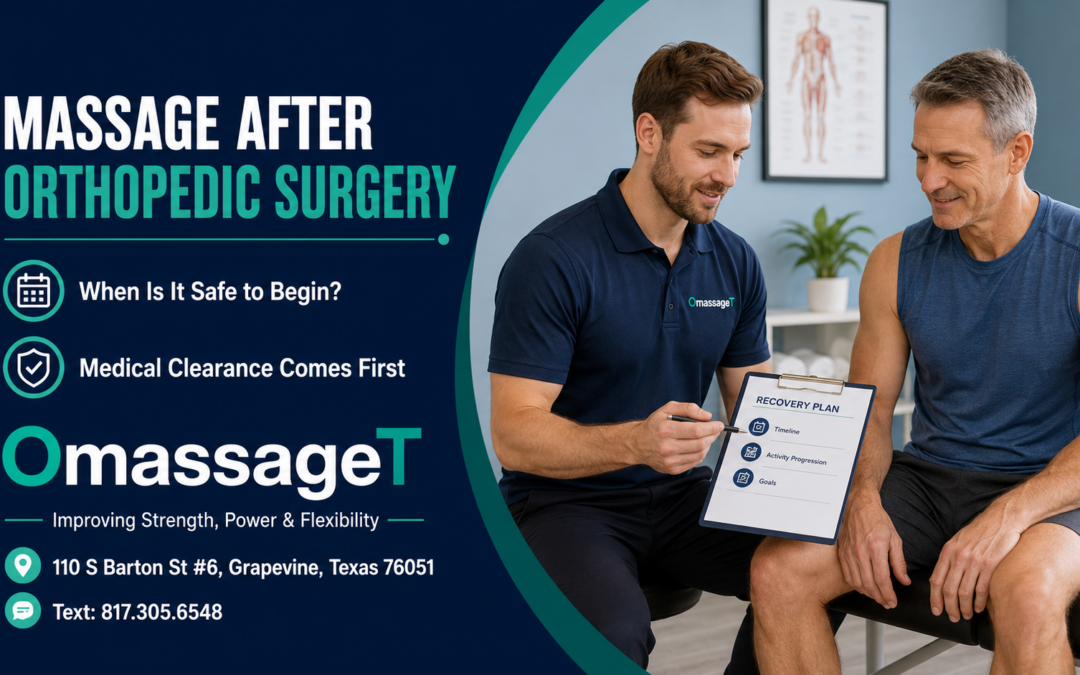
When Can You Receive Massage After Orthopedic Surgery?
After orthopedic surgery, many people want to know when they can safely receive massage.
There is no single answer that applies to every person or procedure. The appropriate time depends on the type of surgery, the surgeon’s instructions, incision healing, swelling, medications, blood-clot risk, weight-bearing restrictions, and the person’s overall health.
Someone recovering from knee replacement may receive different instructions than a client recovering from rotator-cuff repair. Even two people having the same procedure may progress at different rates.
The most important rule is simple:
Medical clearance comes first.
At OmassageT in Grapevine, Texas, Steven works with clients recovering from orthopedic procedures only when massage is appropriate for their stage of healing. Treatment is adjusted to respect the surgeon’s precautions and the client’s comfort.
Why There Is No Universal Waiting Period
It can be tempting to search for a rule such as “wait two weeks” or “wait six weeks.” However, a calendar alone cannot determine whether postoperative massage is safe.
Different orthopedic operations affect different tissues. Procedures may involve:
-
Bone
-
Muscles
-
Tendons
-
Ligaments
-
Joint capsules
-
Cartilage
-
Nerves
-
Blood vessels
-
Surgical implants
The surgeon may also use different techniques, incision locations, or rehabilitation protocols.
Before massage begins, the client should ask the surgeon or another authorized member of the medical team:
-
Is massage currently permitted?
-
Which areas may be treated?
-
Which areas must be avoided?
-
Is direct work near the incision allowed?
-
Are there movement or positioning restrictions?
-
Is the client taking medication that changes bleeding or bruising risk?
-
Are there precautions related to an implant or repaired tissue?
Specific written instructions are especially helpful.
The Early Postoperative Period
Immediately after surgery, care is directed by the surgeon, nurses, and rehabilitation team.
The body is responding to anesthesia, tissue injury, inflammation, and the procedure itself. The client may have dressings, swelling, pain medication, movement restrictions, or instructions designed to protect the repair.
This is not the time to assume that routine massage is appropriate.
During early recovery, the priorities may include:
-
Protecting the surgical repair
-
Monitoring the incision
-
Preventing infection
-
Managing pain and swelling
-
Reducing blood-clot risk
-
Following weight-bearing restrictions
-
Beginning surgeon-approved movement
-
Attending physical or occupational therapy
-
Getting adequate rest and nutrition
Massage should never interfere with these priorities.
The Incision Must Be Protected
A fresh or incompletely healed incision should not receive routine massage.
Direct pressure, friction, lotion, or stretching around an unhealed incision could irritate the area or interfere with healing. Massage should also not be performed over surgical glue, stitches, staples, drainage sites, open skin, or active dressings.
Clients should monitor the incision according to their medical team’s instructions.
Possible warning signs of infection can include increasing redness, warmth, drainage, worsening swelling, the wound opening, fever, or increasing pain. These symptoms require communication with the surgical team—not massage.
MedlinePlus advises postoperative patients to check wounds for signs such as increasing redness or drainage and to contact the healthcare provider if the wound begins to open. MedlinePlus: Surgical wound care
Direct work near the surgical site should begin only after the incision has healed adequately and the surgeon or rehabilitation professional has approved it.
Blood-Clot Risk Must Be Taken Seriously
Orthopedic surgery—particularly surgery involving the hip or knee—can increase the risk of blood clots.
Massage must not be performed when a blood clot is known or suspected. Pressure or manipulation in that situation could be dangerous.
The American Academy of Orthopaedic Surgeons lists possible warning signs of a leg clot following hip replacement as:
-
Calf or leg pain unrelated to the incision
-
Calf tenderness or redness
-
New or increasing swelling in the thigh, calf, ankle, or foot
Possible signs of a pulmonary embolism include sudden shortness of breath, sudden chest pain, or chest pain associated with coughing. These require immediate medical attention. AAOS: Total hip replacement and clot warning signs
Massage should be postponed if there is unexplained calf pain, redness, warmth, or new swelling until the medical team has evaluated the symptoms.
Blood-Thinning Medication Affects Treatment
Some postoperative clients take blood-thinning medication to reduce the risk of clots.
MedlinePlus notes that people recovering from knee replacement may need blood thinners for a period determined by their medical team. MedlinePlus: Knee replacement discharge
These medications may increase the likelihood of bruising or bleeding. Clients should tell Steven about all medications and any recent changes before treatment begins.
Medical clearance does not automatically mean that every massage technique is appropriate. Pressure may need to remain gentle, and certain areas may still need to be avoided.
Clients should never stop or change prescribed medication so they can receive massage.
Massage Away From the Surgical Site
In some circumstances, the medical team may permit gentle massage away from the surgical area before direct treatment near the incision is appropriate.
For example, a client recovering from knee surgery may be allowed to receive gentle work involving the upper body. Someone recovering from shoulder surgery may eventually be able to receive carefully positioned lower-body massage.
This still requires consideration of:
-
Safe positioning
-
Movement precautions
-
Pain medication
-
Blood-clot risk
-
The person’s ability to get on and off the table
-
Braces, slings, or assistive devices
-
Fatigue and overall health
The client should not be positioned in a way that strains the repair or violates postoperative precautions.
Sometimes the best early session is shorter, gentler, and focused primarily on comfort and relaxation rather than corrective work.
Supporting Muscles That Have Been Compensating
Before surgery, people often change how they move to avoid pain. After surgery, they may develop additional compensations while using crutches, a walker, sling, brace, or protective movement pattern.
These adaptations can affect areas beyond the surgical site.
A client recovering from knee or hip surgery may experience additional work through the opposite leg, hips, lower back, shoulders, or arms. Someone wearing a shoulder sling may notice neck, upper-back, or opposite-shoulder tension.
When medically permitted, massage may address some of these compensating areas without interfering with the repair.
Steven considers the entire movement pattern rather than working only where the surgery occurred.
When Can Scar Massage Begin?
Scar massage is different from general postoperative massage.
Direct scar work should not begin until the incision is fully closed, adequately healed, free of infection, and approved by the surgeon or appropriate rehabilitation professional.
Even after the surface appears healed, deeper tissues continue recovering. Treatment should begin conservatively and respond to the client’s sensitivity and medical restrictions.
Scar work may involve gentle contact around or eventually across the healed area. The goal is not to aggressively “break up” scar tissue. Excessive pressure can irritate sensitive tissues and is not necessary for effective treatment.
Some scars remain tender, numb, raised, or sensitive for an extended period. Any unexpected change should be discussed with the medical team.
Massage and Physical Therapy Have Different Roles
Postoperative physical therapy is often a central part of orthopedic recovery.
The physical therapist may provide exercises and guidance to restore joint movement, strength, balance, walking mechanics, and functional ability. The therapist also helps the client progress while protecting the surgical repair.
Orthopedic massage may complement that process by addressing permitted muscular and myofascial restrictions, compensating areas, relaxation, and body awareness.
Massage should not replace prescribed rehabilitation exercises. It should also not be used to push a joint beyond the limits established by the surgeon or physical therapist.
When everyone’s roles are respected, the client receives a more coordinated recovery plan.
A Safe Progression for Postoperative Massage
Postoperative treatment usually progresses according to healing and medical guidance rather than a fixed schedule.
A general progression may look like this:
Stage 1: Medical protection
The surgical team manages the incision, swelling, medication, clot prevention, and early movement. Massage may not yet be appropriate.
Stage 2: Clearance for limited massage
The medical team may permit gentle treatment away from the surgical site. Positioning and pressure remain conservative.
Stage 3: Work around the recovering region
Once approved, treatment may begin addressing permitted muscles surrounding the surgical area without placing stress on the repair.
Stage 4: Healed-scar and mobility support
After adequate healing and specific clearance, careful scar work or myofascial techniques may become appropriate.
Stage 5: Return to strength and activity
Massage may support recovery as the client rebuilds mobility, flexibility, strength, power, and confidence through prescribed rehabilitation and exercise.
Not every client follows these stages at the same speed.
Questions Steven May Ask Before Treatment
Before scheduling or beginning postoperative massage, Steven may ask:
-
What surgery did you have?
-
When was the procedure performed?
-
What did the surgeon repair or replace?
-
Has your surgeon cleared you for massage?
-
Is the incision completely closed?
-
Are there signs of infection or unusual swelling?
-
Are you taking blood thinners?
-
Do you have movement or weight-bearing restrictions?
-
Are you attending physical therapy?
-
Which positions are comfortable and permitted?
-
Have you experienced calf pain, redness, or shortness of breath?
-
What are your current recovery goals?
These questions are designed to protect the client and adapt the session appropriately.
Reasons to Postpone Massage
Massage should be postponed and medical guidance obtained if the client has:
-
No clearance when clearance is required
-
A fresh or open incision
-
Drainage or increasing redness
-
Possible infection
-
Fever or illness
-
Unexplained calf pain
-
New or increasing swelling
-
Possible blood-clot symptoms
-
Uncontrolled postoperative pain
-
A new change in sensation or strength
-
A complication being evaluated
-
Instructions from the surgeon to avoid massage
Sudden chest pain or shortness of breath requires emergency medical attention.
Positive Support Without Rushing Healing
Many people are eager to feel normal again after surgery. That motivation can be helpful, but recovery should not be rushed.
Massage is most useful when it respects the body’s healing process. The goal is not to force movement, eliminate every protective response, or reach the surgical area as quickly as possible.
Instead, postoperative orthopedic massage should progress thoughtfully—beginning only when safe and changing as the client’s medical restrictions and abilities change.
Postoperative Orthopedic Massage in Grapevine, Texas
If you are recovering from orthopedic surgery and would like to consider massage, begin by speaking with your surgeon or rehabilitation professional.
Bring Steven your procedure information, medical clearance, current restrictions, and medication information. This allows him to plan a session that respects your stage of recovery.
At OmassageT in Grapevine, Texas, Steven works with clients before and after orthopedic procedures. His approach emphasizes communication, consent, whole-body movement, and cooperation with the client’s medical plan.
Massage cannot guarantee a faster recovery, but when used at the appropriate time, it may provide positive support as you work toward greater comfort, mobility, strength, and confidence.
To discuss whether orthopedic massage may be appropriate for your recovery, contact OmassageT:
110 S Barton St #6, Grapevine, Texas 76051
Text: 817.305.6548
OmassageT — Improving Strength, Power & Flexibility