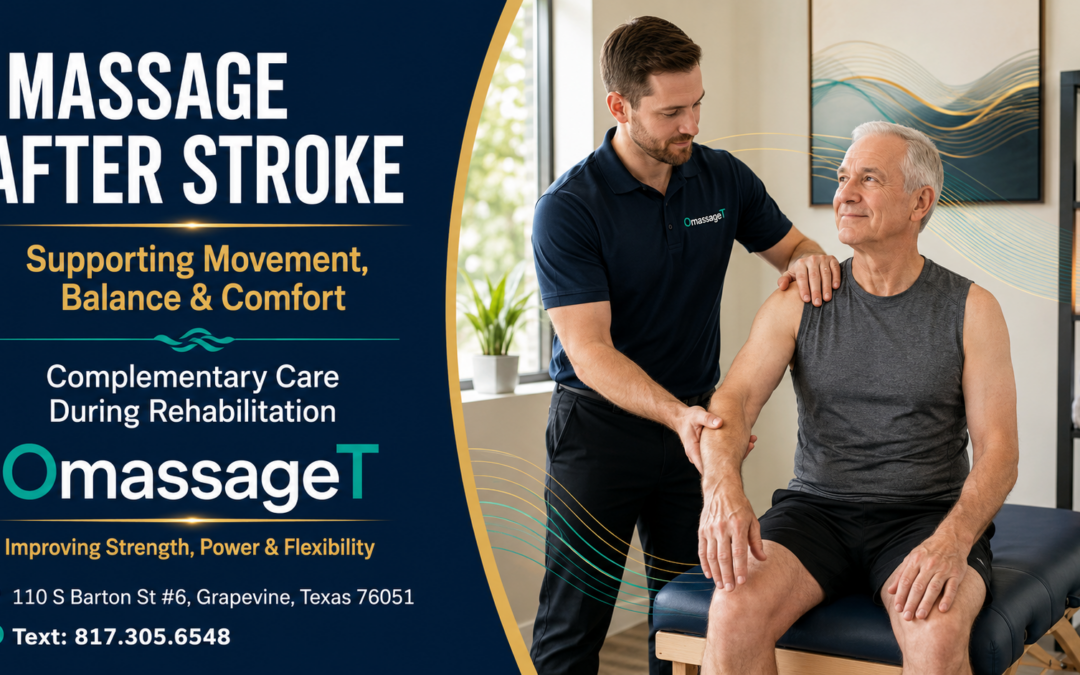
Massage After Stroke: Supporting Movement, Balance, and Comfort
A stroke can change movement, balance, sensation, coordination, and the way a person experiences their body.
Recovery is different for every stroke survivor. Some people experience weakness on one side. Others develop muscular tightness, guarding, altered posture, reduced balance, fatigue, or difficulty moving an arm or leg comfortably.
Medical treatment and rehabilitation are essential. Physicians, nurses, physical therapists, occupational therapists, and speech-language pathologists each have important roles in stroke recovery.
For medically stable clients who have received appropriate clearance, massage and myofascial work may be considered complementary care. These services do not treat the brain injury or replace neurological rehabilitation. Their purpose is to support comfort, body awareness, relaxation, and the soft tissues affected by changes in movement.
At OmassageT in Grapevine, Texas, Steven has worked with stroke survivors whose families have reported easier movement, improved balance or stability, and greater relaxation following sessions. These are individual experiences rather than promised results.
How Stroke Can Affect Movement
A stroke occurs when blood flow to part of the brain is blocked or when a blood vessel in the brain bursts.
Because the brain controls movement and sensation, a stroke may affect the opposite side of the body from the injured brain region. The specific changes depend on the stroke’s location and severity.
Possible effects include:
-
Weakness on one side
-
Reduced coordination
-
Altered balance
-
Changes in walking
-
Muscle stiffness or spasticity
-
Reduced joint movement
-
Shoulder discomfort
-
Changes in sensation
-
Difficulty recognizing body position
-
Fatigue
-
Difficulty performing daily activities
Some muscles may remain underactive while others become tense or difficult to relax. The person may also adopt new postures or movement strategies to feel more secure.
Why Tissues May Feel Firm, Bound, or Restricted
Stroke does not simply “harden” fascia. However, reduced movement, sustained positioning, muscle overactivity, guarding, and changes in how an arm or leg is used may contribute to increased soft-tissue stiffness.
Fascia is connective tissue that surrounds, separates, and supports muscles and other structures. It participates in the body’s larger mechanical and sensory system.
When a person moves less or holds an arm or leg in the same position for long periods, muscles and connective tissues may feel less mobile. The person may describe the area as:
-
Tight
-
Hard
-
Bound
-
Heavy
-
Stuck
-
Difficult to lengthen
-
Uncomfortable to move
Steven may feel areas that do not glide or respond like the surrounding tissues. His goal is to work patiently with those restrictions—not to tear or physically break fascia apart.
What Does “Breaking Up Bound Tissue” Mean?
Practitioners and clients sometimes say that massage “breaks up” bound fascia or scar tissue.
This phrase can describe the experience of an area becoming softer or moving more freely, but it should not be interpreted as literally breaking mature connective tissue apart with the hands.
A more accurate explanation is that gentle myofascial work may influence:
-
Muscular guarding
-
Sensory input
-
Comfort with touch
-
Stretch tolerance
-
Perceived stiffness
-
Tissue glide
-
Awareness of the affected side
-
Willingness to move
After treatment, an area may feel less restricted and movement may become easier. That change is meaningful even when the exact biological mechanism cannot be determined during a session.
What Is Myofascial Release?
Myofascial release is a hands-on approach involving muscles and their surrounding connective tissues.
Steven may use slow, sustained contact while observing the client’s response. The work should not be aggressive or painful.
Stroke survivors may have changes in sensation, communication, muscle tone, and movement control. This means pressure that would be comfortable for another client may not be appropriate.
Treatment needs to be individualized according to:
-
Medical history
-
Type and timing of the stroke
-
Current rehabilitation plan
-
Medications
-
Sensation
-
Communication ability
-
Joint stability
-
Skin condition
-
Muscle tone
-
Fatigue
-
Client consent and comfort
More pressure is not necessarily more effective.
Supporting Easier Movement
Massage cannot restore brain tissue damaged by a stroke. It also cannot independently retrain walking, balance, or skilled movement.
Those goals belong within neurological rehabilitation.
However, when muscles and soft tissues feel guarded or restricted, permitted movement may feel more difficult. Gentle hands-on work may help some clients feel more comfortable attempting the movements prescribed by their rehabilitation team.
Steven has worked with clients and families who reported that movement appeared easier after a session.
Possible observations might include:
-
An arm resting more comfortably
-
Easier permitted shoulder movement
-
Less resistance during a familiar motion
-
A more relaxed hand or forearm
-
Greater comfort while sitting or standing
-
Improved awareness of the affected side
-
Increased willingness to move
These observations should be shared with the rehabilitation team when appropriate. They do not establish that massage caused neurological recovery.
Balance and Stability After Stroke
Balance involves the brain, vision, inner ear, sensation, strength, coordination, and the ability to recognize the body’s position.
A stroke can affect several of these systems. That is why physical therapy and prescribed balance training are so important.
Massage does not replace balance exercises or supervised walking practice.
It may support the larger process by helping a medically stable client feel more comfortable, relaxed, and aware of the body. If a person feels less guarded or more connected to an affected limb, they may report feeling steadier.
Steven has observed stroke survivors or caregivers reporting improved balance or stability following sessions. This should be presented as a personal response, not an outcome that every stroke survivor can expect.
Relaxation Is a Valuable Goal
Stroke recovery can be physically and emotionally demanding.
Appointments, exercises, changes in independence, fatigue, and uncertainty may create stress for the survivor and family. Muscles may remain tense partly because the person is working hard to feel secure.
A calm, respectful massage session can provide time for the client to rest and receive supportive touch.
Relaxation is not a minor outcome. Feeling comfortable may help the client breathe more naturally, reduce unnecessary guarding, sleep better, or approach rehabilitation with greater confidence.
Massage does not replace mental-health support when it is needed. It may simply offer another positive experience within a larger recovery plan.
Protecting the Shoulder and Affected Arm
Shoulder discomfort is common after stroke, particularly when weakness changes how the arm is supported.
An affected arm should never be pulled or forced through a range. The shoulder may be vulnerable if the surrounding muscles are not controlling the joint effectively.
During a session, Steven must carefully support the arm and follow medical or rehabilitation precautions. Positioning should remain comfortable, and movement should never be forced.
The client’s physical or occupational therapist may provide specific instructions about:
-
Supporting the shoulder
-
Safe movement ranges
-
Positioning the arm
-
Handling increased muscle tone
-
Protecting a painful joint
-
Using braces or supports
Those instructions should be followed during massage.
Communication and Consent
Some stroke survivors have difficulty speaking or understanding language. Others can communicate normally but need extra time to respond.
Steven explains his plan, discusses hand placement, and checks the client’s comfort. When communication is affected, the client’s established communication system should be respected.
A caregiver may provide useful medical history or help explain familiar signals, but the stroke survivor remains the person receiving care. Their dignity, preferences, and consent matter.
Treatment should stop or change if the client appears uncomfortable, unusually tired, confused, distressed, or unable to participate safely.
Medical Clearance and Medication
Stroke survivors should receive medical clearance before beginning massage.
Steven needs to know about:
-
The date and type of stroke
-
Current medical stability
-
Blood pressure concerns
-
Blood-thinning medication
-
Blood-clot history
-
Changes in sensation
-
Seizure history
-
Skin problems
-
Swelling
-
Joint instability
-
Current therapy and precautions
-
Any recent medical changes
Blood-thinning medication may increase bruising risk. Reduced sensation may prevent a client from accurately feeling excessive pressure or heat.
The session may need to be shorter, gentler, and positioned differently from a routine orthopedic massage.
Recognizing a Possible New Stroke
Massage should never continue if a client develops possible stroke symptoms.
Warning signs may include sudden:
-
Facial drooping
-
Arm or leg weakness or numbness
-
Confusion
-
Difficulty speaking or understanding speech
-
Vision problems
-
Trouble walking
-
Dizziness or loss of balance
-
Severe headache with no known cause
The CDC advises calling 911 immediately when stroke symptoms appear. A transient ischemic attack, sometimes called a mini-stroke, also requires emergency care. CDC: About Stroke
Do not drive the person home or wait to see whether the symptoms improve. Emergency treatment is time-sensitive.
Massage Is Complementary Care
Stroke rehabilitation may include physical therapy, occupational therapy, speech therapy, medical management, mental-health support, and assistance with daily activities.
Massage should complement—not compete with—this care.
The evidence for massage after stroke is still limited and varies by technique and outcome. Some research has examined forms of massage for post-stroke muscle stiffness or discomfort, but studies differ in quality and cannot establish that massage will produce functional recovery for every person.
Responsible care focuses on the individual client’s response while staying within the medical plan.
Supporting Stroke Survivors in Grapevine, Texas
At OmassageT, Steven works with medically stable stroke survivors to support comfort, relaxation, body awareness, and soft-tissue mobility.
He considers the whole body—not only the side most visibly affected. The opposite side may be working harder, posture may have changed, and the neck, shoulders, back, hips, or legs may be compensating.
Clients and caregivers have reported positive changes such as easier movement, improved balance or stability, and greater relaxation after sessions. These experiences are encouraging, but they are not guarantees and do not mean massage has reversed the stroke.
The goal is to contribute positively to the person’s broader recovery journey while respecting every medical and rehabilitation instruction.
To discuss whether massage may be appropriate during stroke rehabilitation, contact OmassageT:
110 S Barton St #6, Grapevine, Texas 76051
Text: 817.305.6548
OmassageT — Improving Strength, Power & Flexibility