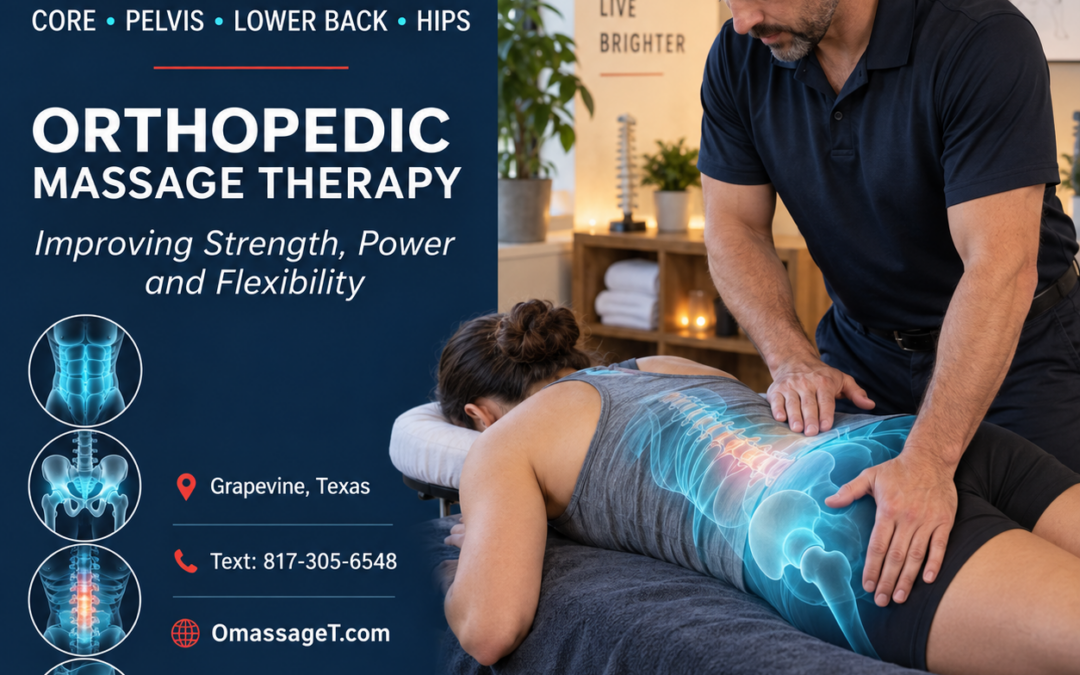
Treating the Body’s Center: How the Core, Pelvis, Lower Back, Lower Thoracic Spine, and Hips Work Togeth
Pain and restricted movement are not always caused by a problem in the exact location where symptoms are felt. The body functions as a connected system, and few areas demonstrate this connection more clearly than the core, pelvis, lumbar spine, lower thoracic spine, and hips.
Together, these regions form the body’s center. They help transfer force between the upper and lower body, support posture, maintain balance, and create stability during everyday activities and athletic movement.
When one part of this central system becomes tight, restricted, weak, or unbalanced, other areas may begin compensating. Over time, those compensations can contribute to lower-back discomfort, hip tightness, upper-back tension, reduced flexibility, poor balance, or difficulty moving efficiently.
At Orthopedic Massage Therapy in Grapevine, Texas, I consider how these areas work together rather than treating each one as an isolated structure.
The Core Is More Than the Abdominal Muscles
Many people think of the core as only the abdominal muscles visible at the front of the body. In reality, the core is a three-dimensional system surrounding the center of the torso.
This system includes muscles and connective tissues associated with the abdomen, lower back, diaphragm, pelvis, and hips. These structures work together to stabilize the spine, control movement, support breathing, and transfer force throughout the body.
A healthy core must do more than produce strength. It also needs coordination, mobility, balance, and the ability to respond to movement.
Someone can have strong abdominal muscles and still experience restrictions or poor coordination through the core and pelvis. Likewise, a person who performs regular core exercises may continue to experience lower-back tightness if the hips, fascia, breathing patterns, or surrounding tissues are not moving well.
The Pelvis Is a Central Point of Balance
The pelvis connects the spine to the legs. Because of this position, it plays an important role in nearly every movement involving the upper and lower body.
Walking, running, bending, lifting, sitting, standing, and rotating all require coordination through the pelvis. If the pelvis is not moving or stabilizing evenly, the body may compensate above or below it.
For example, a restriction around one hip may cause the pelvis to rotate or shift. The lower back may then work harder to maintain balance. One leg may begin absorbing more force than the other, or the upper body may lean or rotate to compensate.
These changes are not always obvious. A client may notice only lower-back discomfort, stiffness through the upper back, or recurring tightness in one hamstring. Looking at the pelvis and hips may reveal that the painful area is only one part of a larger movement pattern.
Understanding the Lumbar Spine
The lumbar spine is the lower portion of the spine. It is designed to provide support while allowing movements such as bending, extending, and some side-to-side motion.
The lumbar area carries substantial loads during daily activities. Sitting for extended periods, repetitive lifting, athletic training, previous injuries, and imbalances through the hips or pelvis may all increase stress on the lower back.
When the hips do not move well, the lumbar spine may attempt to create the missing movement. If the core is not coordinating effectively, muscles surrounding the lower back may tighten to create additional stability.
This tightness can be protective. The body may be attempting to keep the person safe by limiting movement around an area it does not trust. Simply applying intense pressure to the lower back may not address why those muscles became tight.
An orthopedic massage session may therefore include work around the hips, pelvis, core, and lower thoracic region—not only the location where lower-back discomfort is felt.
The Importance of the Lower Thoracic Spine
The thoracic spine makes up the middle and upper portions of the back. Its lower section meets the lumbar spine near the bottom of the rib cage.
This transition area is important because it helps connect movement of the rib cage and upper body with the lower back and pelvis. It also has a close relationship with breathing and rotation.
If the lower thoracic region is restricted, the lumbar spine may compensate by moving more than it should. A person may feel lower-back tightness even though part of the limitation begins higher in the torso.
Restrictions around the rib cage and lower thoracic spine may also affect posture and breathing mechanics. Because the diaphragm works closely with the abdominal and pelvic structures, breathing patterns can influence tension and coordination throughout the core.
Treating this area may help restore a smoother transition between the upper and lower body.
The Hips Influence the Lower Back and Beyond
The hip joints are designed to produce significant movement. They help the body walk, run, squat, climb stairs, change direction, and generate power.
When hip mobility becomes limited, the body must find movement somewhere else. The pelvis may rotate, the knees may move differently, or the lumbar spine may take on additional stress.
Common areas of restriction may include the hip flexors, gluteal muscles, deep hip rotators, quadriceps, hamstrings, inner thighs, and connective tissue surrounding the pelvis.
A previous hip, thigh, or leg injury may also continue influencing movement long after the original pain has improved. The person may unconsciously protect one side, shift weight to the opposite leg, or develop a different walking pattern.
Over time, these compensations may contribute to discomfort in the lower back, knees, shoulders, or upper back.
Fascia Connects These Regions
Fascia is connective tissue that surrounds and connects muscles, bones, nerves, and other structures throughout the body. It allows tissues to support one another and glide during movement.
When fascia becomes restricted or hardened, movement in one area may influence tension somewhere else. A restriction around the abdomen, hip, or pelvis may affect how the lower back moves. Tightness near the lower ribs may influence the lumbar spine and core.
Myofascial release is one of the techniques I use to address these restrictions. The goal is not to force the body but to encourage restricted tissues to soften and move more freely.
As the tissues release and the body becomes more balanced, clients may describe feeling open, lighter, more stable, or taller. They have not become physically taller. Instead, reduced restriction may allow them to stand closer to their natural posture and actual height.
Why Treating Only the Painful Area May Not Be Enough
Suppose someone seeks treatment for recurring lower-back discomfort. Working directly on the back may provide temporary relief, but the symptoms may return if the hips remain restricted or the pelvis continues to move unevenly.
Another person may experience lower thoracic or upper-back tightness caused partly by limited movement through the pelvis and core. Treating only the upper back may overlook what is happening below it.
This is why orthopedic massage looks at relationships throughout the body. The objective is to ask:
- Where is movement restricted?
- Which areas appear to be compensating?
- Is one side working harder than the other?
- Are previous injuries influencing the current pattern?
- How are the hips, pelvis, spine, and core working together?
These questions help guide a treatment plan based on the individual rather than using the same routine for everyone.
What Treatment May Include
Treatment involving the body’s center may include careful work around the lower thoracic spine, lumbar muscles, hips, gluteal region, pelvis, abdomen, and surrounding connective tissues.
The exact approach depends on the client’s symptoms, history, comfort, and movement patterns. Not every person requires treatment in every area.
Because some of these regions can feel personal or sensitive, communication and consent are especially important. Before beginning, I explain the treatment plan, the areas I would like to address, and where my hands will be placed. I continue checking with the client throughout the session.
The client should always feel informed, respected, and comfortable. Treatment can be modified or stopped at any time.
Who May Benefit From This Approach?
Examining and treating these connected regions may be helpful for people experiencing:
- Lower-back tightness or restricted movement
- Hip discomfort or reduced hip mobility
- Pelvic imbalance or a feeling of being uneven
- Lower thoracic and mid-back tension
- Tight hamstrings or hip flexors
- Difficulty rotating or bending comfortably
- Changes in posture
- Reduced balance or stability
- Movement restrictions following a previous injury
- Athletic performance or recovery concerns
- Compensations following orthopedic surgery, with appropriate medical clearance
Orthopedic massage therapy does not diagnose medical conditions and is not a substitute for medical care. Severe pain, sudden weakness, numbness, loss of bladder or bowel control, major trauma, unexplained symptoms, or worsening pain should be evaluated promptly by an appropriate healthcare professional.
Restoring Balance Through the Body’s Center
The core, pelvis, lumbar spine, lower thoracic spine, and hips are deeply connected. A restriction in one region can change how the entire body moves.
By examining these areas together, orthopedic massage therapy may help reduce muscular and fascial restrictions, improve mobility, support balance, and allow movement to feel more natural.
The goal is not merely to chase pain or create temporary relaxation. It is to understand the larger pattern and help the body return to better organization and function.
If you are experiencing lower-back tightness, hip restrictions, pelvic imbalance, or limited movement through the center of your body, schedule an appointment with Orthopedic Massage Therapy in Grapevine, Texas.
Improving Strength, Power and Flexibility
Text: 817-305-6548
Website: OmassageT.com
Location: 110 S Barton St #6
Grapevine, Texas
76051