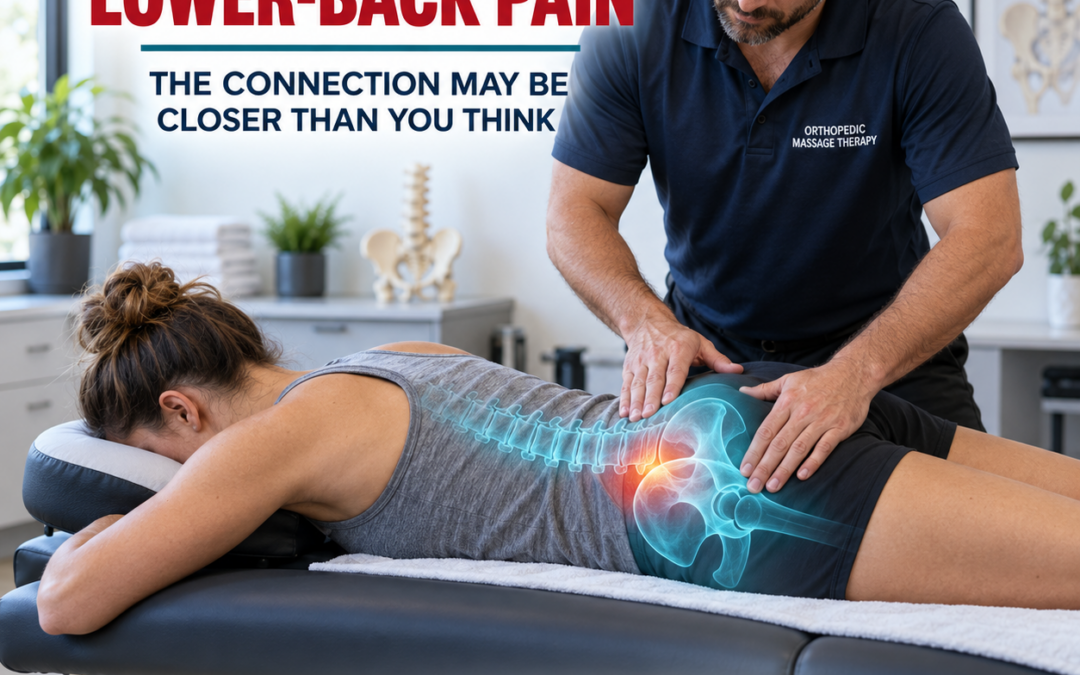
Why Hip Tightness May Be Contributing to Your Lower-Back Pain
Lower-back pain is one of the most common reasons people seek orthopedic massage therapy. Some people notice discomfort after sitting for a long time, while others feel it when standing, walking, exercising, bending, or getting out of bed.
Although the pain is felt in the lower back, the underlying problem may involve more than the lumbar muscles. Restrictions through the hips, pelvis, core, and upper legs can change how the lower back moves and handles physical stress.
At Orthopedic Massage Therapy in Grapevine, Texas, I look beyond the painful area to understand how different parts of the body may be contributing to the client’s discomfort.
The Hips and Lower Back Must Work Together
The hips are designed to create a significant amount of movement. They allow us to walk, run, climb stairs, squat, bend, rotate, and change direction.
The lower back also moves, but it has an important role in providing stability and transferring force through the center of the body.
When the hips move freely, the workload can be distributed more evenly. When hip mobility is limited, the lower back may attempt to create movement that should be coming from the hips.
Over time, this additional demand may contribute to muscular fatigue, tightness, restricted movement, or recurring discomfort.
This does not mean that every case of lower-back pain is caused by tight hips. Back pain can have many different causes and should be evaluated appropriately. However, the relationship between the hips, pelvis, and lumbar spine should not be overlooked.
What Does Hip Tightness Feel Like?
Hip tightness does not always feel like pain directly inside the hip joint. It may be experienced as:
-
Difficulty standing fully upright after sitting
-
A pulling sensation at the front of the hip
-
Tightness through the buttocks or upper thighs
-
Limited movement while squatting or lunging
-
Uneven stride length while walking or running
-
Difficulty rotating in one direction
-
Lower-back tension after prolonged sitting
-
A feeling that one hip sits higher or moves differently
-
Tight hamstrings that return even after stretching
Sometimes a person does not realize their hips are restricted until certain movements are evaluated. The body may have become so accustomed to compensating that the altered pattern feels normal.
How Sitting Can Affect the Hips and Lower Back
Many people spend hours each day sitting at a desk, driving, watching television, or using electronic devices.
Sitting is not automatically harmful, and there is no single perfect sitting position. However, remaining in one position for an extended period can reduce movement variety and place certain tissues in shortened or compressed positions.
While sitting, the hips remain bent. If someone spends much of the day in this position, muscles and fascia around the front of the hips may begin to feel restricted. When the person stands, the body must transition from a flexed position to an upright one.
If the hips do not extend comfortably, the pelvis or lower back may compensate. The person may arch the lumbar spine, lean forward, or shift their weight to one side.
How someone sits may also matter. Consistently crossing the same leg, sitting on one foot, carrying a wallet in a back pocket, or leaning toward one side can create repeated asymmetrical stress through the hips and pelvis.
The problem is not necessarily one position by itself. It may be the amount of time spent there and the lack of varied movement throughout the day.
Standing Habits Can Create Compensation
Standing may seem symmetrical, but many people naturally place more weight on one leg. They may shift one hip outward, lock one knee, or rotate one foot differently.
These habits may begin because of comfort, fatigue, work demands, or a previous injury. A person who once injured an ankle, knee, hip, or thigh may have learned to rely more heavily on the opposite side.
Even after the injury has healed, the compensation can remain.
When one side repeatedly carries more weight, muscles around the pelvis and lower back may work unevenly. One side may become overworked while the other side contributes less to stability.
The person may feel pain in the lower back, but the pattern may involve the hips, legs, and pelvis as well.
Sleeping Positions May Influence Morning Discomfort
The body remains in sleeping positions for several hours at a time. A person who sleeps with the pelvis rotated, one leg pulled far forward, or the lower back strongly arched may wake up feeling stiff or uneven.
Again, this does not mean there is one correct sleeping position for everyone. Comfort depends on the individual, their health, their mattress and pillows, and their physical needs.
However, a person’s preferred sleeping position can provide useful information. If discomfort is strongest in the morning and improves after movement, it may be helpful to consider how the hips, pelvis, and spine are positioned during sleep.
The way someone gets into and out of bed can also reveal restrictions. Difficulty rolling, pushing up, or placing weight through one leg may indicate that the body is protecting or avoiding movement in a particular area.
Previous Injuries May Continue Affecting the Body
An old injury may contribute to current lower-back discomfort even when the original injury occurred years earlier.
A previous hip, upper-quadriceps, hamstring, knee, or ankle injury may change the way a person walks, stands, lifts, or exercises. The body may shorten a stride, rotate the pelvis, or place more weight on the uninjured side.
These adaptations can be helpful during the initial healing process. The body is trying to protect the injured area. The problem occurs when the compensation continues after it is no longer needed.
Over time, these movement changes may place additional demand on the lower back.
This is why a complete injury history is valuable. A problem that appears new may be connected to a much older pattern.
Fascia Connects the Hips, Pelvis, and Spine
Fascia is connective tissue that surrounds and connects structures throughout the body. It helps muscles and other tissues glide and transmit force during movement.
When fascia becomes restricted or hardened, it may limit motion locally and influence tension in connected areas.
A restriction through the front of the hip may affect how the pelvis moves. Tightness along the side or back of the hip may influence the leg and lumbar region. Restrictions in the abdomen or lower thoracic area may also affect how the core and pelvis coordinate.
Myofascial release may help address these restrictions and encourage the tissues to move more freely.
The goal is not to force the body or chase the most painful location. It is to identify areas that may be contributing to the larger pattern.
Why Stretching the Hips May Not Be Enough
People with hip tightness are often told to stretch more. Stretching can be helpful, but it may not completely resolve the problem.
A hip may feel tight because the surrounding muscles are overworked, protecting an unstable area, or compensating for limited movement elsewhere. Repeatedly stretching the same muscle may provide temporary relief without addressing why it continues to tighten.
The core, pelvis, lower back, and hips need both mobility and stability. Treatment should consider how these areas coordinate rather than focusing only on increasing flexibility.
This is especially important for athletes. More flexibility is not always better if the athlete cannot control that movement with strength and stability.
How Orthopedic Massage Therapy May Help
An orthopedic massage session may include evaluating and treating the:
-
Hip flexors
-
Gluteal muscles
-
Deep hip rotators
-
Quadriceps and hamstrings
-
Inner and outer thighs
-
Lumbar muscles
-
Lower thoracic region
-
Abdomen and core
-
Fascia surrounding the pelvis
The treatment is adapted to the individual’s history, symptoms, movement, and comfort. Not every client needs work in every area.
Because areas around the abdomen, pelvis, and hips may feel sensitive or personal, I explain the treatment plan and intended hand placement before beginning. I continue checking with the client throughout the session. The client can ask questions, request a change, or stop the treatment at any time.
Looking Beyond the Location of Pain
Treating only the lower back may provide temporary relief, but symptoms can return if restrictions through the hips and pelvis remain unchanged.
By examining how the body sits, stands, sleeps, walks, and moves, it may be possible to identify patterns that are placing additional stress on the lumbar region.
The goal of orthopedic massage therapy is not simply to make an area feel better for a short time. It is to improve movement, address restrictions, and help the body return to better balance and function.
Orthopedic Massage Therapy in Grapevine, Texas
If you are experiencing lower-back tightness or restricted hip movement, the painful area may be only one part of the problem.
Orthopedic massage therapy can help address muscular and fascial restrictions throughout the hips, pelvis, core, and spine. Every treatment is based on the individual’s history, movement patterns, and goals.
Improving Strength, Power and Flexibility
Text: 817-305-6548
Website: OmassageT.com
Location: 110 S Barton #6
Grapevine, Texas
76051