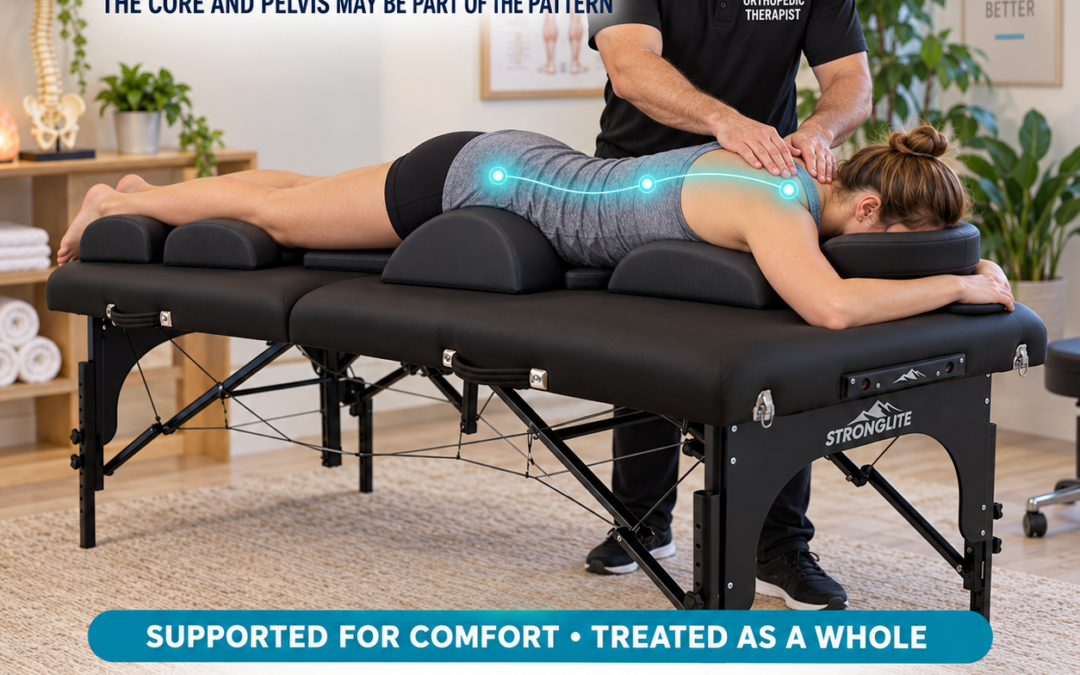
Neck and Shoulder Pain: Why the Problem May Involve Your Core and Pelvis
When someone experiences neck or shoulder pain, treatment often focuses only on the place that hurts. The neck may feel tight, the upper trapezius may feel overworked, or movement through the shoulder may become uncomfortable.
Although these areas deserve attention, the painful location may be only one part of a much larger pattern.
The pelvic floor, iliacus, psoas, quadratus lumborum, diaphragm, lower thoracic spine, core, and pelvis can influence how the upper body is supported and how force travels through the body.
This does not mean that every case of neck or shoulder pain begins in the pelvis. Pain has many possible causes. However, when symptoms keep returning despite direct work on the neck and shoulders, it may be helpful to examine what is happening below them.
At Orthopedic Massage Therapy in Grapevine, Texas, I look at how the whole body is working together—not only the location where pain is felt.
The Body Is One Connected System
The neck and shoulders do not float independently above the rest of the body. They are supported by the rib cage, spine, core, pelvis, hips, and legs.
When standing, the feet meet the ground and force travels upward through the legs and pelvis. The core helps organize the center of the body, while the thoracic spine and rib cage support movement of the shoulders and neck.
When reaching, lifting, walking, running, or rotating, force must also travel between the upper and lower body.
If movement is restricted at the hips or pelvis, the torso may lean or rotate to compensate. If the lower ribs do not move well, the upper chest and shoulders may work harder during breathing. If the core cannot provide comfortable support, muscles around the neck may increase their activity to create stability.
Over time, the neck or shoulder may become painful even though the larger movement pattern involves several regions.
The Pelvic Floor: The Base of the Core
The pelvic floor is a group of muscles and connective tissues forming the base of the pelvis. It works with the diaphragm, abdominal wall, and deep spinal muscles to manage pressure and support the body’s center.
The pelvic floor is not isolated from the rest of the body. It responds to breathing, posture, movement, lifting, and changes in abdominal pressure.
During a relaxed inhale, the diaphragm moves downward and the pelvic floor generally responds to that pressure change. During exhalation, both structures return toward their resting positions.
If the pelvic floor, abdomen, or diaphragm cannot coordinate comfortably, the body may create tension elsewhere to feel stable. Some people may brace through the abdomen, hold their breath, lift their shoulders, or tighten the neck.
Orthopedic massage therapy does not diagnose or treat pelvic-floor disorders. Those concerns may require evaluation from a qualified pelvic-health professional. However, recognizing the pelvic floor as part of the core helps explain why the pelvis, breathing, spine, and upper body cannot always be separated.
The Iliacus and Psoas
The iliacus and psoas are deep muscles associated with the hips, pelvis, and lumbar spine. Together, they are often referred to as the iliopsoas.
The psoas connects the lumbar spine to the upper thigh. The iliacus is located along the inside of the pelvis and also attaches near the upper thigh.
These muscles help flex the hip and contribute to movement and stability through the pelvis and lumbar region.
Prolonged sitting, repetitive athletic activity, previous injury, surgery, or compensation may influence tension through the iliacus and psoas. When these areas become restricted, the position and movement of the pelvis and lumbar spine may change.
The thoracic spine and rib cage are positioned above the lumbar region. If the lower body remains flexed, rotated, or uneven, the upper body may adapt to keep the head upright and the eyes facing forward.
The person may feel tension in the neck or shoulders, but that tension may be part of the body’s attempt to remain balanced over the pelvis.
The Quadratus Lumborum
The quadratus lumborum, commonly called the QL, is a deep muscle located on each side of the lower back. It connects the pelvis, lumbar spine, and lowest rib.
This position makes the QL an important bridge between the pelvis and rib cage.
The QL assists with side bending, spinal stability, and control of the lowest rib. It also helps support the body during walking and standing.
If a person consistently stands on one leg, carries weight on one side, or has an uneven walking pattern, one QL may work harder than the other.
Tension in the QL may influence the position of the pelvis and lower ribs. Because the lowest rib connects with the thoracic region and breathing mechanics, changes here may continue upward through the rib cage.
The shoulders and neck may then compensate for an uneven or restricted torso.
The Diaphragm Connects Breathing and Stability
The diaphragm is the primary muscle of breathing. It attaches around the lower ribs, sternum, and spine.
Each inhale should create movement through the lower rib cage, abdomen, and body’s center. The diaphragm also works with the pelvic floor and abdominal muscles to help manage internal pressure.
Stress, pain, surgery, pregnancy, injury, prolonged sitting, and habitual bracing may change breathing patterns.
A person may begin breathing primarily into the upper chest. The shoulders may rise with each breath, and muscles in the neck may assist more than necessary.
When this pattern is repeated thousands of times throughout the day, the neck and shoulder muscles may become tired or overworked.
Treating restrictions around the lower ribs, diaphragm, abdomen, and thoracic spine may help the rib cage move more comfortably. It does not treat respiratory disease, but it may reduce soft-tissue restrictions that affect normal movement.
The Thoracic Spine Supports the Neck and Shoulders
The thoracic spine forms the middle and upper portions of the back and connects with the ribs.
Healthy movement through this region helps the torso rotate, bend, extend, and support shoulder movement.
When the thoracic spine is restricted, the neck may rotate or extend more to compensate. The shoulder blades may also have difficulty moving efficiently along the rib cage.
A person reaching overhead may arch the lower back, elevate the shoulders, or push the head forward because the thoracic spine is not contributing enough movement.
The neck and shoulders may become painful, but direct work in those areas may provide only temporary relief if the rib cage, diaphragm, lumbar spine, or pelvis remain restricted.
How Sitting May Affect the Entire Chain
Sitting is a normal activity, and there is no single perfect sitting posture. The concern is often the amount of time spent in one position.
A person may sit with:
-
More weight on one hip
-
The same leg crossed
-
The pelvis rotated
-
The lower back rounded
-
The rib cage collapsed
-
The head positioned forward
-
One arm reaching toward a mouse
-
The torso turned toward a second screen
These positions may not create immediate pain. However, repeating them for several hours each day may influence how muscles and fascia adapt.
The hips may become stiff, the pelvis may shift, the lower ribs may move less, and the shoulders may remain elevated or rounded.
The body may then carry parts of this pattern into standing, walking, exercising, and sleeping.
Changing positions regularly and adding movement throughout the day may be more useful than trying to maintain one rigid posture for hours.
Previous Injuries May Affect Distant Areas
An old injury can change movement long after the original pain has improved.
Someone who injured an ankle may place more weight on the other leg. A previous hip or upper-quadriceps injury may change pelvic rotation. Abdominal surgery may lead to temporary guarding and smaller movements through the torso.
The body may respond above the injury to maintain balance.
If the pelvis shifts, the spine may curve or rotate in response. The shoulder on one side may sit differently, and the neck may adjust to keep the head level.
By the time neck or shoulder pain appears, the original injury may seem unrelated. This is why a complete health and injury history is important when examining a recurring problem.
Fascia Connects the Lower and Upper Body
Fascia is connective tissue surrounding and connecting muscles, bones, nerves, and other structures.
The fascia around the hips and pelvis continues into the abdomen, lower back, diaphragm, ribs, thoracic spine, shoulders, and neck.
A restriction in one region may influence how connected tissues move. This does not mean that every fascial restriction directly causes pain somewhere else. It means the body should be considered as a connected movement system.
Myofascial release may help restricted tissues soften and glide more comfortably. Treatment may include areas above, below, or away from the painful location when those areas appear to be contributing to the larger pattern.
Why Treating Only the Neck May Not Be Enough
Direct treatment of the neck and shoulders can be valuable. These tissues may be painful, restricted, and overworked.
However, if the upper body is compensating for limited movement through the core, ribs, pelvis, or hips, the symptoms may return.
A whole-body approach may examine:
-
How the person breathes
-
Whether the lower ribs expand evenly
-
How the thoracic spine rotates
-
Whether one side of the pelvis carries more weight
-
Hip mobility
-
Previous injuries or surgeries
-
Work and driving positions
-
Sleeping habits
-
Athletic or repetitive movement patterns
These observations help guide treatment that is specific to the individual.
What Orthopedic Massage Treatment May Include
Depending on the client’s needs, treatment may involve careful work around the:
-
Neck and shoulders
-
Shoulder blades
-
Thoracic spine and rib cage
-
Diaphragm region
-
Quadratus lumborum
-
Lumbar spine
-
Abdominal wall and core
-
Iliacus and psoas
-
Hips and pelvis
-
Surrounding fascia
Not every client needs treatment in every area.
Some of these regions are personal or sensitive. Before beginning, I explain the treatment plan, the areas I recommend addressing, and where my hands will be placed.
I continue checking with the client throughout the session. The client may ask questions, decline treatment in any area, request a change, or stop the session at any time.
Looking Beyond the Location of Pain
Neck and shoulder pain may involve more than tight upper-body muscles. The pelvic floor, iliacus, psoas, quadratus lumborum, diaphragm, thoracic spine, and pelvis may all be pieces of a larger movement pattern.
The goal is not to assume that every problem begins in the core or pelvis. The goal is to remain curious about how the entire body is adapting.
By addressing relevant restrictions and compensation patterns, orthopedic massage therapy may help improve movement, reduce unnecessary muscular tension, and allow the body to feel more balanced.
Orthopedic Massage Therapy in Grapevine, Texas
If neck, upper-back, thoracic, or shoulder discomfort keeps returning, it may be helpful to look beyond the painful area.
Orthopedic massage therapy considers how the neck and shoulders interact with the ribs, diaphragm, core, spine, pelvis, and hips.
Each treatment is based on the client’s history, movement, comfort, and individual goals.
Improving Strength, Power and Flexibility
Text: 817-305-6548
Website: OmassageT.com
Location: 110 S Barton #6
Grapevine, Texas
76051